You can feel it, right? The quiet panic behind the group chat jokes. The way your assignments now come with an unspoken question: “Did you write this… or did something else?” The internships that used to require a junior assistant now require “someone who can work with AI tools.” The careers that looked stable suddenly look… negotiable.
Here’s the problem with how this conversation is usually framed: it assumes the goal is to outrun AI. That’s like trying to outrun a calculator at math.
The real goal is to become the person who decides what the calculator should be used for—and what should never be handed to it in the first place.
The future-proof student isn’t the one who avoids AI. It’s the one who builds the human skills that make AI safe, meaningful, and worth trusting.
This article is a practical map: five “human-only” career skills that AI can assist with, but cannot truly replace—and how students can train them now, without waiting for a fancy internship or a perfect mentor.
Table of Contents
- Why “Human-Only” Still Matters in an AI World
- Skill 1: Sensemaking (Turning Information Into Understanding)
- Skill 2: Emotional Intelligence (The Skill Behind Every “People Problem”)
- Skill 3: Judgment & Ethics (Knowing What Should Be Done)
- Skill 4: Taste, Creativity & Story (Making Work That Feels Alive)
- Skill 5: Collaboration & Leadership (Getting Humans to Move Together)
- The 14-Day Human-Only Skill Checklist (Student-Friendly)
- Real-Life Scenario: The Group Project Where AI “Helped” Too Much
- Balanced Risk Section: The Upside and the Trap
- FAQ
Why “Human-Only” Still Matters in an AI World
Let’s be honest: AI can already do a lot of what schools reward. It can summarize chapters, draft essays, explain concepts, generate code, and even make a slide deck that looks like it came from a consulting firm.
So what’s left for you?
Plenty—if you understand what’s actually happening. AI is expanding the supply of “acceptable” output. The average memo, the average homework answer, the average marketing caption—those are becoming cheap. When supply rises, value shifts. Employers stop paying extra for work that looks correct on the surface. They pay for people who can handle what’s underneath: ambiguity, trade-offs, human stakes, and responsibility.
That’s why the most valuable students in the next decade won’t be defined by how quickly they can produce. They’ll be defined by how well they can choose: choose the right problem, choose the right constraints, choose what to trust, choose what to verify, choose what to say—and how to say it without breaking relationships.
In other words: your “human-only” skillset is your career moat. If you want a deeper companion piece on building a moat in the AI era, connect this with: AI career moat skills.
Before we get into the five skills, a quick reality check in one table. Use it like a compass whenever you’re unsure where to invest your energy.
| What AI Is Great At | What Humans Must Own | Student “Moat” Question |
|---|---|---|
| Speed, drafts, pattern matching, instant explanations | Choosing goals, defining “good,” understanding context | Do I know what success looks like before I generate output? |
| Summaries, search-like synthesis, formatting, polish | Truth-checking, source judgment, accountability | Can I defend why I trust this result? |
| Generating options (many angles, many versions) | Taste, storytelling, what resonates with real people | Can I explain why this version is the right one? |
| Routine tasks, repetitive workflows, automation | Leadership, coordination, conflict resolution | Can I help a group move forward when emotions show up? |
Skill 1: Sensemaking (Turning Information Into Understanding)
Most students think the challenge is “getting information.” That used to be true. Now the challenge is the opposite: you’re drowning in it.
Sensemaking is the ability to take messy inputs—notes, articles, AI-generated summaries, data, opinions—and build a clear mental model: what’s true, what’s likely, what’s missing, and what matters. AI can hand you a summary, but it can’t feel the difference between “this seems coherent” and “this is actually correct in the real world.” It also can’t decide which uncertainty is dangerous and which is harmless.
Practically, sensemaking means you can do four things reliably:
- Frame the question: what problem are we actually solving?
- Spot weak claims: what sounds confident but isn’t supported?
- Hold multiple hypotheses: what else could explain this?
- Communicate the model: explain it so others can act on it.
Want a student-friendly training ground? Research. Not “search,” research. If you’re building this skill, pair this article with: Beyond Google: deep research workflows for students.
Weekly drill (30 minutes): Pick one topic from class. Ask AI for a summary, then do a “skeptic pass.” You must find two reputable sources that confirm key points and one source that challenges them. Your brain learns the difference between “sounds right” and “stands up.” That muscle is employable in every field—from finance to medicine to policy—because it’s the muscle of reality.
Skill 2: Emotional Intelligence (The Skill Behind Every “People Problem”)
If you’ve ever watched a group project fail, you already know: most failures aren’t technical. They’re emotional.
Emotional intelligence (EQ) isn’t being “nice.” It’s being accurate about humans. It’s noticing tension before it becomes conflict. It’s naming what’s happening without humiliating anyone. It’s staying calm when someone else isn’t. And yes—it’s also being persuasive without being manipulative.
AI can generate empathetic words. But it doesn’t carry the weight of a relationship. It doesn’t have a reputation. It doesn’t walk into class tomorrow with the consequences of what it said today. Humans do. That’s why EQ remains a career differentiator even in hyper-automated workplaces.
Student reality: Your first job won’t pay you for being the smartest person in the room. It will pay you for being the person who can work with smart people without making the room toxic.
Technical skill gets you noticed. Emotional skill gets you trusted. And trust is what turns opportunities into careers.
Try this simple EQ practice: the “10-second mirror.” When you’re triggered, pause and label your emotion like a scientist: “I’m anxious,” “I’m embarrassed,” “I feel dismissed.” Then ask: “What do I need right now—clarity, respect, time, reassurance?” That small move prevents impulsive reactions that burn bridges.
For students using AI daily, EQ also includes knowing when AI should not be in the room. If you’re working through sensitive personal issues, privacy matters. This related guide is worth linking for families and students alike: The Privacy Check.
Skill 3: Judgment & Ethics (Knowing What Should Be Done)
Here’s a truth students don’t hear enough: many careers aren’t about doing tasks. They’re about making decisions under uncertainty—decisions that affect real people.
Judgment is the ability to weigh trade-offs and make a call you can stand behind. Ethics is the system you use to decide what’s acceptable when incentives pull you in the wrong direction. AI can propose options, but it can’t be accountable. It can’t be blamed. It can’t lose its scholarship, get expelled, break a client’s trust, or harm someone with a careless recommendation.
In the classroom, this shows up as: “Is using AI here learning support or academic dishonesty?” In internships, it becomes: “Should we feed customer data into this tool?” In healthcare, it becomes: “Do we trust this model’s output if it might misdiagnose?” The point is: the higher the stakes, the more judgment matters.
A practical ethics framework students can use:
- Transparency: If someone asked, could I explain how I used AI without shame?
- Consent: Did I use other people’s data, work, or images without permission?
- Harm check: Who could be harmed if this output is wrong?
- Responsibility: If this backfires, am I willing to own the outcome?
This also connects to modern scam awareness. If you can’t spot manipulation (deepfakes, synthetic voices, fake screenshots), your judgment gets hacked. A useful internal link here is: The Digital Defence Kit.
Judgment is not a “soft skill.” It’s the skill that protects your future self when speed and convenience tempt you to cut corners.
Skill 4: Taste, Creativity & Story (Making Work That Feels Alive)
AI can generate content. But it struggles with something subtle: taste—the ability to know what’s worth making, what’s worth keeping, and what feels emotionally true.
Think about the last time you saved something: a video, a paragraph, a design, a song. You didn’t save it because it was “correct.” You saved it because it hit something human: humor, longing, surprise, clarity, relief.
Taste is how you make outputs that people choose—especially when there’s an infinite amount of “good enough” content available. Creativity isn’t just art. It’s problem-solving with originality. It’s generating a fresh approach when the standard approach fails. It’s seeing connections between fields that look unrelated.
Students can train this without becoming “creative professionals.” Try the “two versions” exercise:
- Write a short explanation of a concept for a 10-year-old.
- Write the same concept for a busy CEO in 90 seconds.
- Ask AI for versions too—then critique them. What feels generic? What feels sharp? Why?
That critique is the point. You’re not trying to beat AI at generating. You’re training your editorial brain to recognize quality—and then direct AI toward it.
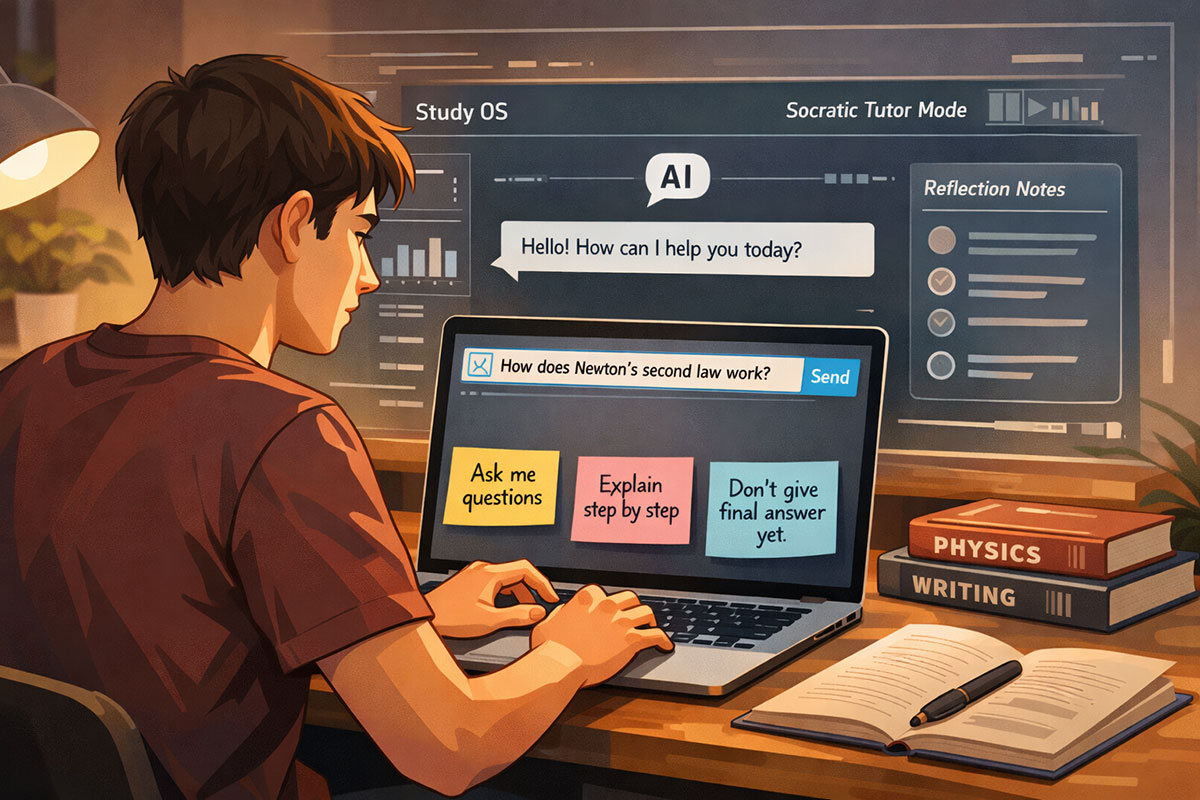
If you like using AI as a learning partner (not a shortcut), connect this section with: Use AI as a Socratic tutor, not an answer key.
Skill 5: Collaboration & Leadership (Getting Humans to Move Together)
Leadership sounds like something you earn later. In reality, students practice it every week: in labs, clubs, group assignments, family responsibilities, part-time jobs.
Collaboration is the ability to work with different personalities, align on a goal, and deliver without constant conflict. Leadership is what happens when you can do that and help others do it too. AI can coordinate schedules and draft meeting notes, but it can’t do the hardest part: earning buy-in, repairing trust, and guiding a group through disagreement.
In the AI era, leadership becomes even more valuable because the “work” gets faster. When output is instant, the bottleneck becomes human coordination. The group that wins isn’t the one with the best tool. It’s the one that can decide quickly, communicate clearly, and recover when something goes wrong.
Three leadership moves students can practice immediately:
- Clarify roles: “Who owns what by when?” (Avoids silent confusion.)
- Surface risks early: “What could mess this up?” (Prevents last-minute chaos.)
- Close loops: Summarize decisions in one message so everyone shares reality.
If you want a modern angle on how AI changes teamwork and jobs, a relevant internal link is: Your new teammate: how agentic AI is redefining every job.
This is why “communication” is not a separate skill from leadership. Communication is leadership’s delivery mechanism.
The 14-Day Human-Only Skill Checklist (Student-Friendly)
You don’t build these skills by reading about them once. You build them the same way you build strength: small reps, repeated. Here’s a two-week checklist you can actually follow during classes.
- Day 1–2 (Sensemaking): Take one AI summary and verify 3 claims with sources.
- Day 3–4 (EQ): Use the “10-second mirror” once per day; write one sentence about what changed.
- Day 5–6 (Judgment): Create your personal AI ethics rule for assignments (what you allow vs avoid).
- Day 7 (Taste): Rewrite one explanation for two audiences (kid vs CEO).
- Day 8–9 (Leadership): In a group task, clarify roles and deadlines in one message.
- Day 10 (Sensemaking): Identify one “unknown” you need to ask a teacher/mentor about.
- Day 11 (EQ): Practice “repeat back what you heard” in a real conversation once.
- Day 12 (Judgment): Do a harm-check: who could be affected if your work is wrong?
- Day 13 (Taste): Compare your version vs AI’s version—write 3 critique notes.
- Day 14 (Leadership): Close a loop: summarize decisions, next steps, and owners.
If you struggle with focus and consistency, don’t “power through” alone. Combine this plan with a structure that respects your brain: AI for ADHD and focus (study sprinting without burnout).
Real-Life Scenario: The Group Project Where AI “Helped” Too Much
Let’s make this real. Imagine a second-year student team assigned a business strategy presentation. Four students. Two weeks. The professor says, “Use tools if you want, but your thinking must be original.” Everyone nods. Nobody wants to look clueless.
On day one, the most confident student drops a message: “I’ll make a quick draft using AI so we have a base.” The draft arrives fast—executive summary, SWOT analysis, competitor grid, product roadmap. It looks polished. It also feels… strangely generic. But nobody wants to be the person who says that out loud, because the draft is “good” and time is short.
So they build on it. They refine slides. They add charts. They rehearse. Then the professor asks a simple question during the presentation: “Why did you choose this target customer? What evidence supports it?”
Silence. Not because they’re unintelligent—because the decision wasn’t theirs. The “answer” came from a model that sounded confident. The team can’t defend it, because they never did the sensemaking work: verifying assumptions, checking local context, and connecting the strategy to real-world constraints.
After class, the team splits into two emotional camps. One student feels betrayed: “We’re going to fail because you used AI too much.” Another feels attacked: “I did the work. You didn’t contribute.” A third student quietly worries about academic integrity and whether they crossed a line. The problem is no longer the assignment. It’s trust.
Now watch what happens when a “human-only” student steps in—not as a hero, but as a stabilizer:
- EQ: They name the tension without blame: “We’re stressed, and we’re also not aligned on what counts as original thinking.”
- Judgment: They propose a boundary: “Let’s treat AI as a brainstorming tool, not as our decision-maker.”
- Sensemaking: They assign verification tasks: “Each of us must validate one key assumption with sources.”
- Leadership: They reset roles and timelines, then close the loop in one message.
- Taste: They rewrite the narrative so it sounds like their insights, not generic consultant-speak.
Two days later, they present again—this time with fewer slides, clearer reasoning, and real evidence. They don’t just look smarter. They are smarter, because they used the assignment the way it was meant to be used: to build judgment, not just output.
Balanced Risk Section: The Upside and the Trap
It would be dishonest to pretend AI is only a threat. For students, it can be a legitimate advantage—especially if you lack tutoring support, time, or confidence.
The upside is real: AI can help you study faster, generate practice questions, explain confusing topics in multiple ways, and reduce “blank page” anxiety. It can also make you more ambitious. When drafting becomes cheaper, you can iterate more. When research becomes easier, you can explore more angles. When language becomes easier, you can communicate beyond your first-language comfort zone.
But here’s the trap: AI can also quietly replace the exact mental reps that build your career. If you outsource thinking, you don’t develop sensemaking. If you outsource hard conversations, you don’t develop EQ. If you outsource choices, you don’t develop judgment. If you outsource voice, you don’t develop taste. If you outsource coordination, you don’t develop leadership.
There’s also a social risk students underestimate: when everyone can produce polished output, “polish” becomes suspicious. Professors, recruiters, and teammates start asking: “Do you understand this, or did you generate it?” The way out isn’t to hide AI use. It’s to show evidence of thought: notes, sources, decisions, trade-offs, and a voice that feels human.
If you want AI to help without taking your growth, use the “two-layer rule”:
- Layer 1: AI can draft, brainstorm, and explain.
- Layer 2: You must verify, decide, and own the final reasoning.
That’s the balance: speed plus responsibility.
FAQ
1) If AI can do my homework faster, why should I spend time on “human-only” skills?
Because homework is not the economy. Homework is a training environment. If you use AI to skip the training, you’re borrowing time from your future self. The workplace rewards people who can handle messy reality: unclear goals, conflicting opinions, incomplete data, and consequences. AI can help you produce “an answer,” but your career depends on whether you can produce the right answer for the right reason.
Also, the moment you leave school, nobody pays you for output alone. They pay you for outcomes. Outcomes require judgment, communication, and coordination—skills that don’t appear magically at graduation. If you build them now, you’ll feel it later as confidence: you’ll walk into interviews able to explain not just what you did, but why you did it, what you considered, and what you’d change next time.
Use AI, absolutely. But use it like a gym machine—not like an Uber that drives the route for you while your brain stays in the passenger seat.
2) What’s the single most important “human-only” skill from this list?
If I had to choose one, it’s judgment. Judgment is the parent skill that protects everything else. You can be creative, but without judgment you create the wrong thing. You can be emotionally aware, but without judgment you choose the wrong moment to speak. You can lead, but without judgment you lead people into bad decisions.
Judgment matters more as stakes rise. In low-stakes situations, mistakes are learning. In high-stakes situations—healthcare, finance, law, security—mistakes become harm. AI can produce confident answers even when it’s wrong. Your judgment is what decides: verify, escalate, ask a human, slow down, or stop.
The good news: students can practice judgment daily. Every time you decide whether to trust an output, cite a source, disclose AI use, or revise a claim, you’re strengthening the muscle that employers can’t buy in a software subscription.
3) How do I prove these skills to recruiters if they’re not a certificate?
You show them through artifacts and stories. Recruiters can’t “see” your internal sensemaking, so you make it visible. Keep a small portfolio of work where your thinking is documented: a research note with sources and uncertainties, a project write-up showing trade-offs, a reflection explaining how you resolved conflict, or a presentation where you explain why you rejected certain options.
In interviews, use a simple structure: context → constraints → decision → result → what you learned. That format signals judgment and accountability. Even for student roles, it separates you from candidates who only describe tasks.
You can also demonstrate “human-only” skills by leading a club initiative, mentoring juniors, organizing a study group, or running a community project. Those experiences are leadership laboratories. The key is to articulate what was hard: aligning people, handling miscommunication, and making calls with imperfect information. That’s what the real world pays for.
4) Isn’t emotional intelligence just personality? What if I’m introverted?
EQ is not personality. It’s a learnable skill set. Introverted students can have excellent EQ because EQ is about accuracy, not volume. You don’t need to be loud. You need to be aware. The best conflict-resolvers are often the calmest people in the room—the ones who listen carefully and speak precisely.
Start small: practice reflecting back what someone said before you respond. Ask one clarifying question instead of assuming. Notice your own stress signals and pause before replying. These are tiny moves that compound over time.
Also, EQ doesn’t mean you become everyone’s therapist. It means you become someone who can work well with humans under pressure. That includes setting boundaries, saying no respectfully, and giving feedback without cruelty. In a world where teams are hybrid, global, and fast-moving, that ability becomes a superpower—especially for introverts who can bring steadiness to chaotic environments.
5) How do I use AI for studying without becoming dependent on it?
Use AI as a tutor and training partner, not as a replacement brain. A good rule is: never let AI do the last step of learning. Let it explain, quiz you, and generate examples—but you do the final synthesis in your own words. If you can’t explain it without the tool open, you don’t own it yet.
Try “active use”: ask AI to quiz you, then grade your answers and point out gaps. Ask it to generate misconceptions and test whether you can spot them. Ask for multiple perspectives on the same concept and compare. That builds sensemaking, not dependency.
If you’re using AI to draft writing, do a “human pass” at the end: insert a personal example, add a real constraint from your class or local context, and rewrite at least 20% in your own voice. The goal is to keep your identity in the work—because your voice is part of your professional value.
6) What should I do if my school has strict AI rules and I’m unsure what’s allowed?
Don’t guess. That’s the fastest way to land in trouble. Treat it as a judgment exercise: clarify the boundary early. Ask your teacher or department for examples: “Is AI allowed for brainstorming? For grammar checks? For outlines?” Many institutions are still updating policies, and ambiguity is common.
If you do use AI, keep a simple usage log: what you asked, what you used, and what you changed. This isn’t paranoia—it’s professionalism. It also helps you reflect: did AI help you learn, or did it replace your effort?
When in doubt, the safest approach is to use AI for learning support (practice questions, explanations, study planning) rather than direct submission. And remember: even if something is technically permitted, your goal is bigger than compliance. Your goal is building skills that remain valuable when the tools change again next year.
About the Author
Girish Soni is the founder of TrendFlash and an independent AI strategist covering artificial intelligence policy, industry shifts, and real-world adoption trends. He writes in-depth analysis on how AI is transforming work, education, and digital society. His focus is on helping readers move beyond hype and understand the practical, long-term implications of AI technologies.