- Day 1: Setting Up Your Study OS
- Day 2: The Research Revolution
- Day 3: Mastering NotebookLM
- Day 4: Field-Specific Power Moves
- Day 5: Writing with Integrity
- Day 6: The Career Jumpstart (Current)
- Day 7: Personal AI Agents
The hardest part of education is not always passing exams. Sometimes it is the strange silence that comes after them. You finish the assignment. You submit the project. You graduate. Then a new question appears: now what exactly makes you hireable?
Many students assume the answer is simple. Get the degree. Make a resume. Apply everywhere. Hope something works. But the job market does not reward effort alone. It rewards clarity, relevance, proof, and confidence under pressure. That is where so many smart students get stuck. They are capable, but they do not know how to present that capability in a language employers actually recognize.
AI can help close that gap, but not in the lazy, spammy way people fear. This is not about asking a chatbot to invent experience or flood LinkedIn with buzzwords. It is about using AI as a brutally honest mirror. A smart pattern-finder. A practice partner. A portfolio coach. A recruiter simulator. In other words, it can help you move from “I studied this” to “I can prove I’m ready to do this.”
The new advantage is not merely knowing things. It is knowing how to translate what you know into signals employers trust.
In this sixth day of our series, we focus on the bridge between the classroom and the first serious role. We will break down how students can reverse-engineer job descriptions, identify skill gaps in their resumes, optimize LinkedIn for discoverability, and practice tough interviews with voice-based AI agents that push beyond textbook answers. This is where education starts becoming employability.
And this matters even more when you consider the broader shifts happening across industries. Students are not graduating into the same market their older siblings entered. Roles are changing, hiring filters are tightening, and AI literacy itself is becoming part of professional readiness. That is why it helps to understand the bigger picture in articles like The Future of AI Jobs in the US: Careers to Watch in 2025, especially if you want to position yourself where opportunity is actually growing rather than where it is quietly shrinking.
Table of Contents
- From Degree to Proof: Why Students Need a Portfolio Strategy Now
- Reading the Job Ad Backwards: How AI Reveals the Real Skill Gaps
- Your LinkedIn Is Not a Biography: It Is a Search Surface
- Pressure Practice: Using Voice AI for Realistic Mock Interviews
- The Smart Way to Build Fast Without Looking Fake
- FAQ: Building a Job-Ready Portfolio with AI
From Degree to Proof: Why Students Need a Portfolio Strategy Now
A degree still matters. Let’s be clear about that. It signals discipline, exposure, and baseline knowledge. But on its own, it rarely tells an employer how you think, what you can build, or whether you can step into real work without constant hand-holding. That is why students who rely only on grades often feel invisible during hiring. The issue is not always a lack of talent. It is a lack of evidence.
What employers increasingly want is proof in context. They want to see whether your skills connect to actual tasks. Can you analyze data and present it clearly? Can you write a concise summary for stakeholders? Can you use tools responsibly? Can you explain your decisions without sounding rehearsed? A portfolio is where those answers begin to show up.
The good news is that a portfolio no longer has to mean a designer’s website full of polished client projects. A strong student portfolio can be much simpler and still highly persuasive. It can include case-study style class projects, a GitHub repository with thoughtful README files, short data dashboards, slide decks, writing samples, mini research briefs, short demo videos, and even reflections on how you solved messy problems. AI can help you organize these materials into something coherent instead of random.
Think of your portfolio as a translation layer. In university, your work is usually judged by professors who already understand the assignment. In hiring, your work is judged by strangers who do not know your curriculum. They do not automatically see why that capstone mattered or why your thesis required analytical depth. You have to make the relevance obvious. AI is useful here because it can help rewrite project descriptions in employer-friendly language without turning them into stiff, generic nonsense.
It can also help you prioritize what belongs in your portfolio. Not every assignment deserves a spotlight. Some projects demonstrate execution. Others show curiosity. Some are too academic to impress outside the classroom. By feeding project summaries and target role requirements into AI, you can start identifying which work samples should be featured first and which need reframing.
A job-ready portfolio is not a museum of everything you have done. It is an argument for why you can do what comes next.
This shift from accumulation to curation is powerful. Instead of asking, “What should I upload?” ask, “What would make a recruiter trust me faster?” That question changes everything. It forces focus. It leads to better positioning. And it helps students stop confusing busyness with readiness.
Reading the Job Ad Backwards: How AI Reveals the Real Skill Gaps
Most students read job descriptions the wrong way. They scan the title, glance at the responsibilities, panic at the requirements, and either apply blindly or talk themselves out of trying. But job descriptions are not just gatekeeping documents. They are blueprints. If you know how to read them carefully, they tell you exactly how employers describe value.
This is where reverse-engineering becomes powerful. Instead of asking, “Am I qualified?” ask, “What patterns is this employer rewarding?” AI is remarkably good at spotting those patterns when you use it with intention. You can paste a job description alongside your resume and ask the model to extract missing keywords, compare responsibilities to your evidence, identify soft-skill signals, and suggest concrete portfolio additions that would reduce perceived risk for a recruiter.
For example, a data analyst job might mention SQL, dashboarding, stakeholder communication, Excel modeling, and data visualization tools like Tableau or Power BI. A student may already have analytical skills but describe them vaguely. Their resume might say “completed data projects using spreadsheets and reports,” while the job description is effectively shouting, “Show us visual communication, tool familiarity, and business relevance.” AI can spot that mismatch quickly.
This process becomes even more strategic when you think in terms of career durability. Skill gaps are not only about winning one interview. They are about building a professional moat. That is why it is worth pairing this exercise with AI Career Moat: 9 Skills That Make You Impossible to Replace. If the job description reveals a missing requirement, do not just patch the gap for one application. Ask whether the missing skill is part of a larger pattern you should strengthen for long-term value.
Here is a simple comparison of how students often apply versus how AI-assisted reverse-engineering improves the process:
| Approach | What the Student Does | Likely Result |
|---|---|---|
| Traditional | Sends the same resume to many jobs with small edits | Low interview rate and vague feedback |
| AI-Assisted | Compares each target role against resume, portfolio, and LinkedIn | Better alignment and clearer positioning |
| Traditional | Focuses only on qualifications section | Misses unspoken priorities in the role |
| AI-Assisted | Extracts keywords, themes, deliverables, and evidence gaps | Creates stronger, role-specific applications |
| Traditional | Assumes missing one skill means “not qualified” | Stops applying too early |
| AI-Assisted | Finds bridgeable gaps and suggests quick proof-building actions | Turns weakness into an action plan |
Used properly, AI does not replace judgment here. It sharpens it. You still need to decide what is honest, achievable, and worth learning. But instead of wandering through job listings in a fog, you start seeing the terrain. And once you can see it, you can respond with precision.
Your LinkedIn Is Not a Biography: It Is a Search Surface
Many students treat LinkedIn like a digital resume copy. They upload a photo, paste some credentials, maybe write “aspiring professional” somewhere, and move on. Then they wonder why nobody reaches out. The problem is simple: recruiters are not reading profiles the way friends read social media bios. They are searching. Filtering. Scanning for relevant language. LinkedIn is not just a page. It is a search environment.
That changes how you should build it. Your profile should not read like a life story. It should surface the terms, tools, outcomes, and areas of interest that connect you to the roles you want. AI can help you identify what recruiters are likely to search for in your field, then audit whether your headline, About section, featured links, project descriptions, and skills section actually reflect those signals.
Suppose you are targeting entry-level analyst roles. Your profile headline should not waste space on vague self-descriptions. It should communicate function and focus. Your About section should mention the kinds of datasets, tools, business questions, or reporting problems you have worked on. Your project entries should not just say what you submitted for class. They should say what problem you solved, what method you used, and what insight you uncovered.
This is also where fast credibility-building matters. Many students know they need a stronger profile but feel intimidated by the gap between where they are and where the best candidates seem to be. That is why focused, realistic upskilling matters more than endless collecting. One relevant project, one visible certification, and one clean proof-of-work sample can do more for your profile than ten generic “learning” posts. For students who need quick but credible additions, 8 AI Certifications That Actually Get You Jobs and Won’t Cost $10K is a useful starting point because it emphasizes practical signal over prestige theater.
Here is a checklist you can use to turn LinkedIn from passive profile into active asset:
- Does your headline include the function you are targeting, not just your degree?
- Does your About section mention tools, project types, and outcomes in plain language?
- Have you added 2–4 strong portfolio links in the Featured section?
- Do your project bullets explain the problem, process, and result?
- Have you aligned your skills list with recurring terms in job descriptions?
- Is your profile photo clear, recent, and professional without being stiff?
- Have you removed empty buzzwords that say little and waste space?
One important caution: optimization is not the same as stuffing keywords everywhere. Recruiters can sense emptiness too. If your profile is overloaded with terms you cannot discuss in an interview, it will collapse under basic scrutiny. The goal is discoverability anchored in truth. That balance matters.
Pressure Practice: Using Voice AI for Realistic Mock Interviews
Students often prepare for interviews in the least realistic way possible. They read common questions. They write ideal answers. They practice silently in their heads. Then the real interview begins, and suddenly their voice tightens, their examples disappear, and their confidence drops by half. Why? Because interview performance is not just about having good thoughts. It is about retrieving them under pressure.
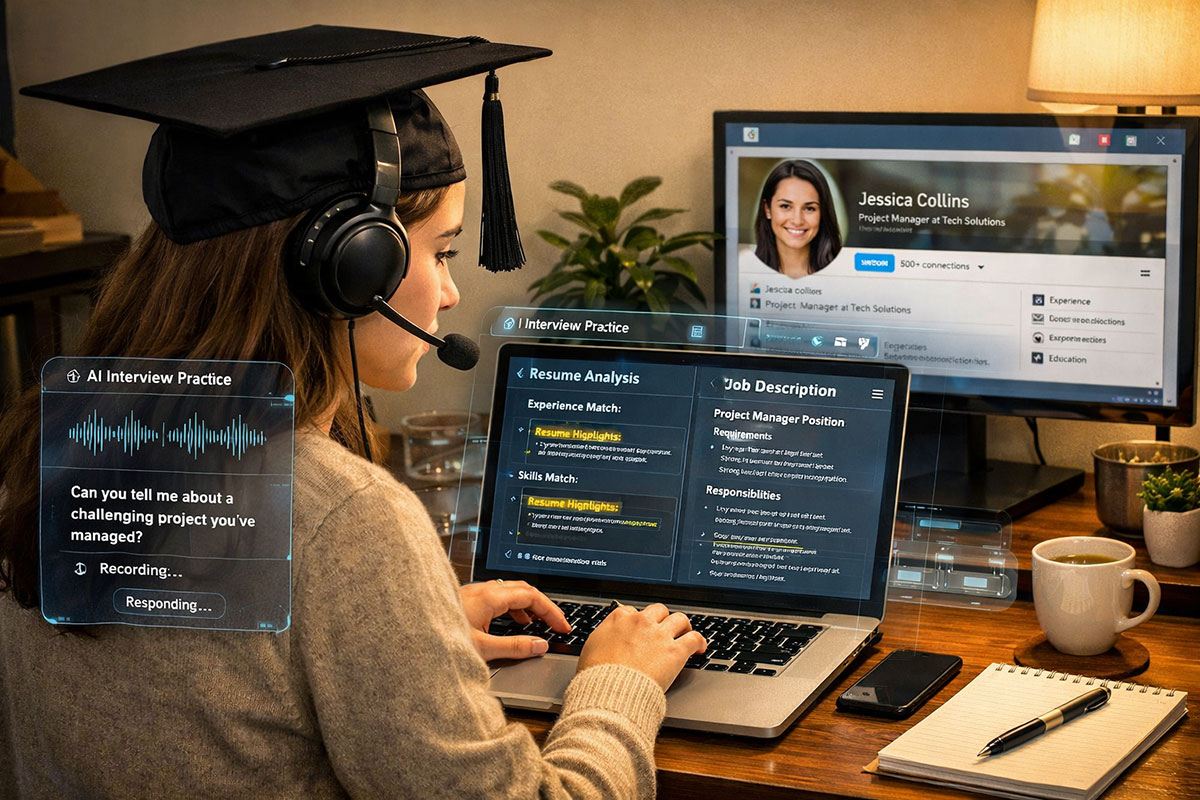
This is where voice-based AI agents are surprisingly useful. A text chatbot can help brainstorm answers, but a voice agent changes the emotional texture of practice. It interrupts. It asks follow-ups. It forces you to think while speaking. It helps you hear your own vagueness. And that matters because many candidates do not fail interviews due to lack of knowledge. They fail because their answers sound scattered, generic, or too abstract.
You can use a voice AI setup to simulate multiple interview modes. One mode can focus on behavioral questions like “Tell me about a time you handled conflicting priorities.” Another can focus on technical reasoning, asking you to explain a project decision step by step. A third can simulate stress by adding time pressure, short interruptions, or skeptical follow-up questions. This is especially helpful for students who freeze when they are challenged rather than simply invited to speak.
The goal is not to memorize scripts. In fact, AI is most helpful when it pushes you away from memorization. A good practice prompt asks the agent to listen for weak examples, overlong answers, missing outcomes, vague verbs, filler phrases, and unconvincing storytelling. It can then score your clarity, confidence, specificity, and structure. That feedback loop is more actionable than generic encouragement.
Consider the difference between these two answers to the same question: “Tell me about a project you’re proud of.” One answer lists tasks. The other tells a small story with context, challenge, action, and result. The second one is more memorable because it helps the interviewer picture you at work. Voice practice helps build that muscle.
It also gives students something they rarely get elsewhere: repetition without embarrassment. You can fail privately. Start over. Tighten your phrasing. Learn how to pause. Learn how to recover when you lose your place. That kind of low-stakes repetition is deeply valuable, especially for first-generation graduates, introverts, or students entering highly competitive roles where pressure is part of the evaluation.
And here is the hidden advantage: mock interviews often expose portfolio weaknesses too. When you cannot clearly explain a project, that is usually a sign the project itself needs better framing. In that way, interview practice is not just preparation. It is diagnosis.
The Smart Way to Build Fast Without Looking Fake
There is a temptation that appears the moment students realize AI can help with applications: speed. Can I generate portfolio copy faster? Rewrite my resume faster? Produce LinkedIn posts faster? Practice questions faster? Yes, absolutely. But speed becomes dangerous the moment it disconnects from truth. Employers may use AI filters, but humans still make final judgments. And humans are very good at sensing when a candidate sounds polished on paper and hollow in conversation.
So how do you use AI to move faster without looking fake? By treating it as an amplifier of real effort, not a substitute for it. Let it organize your thinking, reveal blind spots, strengthen wording, and create practice loops. Do not let it manufacture competence you cannot defend.
The real-life scenario below shows what healthy acceleration looks like in practice.
Real-Life Scenario: A Graduate Uses AI to Turn a Near-Miss Resume Into a Real Interview Opportunity
A recent graduate targeting an entry-level data analysis role finds a job posting that feels almost perfect. The company wants someone comfortable with spreadsheets, SQL basics, business reporting, stakeholder communication, and data visualization. The graduate has done class projects with spreadsheets and some beginner SQL, and has even presented findings in class. On paper, it seems close enough. But close enough is often invisible in a crowded applicant pool.
Instead of applying immediately, the student pastes the job description and current resume into Claude 3.5 Sonnet and asks for a gap analysis. The prompt is simple: identify missing keywords, underdeveloped proof points, and the likely reasons a recruiter might hesitate. The result is eye-opening. The AI highlights that “Data Visualization” appears to be a major signal in the job description, but the resume never uses that phrase directly. It also points out that the student’s project descriptions focus on tasks completed rather than insights communicated. In other words, the resume sounds like coursework, not business-ready analysis.
The student does not panic. They take action. Over the weekend, they complete a short practical course focused on dashboard creation and data storytelling. They rebuild one past academic project into a clearer portfolio piece, adding charts, a brief explanation of the business question, and a short section on what decision the analysis could support. Then they update their resume to reflect this evidence honestly. No exaggeration. Just sharper framing backed by new proof.
Next, they turn to interview preparation. Using an AI voice agent, they rehearse answers to behavioral and project-based questions. The first few rounds are rough. Answers are too long. The examples wander. The student keeps saying, “Basically…” and “Kind of…” when they are nervous. The AI flags these habits and pushes follow-up questions: “What was the actual outcome?” “Why did you choose that chart?” “How would you explain this to a non-technical manager?” That pressure is uncomfortable, but useful.
By the time the application goes out, the student is not a completely different person. They are still early-career. Still learning. But now their materials tell a much clearer story. They are no longer presenting themselves as someone who merely completed assignments. They look like someone beginning to think like an analyst. They get the interview.
That is the real promise of AI in career preparation. Not magic. Not shortcuts. Better feedback, faster iteration, and more visible proof.
Where AI Helps Most—and Where Students Should Stay Careful
There is a balanced way to think about AI in career building. On the positive side, it reduces guesswork. It helps students understand market language, identify blind spots, structure stronger stories, and practice more often than a busy mentor or career office usually can provide. It can be especially empowering for students who lack access to elite networks, expensive coaches, or insider guidance on professional norms.
It also helps level the emotional side of the process. Job searching is full of uncertainty. AI can turn some of that uncertainty into experiments. Change the wording. Refine the project summary. Rehearse the answer again. That sense of movement matters because helplessness is one of the biggest threats to momentum.
But there are real concerns too. Students can become over-reliant on generated language and lose their own voice. They can optimize for keywords so aggressively that their profile becomes generic. They can mistake polished phrasing for actual readiness. And they can cross ethical lines by overstating tools, responsibilities, or results they did not truly own.
The healthiest rule is simple: use AI to clarify, strengthen, and rehearse what is true. Never use it to construct a professional identity you cannot carry in real life.
That standard protects more than your reputation. It protects your confidence. Because the strongest interview energy does not come from sounding perfect. It comes from knowing your evidence is real.
FAQ: Building a Job-Ready Portfolio with AI
1. Can AI really help me get hired, or does it just make my applications sound better?
AI can absolutely help, but the most important distinction is this: it helps most when it improves alignment, not when it merely improves wording. Better wording has value, of course. A stronger resume bullet or more focused LinkedIn summary can improve first impressions. But the deeper benefit is that AI helps you understand what hiring managers are actually looking for and whether your current materials provide convincing proof.
Think of it as moving from decoration to diagnosis. If your resume is weak because it hides relevant evidence, AI can help surface what matters. If your portfolio lacks a key skill signal, AI can help identify that missing link. If your interview answers are too vague, AI can help you practice until you become more specific and persuasive. So yes, it can improve language. But the real win is helping you become more strategically visible.
That said, AI is not a substitute for substance. It cannot replace the work of building proof. It cannot make a weak project strong unless you actually refine the project. It cannot create confident interview performance unless you practice out loud. The students who benefit most are the ones who use AI as a feedback system, not as a mask.
2. What should I put in a portfolio if I do not have internships yet?
You do not need internships to build a credible early-career portfolio. What you need is evidence of thought, execution, and relevance. That can come from class projects, independent work, volunteer experiences, student leadership, freelance experiments, hackathons, research assignments, or even self-initiated case studies. The key is not whether you were paid. The key is whether the work demonstrates something useful.
For example, a student targeting marketing roles could create a mini campaign teardown, analyze a brand’s messaging, and propose improvements. A data-focused student could take a public dataset, clean it, visualize it, and explain what decisions it might support. A writing-oriented student could publish polished explainers or industry summaries. A product-minded student could audit an app flow and document improvements.
AI can help you frame these pieces in professional language, but your goal should be to show how you think. Include context, your approach, the tools you used, what you learned, and what you would improve next time. Employers hiring junior talent do not expect finished mastery. They look for signs of initiative, problem-solving, and learning velocity.
3. How many keywords should I add to LinkedIn and my resume?
There is no magic number, and thinking in terms of quantity can lead you in the wrong direction. What matters is relevance and placement. You want the most meaningful recurring terms from your target job descriptions to appear naturally in the places where they belong: your headline, About section, experience or project bullets, skills section, and sometimes the names or descriptions of featured portfolio items.
What you do not want is awkward repetition that makes your profile sound mechanical. Recruiters and hiring managers may search by keyword, but they still read with human judgment. If your profile looks engineered rather than credible, it can backfire. A good rule is to focus on the core themes that appear repeatedly across several target roles. Those are usually the strongest indicators of what the market actually values.
AI can help by extracting recurring language across job posts and showing where your current profile is too vague. But always review the final wording yourself. Ask whether you could confidently discuss each term in an interview. If the answer is no, it probably does not belong there yet.
4. Are AI mock interviews actually useful if they are not real humans?
Yes, especially for early-stage repetition. Human mock interviews are great, but they are often hard to schedule, emotionally awkward, or too limited in number. AI gives you volume. That matters because confidence is built through repetition, not just advice. The more often you answer aloud, the more you notice your habits: rambling, weak examples, unclear outcomes, nervous filler words, or vague claims.
AI mock interviews are particularly useful for practicing structure. They help you train yourself to answer in a way that is concise but not empty, detailed but not chaotic. They can also simulate follow-up pressure, which is where many students struggle. A human interviewer rarely stops at your first answer. They probe. A good AI setup can do the same.
Of course, AI feedback is not perfect. It may miss emotional nuance or cultural context, and it may not always judge the quality of an example the same way a hiring manager would. So the best approach is to use AI for repetition and self-awareness, then bring your strongest answers into a real conversation with a mentor, peer, or coach when possible.
5. How fast can I realistically improve my job readiness with AI?
Faster than many students think, but not instantly. The realistic benefit of AI is not overnight transformation. It is accelerated iteration. In a few days, you can often identify the biggest gaps in your resume, sharpen your LinkedIn profile, improve the framing of one or two strong projects, and begin practicing interview answers in a more disciplined way. That alone can create a noticeable difference in how prepared you feel.
Over a few weeks, the gains become more substantial. You can add a targeted micro-course, rebuild a weak portfolio sample into a stronger case study, refine your professional positioning, and get much better at explaining your work clearly. What usually takes students a month of confusion can become a structured process when AI helps organize the path.
But readiness still depends on action. If AI tells you a skill is missing and you do nothing, nothing changes. If it helps you identify a useful certification, but you never finish it, you gain little. Speed comes from combining diagnosis with execution. That is the real formula.
6. What is the biggest mistake students make when using AI for career prep?
The biggest mistake is using AI to sound qualified instead of becoming easier to trust. That sounds subtle, but it changes everything. When students chase polished wording without strengthening evidence, they create a fragile kind of confidence. The application may look impressive, but the interview exposes the gaps quickly.
A close second mistake is being too passive with prompts. Students often ask AI for generic resume help or “best interview answers” without providing a specific target role, a real job description, or enough personal context. The result is bland advice. AI becomes much more useful when you feed it concrete material and ask sharper questions: What is missing? What sounds weak? What would a recruiter doubt? What proof should I add?
The best use of AI is not performance theater. It is honest preparation with better tools.
Pro Tip: Your resume is polished and your interview skills are sharp. But the ultimate flex is bringing your own automated workflows to your first job. Tomorrow, in our grand finale Day 7, we step into the “Builder Phase”—showing you how to create your very first Personal AI Agent to automate your daily tasks while you sleep. Personal AI Agents
About the Author
Girish Soni is the founder of TrendFlash and an independent AI strategist covering artificial intelligence policy, industry shifts, and real-world adoption trends. He writes in-depth analysis on how AI is transforming work, education, and digital society. His focus is on helping readers move beyond hype and understand the practical, long-term implications of AI technologies.