- Day 1: Setting Up Your Study OS
- Day 2: The Research Revolution (Current)
- Day 3: Mastering NotebookLM
- Day 4: Field-Specific Power Moves
- Day 5: Writing with Integrity
- Day 6: Career Jumpstart
- Day 7: Personal AI Agents
Students have discovered something powerful in the last two years: AI can make academic work feel less overwhelming. A blank page becomes a starting point. A confusing topic becomes a clearer explanation. A rough question becomes a useful outline. That part is real. But there is another side to this story that deserves more attention, especially if you care about grades, credibility, and long-term learning.
The same tool that can explain a theory beautifully can also invent a paper, attach a believable author name, add a plausible journal title, and hand it to you with total confidence. It sounds polished. It looks academic. It feels helpful. And yet it can be completely false. That is where many students get into trouble.
Day 1 of this series was about building your study environment properly. If you missed it, go back and read Setting Up Your Study OS. The point was simple: serious students need a system, not just a chatbot. Day 2 is the natural next move. Once your study setup exists, you need to fix your research habits.
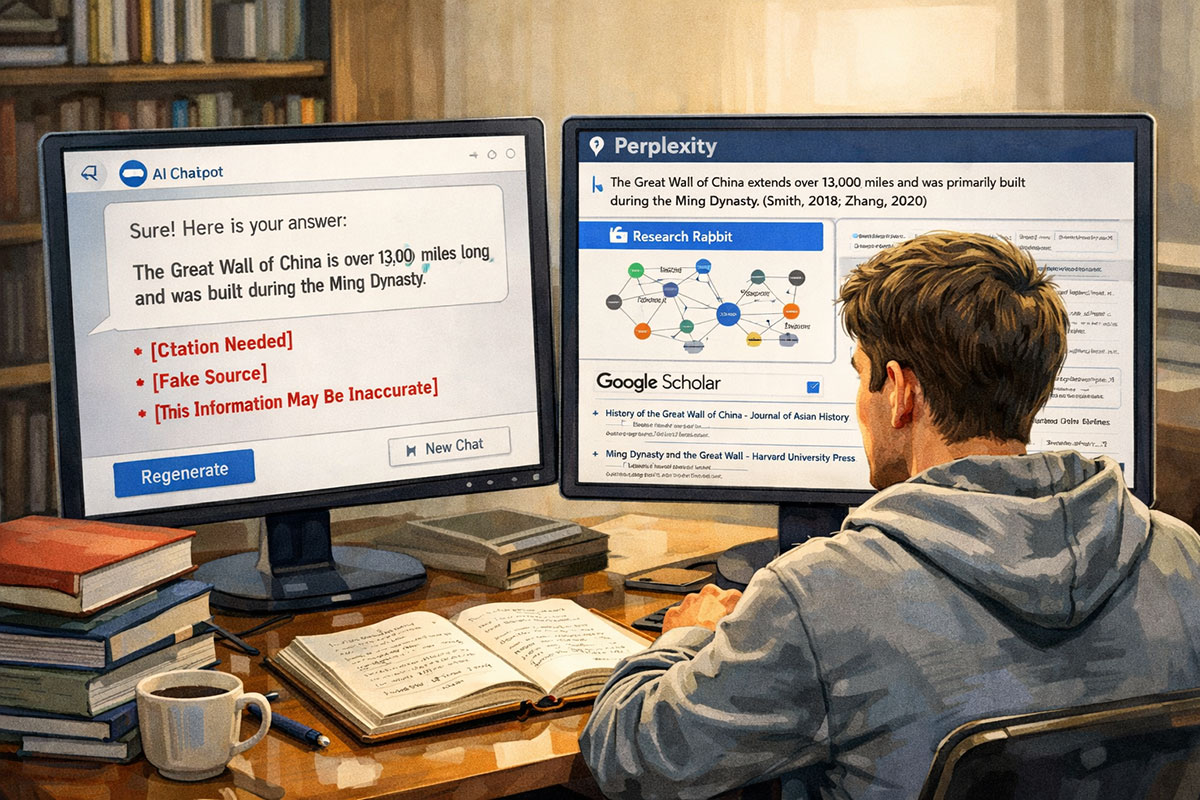
This is where the real research revolution begins. Instead of treating a general-purpose chatbot like a fact machine, smart students are learning to separate idea generation from source verification. They still use AI, but they use the right kind of AI for the right job. That means tools built to surface actual papers, show citation trails, map academic relationships, and help you confirm that a source exists before you trust it.
A fluent answer is not the same thing as a verified answer. In academic work, that difference can decide whether you earn trust or lose it.
That distinction matters because large language models are designed to generate likely next words, not to guarantee source-level truth. OpenAI itself has explained that evaluation systems can encourage confident guessing rather than uncertainty, which helps explain why hallucinated details still appear in model outputs. Meanwhile, published academic analyses have documented fabricated or inaccurate references generated by ChatGPT-like systems.
So this article is not an anti-AI rant. It is a student survival guide. We will look at why standard LLMs hallucinate citations, why that creates real academic risk, and how tools like Perplexity, Research Rabbit, and Google Scholar’s newer AI-assisted features can help you move from smooth-sounding answers to verifiable evidence. By the end, you should have a much clearer sense of how to research like a modern student without outsourcing your judgment.
Table of Contents
- Why standard chatbots make up sources
- Why fake citations are more dangerous than they look
- What a better AI research stack looks like
- Real-life scenario: the thesis that almost collapsed
- A practical workflow for verifiable research
- FAQ
Why standard chatbots make up sources
Let’s start with the uncomfortable truth. A standard chatbot is often excellent at language and surprisingly weak at evidence discipline. That does not mean it is useless. It means students need to stop asking it to play a role it was never built to perform reliably on its own.
When a student types, “Give me five peer-reviewed sources on colonial trade networks,” a general chatbot often tries to be helpful by producing something that looks like an answer. It may return article titles, author names, dates, journals, even DOIs. But unless the system is grounded in a live retrieval layer or connected to a trusted scholarly database, it may simply be assembling the most statistically plausible version of what a citation should look like.
That is why hallucinated citations are so dangerous. They do not usually look obviously fake. They look almost right. An invented article title may sound exactly like something a historian would publish. A fake author name may resemble real names in the field. A journal title may be close enough to a legitimate one to slip past a tired student at midnight.
If you want a broader look at how these failures show up across AI use cases, TrendFlash recently broke this down in AI Hallucinations Are Getting More Dangerous: How to Spot and Stop Them in 2025. The core lesson applies directly to academic work: the more confident the output sounds, the more disciplined you need to be about checking it.
Google Scholar itself remains a broad search engine for scholarly literature, while Google Scholar Labs was introduced as an experimental AI-powered way to explore detailed research questions from multiple angles. Google describes Scholar Labs as experimental and limited in availability, which is important because it signals both promise and caution. Research tools are improving, but students still need verification habits.
The mistake many students make is assuming every AI interface works the same way. It does not. Some systems primarily generate text. Others are built to retrieve and organize sources. Others try to do both. Your job is to understand the difference. The moment you stop treating all AI as one giant magic box, your academic work gets stronger.
Why fake citations are more dangerous than they look
You might think, “Fine, I will just double-check later.” But in practice, fake citations create more damage than students expect. They waste time, weaken trust, and quietly distort the learning process itself.
First, there is the obvious academic risk. A fabricated citation in an essay, lab report, thesis, or presentation can trigger penalties ranging from lost marks to academic integrity reviews, depending on the institution and the context. Even when a professor believes it was accidental, the student still looks careless. In higher-level work, especially dissertations or capstone projects, that can be devastating.
Second, there is a subtler problem: hallucinated references distort your understanding of the field. Imagine building your argument around a paper that does not exist. You are not just citing badly. You are constructing your thinking on missing ground. The logic of your essay starts leaning on a phantom source. That makes your synthesis weaker, even if no one immediately catches it.
Third, overreliance on standard chatbots can train students into passivity. Instead of asking, “Where did this come from?” they ask, “Can I use this quickly?” That shift sounds small, but it changes the quality of scholarship. Good research is not only about finding information. It is about tracing provenance, checking authority, comparing interpretations, and noticing disagreement between sources.
This is exactly why upgrading your student tool stack matters. We already touched on the broader ecosystem in The 2025 AI Learning Stack. The takeaway here is that research deserves its own category of tools. Not everything should be routed through one chatbot window.
The real academic advantage is not getting answers faster. It is learning how to separate generated language from grounded evidence.
There is also an emotional cost. Students who rely on fake citations often lose confidence in all AI once they get burned. That is understandable, but it is the wrong conclusion. The issue is not that every AI tool is untrustworthy. The issue is that different tools serve different functions. A brainstorming tool is not automatically a source-verification tool. A writing assistant is not automatically a literature review engine.
In other words, the danger is not just hallucination. It is category confusion. Once you fix that, your workflow becomes much safer.
What a better AI research stack looks like
So what should students use instead? Not instead of AI entirely, but instead of blind trust. The better approach is to combine reasoning tools with retrieval tools. Think of this as moving from “ask one chatbot everything” to “build a research pipeline.”
Perplexity is useful because it is built around search-grounded answers and source-linked responses. Its platform materials emphasize real-time search, ranked results, and grounded retrieval, which is exactly the kind of architecture students should value when they are exploring factual questions. It is not perfect, and every citation still deserves checking, but it is structurally much better suited to evidence-seeking than a purely generative chat interface.
Research Rabbit solves a different problem. It is not mainly there to give you a polished answer paragraph. It helps you discover relationships between papers, authors, and citation trails. Its own guides emphasize starting from seed papers, discovering related work, visualizing citation maps, and tracking authors over time. That makes it powerful for literature reviews, thesis work, and interdisciplinary topics where the hidden connection between papers matters more than a neat summary.
Google Scholar remains a core foundation because it gives you direct access to scholarly literature search. Scholar Labs adds an emerging AI layer for question-driven exploration, but even there, the smart move is to treat the AI summary as a navigation aid, not a final authority. Use it to orient yourself. Then open the papers. Check the abstract. Look at the authors. Follow who cites whom.
Here is the simplest way to think about the stack:
| Tool | Best Use | Strength | Main Caution |
|---|---|---|---|
| Standard ChatGPT-style chatbot | Brainstorming, explaining concepts, outlining questions | Fast, flexible, conversational | Can invent papers, authors, and citations |
| Perplexity | Source-linked exploration of factual questions | Grounded search workflow | Still verify every cited source manually |
| Research Rabbit | Literature discovery and citation mapping | Excellent for finding connections between papers | Requires good seed papers to shine |
| Google Scholar / Scholar Labs | Scholarly search and research orientation | Direct academic search foundation | AI layers are experimental; do not skip source checking |
Notice the pattern? None of these tools removes the need for judgment. The best ones simply make good judgment easier.
Real-life scenario: the thesis that almost collapsed
A final-year university student, let’s call her Nisha, was writing a history thesis on trade routes, colonial bureaucracy, and information control in the late nineteenth century. She was bright, hardworking, and under pressure. Like many students, she had started using a general AI chatbot to move faster through the messy early stages of research.
At first, it felt like a breakthrough. The chatbot helped her generate topic angles, sharpen her thesis question, and suggest a list of apparently relevant academic sources. One paper in particular seemed perfect. It had exactly the framing she needed: a tight connection between imperial record-keeping and shifts in maritime trade policy. The title sounded right. The author sounded credible. The citation format looked professional.
So she used it.
A few days later, during a supervision meeting, her advisor asked a basic follow-up question: “Where did this paper appear?” Nisha could not answer clearly. They searched for it. Nothing. They searched again using variations of the title. Still nothing. The advisor then checked the supposed journal. No record. The paper did not exist.
That moment changed how she approached research.
Instead of abandoning AI completely, she rebuilt her workflow. First, she used Perplexity to ask a narrower version of her original question and focused only on answers that surfaced linked sources she could open and verify herself. That gave her several legitimate papers and book chapters she had not found through the chatbot. Next, she imported key seed papers into Research Rabbit. That was where the breakthrough happened.
By tracing citation relationships visually, she noticed that two authors working in adjacent areas had both cited a less obvious archival study that never appeared in her original searches. One focused on shipping administration. The other focused on colonial information systems. The overlap between them revealed a stronger, more original connection than the fake paper ever had. She followed that trail, read the real studies, and restructured her thesis argument around verified evidence.
The final result was not just safer. It was better. Her argument became more nuanced because it emerged from actual scholarship rather than from an AI-generated shortcut. She stopped asking, “Can AI find me a perfect source?” and started asking, “Can AI help me uncover the real scholarly landscape faster?” That is a much smarter question, and it is the one more students need to learn.
A practical workflow for verifiable research
If you want a simple rule, here it is: use general AI for thinking support, and research AI for evidence discovery. Once you separate those two, the workflow becomes much cleaner.
Start with your question, not your citation list. Use a conversational AI tool to refine the research question if you need help narrowing a topic. Ask it to generate angles, counterarguments, subtopics, and keyword clusters. But do not ask it to be your final bibliography. That is where many students drift into trouble.
Next, move into a verification-first tool. Use Perplexity or Google Scholar to identify real papers, authors, and journals. Open the links. Read the abstracts. Confirm publication details. Save only what you can independently verify.
Then move to relationship mapping. This is where Research Rabbit becomes especially valuable. Add two or three seed papers that are clearly relevant. Look at who cites them, what adjacent authors show up repeatedly, and which clusters of work seem central to the field. This is often the stage where students discover the papers that turn a decent essay into a strong one.
After that, build a source log. A simple spreadsheet or notes database is enough. Track author, year, title, journal, main argument, methods, and why the source matters to your project. If a source is only mentioned by AI but you cannot verify it manually, it does not enter the log. Treat that as a non-negotiable rule.
Here is a practical checklist you can use on every assignment:
- Did I verify that each cited source actually exists?
- Did I open the original paper, abstract, or publisher page myself?
- Did I confirm the author name, title, year, and journal details?
- Did I separate brainstorming AI from source-finding AI?
- Did I trace at least one citation trail beyond the first search result page?
- Did I remove any source I could not independently confirm?
- Did I save notes on why each source matters to my argument?
There is one more point worth making. Research integrity is not just about avoiding punishment. It is about becoming the kind of thinker who can tell the difference between polished noise and grounded evidence. That skill will matter long after university, whether you work in law, policy, science, business, journalism, or anywhere else that depends on reliable information.
Where AI research tools genuinely help and where students still need caution
It would be lazy to say these tools are either amazing or dangerous. The truth is more useful than that. They are both powerful and limited, and mature students should understand both sides.
On the benefit side, AI research tools reduce friction. They help students move from vague curiosity to concrete sources faster. They can surface adjacent papers, identify repeated authors, and organize the early chaos of a literature review. This matters because many students do not fail at research due to lack of intelligence. They fail because the process feels too large, too scattered, and too hard to begin.
They also make pattern recognition easier. Research Rabbit, for instance, can reveal scholarly relationships that a standard keyword search would bury. Scholar-oriented AI tools can help students phrase better questions. Search-grounded tools can shrink the distance between “I think my topic is around this” and “Here are three real directions the literature takes.” That is a real academic advantage.
But the concerns are just as important. Search-grounded does not mean infallible. AI summaries can flatten nuance. Citation lists can still contain errors. Ranking systems can bias attention toward more visible sources rather than the most relevant ones. Experimental features may change quickly or be available only to some users, as Google has noted for Scholar Labs.
There is also a skill risk. If students outsource every decision about what matters, they may become faster without becoming wiser. That is not progress. Real research requires judgment: knowing when a source is central, when a paper is outdated, when a study’s methods limit its claims, and when a missing perspective changes the whole frame of the debate.
The healthiest mindset is not fear or hype. It is disciplined partnership. Use AI to expand your reach. Do not let it replace your standards.
Frequently Asked Questions
1. Why does ChatGPT sometimes create fake academic citations even when the answer sounds confident?
Because confidence in language generation is not the same as evidence retrieval. A standard LLM is trained to produce plausible text, not to guarantee that every citation corresponds to a real paper in a live scholarly database. If you ask it for references in a field with familiar naming patterns, it may generate something that looks academically correct without actually being real. That is why fake titles, invented authors, and broken journal details can appear in polished outputs. The danger is that the result often passes the “looks professional” test. Students should treat such outputs as suggestions to investigate, not references to paste directly into assignments.
2. Is Perplexity completely safe for academic citations?
No tool deserves blind trust, including Perplexity. What makes it more useful is that it is built around grounded search and linked sources, which gives students a much better starting point for verification. But a better starting point is not the same as a final guarantee. You should still open the cited page, confirm the details, and check whether the source is primary, secondary, peer-reviewed, or just a general web page discussing a topic. Think of Perplexity as a research assistant that points you toward evidence faster, not as an authority that eliminates your need to verify.
3. What makes Research Rabbit different from a normal search engine?
Research Rabbit is especially valuable for discovery through relationships rather than simple keyword matching. Instead of just giving you a list of results, it helps you see how papers connect through citations, authors, and thematic clusters. That makes it powerful when your project requires a literature review, a thesis framework, or a deeper understanding of how a field has evolved. Students often find that keyword search gives them the obvious papers, while citation mapping reveals the meaningful bridges between them. Those bridges are often where stronger essays and more original arguments begin.
4. Can I still use a standard AI chatbot in my academic workflow?
Absolutely. The smarter approach is not to ban it, but to assign it the right role. Use it for brainstorming research questions, clarifying difficult concepts, generating keyword ideas, comparing theoretical frames, or stress-testing your outline. Those are valuable uses. The problem begins when students ask a general chatbot to act as an unsupervised source engine. That is a category mistake. Let the chatbot help you think. Let research-specific tools help you find and verify. When you divide the work this way, AI becomes far more useful and much less risky.
5. What is the minimum verification process I should follow before citing any AI-surfaced source?
At a minimum, confirm that the source exists in a real database, publisher page, journal archive, or reliable academic index. Open the source yourself. Check the exact title, author names, publication year, and outlet. Read at least the abstract, and ideally the introduction or relevant section. Make sure the source actually says what you think it says. Finally, note why it matters to your argument. If any of those steps fail, do not cite it. This takes a little more time up front, but it saves enormous amounts of trouble later, especially in major assignments.
6. What if my professor allows AI tools but warns against misuse?
That usually means the professor understands AI can be helpful but expects you to remain accountable for accuracy and integrity. In practice, that should push you toward transparent, verification-heavy workflows. Keep notes on how you found sources. Save links. Maintain a research log. If you use AI to narrow a topic or find leads, that is usually defensible. If you submit invented citations because you assumed the machine had checked them for you, that is much harder to defend. The safest approach is to act as though you may need to explain your workflow at any point. Good habits become very clear under that standard.
Final thought
The students who thrive in the AI era will not be the ones who copy the fastest. They will be the ones who verify the best. That is the real shift. AI is not removing the need for research discipline. It is increasing the value of it.
If Day 1 was about setting up your environment, Day 2 is about rebuilding your standards. Use conversational AI to think more clearly. Use research tools to find real evidence. And never confuse a polished answer with a trustworthy source.
Pro tip: Now that you know how to find real, verifiable research, what do you do with those massive 50-page PDF reports? In Day 3 of this series, we will show you how to turn your boring textbooks and research papers into a personal, interactive podcast using Google NotebookLM. Mastering NotebookLM
About the Author
Girish Soni is the founder of TrendFlash and an independent AI strategist covering artificial intelligence policy, industry shifts, and real-world adoption trends. He writes in-depth analysis on how AI is transforming work, education, and digital society. His focus is on helping readers move beyond hype and understand the practical, long-term implications of AI technologies.