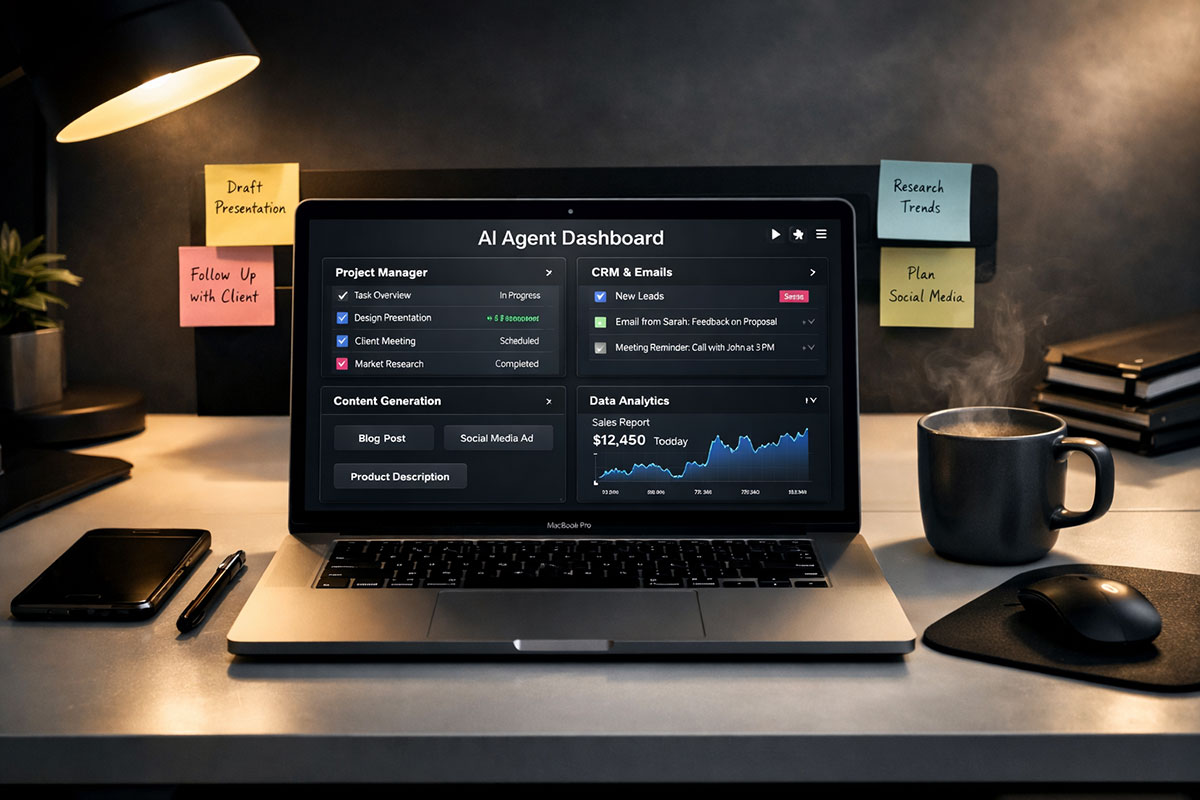
AI agents are powerful. That is exactly why they are dangerous in careless hands.
Right now, a lot of professionals are treating automation like a toy. They wire together a chatbot, a few prompts, an email tool, maybe a spreadsheet connector, and suddenly they think they have built a reliable digital operator. In reality, many of them have handed the keys of a high-performance machine to something that does not understand context, politics, reputation, or consequence.
That is the real story behind the current obsession with “agentic workflows.” Yes, they can save time. Yes, they can remove repetitive work. And yes, when they are designed correctly, they can be a serious career advantage. However, if you skip the guardrails, the same setup can damage client trust, expose private data, flatten your personal brand, and make you look reckless instead of efficient.
If you missed our recent $0 agentic workflow case study, read that first. It shows why the model is so attractive. This article is the necessary counterweight, because the same system that makes you faster can also make your mistakes scale faster than you ever could on your own.
And that is the trap. People assume AI failure looks dramatic. Usually, it does not. Usually, it looks like a small wrong summary, a slightly off client email, a generic LinkedIn post, a stale workflow still running on last quarter’s priorities, or a confidential file dropped into the wrong tool because “it was just for a second.”
In 2026, that kind of sloppiness will not look innovative. It will look amateur.
Table of Contents
- Mistake 1: Shadow AI and quiet data leaks
- Mistake 2: The hallucination loop nobody catches
- Mistake 3: Losing your voice and your edge
- Mistake 4: Letting AI do your thinking
- Mistake 5: Building once, then ignoring it
- FAQ: Safe and smart AI automation
- Final word
Mistake 1: Shadow AI and quiet data leaks
The first career-killer is simple: people feed sensitive information into tools they do not actually control.
This happens every day. Someone is under pressure. They need a faster summary of quarterly performance, a cleaner pitch deck, a redrafted contract note, or a quick breakdown of customer churn. So they copy company financials, sales numbers, client names, internal plans, or legal text into a free public model and tell themselves it is harmless because it is “just one prompt.”
It is not harmless.
“Shadow AI” is what happens when employees use unofficial AI tools outside approved policy, security review, or procurement. The problem is not just theoretical risk. The real damage starts with loss of control. You often do not know how the data is handled, what settings are enabled, whether training is disabled, who can access logs, or whether that content now sits in a system your company would never approve.
Even worse, many professionals do this because they think speed excuses risk. It does not. If you upload confidential client material into an unsecured tool and that decision later comes under scrutiny, “I was just trying to move fast” will sound weak, not clever.
Think through a realistic disaster. A consultant uploads a client’s raw board memo into a free model to “clean up the language.” The memo contains acquisition discussion, margin pressure, and names of internal stakeholders. Nothing visibly explodes. However, later, the client learns that internal content was handled in an unapproved external system. Trust drops immediately. That consultant is no longer seen as resourceful. They are seen as unsafe.
That reputational hit matters more in 2026 than many people realize. Technical skill can be replaced. Judgment is what protects careers.
What the smart fix looks like
First, stop assuming every model is appropriate for every task. It is not.
Second, separate your workflows into clear risk levels. Public content drafting is one thing. Client data, financial documents, legal notes, HR records, and proprietary strategy are another. Those should never enter random consumer-grade tools simply because the interface is convenient.
- Use enterprise plans with clear privacy controls and admin oversight.
- Confirm data handling settings instead of guessing.
- Use local models or private-hosted workflows for highly sensitive material.
- Strip identifying details before testing prompts on non-sensitive environments.
- Document your AI use policy so your team knows what is allowed and what is reckless.
If your company has no policy yet, that does not mean anything goes. It means you need to be more cautious, not less.
The brutal truth: the professional who leaks data through casual AI use will not be remembered as an early adopter. They will be remembered as the person who could not be trusted with judgment.
Mistake 2: The hallucination loop nobody catches
The second mistake is more subtle, and in many cases more embarrassing. People let AI generate outward-facing work without a human review checkpoint.
This is where the “agent” fantasy becomes dangerous. Somebody builds an automated chain that reads notes, drafts a report, writes an email, or posts an update. Then they remove themselves from the review step because that is what feels efficient. They want the machine to do the boring parts alone. Unfortunately, the boring parts are often the exact place where the costly errors hide.
Hallucinations are not just weird fake facts. They are also confident distortions, wrong emphasis, invented summaries, and polished nonsense.
That matters because AI output often looks clean enough to pass a rushed glance. The grammar is fine. The structure is sharp. The formatting feels professional. Yet the content may still contain a false deadline, a fabricated comparison, the wrong client name, an invented source, or a summary that quietly reverses the meaning of the original material.
Now imagine that output going straight to a customer, executive, or public audience.
A salesperson asks an AI agent to prepare follow-up emails after discovery calls. The agent drafts ten messages. Nine are fine. One includes a product feature that does not exist because the model inferred it from context. That one email reaches the prospect. The result is predictable: confusion, lost credibility, and a painful internal conversation about who approved the claim.
Or take a research team. They automate weekly insight reports. The report cites a market shift that was never verified, but the sentence sounds authoritative enough that nobody catches it before distribution. The report lands with leadership. One executive repeats the false point in a planning meeting. Now the damage is political, not just editorial.
Why this mistake spreads so quickly
Because automation creates emotional distance. When you are not writing each line yourself, you start feeling less responsible for each line. That is dangerous thinking.
Also, many professionals confuse speed with maturity. A workflow that produces output automatically is not necessarily a mature workflow. In many cases, it is just an unmonitored pipeline for believable errors.
The guardrail that should never be optional
You need a Human-in-the-Loop step for any workflow that sends, publishes, recommends, commits, or decides.
- Draft automatically, but approve manually.
- Summarize automatically, but verify against source material.
- Classify automatically, but spot-check edge cases.
- Prepare outreach automatically, but never send blindly.
The goal is not to slow everything down. The goal is to put human judgment exactly where mistakes become expensive.
If an AI system can affect your reputation in public, it should never operate without a review stage. That is not fear. That is basic professional hygiene.
Mistake 3: Losing your voice and your edge
Here is a quieter form of career sabotage: letting AI flatten your writing until you sound like everyone else.
A lot of professionals do this without noticing. They start by using AI to clean up rough drafts. Then they let it rewrite emails, summaries, LinkedIn posts, proposals, meeting notes, and internal memos. Gradually, the tone changes. Their writing becomes smoother, but also safer. Then it becomes cleaner, but also emptier. Finally, it becomes bland enough that anyone could have written it.
That is a problem because your voice is not decoration. It is part of your professional identity.
People hire, trust, promote, and remember humans who sound like humans. They remember sharp judgment, strong point of view, clear phrasing, and lived experience. They do not remember the fiftieth polished paragraph that sounds like it came from a generic corporate content machine.
This is especially dangerous for consultants, marketers, founders, recruiters, sales leaders, analysts, and anyone building authority online. If AI strips out your phrasing, your instincts, your humor, your skepticism, and your rhythm, it is not “helping you scale.” It is slowly erasing the exact qualities that make your work distinct.
And yes, readers notice. Maybe not in one post. Maybe not in one memo. But over time, they feel the sameness. Everything starts sounding polished, agreeable, and forgettable.
That is how personal brands die now. Not in scandal. In sterilization.
How this plays out in the real world
Picture a manager who built a strong internal reputation because their updates were direct, sharp, and actionable. Then they start using AI for all weekly summaries. The new notes are cleaner, but less specific. They lose urgency. They lose judgment. They lose the little moments where that manager used to signal what mattered most.
After a few months, leadership does not say, “Your writing got worse.” They simply stop reacting the same way. The notes feel less useful. The person feels less decisive. Their authority slips without a formal warning.
How to use AI without becoming a corporate clone
Use AI as an editor, not as a replacement for your point of view.
- Start with your own rough draft before asking for cleanup.
- Give the model examples of your actual tone instead of generic style instructions.
- Keep your sharp opinions and lived specifics in the final version.
- Rewrite openings and conclusions yourself because that is where voice carries most.
- Delete “clean” sentences that say nothing even if they sound professional.
The point is not to sound messy. The point is to sound real.
If AI improves your clarity while preserving your identity, that is leverage. If it makes you sound interchangeable, that is self-sabotage.
Mistake 4: Letting AI do your thinking
This is the most dangerous mistake of all because it feels intelligent when it is actually lazy.
Too many people are now asking AI what goal to pursue, what strategy to pick, what market to enter, what offer to build, or what content direction to choose. In other words, they are outsourcing judgment instead of execution. That is not efficiency. That is surrender.
AI can help you explore options. It cannot carry accountability for your direction.
Strategy is not just pattern recognition. It is trade-offs, timing, politics, risk appetite, positioning, context, and intent. Those things depend on knowing what matters, what is possible, what is dangerous, and what you are willing to sacrifice. A model can suggest. It cannot own the consequence.
Yet many professionals now use AI as a substitute for conviction. They do not want help sharpening a chosen goal. They want the system to tell them what goal to have in the first place. That sounds modern. In practice, it creates generic plans built from averages, not from reality.
For example, a founder asks an AI what product to build next. The model scans broad market patterns and recommends a sensible-looking expansion path. The recommendation sounds plausible, so the founder follows it. However, it ignores the founder’s actual strengths, their team limitations, current customers, and political constraints. The result is not innovation. It is expensive drift.
The same pattern appears inside companies. A professional asks AI what KPI to prioritize, what market segment to pursue, what newsletter angle to publish, or what positioning language to adopt. The answers often sound coherent. But coherence is not wisdom. A polished answer can still be strategically weak.
Use AI for force multiplication, not direction setting
The better question is not “What should my goal be?” It is “Given this goal, what are my best options, risks, blind spots, and execution paths?”
That framing keeps the human in charge.
- Set the objective yourself.
- Ask AI to pressure-test the plan.
- Use it to surface assumptions and second-order effects.
- Let it compare scenarios, not choose your identity.
- Keep final strategic decisions human-owned.
The professionals who win in 2026 will not be the ones who ask AI what to want. They will be the ones who know what they want and use AI to get there faster.
Mistake 5: Building once, then ignoring it
The last mistake is the one that ruins otherwise competent systems: people build custom instructions, workflows, and automations once, then assume they will stay useful forever.
They will not.
Company priorities change. Product messaging shifts. Customer profiles evolve. Compliance requirements tighten. Sales goals move. Leadership changes its mind. Entire teams reorganize. Yet many AI users still operate as if the instructions they wrote three months ago remain correct just because the workflow still runs.
This is the “set and forget” trap, and it is more dangerous than obvious failure.
Why? Because outdated automation often works perfectly. It still produces outputs. It still follows the rules you gave it. It still completes the task on schedule. The problem is that the rules are now wrong.
That is how bad automation hides. Not by breaking, but by succeeding at yesterday’s mission.
Imagine a content team that built an AI workflow to support a traffic strategy focused on volume keywords. Later, the company shifts toward higher-intent commercial content and a more premium brand tone. Nobody updates the prompts, examples, or editorial constraints. The system continues generating top-of-funnel fluff with cheerful generic phrasing. Output volume looks healthy. Meanwhile, the business objective has already moved on.
Or picture a sales workflow trained on an old offer structure. The company changes pricing, qualification rules, and ideal customer profile. The AI agent still drafts outreach based on the previous assumptions. Again, nothing crashes. The damage appears as lower conversion, stranger conversations, and slow erosion of trust.
Maintenance is not optional
If an agent affects real work, it needs regular review. That means prompts, instructions, examples, tools, permissions, fallback rules, and escalation paths all need scheduled maintenance.
- Review workflows monthly if they touch external communication.
- Update custom instructions when company priorities shift.
- Retest edge cases after every meaningful process change.
- Audit outputs instead of assuming consistency equals relevance.
- Version your prompts and rules so changes are intentional, not accidental.
An outdated AI system is like an employee with perfect memory and no situational awareness. It will do exactly what you asked long after it stopped being useful.
That is not automation maturity. That is operational negligence with a polished interface.
FAQ: Safe and smart AI automation
Is it safe to use ChatGPT for company data?
It depends on the plan, the settings, the company policy, and the sensitivity of the data. As a rule, do not place confidential financial, legal, HR, client, or strategic information into consumer-grade tools without explicit approval and verified privacy controls.
How do I prevent AI from sounding robotic?
Start from your own draft, use your real examples, keep your sharp phrasing, and edit the final version yourself. AI is better at cleanup than identity, so do not let it replace the parts of your writing that make you recognizable.
Should AI agents be allowed to send emails automatically?
Only in tightly controlled, low-risk cases with strong review rules. For anything client-facing, sensitive, persuasive, or reputation-sensitive, a human approval step should remain in place.
What is the biggest mistake professionals make with AI automation?
The biggest mistake is confusing output with judgment. AI can generate fast work, but it cannot own consequences, read politics, protect trust, or understand the full cost of being wrong in the way a responsible human can.
The real career advantage is not speed alone
AI is not the enemy. Careless automation is.
Used well, AI can remove repetitive work, sharpen your output, and give you time back for higher-value thinking. Used badly, it can leak data, publish nonsense, flatten your voice, distort your priorities, and keep executing old instructions long after reality changed.
The winning mindset for 2026 is simple: automate tasks, not judgment. Speed up production, but protect review. Use assistance, but keep authorship. Build systems, but maintain them like they matter, because they do.
If you want the upside without the career damage, you need more than prompts. You need process discipline, privacy awareness, editorial standards, and the humility to admit that not every task should be handed to an agent.
That is the line many people will miss.
Subscribe to the TrendFlash newsletter if you want safe, tested workflows that save time without wrecking trust. The future belongs to professionals who know where automation ends and judgment begins.
About the Author
Girish Soni is the founder of TrendFlash and an independent AI strategist covering artificial intelligence policy, industry shifts, and real-world adoption trends. He writes in-depth analysis on how AI is transforming work, education, and digital society. His focus is on helping readers move beyond hype and understand the practical, long-term implications of AI technologies.