If you run a digital business, the rules just changed again.
The May 2026 AI release cycle was not another round of shiny demos for LinkedIn influencers. It was a direct attack on the biggest hidden cost inside every AI agency: execution.
Until now, most small AI agencies had the same problem. They could sell automation, chatbots, research systems, content engines, CRM workflows, scraping tools, and internal copilots — but delivery still required expensive models, manual supervision, and too much founder time.
Now the stack has split into three clear jobs.
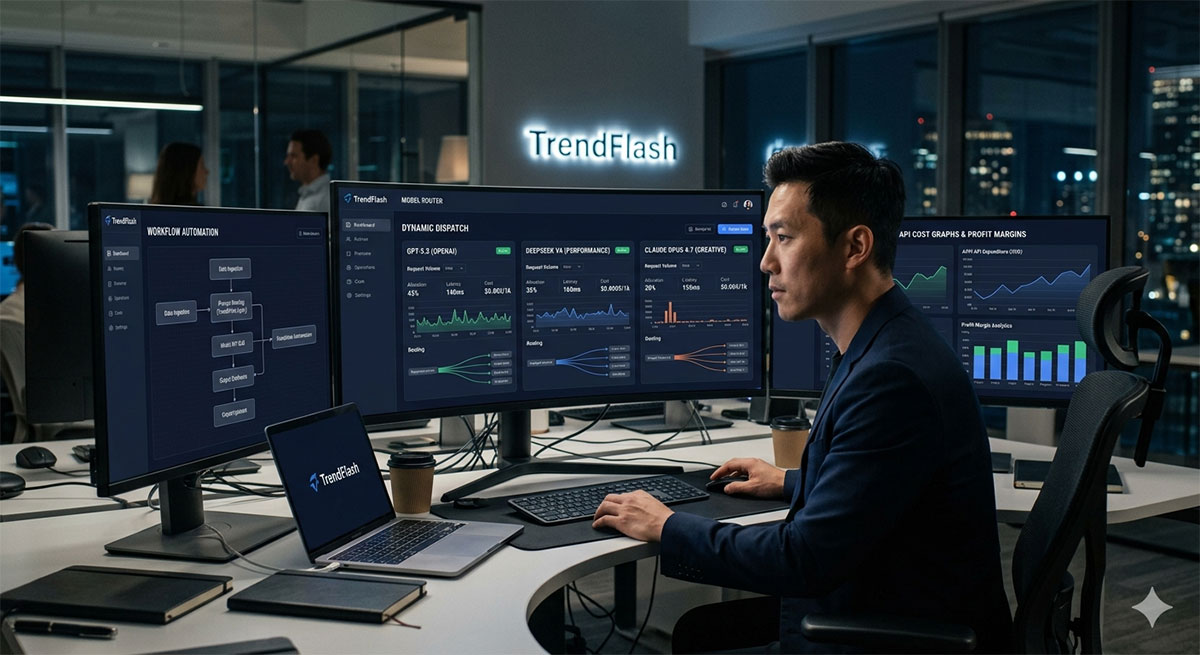
GPT-5.5 becomes your execution engineer. DeepSeek V4 becomes your cost-cutting machine. Claude Opus 4.7 becomes your safety layer for strict, high-risk client work.
That combination matters because agency profit is not created when you impress a client with an AI demo. Profit is created when you deliver the same or better outcome at a lower cost, in less time, with fewer revisions.
However, here is the brutally honest warning: do not upgrade your tool stack just because new models are available. If you are still learning the basics, first build your 1-person AI agency, get a real offer, close real clients, and only then obsess over routing, margins, and model economics.
Because if you do not have revenue, a better model is not leverage. It is just another subscription.
Table of Contents
- The Execution Gap: Why May 2026 Changed the Agency Game
- GPT-5.5: The New Workhorse for Agentic Delivery
- DeepSeek V4: The Margin Booster Agencies Needed
- Claude Opus 4.7: The Premium Safety Net
- The Agency Action Plan: How to Route Work Now
- FAQ: Model Routing, Cost, and Client Data
- Conclusion: Stop Testing Models and Start Closing Clients
The Execution Gap: Why May 2026 Changed the Agency Game
Most AI agency owners are still asking the wrong question.
They ask, “Which model is the smartest?”
That is beginner thinking.
The better question is: Which model should handle which task so I can protect margin, reduce delivery time, and avoid client risk?
Because in 2026, the winner is not the agency using the most powerful model for everything. The winner is the agency using the right model at the right point in the workflow.
OpenAI’s GPT-5.5 was introduced as a stronger model for coding, research, data analysis, and complex professional work, with OpenAI positioning it as a step up for execution-heavy tasks. OpenAI’s pricing page lists GPT-5.5 at $5 per 1M input tokens and $30 per 1M output tokens, which makes it powerful but not cheap.
Meanwhile, DeepSeek V4 moved in the opposite direction: aggressive efficiency. Reuters reported that DeepSeek’s V4 series includes Pro and Flash variants, with Flash designed as the faster, more cost-effective option and a 1-million-token context window.
Anthropic also pushed Claude Opus 4.7 as a serious high-end model, highlighting stronger coding benchmark performance, faster median latency, and strict instruction following.
So, yes, the model race is still happening. However, the real business story is simpler: AI delivery has become a routing problem.
You no longer need one expensive model to handle everything. Instead, you need a stack that behaves like a small technical team.
- GPT-5.5 handles difficult building, coding, debugging, and agentic execution.
- DeepSeek V4 Flash handles bulk processing, long-context reading, extraction, summarization, and repetitive client tasks.
- Claude Opus 4.7 handles high-risk writing, legal-style briefs, compliance-sensitive output, and strict instruction work.
This is where profit margins start changing.
Previously, an agency might run every workflow through a premium model because it felt safer. However, that approach quietly burns margin on low-value tasks.
For example, using a premium model to classify 20,000 support tickets is wasteful. Using a premium model to rewrite a final board-level client report may be justified.
The stack is no longer about loyalty to one AI provider. It is about ruthless workload separation.
GPT-5.5: The New Workhorse for Agentic Delivery
GPT-5.5 is not the model you use for cheap bulk summarization.
It is the model you use when failure is expensive, logic is messy, and the task requires multiple steps.
Think of GPT-5.5 as your agency’s lead engineer. Not your intern. Not your content assistant. Your lead engineer.
That means it belongs in workflows like:
- Building custom client automation scripts.
- Debugging Laravel, Node, React, Python, or API integration issues.
- Creating scraping workflows with error handling.
- Designing database-backed internal tools.
- Writing complex prompt chains and agent instructions.
- Refactoring messy client codebases.
- Connecting CRMs, WhatsApp APIs, payment systems, and reporting dashboards.
This is why GPT-5.5 matters for AI agencies. It pushes the agency owner closer to “technical delivery without hiring a full-time senior developer.”
However, do not misunderstand this.
GPT-5.5 does not magically remove the need for technical judgment. It reduces the cost of reaching a working solution.
If you are selling “AI workflow setup” for $2,000 to $10,000, the real money is not in the prompt. The real money is in shipping a reliable system that survives client usage.
That means edge cases. Authentication. Failed API calls. Database structure. Logs. Retries. Admin controls. Client handover documents.
GPT-5.5 is valuable because it can help with the painful middle layer where most AI agency beginners collapse.
This is also why agencies should compare it against older stack choices. If you are upgrading from our previous 2026 agentic tech stack recommendations, GPT-5.5 should be treated as the premium build model, not the default model for every task.
Use it when the work requires reasoning across tools, APIs, and code. Do not use it just to summarize meeting notes or rewrite a generic email.
Here is a practical agency example.
A client wants an automated lead research system. The workflow must scrape company websites, enrich contacts, classify leads by industry, generate a short sales angle, and push qualified leads into a CRM.
GPT-5.5 should help design the architecture, write the scraping logic, debug API failures, generate the data schema, and produce the internal operating guide.
However, once the system is running, you should not use GPT-5.5 for every single lead summary if a cheaper model can do it well enough.
That is where the margin booster enters.
DeepSeek V4: The Margin Booster Agencies Needed
DeepSeek V4 is the financial core of this stack update.
Not because it is always the smartest model. Because it changes the unit economics of high-volume delivery.
DeepSeek V4 Flash has been reported by model pricing trackers and provider listings at roughly $0.14 per 1M input tokens and $0.28 per 1M output tokens, while DeepSeek’s V4 line is also associated with a 1-million-token context window. Always check the live provider pricing before billing clients because discounts and provider rates can move.
Now compare that to GPT-5.5 API pricing listed by OpenAI at $5 per 1M input tokens and $30 per 1M output tokens.
The difference is not small. It is violent.
For output tokens, $0.28 versus $30 is roughly a 99% model-cost reduction. That does not automatically mean your entire agency has a 99% profit margin, because you still have labor, tooling, hosting, revisions, sales time, support, and taxes.
However, it does mean your AI inference cost on the right workload can collapse.
That is the agency opportunity.
Let’s make it real.
Example: Monthly Client Reporting Workflow
Imagine you sell a monthly AI reporting package to a client for $1,500.
The workflow processes support tickets, call notes, emails, CRM updates, and sales comments. It then creates a management report with patterns, risks, missed opportunities, and recommended actions.
If you push every stage through a premium frontier model, your cost may still be acceptable, but it is lazy routing. More importantly, it becomes dangerous when you scale from 3 clients to 30 clients.
Instead, route the bulk work through DeepSeek V4 Flash:
- Ticket clustering.
- First-pass summarization.
- Data extraction.
- Duplicate detection.
- Long document reading.
- Draft insight grouping.
Then reserve GPT-5.5 or Claude Opus 4.7 for the final synthesis, business recommendations, and sensitive client-facing language.
That one change can turn a workflow that feels expensive into one that scales cleanly.
Example: Bulk SEO Content Refresh
Now take a content agency selling SEO refresh packages.
The client has 500 old blog posts. They want outdated sections identified, internal links suggested, meta descriptions rewritten, and missing FAQ questions added.
This is not a job for one expensive model from start to finish.
DeepSeek V4 Flash can process the bulk pages and classify issues. Then GPT-5.5 can handle complex technical articles. Finally, Claude Opus 4.7 can review sensitive claims where accuracy and instruction discipline matter.
That is how an agency owner stops thinking like a freelancer and starts thinking like a system designer.
And this connects directly to maximizing your value-based pricing and retainers.
You do not charge based on token cost. You charge based on the business outcome.
If a workflow saves a client 40 staff hours per month, your invoice should not be calculated by adding 20% markup to API usage. That is the fastest way to stay poor while your client captures the value.
Instead, calculate the value of saved time, faster decisions, reduced errors, and operational consistency. Then use cheaper routing to protect your backend margin.
That is the game.
Claude Opus 4.7: The Premium Safety Net
Claude Opus 4.7 is not the cheapest model in the room.
It is not supposed to be.
In this stack, Claude Opus 4.7 is your compliance officer.
Anthropic describes Opus 4.7 as stronger on complex coding workflows, with faster median latency and strict instruction following. For agencies, that instruction-following angle is the part to pay attention to.
Because some client tasks do not fail loudly. They fail quietly.
A chatbot gives slightly wrong refund instructions. A policy document changes the meaning of a clause. A client proposal promises something the delivery team cannot provide. A financial summary overstates confidence. A legal-style document uses the wrong tone.
That is where cheap models can become expensive.
So, where should Claude Opus 4.7 sit?
- Final review of high-risk client documents.
- Compliance-sensitive summaries.
- Strict brand voice enforcement.
- Policy interpretation drafts.
- Enterprise proposal writing.
- Client-facing strategic recommendations.
- Instructions where “almost right” is not good enough.
Notice the pattern.
You are not using Opus 4.7 for bulk extraction. You are using it where the cost of a bad answer is higher than the cost of the model.
That is premium routing.
For example, if an AI agency is building an HR policy assistant for a client, DeepSeek can help process the internal handbook and extract sections. GPT-5.5 can help build the workflow and connect it to the company portal.
However, the final employee-facing answers should be reviewed through a stricter model layer, and ideally human-reviewed for sensitive policies.
That is not overkill. That is professional delivery.
The Agency Action Plan: How to Route Work Now
Here is the immediate takeaway.
Stop asking, “Which model should I use?”
Start asking, “What is the risk level, volume level, and complexity level of this task?”
Then route accordingly.
Use DeepSeek V4 Flash for Volume
Send DeepSeek V4 Flash the work that has scale but low reputational risk.
- Bulk document processing.
- Raw summarization.
- Data extraction.
- Classification.
- Long-context review.
- First-draft insight grouping.
- Internal analysis that will be reviewed later.
This is where agencies save serious money.
However, do not send confidential client data blindly into any model provider. Review the provider’s data policy, enterprise options, retention rules, region controls, and contract terms before using it for sensitive production work.
Use GPT-5.5 for Build Work
Send GPT-5.5 the jobs that require deeper reasoning, tool use, coding skill, and multi-step execution.
- Software setup.
- API integration.
- Workflow architecture.
- Debugging.
- Agent design.
- Complex prompt engineering.
- Automation reliability planning.
In plain English, GPT-5.5 is where you spend money to save founder time.
If it saves you 8 hours of debugging, the API cost is irrelevant.
Use Claude Opus 4.7 for Risk
Send Claude Opus 4.7 the work where the final answer must follow the client brief tightly.
- Final client reports.
- Legal-style summaries.
- Compliance-heavy content.
- Enterprise proposals.
- Sensitive customer communication.
- Brand-critical writing.
This is not about being fancy. It is about not destroying trust after the automation technically “works.”
The Simple Routing Rule
Here is the model-routing rule I would use today:
- Cheap and large? Send it to DeepSeek V4.
- Complex and technical? Send it to GPT-5.5.
- High-risk and client-facing? Send it to Claude Opus 4.7.
That is the stack.
Not because it sounds advanced. Because it matches business reality.
FAQ: Model Routing, Cost, and Client Data
Do I need subscriptions to all three models?
No. If you are still pre-revenue, start with one strong model and build your offer first.
However, once you have paying clients, using multiple models through APIs or routing platforms can protect your margin and improve delivery quality.
Is DeepSeek safe for client data?
Do not assume that any AI provider is safe by default.
For sensitive client data, check the provider’s data retention policy, enterprise terms, hosting region, compliance posture, and whether your client contract allows third-party AI processing.
Should I replace GPT-5.5 with DeepSeek V4 for everything?
No.
DeepSeek V4 Flash is attractive for high-volume, lower-risk work. GPT-5.5 is still better positioned for complex coding, agentic workflows, and difficult build tasks where quality saves time.
Can this stack really double agency profit margins?
It can, but not automatically.
If your current delivery process wastes premium model tokens on bulk tasks, smarter routing can sharply reduce costs. However, real profit also depends on pricing, sales, client quality, support load, and how reusable your workflows are.
What is the biggest mistake agency owners will make with this update?
They will test models for weeks instead of selling offers.
Model testing feels productive, but client acquisition pays the bills.
Conclusion: Stop Testing Models and Start Closing Clients
The mid-2026 agency stack is clear.
GPT-5.5 is your builder.
DeepSeek V4 is your margin machine.
Claude Opus 4.7 is your safety net.
That is all you need to know before taking action.
Do not spend the next month arguing online about which model is “best.” That conversation is mostly useless.
The best model is the one that helps you close the client, deliver the outcome, reduce your cost, and keep the account for another month.
So build a simple routing system.
Put DeepSeek V4 on bulk processing. Put GPT-5.5 on technical execution. Put Claude Opus 4.7 on high-risk client-facing work.
Then package the result into a productized offer: AI reporting systems, CRM automations, lead research engines, internal copilots, content refresh workflows, support ticket analysis, or custom business dashboards.
Because the agencies that win in 2026 will not be the ones with the longest tool list.
They will be the ones with the clearest offer, the fastest delivery system, and the strongest margins.
Stop testing models. Start closing clients.
And if you want weekly breakdowns on profitable AI workflows, model-routing strategies, and business blueprints you can actually sell, subscribe to the TrendFlash newsletter.
The stack is ready. The market is ready.
Now the only question is whether you are still hiding behind research — or finally building the agency.
About the Author
Girish Soni is the founder of TrendFlash and an independent AI strategist covering artificial intelligence policy, industry shifts, and real-world adoption trends. He writes in-depth analysis on how AI is transforming work, education, and digital society. His focus is on helping readers move beyond hype and understand the practical, long-term implications of AI technologies.