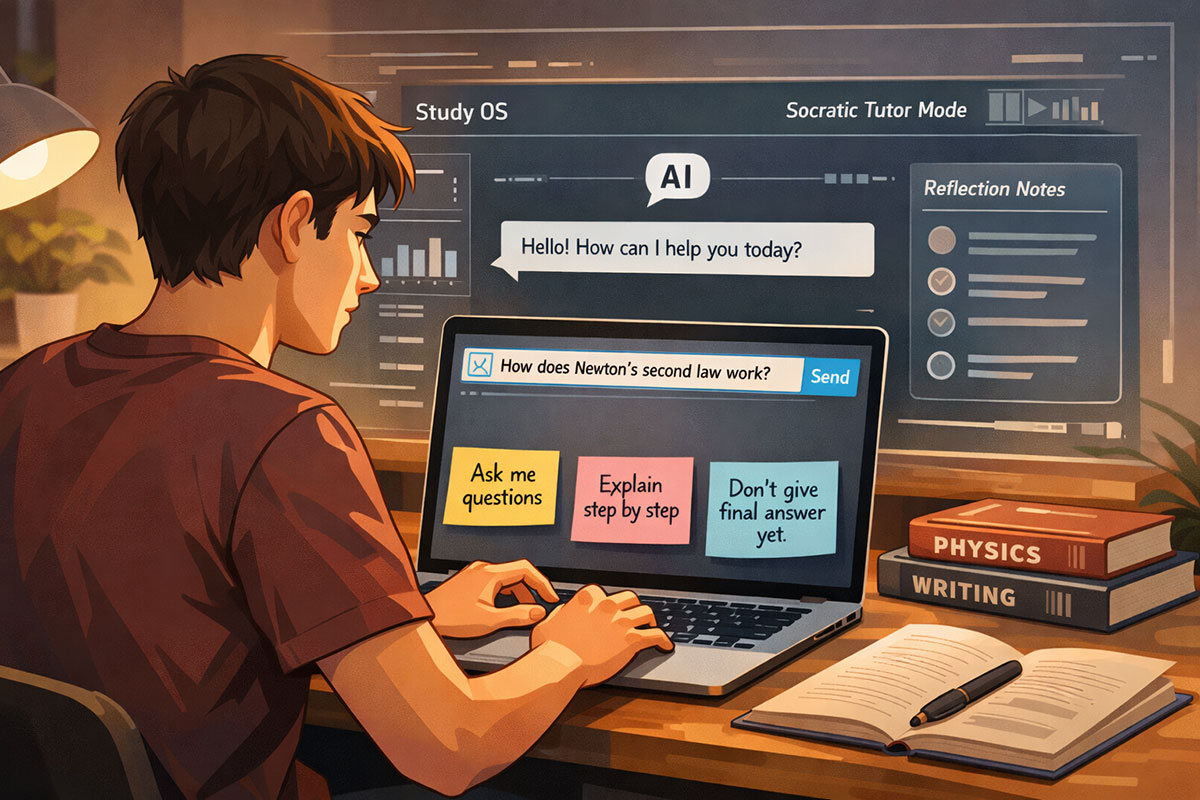
- Day 1: Setting Up Your Study OS
- Day 2: The Research Revolution
- Day 3: Mastering NotebookLM
- Day 4: Field-Specific Power Moves
- Day 5: Writing with Integrity (Current)
- Day 6: Career Jumpstart
- Day 7: Personal AI Agents
Students are stuck in a strange moment.
On one side, AI tools are everywhere. They can brainstorm, summarize, suggest better wording, and critique your argument in seconds. On the other side, classrooms are filled with anxiety: fear of being accused, fear of crossing a line you did not even realize existed, fear that one wrong prompt could turn a legitimate assignment into an academic integrity problem.
That tension is real. And it is exhausting.
The worst part is that many students are not trying to cheat in the cartoon-villain sense of the word. They are trying to keep up. They are overloaded, under pressure, and surrounded by technology that promises speed. So they ask AI to “help,” and before they know it, the tool is doing the thinking, the framing, the drafting, and the polishing. The result looks clean. It sounds formal. It also barely sounds like them.
That is where the real danger begins.
AI does not become unethical only when it breaks a rule. It becomes harmful the moment it replaces your thinking instead of extending it.
This article is about drawing a line that actually makes sense. Not a panic-driven line. Not a vague “never use AI” rule that ignores reality. A practical line students can follow: use AI where it sharpens your process, refuse it where it steals your voice, and build work that can survive both instructor scrutiny and your own conscience.
We are going to talk about the modern ethics of AI writing, why flawed AI detectors create so much fear, and why original thought is still your strongest protection. Most importantly, we will walk through a method that works in the real classroom: use AI for early ideation, write the draft yourself, then bring AI back in as a demanding reviewer.
Think of it as a guardrail for your mind.
The New Writing Problem Isn’t Just Plagiarism
When people talk about AI and school, they usually jump straight to cheating. That makes sense, but it misses the deeper issue. The biggest academic risk is not always copied text. It is outsourced thinking.
A student can submit a fully original-looking essay that still reflects almost none of their own intellectual work. The outline came from AI. The thesis came from AI. The transitions came from AI. The examples were suggested by AI. The final polish was AI-generated too. Technically, maybe nothing was copied from another student or website. But the central work of writing—deciding what matters, weighing evidence, shaping an argument, hearing your own reasoning emerge on the page—was skipped.
And that loss matters.
Writing is not just a delivery system for ideas. It is how ideas become clearer. Many students discover what they really think while drafting, not before. They notice weak claims, forced logic, thin evidence, or lazy assumptions precisely because they are wrestling with the words. If AI does all of that wrestling, your brain does not build the same strength.
That is why ethical guidelines are urgently needed now that AI use is so widespread among students. TrendFlash recently explored how common this has become in 92% of Students Use AI in 2025: Is It Cheating or Smart Learning?. Once a tool becomes normal, the question shifts. It is no longer “Are students using AI?” It is “Are students using it in a way that still preserves learning?”
There is also a long-term cost. If you use AI as a ghostwriter often enough, you start to lose trust in your own ability to begin. Your first paragraph feels weak unless a machine gives you one. Your structure feels shaky unless a chatbot arranges it. Your vocabulary starts to sound borrowed. That dependency can quietly damage confidence even while grades seem fine on the surface.
We have already written about that danger in Why Students Fear AI Is Making Them Lazy Learners. The fear is not irrational. If AI becomes your replacement writer, it can absolutely weaken the very mental muscles education is supposed to build.
So yes, plagiarism matters. But the more useful question is this: are you still the author of your own thinking?
The Sandwich Method: A Smarter Way to Use AI
Students need something better than guilt and guesswork. They need a usable process. That is where the Sandwich Method comes in.
The idea is simple.
Use AI at the beginning for exploration. Then remove it while you draft. Then bring it back at the end as a reviewer rather than a writer.
Why does this work so well? Because it protects the most important part of academic writing: the middle. That middle layer—your draft—is where your own interpretation, style, and reasoning should live.
Here is what the method looks like in practice:
| Stage | What You Do | What AI Can Do | What AI Should Not Do |
|---|---|---|---|
| Beginning | Choose topic, define question, gather direction | Brainstorm angles, suggest outline options, surface possible questions | Write thesis and full essay for you |
| Middle | Draft the essay yourself | Stay out of the drafting process | Generate paragraphs, topic sentences, analysis, or conclusion |
| End | Revise and strengthen logic | Act like a peer reviewer, point out weak claims, missing evidence, unclear structure | Replace your draft with a more polished AI version |
At the first stage, AI can be genuinely useful. Maybe you are staring at a blank page and need help narrowing a topic. Maybe you have too many ideas and need possible structures. Maybe you want five possible angles on a history prompt before choosing one. This is legitimate support. It helps you start, but it does not take ownership of your work.
Then comes the critical rule: once you know where you are going, write the actual draft entirely yourself. No paragraph generation. No “make this sound more academic” prompt that rewrites half the paper. No asking a chatbot to fill in weak spots with polished analysis you did not produce. This is the moment where your intellectual fingerprint has to appear.
After the draft is done, AI becomes valuable again. But now it plays a different role. Instead of acting like a ghostwriter, it acts like a tough editor or skeptical professor.
You can prompt it like this: “Act as a demanding professor. What claims in this essay are underdeveloped? What counter-arguments did I ignore? Where does my logic feel weak or too general?”
That is a powerful use of AI because it keeps ownership in your hands. The insight may come from the tool, but the revision decisions remain yours. You are still the writer. AI becomes the mirror, not the mind.
The safest way to write with AI is to let it challenge your ideas, not manufacture them.
This is also why the major-specific tools we discussed in Day 4: Field-Specific Power Moves need an ethical foundation. The fanciest research assistant or technical explainer is useless if you use it in a way that turns your assignment into an integrity violation. Powerful tools only help when your process stays clean.
Why Voice Matters More Than Ever
One of the strangest side effects of AI writing is that it can make smart students sound bland.
You have probably seen this already: essays full of polished transitions, balanced phrasing, tidy structure, and almost no memorable thought. They sound “correct” but strangely bloodless. No tension. No real angle. No sense that a person wrestled with the question and came out with a perspective.
That is what happens when writing becomes optimized for smoothness instead of meaning.
Your voice is not just about slang, personality, or a casual tone. In academic work, voice shows up in what you choose to emphasize, how you connect ideas, where you push back, what examples you bring in, and how you frame the problem. Two students can read the same sources and still produce very different essays if they are actually thinking.
AI tends to flatten that difference. It often defaults to the center. It gives the expected argument, the respectable phrasing, the safe summary. That may look acceptable at first glance, but it rarely feels alive. And in many classrooms, lifeless writing is not just boring. It is suspicious.
Professors read student work for a living. They notice when a paper says all the “right” things but never risks a real thought. They notice when the wording sounds detached from the student they know in class. They notice when the paper is technically neat but intellectually thin.
So how do you keep your voice?
Start by grounding your draft in your own actual reactions to the material. What confused you? What surprised you? Which argument felt incomplete? What connection did you notice that was not obvious at first? Those questions naturally pull you away from generic AI language and toward authentic reasoning.
Second, use specific evidence that reflects your reading process. Not random examples sprinkled in by a chatbot. Your examples. Your interpretation of the lecture, text, case study, or dataset. The more your essay reflects your path through the material, the less replaceable it becomes.
Third, revise for texture, not just correctness. Ask yourself whether your paragraphs sound like thought in motion or just polished filler. A strong student paper does not need to sound stiff to sound intelligent. In fact, the opposite is often true. Clear, confident writing usually reflects clearer thinking.
Voice is your strongest defense because it is hard to fake at scale. AI can imitate style on the surface. It struggles more with the deeper rhythm of genuine judgment.
AI Detectors, Student Anxiety, and the Originality Question
Let’s talk about the fear hanging over this whole topic: AI detectors.
Students worry about them for good reason. Many detectors are inconsistent, overconfident, or unable to distinguish between genuinely machine-generated writing and polished human prose. That creates a miserable atmosphere. A careful student can still feel vulnerable, while a reckless student may assume minor editing will make AI-written work “safe.” Neither response is healthy.
The problem is that detectors often tempt everyone into the wrong conversation. Students start asking, “How do I avoid being flagged?” when the better question is, “Is this actually my work?” Those are not the same thing.
Trying to beat a detector is a dead-end mindset. It leads to surface tricks: adding typos, changing a few words, asking another tool to “humanize” the text. None of that builds skill. None of it protects learning. It just turns writing into camouflage.
Original thought works differently. When your ideas are truly yours, your essay has a kind of internal coherence that is difficult to manufacture through shortcuts. Your examples connect to your claims in a natural way. Your phrasing may not be perfect, but it carries a pattern of judgment that belongs to you. Your revisions respond to your own line of reasoning rather than a machine’s template.
That is why original thinking is still the ultimate defense. Not because detectors are magical, but because authentic work tends to leave evidence of authentic process.
And process matters more than ever. Keep notes. Save outlines. Preserve draft history. If your school has unclear policies, document how you used AI. “I used it to generate three possible essay structures, then wrote my own draft and used it again to identify counter-arguments” is a far stronger position than “I only used it a little.” Specificity shows responsibility.
There is also an emotional piece here. Some students are scared to use AI even for allowed purposes because they do not want to be falsely accused. That fear is understandable, but the answer is not total paralysis. The answer is disciplined transparency and a method you can defend. If your instructor permits brainstorming or revision support, use those functions cleanly and thoughtfully.
A good rule is this: if you would feel embarrassed explaining your exact workflow out loud, the workflow probably needs work.
Your Practical Anti-Plagiarism Code for Every Assignment
Ethics become easier when they are concrete. So here is a practical code you can use before you submit any AI-assisted assignment.
A student checklist before turning anything in
- Did I use AI only for brainstorming, outlining options, or critique—not for writing my actual draft?
- Can I explain my thesis in my own words without looking at the essay?
- Did I personally choose the examples, evidence, and interpretation in this paper?
- Would I be able to defend any paragraph if my professor asked how I developed it?
- Did I revise based on feedback instead of replacing my work with polished AI text?
- Have I checked my course policy on AI use and stayed inside it?
- Do I still sound like myself on the page?
That last question matters more than it seems. Many students look for ethical rules in policy documents alone. But there is also an inner test. If you read the work and feel detached from it, that is a warning sign. If the essay sounds more like what you imagine a “perfect student” should sound like than what you actually think, pause.
There are also a few practices worth avoiding completely.
Do not ask AI to write the first draft and then “lightly edit” it. That path is almost always a trap because the structure, logic, and tone are already machine-led. Do not paste lecture notes into a chatbot and ask it to “turn this into an essay.” That is not study support; it is outsourced composition. And do not rely on tools that promise to make text “undetectable.” Those services are not solving a learning problem. They are selling panic.
Instead, build a repeatable workflow. Start with your own question. Use AI to widen your options. Write on your own. Ask for critique. Revise deliberately. Save your drafts. The more stable your method becomes, the less tempting shortcuts will feel.
Here is the irony many students discover too late: ethical AI use often leads to better grades than shortcut use. Why? Because instructors reward clear thinking, specific argument, and genuine engagement. Those are exactly the qualities the shortcut route tends to flatten.
Real-Life Scenario: Two Students, Two Outcomes
Imagine two students in the same modern history class. Both are assigned an essay on the Cold War. Both are busy. Both know AI tools can help. But they choose very different paths.
Student A opens ChatGPT and types: “Write me a strong college essay on the Cold War with an introduction, three body paragraphs, and a conclusion.” Within seconds, they get something tidy and competent-looking. The structure is clean. The wording sounds academic. It mentions containment, the arms race, ideological conflict, and global influence. Student A changes a few phrases, swaps in one extra sentence, and submits it.
The paper is not wildly wrong. That is almost the problem. It is generic in the smoothest possible way. The thesis is broad. The analysis is predictable. The examples feel textbook-flat. When the paper is reviewed, it raises concern. Whether through an AI detector, instructor instinct, or simple comparison to the student’s previous work, the essay does not feel authored so much as assembled. At best, Student A gets a warning. At worst, they face an academic integrity review. Even if the case never escalates, the paper earns a mediocre grade because it says little that could not have been generated by anyone with a prompt bar.
Student B uses AI differently. They begin by asking for five possible angles on a Cold War essay, focusing on how ideology shaped policy decisions. They read the suggestions, reject three, combine two, and build a working outline. Then they close the AI tab and write their draft alone. It takes longer. Their first version is uneven. One body paragraph leans too descriptive. Their conclusion feels rushed.
Only after finishing do they bring in an AI assistant again—this time Claude—with a smarter prompt: “Act as a tough professor. What counter-arguments did I miss? Which parts of this essay are too general? Where does my logic need stronger support?” The tool points out that the essay overstates ideological purity and underplays strategic self-interest. It also notes that one paragraph assumes causation where the evidence only shows correlation.
Student B does not copy the feedback blindly. They think about it. They go back to their sources. They revise the thesis, sharpen the evidence, and add a more nuanced counterpoint. The final essay feels different from Student A’s in a way that professors instantly recognize. It has tension, choice, and judgment. It does not just summarize the Cold War. It argues something. Student B earns an A+ not because AI made the paper better on its own, but because AI was used to pressure-test genuine thinking.
That difference is the whole point of this article.
One student used AI to avoid the hard part. The other used AI to improve the hard part they had already done themselves.
FAQ
1. Is using AI for brainstorming considered cheating?
Usually, no—but it depends on your school, your instructor, and how far the brainstorming goes. There is a big difference between asking for possible angles on a topic and asking for a ready-made thesis, argument structure, and body paragraph flow that you then treat as your own. Brainstorming is generally defensible because it is similar to talking through ideas with a classmate, tutor, or writing center. It can help you overcome blank-page paralysis and see possibilities you might not have considered.
That said, ethical use still requires restraint. If the brainstorming stage becomes so detailed that the actual writing decisions have already been made for you, the line starts to blur. A good test is whether you are still doing the intellectual selection yourself. Did you choose the angle, adapt the structure, and formulate the argument in your own terms? Or did you simply accept the machine’s most plausible version because it was convenient?
When in doubt, check the course policy and keep your use narrow. Brainstorm with AI, then take control quickly. The point is to get unstuck, not to hand over authorship before the real work begins.
2. If AI detectors are unreliable, why should I worry at all?
You should worry less about detectors as technology and more about what they represent in the classroom: heightened scrutiny. Even if a detector is flawed, it can still trigger questions, and those questions can become stressful if your process was sloppy or difficult to explain. That is why the goal should never be to “beat” a detector. The goal should be to build work that reflects a defensible, authentic process.
Reliable or not, detectors have changed student behavior because they increase the cost of ambiguity. If your essay was largely machine-written, you may not be able to explain how you arrived at your ideas, why you structured a paragraph a certain way, or what led you to revise a claim. That is where students get exposed—not always by software, but by the lack of a real thinking trail.
So yes, detector fear is understandable. But the smarter response is not panic. It is process discipline: keep drafts, keep notes, know your workflow, and make sure your final submission actually sounds and feels like something you wrote.
3. Can I use AI to improve grammar and clarity after I finish my draft?
In many cases, yes. This is one of the most reasonable uses of AI, especially for students who are multilingual, writing under time pressure, or trying to make complex ideas clearer. Asking AI to flag awkward sentences, identify repetitive phrasing, or point out unclear transitions is closer to editing support than authorship replacement.
But even here, moderation matters. There is a difference between “Help me tighten these sentences” and “Rewrite this whole essay so it sounds more sophisticated.” Once you move from cleaning expression to replacing expression, your voice can disappear quickly. An over-polished draft often ends up sounding less persuasive because it no longer matches the student behind it.
The safest approach is to ask for comments, not full rewrites. Let the tool point out unclear areas, and then make the changes yourself. That preserves authorship while still giving you the benefit of an extra set of eyes.
4. What if my professor allows AI, but I still feel like using it too much is making me weaker?
That instinct is worth trusting. Permission does not automatically equal wisdom. A tool can be allowed and still be unhelpful if it starts replacing cognitive struggle that you actually need for growth. In fact, some of the most important learning moments in writing come from discomfort: not knowing how to start, realizing your argument is weak, discovering that your evidence does not fully support your claim. Those moments are frustrating, but they are also developmental.
If AI is making every step frictionless, you may be losing something valuable. The answer is not to reject the tool entirely. It is to use it selectively. Keep the stages that force you to think. Let AI support the edges of the process rather than swallowing the center.
A good practice is to set a personal boundary before you begin: “I can use AI for structure ideas and revision feedback, but the thesis and analysis must come from me.” That kind of self-rule protects you from drifting into dependency while still letting you benefit from the technology.
5. How do I know whether an essay still sounds like me?
Read it aloud. That is one of the fastest and most revealing tests available. If certain sentences feel strangely formal, emotionally flat, or disconnected from how you normally explain ideas, pay attention. Your academic voice does not need to sound casual, but it should still feel inhabited. You should recognize your judgment inside the writing.
Another useful test is oral explanation. Can you summarize each paragraph’s purpose without staring at the text? Can you explain why a certain example appears where it does? Can you defend the thesis in conversation? If the answer is yes, your essay is probably rooted in your thinking. If the answer is no, the writing may be more borrowed than you realized.
You can also compare the draft to earlier work you wrote without AI. Not line by line, but in spirit. Does this paper still carry your habits of emphasis, your style of questioning, your way of connecting evidence to interpretation? Voice is not a gimmick. It is the pattern of how you think on the page.
6. What is the single best rule for using AI in writing ethically?
If there is one rule worth memorizing, it is this: never let AI do the part your class is actually trying to teach you. If the assignment is meant to develop argument, then argument must come from you. If it is meant to develop analysis, your analysis cannot be outsourced. If it is meant to test interpretation, the interpretive leap has to be yours.
This rule cuts through a lot of confusion. It does not ban all AI use, and it does not depend on detecting every gray area perfectly. Instead, it asks a deeper question: what is the educational purpose of this task? Once you know that, the boundary becomes clearer.
AI can support learning. It can help you clarify, organize, question, and revise. But the core intellectual labor of the assignment belongs to you. That is not just an ethical rule. It is what keeps the assignment worth doing in the first place.
Writing with AI is not automatically dishonest. Writing without thinking is.
The students who will thrive in this new era are not the ones who avoid every tool, and not the ones who hand their minds over to every tool. They are the ones who learn how to collaborate without surrendering authorship. They know when to ask for help, when to think alone, and when to let critique sharpen work they genuinely own.
That is the real anti-plagiarism code: protect the part of the process where your voice is formed. Everything else is secondary.
Pro tip: You’ve mastered your Study OS, research, notes, tools, and ethics. You are officially crushing the classroom. But what happens after graduation? In Day 6 of this series, we flip the script and use AI to hack the job market, optimize your LinkedIn, and build a career portfolio that recruiters cannot ignore.Career Jumpstart
About the Author
Girish Soni is the founder of TrendFlash and an independent AI strategist covering artificial intelligence policy, industry shifts, and real-world adoption trends. He writes in-depth analysis on how AI is transforming work, education, and digital society. His focus is on helping readers move beyond hype and understand the practical, long-term implications of AI technologies.