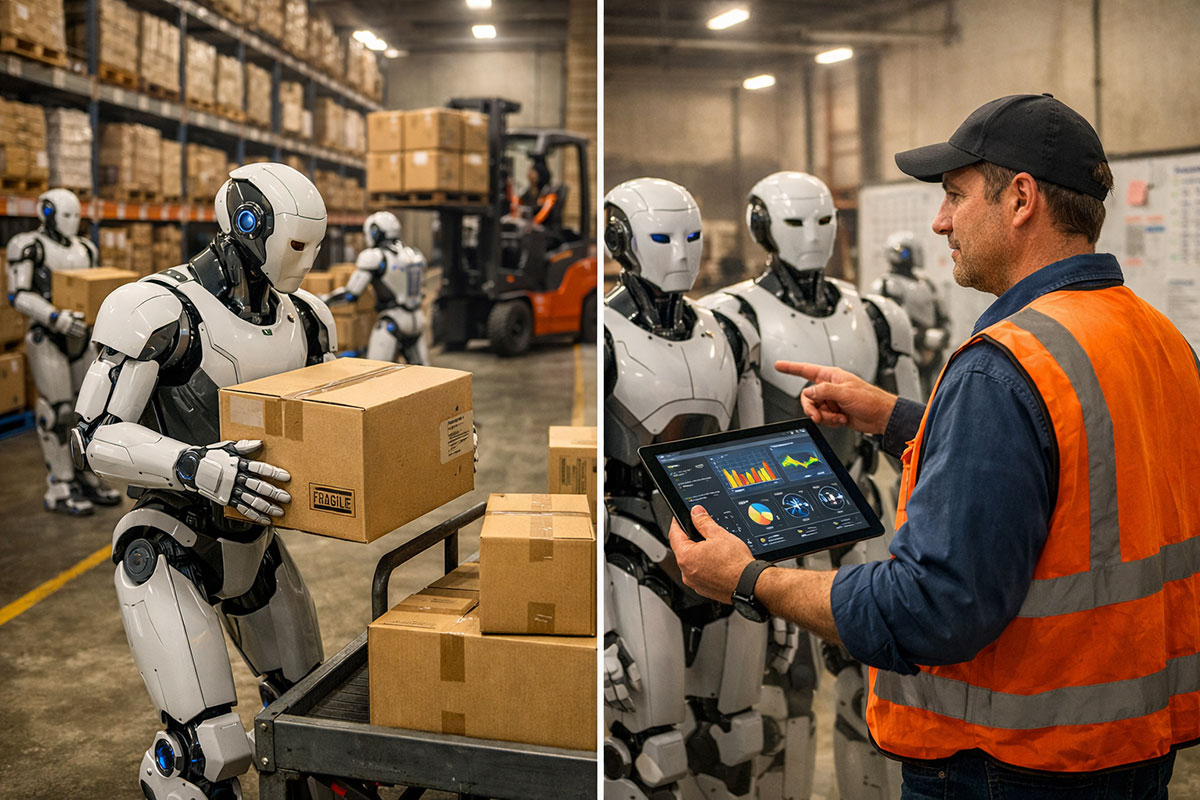
TrendFlash.net has covered the AI workforce story from every angle—from agentic AI jobs exploding to why the future of work is turning into a skills game. But this week, the debate got personal—and political.
What happened on January 16, 2026 (and why the world is paying attention)
On January 16, 2026, the UK’s Science Minister Patrick Vallance publicly framed robotics as a productivity upgrade: robots should take the “repetitive” parts of warehouse and factory work, changing jobs rather than wiping them out. At the same time, London’s Mayor Sadiq Khan warned AI could usher in a “new era of mass unemployment” unless government moves faster to protect workers and retrain at scale.
The key tension is not “robots vs humans.” It’s whether countries and companies redesign work fast enough so that humans become more valuable as robots become more capable.
This is why the argument matters far beyond the UK: warehouses and factories are the first visible wave, but the same logic applies to offices, hospitals, retail, logistics, construction, and even the “knowledge work” economy that assumed it was safe.
Topic Brief: category, angle, target keywords, why now
| Item | What we’re covering |
|---|---|
| Category | AI News & Society (jobs, policy, economics, real-world adoption) |
| Angle | Not “will robots take jobs?”—but which tasks they take first, which new roles appear, and how to build a Human-Plus career that grows with automation. |
| Target keywords | AI unemployment debate, robotics 2026, humanoid robots warehouse, human-AI collaboration, future of work skills, reskilling strategy |
| Why now | Because robotics is crossing a threshold: adoption is rising, humanoid prototypes are moving into real sites, and policy is shifting to accelerate deployment. |
The 3 stories people tell about robots and jobs (and what’s missing)
Most headlines force you to pick a side. Reality is messier—and that’s where the opportunity hides.
| Narrative | What it gets right | What it misses | The “tell” to watch in 2026 |
|---|---|---|---|
| 1) Doom: “Mass unemployment is inevitable” | Automation can remove tasks faster than labor markets adapt. | Jobs are bundles of tasks; automation usually hits parts first, not entire roles. | Hiring freezes + quiet task automation before layoffs. |
| 2) Boom: “Productivity makes everyone richer” | Productivity gains can raise output, lower costs, and create new industries. | Gains don’t automatically distribute; transition pain can be brutal without training pathways. | Wage polarization: top skills win, mid skills stall. |
| 3) Human-Plus: “Work becomes a partnership” | Humans + agents + robots reorganize workflows and create hybrid roles. | Requires deliberate redesign, tooling, safety governance, and reskilling. | New job titles: robot supervisor, workflow orchestrator, AI quality lead. |
That third story—Human-Plus—is the one many people “like” but don’t operationalize. So let’s operationalize it.
First, the hard numbers: robots are showing up faster than your intuition
The International Federation of Robotics reported 542,000 industrial robots installed in 2024, with annual installations above 500,000 for the fourth year running—and about 4.664 million industrial robots operating worldwide.
Meanwhile, the World Economic Forum’s Future of Jobs Report 2025 projects structural transformation equal to 22% of today’s jobs by 2030—170 million jobs created versus 92 million displaced, for a net gain of 78 million. Translation: the problem is not “no jobs.” The problem is mismatch—skills, location, timing, and who gets the upside.
Now add a cultural shift: “physical AI” went mainstream at events like CES, where robots moved from novelty to “product strategy.” If you missed that shift, start with CES 2026: what physical AI really means and then compare it with the real-world momentum behind Boston Dynamics Atlas in industry.
Why warehouses and factories are “Wave 1”
Vallance’s framing is specific: warehouses and factories are already structured for automation—repeatable routes, measurable throughput, strict safety zones, and clear ROI. In that environment, “humanoid” matters less than “useful”: if a robot can move, lift, scan, and navigate safely, the business case writes itself.
But here’s the part people miss: automation doesn’t erase the work. It reorganizes it.
What changes first in a warehouse?
- Repetitive movement becomes robotic (transport, basic picking, pallet movement).
- Exception handling becomes human (damaged goods, ambiguous labels, unexpected inventory behavior).
- Coordination becomes a new layer (humans orchestrating fleets through dashboards and policies).
- Quality & safety becomes higher stakes (humans auditing systems, incidents, near-misses).
If you want a simple mental model: robots absorb repetition, humans absorb ambiguity. The fight is over who gets trained and paid for ambiguity.
The “Human-Plus” era, explained like a manager would explain it
McKinsey describes the future workforce as a partnership between people, agents, and robots—with automation potential being technical possibility, not a direct forecast of job losses. The bigger shift is workflow redesign: not automating tasks one-by-one, but rebuilding the full system of work.
Here’s what Human-Plus means in practice:
Human-Plus = You + (AI agent) + (robotic system) + (domain judgment)
Think of it as a stack:
- AI agents handle planning, coordination, drafting, forecasting. (Related: AI agents took over in 2025 and Google’s agent trends for 2026.)
- Robots execute physical work with increasing autonomy (movement, manipulation, inspection).
- Humans define goals, set constraints, handle edge cases, make judgment calls, and stay accountable.
So the question is not “Will AI replace you?” It’s:
Will you become the person who can command AI systems—or the person being commanded by them?
Jobs at risk vs. jobs reshaped: a reality-based map
Below is a practical table you can use for career planning. It avoids hype and focuses on what changes inside roles.
| Role family | Tasks most exposed (2026–2028) | Human-Plus upgrade path | What to learn |
|---|---|---|---|
| Warehouse associate | Basic picking, transport, scanning, routine packing | Robot-floor coordinator / exception handler | Dashboard ops, safety protocols, root-cause thinking |
| Manufacturing line worker | Repeatable assembly, visual inspection, part transport | Automation technician / QA + robot cell supervisor | Basic robotics, SOP auditing, defect analysis |
| Junior office roles | Research summaries, drafts, scheduling, basic reporting | Workflow orchestrator / AI quality reviewer | Prompting, verification, stakeholder communication |
| Customer support | Tier-1 queries, refunds, routine troubleshooting | Escalation specialist / policy + training lead | Edge-case handling, escalation playbooks, empathy |
| Healthcare support | Admin workflows, documentation, scheduling | Clinical ops + AI compliance coordinator | Process design, privacy basics, error checking |
If you want a deeper workforce lens (with numbers and role categories), pair this with AI job transformation (data-driven guide) and AI career moat skills.
So… is mass unemployment coming?
It can—in specific places, for specific cohorts, in specific time windows.
Mayor Khan’s warning is essentially about transition speed: if adoption accelerates while training and job creation lag, unemployment spikes in the short-to-medium term. Vallance’s view is about task transformation and productivity gains—if the economy absorbs workers into upgraded roles, unemployment doesn’t explode. Both can be true depending on policy and business behavior.
The 4 conditions that decide the outcome
- Adoption pace: how quickly robots/AI roll out across sectors.
- Reskilling throughput: can we retrain millions fast enough (not just “offer courses”)?
- Mobility: can workers move across roles, industries, and geographies?
- Distribution: do productivity gains turn into wages and new hiring—or just margins?
Robotics doesn’t automatically create unemployment. Unmanaged transitions do.
The company playbook: how businesses can avoid “robot backlash”
If you run operations, your biggest risk in 2026 isn’t only technical—it’s social: brand damage, labor disputes, and political pressure when layoffs hit. Here’s a practical playbook.
1) Audit tasks, not job titles
Use a “task heatmap” approach: what % of work is repetitive, variable, risky, or customer-facing? Automation should start where it improves safety and throughput without wrecking trust.
2) Redesign workflows end-to-end
McKinsey’s key point is that gains come from redesigning workflows, not automating isolated tasks. Build systems where humans supervise, validate, and handle exceptions.
3) Create a Human-Plus ladder (internal promotions, not layoffs)
- Operator → robot support associate
- Associate → fleet coordinator
- Coordinator → automation shift lead
- Lead → workflow/quality manager
4) Publish “automation transparency” metrics
Track and share: number of roles upgraded, training completion, internal mobility, incident reduction, throughput gains shared via wages/bonuses.
5) Build governance early
Pair robotics expansion with responsible AI rules. If you’re building policy frameworks, see: AI regulation frameworks and broader AI ethics & governance coverage.
The individual playbook: how to become “Human-Plus” in 90 days
This is the part that matters most if you’re reading this as a worker, student, freelancer, or manager trying to stay relevant.
Days 1–30: pick your “adjacent power skill”
- Operations (SOP design, safety, process mapping)
- Quality (auditing, incident reviews, root-cause)
- Workflow orchestration (agents + tools + coordination)
- Customer nuance (escalation, empathy, relationship)
Start with practical guidance like the “0-dollar AI workspace setup” and tasks you should automate to stay promotable.
Days 31–60: learn to command tools (not just chat)
Robotics-era workers don’t just “use AI.” They use systems: dashboards, ticketing, inventory tools, QA logs, SOPs, and agent workflows. Build muscle memory with step-by-step tooling guides like research + verification workflows.
Days 61–90: prove you can run “hybrid work”
Create a portfolio artifact (even inside a job): a documented process improvement, a training sheet, a QA checklist, an exception-handling playbook, or an automation + human review pipeline.
In the Human-Plus era, your leverage comes from being the person who reduces chaos. Robots reduce repetition. Humans win by reducing ambiguity.
The policy question: what governments can do (beyond speeches)
The UK’s move to reduce red tape for robotics and back adoption hubs signals a familiar strategy: accelerate deployment while promising job transformation.
But if you want to avoid the “mass unemployment” scenario, four policies matter most:
- Training with placement: funded programs tied to real employers and real roles.
- Wage insurance / transition support: soften the shock of moving into a new ladder.
- SME automation support: small firms need templates, not just tech.
- Safety + accountability: clear responsibility when AI systems fail.
Where this goes next (2026–2028): the likely path
Expect robotics to follow the same adoption curve we saw in software automation—slow, then sudden, then normal.
Phase 1: “Visible automation” (now)
Warehouses, factories, logistics nodes—because ROI is measurable and environments are controlled.
Phase 2: “Service robotics at the edges”
Hospitals (assistive), retail backrooms, basic inspections, facility management—where humans still anchor safety and trust.
Phase 3: “Hybrid organizations” become the default
Companies stop hiring for “role titles” and start hiring for systems capability: can you manage agents, robots, and workflows?
If you want to track how fast this shift could accelerate, keep an eye on trendlines like AI running everything and the broader macro view in MIT’s key AI shifts for 2026.
Bottom line: the debate is real—but your response doesn’t have to be fear
The Vallance vs. Khan clash is a symbol of a bigger truth: we’re arguing about outcomes that are not pre-written. Robotics can trigger concentrated pain. It can also unlock real prosperity. The deciding factor is whether we build Human-Plus pathways fast enough—inside companies, inside cities, and inside individual careers.
If you do one thing after reading this: stop asking “Is my job safe?” and start asking “Which tasks in my job are becoming automated—and which Human-Plus tasks can I own next?”
Related Reading (TrendFlash internal)
- Agentic AI: Your New Virtual Coworker is Here
- The Future of Work: How AI Is Redefining Careers and Skills
- Agentic AI Market: $52B → $200B (Where the Jobs Are)
- Boston Dynamics Atlas: The Humanoid Robot Era Begins
- AI Career Moat: 9 Skills That Make You Hard to Replace
Note: All internal links used above were selected only from your provided TrendFlash URL list and site pages.
About the Author
Girish Soni is the founder of TrendFlash and an independent AI strategist covering artificial intelligence policy, industry shifts, and real-world adoption trends. He writes in-depth analysis on how AI is transforming work, education, and digital society. His focus is on helping readers move beyond hype and understand the practical, long-term implications of AI technologies.