Introduction: The Dawn of the AI Co-Scientist
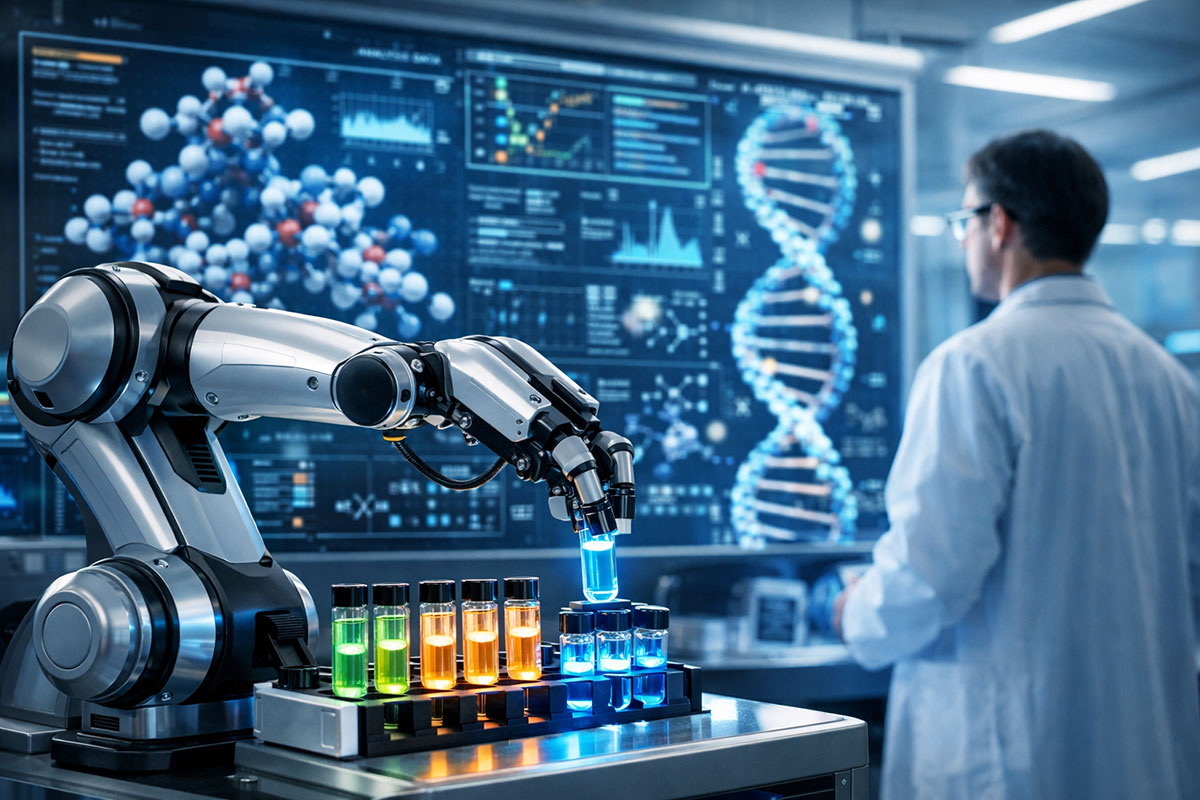
The image of a lone scientist hunched over a microscope is being replaced by a more collaborative vision: a human researcher working alongside an autonomous intelligence. In 2026, we have moved past the era where AI was merely a tool for data crunching. Today, systems like AlphaEvolve and specialized biomarker AI are functioning as lead researchers, proposing their own hypotheses, designing experiments, and identifying breakthroughs that have eluded humans for decades. This shift is not just about speed; it's about the ability to see patterns and connections within "big data" that are simply beyond human cognitive limits. Whether it's in the hunt for non-addictive painkillers or the quest for sustainable energy materials, AI is now the one leading the charge into the unknown.
"AI is not just accelerating science; it's redefining what is discoverable. We are entering an era where the 'lead scientist' on a Nobel-winning paper might very well be an algorithm."
The AlphaEvolve Revolution: Algorithms That Invent Algorithms
At the heart of this scientific renaissance is AlphaEvolve, a Gemini-powered coding agent from Google DeepMind designed to evolve and optimize complex algorithms. Unlike traditional AI, AlphaEvolve doesn't just follow a set of instructions; it uses an evolutionary framework to iteratively improve code, essentially "teaching" itself how to be more efficient.
In 2026, the impact of AlphaEvolve is being felt across multiple disciplines:
- Data Center Efficiency: It has already optimized scheduling for Google's global data centers, recovering 0.7% of compute resources—a massive gain when scaled worldwide.
- Hardware Design: AlphaEvolve has proposed Verilog rewrites for Tensor Processing Units (TPUs), improving the very chips that power AI itself.
- Mathematical Breakthroughs: It solved a 56-year-old math puzzle, finding a more efficient way to multiply matrices than the legendary Strassen's algorithm.
AI-Driven Drug Discovery: From Years to Days
Perhaps the most profound real-world impact of AI is in the field of drug discovery. In 2026, pharmaceutical giants and biotech startups are using agentic AI to navigate the "valley of death" between laboratory research and clinical trials.
| Stage of Discovery | AI Intervention | 2026 Impact |
|---|---|---|
| Target Identification | AI mines vast literature and genomic data to find new disease triggers. | Identifying novel gene candidates for rare diseases in days rather than years. |
| Molecule Design | Generative AI "invents" millions of potential compounds with specific traits. | Creation of 15 million potential compounds for neurodegenerative diseases. |
| Safety Prediction | Deep learning models predict toxicity before a single pill is made. | Reducing late-stage clinical trial failures by up to 50%. |
A major milestone in 2026 is the advancement of opioid-free pain relief. Companies like Vertex and Pfizer are using AI to target the NaV1.8 sodium channel, creating drugs that block pain at the source without the addictive properties of traditional opioids. This is a prime example of how machine learning is solving some of society's most pressing health crises.
Unlocking the Secrets of Cancer with Biomarker AI
In oncology, the focus in 2026 has shifted to precision medicine. AI is now being used to discover biomarkers—biological "fingerprints" that can predict how a specific patient will respond to a particular treatment.
By integrating data from pathology, radiology, and genomics (a process known as multi-modal fusion), AI models are now predicting immunotherapy responses with 70-80% accuracy. This allows doctors to bypass the "trial and error" phase of cancer treatment, moving straight to the most effective therapy for each individual patient. This approach is being operationalized through platforms like the AISB Network, where industry leaders share data to train massive open-source models like OpenFold3.
Materials Science: The Hunt for the Next-Gen Battery
As the world races toward a green energy transition, AI is leading the hunt for sustainable materials. The Materials Project at Berkeley Lab has become an essential infrastructure, providing AI-ready datasets for over 650,000 registered users.
Recent breakthroughs include:
- Lithium-Reduced Batteries: Microsoft and PNNL used AI to discover a new solid-state electrolyte, N2116, which could reduce lithium use by up to 70%.
- Unconventional Combinations: AI is proposing material mixtures that were previously thought to be impossible, such as blending sodium and lithium ions for better conductivity.
- Rapid Prototyping: The journey from a theoretical AI prediction to a working battery prototype has been slashed from 20 years to just 9 months.
Climate AI: Predicting the Unpredictable
Beyond the lab, AI is becoming our lead researcher in understanding and predicting extreme weather. Systems like Google's GraphCast and the startup Beyond Weather are now delivering long-term forecasts that outperform traditional physics-based models.
In 2026, these tools are being used for more than just rain reports. They are predicting cyclone tracks, wildfire paths, and seasonal crop failures with unprecedented accuracy. By analyzing ocean temperatures and atmospheric patterns, these "intelligent advisors" are helping humanitarian organizations and governments prepare for climate-driven disasters days or even weeks in advance.
Conclusion: A New Era of Discovery
The transition of AI from a tool to a lead scientist marks one of the most significant shifts in human history. By automating the "drudgery" of science—the endless screening of molecules, the manual crunching of climate data, the iterative testing of materials—AI is freeing human scientists to do what they do best: ask the big questions and interpret the profound results. As we look toward the rest of 2026, the question is no longer if AI will make the next big discovery, but which one it will be. For more on the evolving role of AI, explore our guide on the rise of AI agents or see how these technologies are redefining careers across all sectors.
About the Author
Girish Soni is the founder of TrendFlash and an independent AI strategist covering artificial intelligence policy, industry shifts, and real-world adoption trends. He writes in-depth analysis on how AI is transforming work, education, and digital society. His focus is on helping readers move beyond hype and understand the practical, long-term implications of AI technologies.