Introduction: The Shift Nobody Fully Noticed
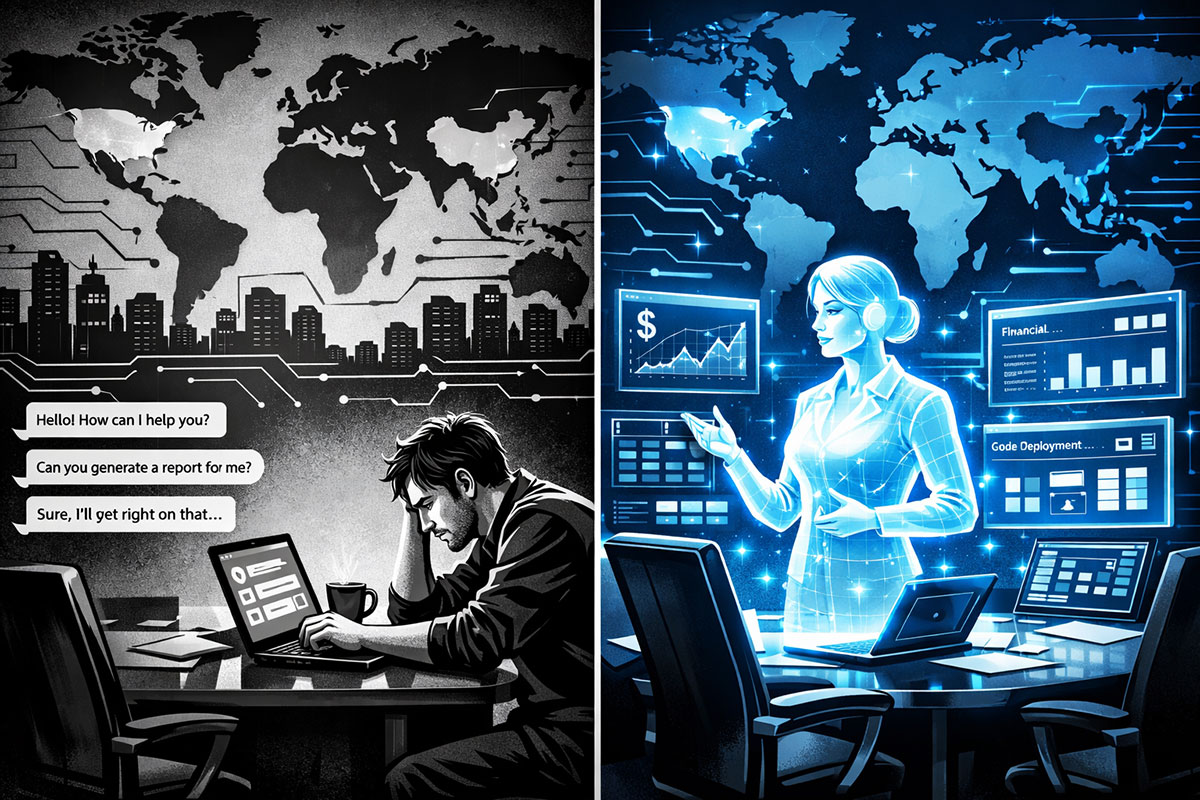
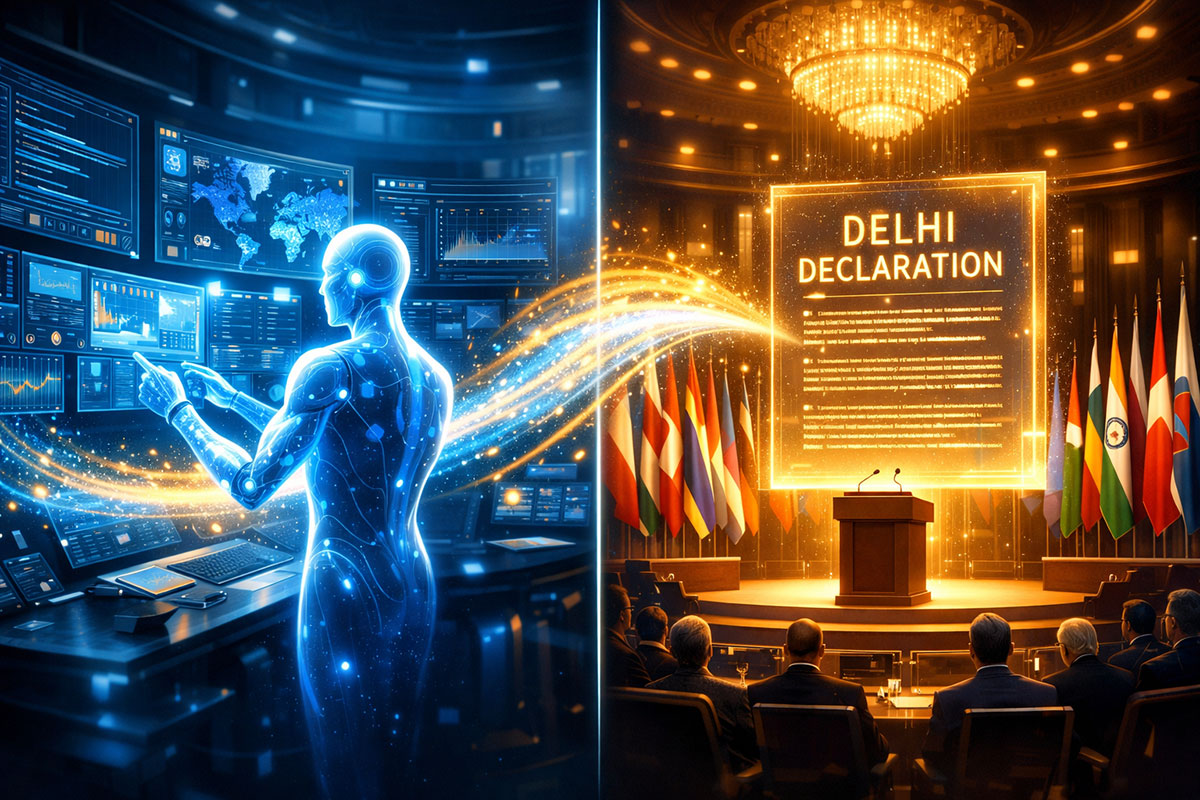
Remember when everyone asked, "But is AI really useful?" That conversation stopped happening in 2025. It wasn't replaced with enthusiasm—it was replaced with operational pragmatism. Companies stopped experimenting with AI as an optional add-on and started rebuilding how they actually work. That's the story of 2025: infrastructure replacing innovation theater.
The year's most consequential developments weren't breakthroughs in model architecture or new benchmarks. They were about who controls distribution, where the computing happens, how the law protects (or doesn't) creators, and whether anyone actually trusts these systems. Those four things—distribution, compute, law, and trust—are where modern power lives. And in 2025, AI became inseparable from all of them.
Part 1: The Model Leap That Actually Mattered
If you watched the AI headlines in 2025, you saw the usual suspects: OpenAI released GPT-5, Anthropic launched Claude 4, and Google pushed Gemini 3. But the framing matters more than the version numbers.
GPT-5 wasn't positioned as "a better chatbot." OpenAI called it "built-in thinking"—a model that could reason through multi-step problems without you spoon-feeding it every detail. The extended context window jumped to 128,000 tokens, meaning it could read entire codebases or books in one go. The personalization got weird—it remembers your tone, your writing style, your preferences, and adjusts itself to you over time.
But here's what made this moment matter: on-device AI became real. GPT-5 could run on your laptop, not just in the cloud. That's infrastructure language, not feature language. It means latency drops, privacy gets better, and dependence on OpenAI's servers becomes optional. That's when something stops being a service you buy and starts being a tool you own.
Claude 4 followed a similar trajectory. Reasoning got more sophisticated. It could work on insanely long documents—we're talking 300-page PDFs that traditional models would choke on. The safety bars got higher too, but that was less about being righteous and more about being reliable. Enterprises don't want to risk their legal exposure on a model that hallucinates.
Gemini 3 did something different. It was explicitly multimodal from the ground up. Text, images, audio, video—all natively understood in one model. No bolted-on vision module. No separate audio pipeline. It could watch a video, understand spatial relationships, read text overlays, and synthesize it all into an answer. That's not incremental improvement. That's what thinking probably looks like when a system doesn't have to translate between modalities.
The performance gaps were real but narrow. In head-to-head benchmarks, they were all competitive. What mattered more was this: these weren't just smarter versions of last year's models. They were the first models genuinely designed to be operational infrastructure. That's a different category entirely.
Part 2: The Distribution Wars—Why Where You Run Matters
If the models are the brain, distribution is the bloodstream. And 2025 was when everyone realized you can't win with a great brain if your distribution sucks.
Google integrated Gemini directly into Search. Not as a separate tab you click into. Not as an optional mode. As the default answer engine. That's distribution strategy. When your search results come back with synthesis, reasoning, and citations automatically baked in, you're not using a feature—you're using infrastructure.
OpenAI couldn't do that because they don't control the browser or the operating system. So they made ChatGPT ubiquitous through ChatGPT Pro, through integrations, through plugins, through partnerships. They're playing a different game: becoming indispensable enough that the platform doesn't matter.
But the real distribution revolution happened quietly in China and India.
China's Cost Efficiency Shock
DeepSeek dropped models that matched GPT-4 capability at approximately 1/100th the cost. This wasn't about being slightly more efficient. This was about rethinking the entire approach to training. They used newer architectures—mixture-of-experts (MoE) systems that activate only the parts of the model relevant to your question. They used less-expensive chips when possible. They trained on 5-6 million dollars while major labs were spending hundreds of millions.
And they open-sourced it. Meaning anyone could download the weights, run it on their own hardware, and stop paying per-token APIs forever. That's not just cost-effective. That's power redistribution.
OpenAI responded by cutting prices and releasing open-weight models. Google did the same. But the cat was out of the bag: the closed-source, expensive API model wasn't inevitable. It was a choice, and there were alternatives.
India's BharatGen: Sovereignty in AI
While China played cost efficiency, India played a different angle: sovereignty and inclusivity. BharatGen, launched in 2025, is a government-backed AI initiative designed to work fluently in 22+ Indian languages. Not English with some translations. Deep understanding of Indian dialects, cultural context, and local knowledge systems.
This matters for distribution because every country realized simultaneously that relying on Western models meant encoding Western assumptions into infrastructure that would eventually run their economies. BharatGen was India saying: we'll build our own. It includes models for agricultural AI (Krishi Saathi helping farmers), e-commerce (e-VikrAI for Indian sellers), and governance.
That's not a feature. That's strategic infrastructure independence.
Part 3: The Compute Reality—Infrastructure Stops Being an Afterthought
For years, AI labs could outrun the infrastructure supporting them. Better models, better training, better results—but the data centers, the power supply, the cooling systems were always catching up.
2025 was when that gap started to close, and it revealed something uncomfortable: infrastructure is now the bottleneck, and not in a way you can innovate around.
Global demand for data center capacity is projected to nearly triple by 2030, largely because of AI workloads. But here's the problem: data centers need power. Lots of it. Hyperscale AI requires massive GPUs running in dense configurations. Google, Microsoft, and Amazon are all competing for renewable energy to power their AI facilities, and the interconnection queues for new power plants are stuffed with multiyear waits.
This forced a geographic shift. Companies stopped building data centers where tech talent is expensive and power is scarce. They started building where power is abundant and cheap: regions with strong wind resources, geothermal capacity, or other renewable advantages. That means AI infrastructure investment is increasingly decoupling from traditional tech hubs.
The Middle East saw this coming early. GITEX 2025 became the showcase for a new model: cloud regions optimized specifically for AI workloads, backed by state funding and long-term power agreements. That's infrastructure thinking.
Edge computing got serious too. Training happens in massive centralized data centers. But inference—the actual moment when the model answers your question—should happen close to you. That's why companies started building "inference zones," compact regional facilities that handle the final computational step without sending data back to the cloud. Latency drops. Privacy improves. Cost per query falls.
This infrastructure conversation isn't exciting. It's not innovative. But it's become essential. Any company pretending to do serious AI in 2026 needs a realistic answer to: where is this actually running, and who pays for the power?
Part 4: The Legal Mess—Copyright, Fair Use, and Nobody Really Knows
In 2025, the legal system started trying to catch up to AI, and it became apparent pretty quickly that it has no idea what it's doing.
Three major copyright cases landed in federal court, and they came to three different conclusions about whether using copyrighted works to train AI constitutes fair use. Judge Alsup (in the Meta case) said training is "transformative—spectacularly so," analogizing it to human learning. He basically said: you can use copyrighted material to build AI models. That's legal.
Another judge (in the ROSS Intelligence case) said: not so fast. ROSS built a legal research tool that directly replicated what Westlaw did, using Thomson Reuters' copyrighted content. That court ruled it wasn't fair use. The reasoning: if your AI's entire purpose is to replace someone else's product, that's not fair use—that's substitution.
A third judge split the difference. Training itself might be transformative and fair, but where you got the material matters. If you sourced from pirated shadow libraries rather than licensed content, fair use probably doesn't protect you.
What does all this mean? It means 2026 will be worse. As these cases appeal, the legal landscape will crystallize into something more concrete. Companies will have to make real choices about where their training data comes from. Copyright licensing for AI training became a real market in 2025. That's not regulation helping innovation. That's regulation taxing it.
The Copyright Office took a preliminary stance that even if training is fair use, the "effect" of AI-generated content on existing creator markets should count against it. That's a broader standard than anything copyright law had before. If that holds, it could require consent for any training on copyrighted work, which would nuke a lot of current AI development.
For India and China, this was actually freeing. Building sovereign AI models meant they could sidestep some of these entanglements. Build on your own language data, your own cultural corpus, your own content. If your training data is homegrown, Western copyright law is someone else's problem.
But it also means the cost of AI development in the West just went up. That cost advantage DeepSeek had? It's getting bigger.
Part 5: Trust Became Currency
If 2024 was the year of hallucinations, deepfakes, and "AI isn't real until it's profitable," 2025 was the year the industry realized none of that mattered if nobody trusted the systems.
Gartner's 2025 Hype Cycle for AI put "AI Trust, Risk, and Security Management" at the top. That's not innovation language. That's operational language. It means enterprises won't deploy AI at scale until they can explain what it's doing, catch it when it's wrong, and hold someone accountable.
This pushed a few things:
Explainability became a feature, not an afterthought. Models started showing their reasoning. Not as a fancy demo—as a requirement. If you can't tell the user or the regulator why your model made a decision, you can't use it for anything important.
Governance frameworks became real. Companies stopped treating AI as a wild-west playground and started treating it like a critical business system. That means audit trails, model versioning, retraining schedules, and clear decision-making authority.
Red-teaming became industrial. Instead of cool hackers finding edge cases, it became a structured process of adversarial testing. Can we break this model? Can we make it output something harmful? If we know the exploit, can we fix it?
Regulation accelerated, but smartly. The EU's AI Act came into force, but the real story was less about the regulation and more about how quickly companies adapted to it. The regulatory barrier became a competitive advantage for companies that could engineer compliance into their systems from day one.
The Narrative That Matters Most: AI Changed from "What Else Can It Do?" to "How Does It Actually Work?"
That shift is massive. It's the difference between being on a hype cycle and being in operational reality. When your CFO is asking about model drift instead of model capabilities, you've left the innovation phase and entered the infrastructure phase.
2026 and Beyond: What This Actually Means
This infrastructure shift has real consequences:
Smaller AI developers got squeezed. You can't compete with OpenAI on APIs anymore if they have better infrastructure. You can't compete with Gemini on distribution because Google owns search. You can compete on cost (like DeepSeek), on sovereignty (like BharatGen), or on being so specialized that you're not competing—you're complementary.
Open-source AI stopped being a hobbyist thing. Companies started running DeepSeek, Llama, and other open models in production because the cost-to-capability ratio finally made sense. Infrastructure investment (GPUs, cooling, power) became cheaper than ongoing API bills.
Geography and geopolitics got woven into AI strategy. If your AI runs in a certain country's data center, that country's laws apply. If your model was trained on a certain country's data, that country can regulate it. China's ability to control domestic AI systems became a feature, not a bug. Europe's AI Act became enforceable because you actually have to host somewhere and someone's checking.
Skills shifted. It stopped being about understanding transformer architecture and started being about understanding deployment, infrastructure, compliance, and cost optimization. The next wave of AI jobs isn't research—it's operations.
The Normalization Timeline
2026 will be the year most of the major technology decisions made in 2025 become obvious. Gemini will be the default search paradigm in many places. GPT-5 will be running on enough devices that cloud-only inference is obsolete for many use cases. DeepSeek's cost model will force open-source adoption at enterprises that never would've considered it in 2024.
The question people stop asking is, "Is AI real?" They'll start asking, "Which AI infrastructure are we locked into, and how do we avoid that next time?"
Conclusion: The Year Everything Changed Was Boring
Looking back, 2025 wasn't dramatic. It wasn't about a breakthrough that shocked the world. It was about infrastructure becoming visible. About cost and geography and law mattering as much as capability. About the moment when a transformative technology stops being a technology and starts being the invisible foundation everything runs on.
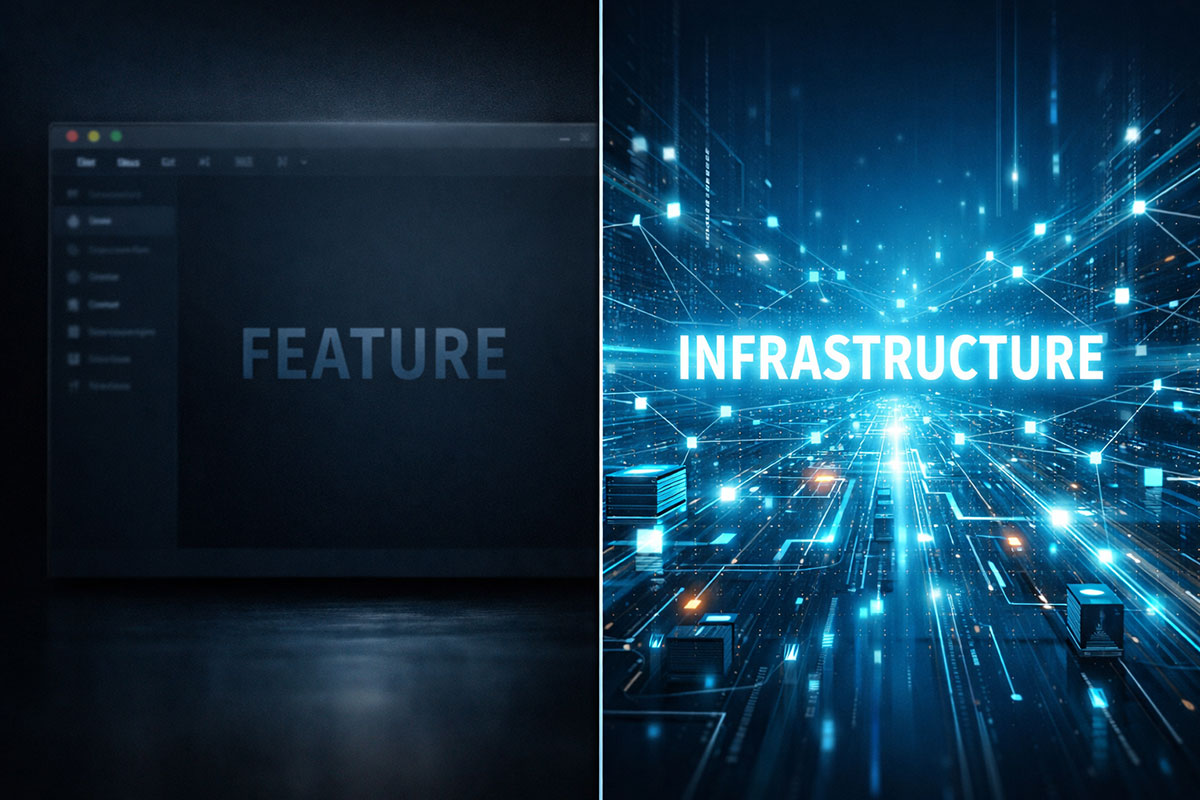
That's what it means for AI to stop being a feature.
About the Author
Girish Soni is the founder of TrendFlash and an independent AI strategist covering artificial intelligence policy, industry shifts, and real-world adoption trends. He writes in-depth analysis on how AI is transforming work, education, and digital society. His focus is on helping readers move beyond hype and understand the practical, long-term implications of AI technologies.