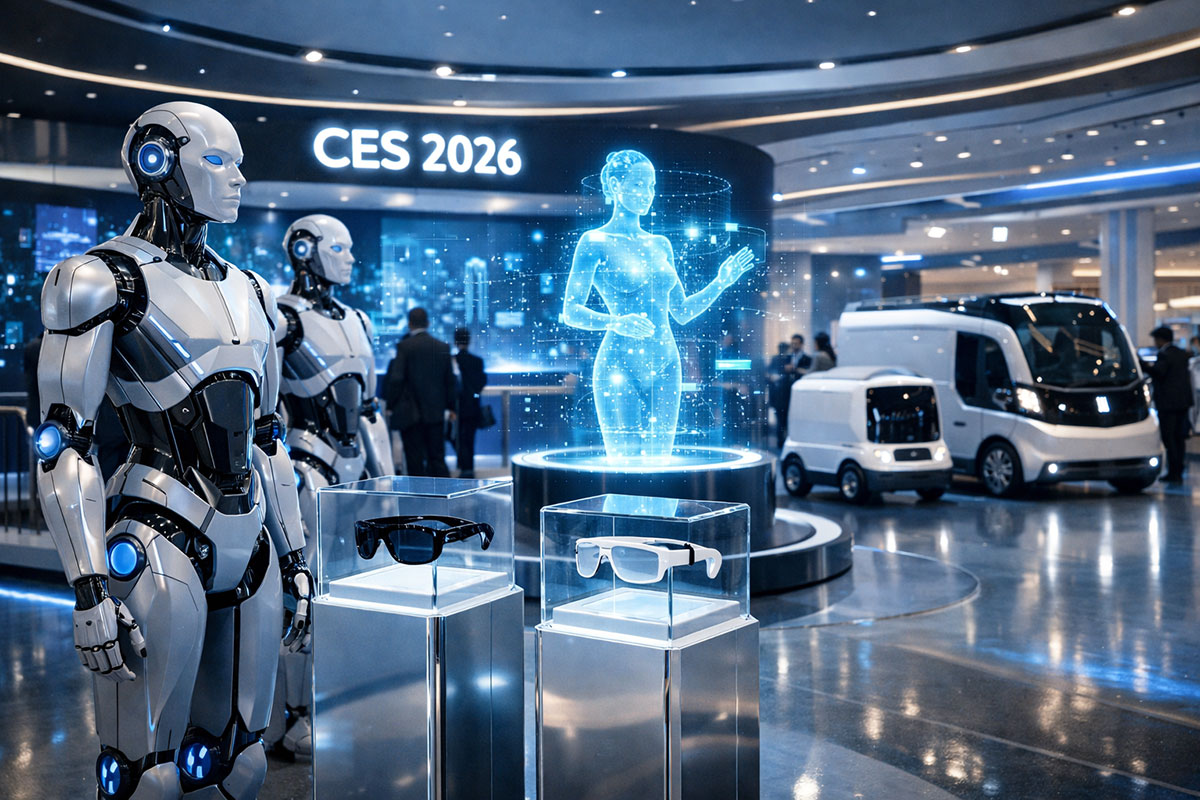
The Moment Everything Changed
On January 6-7, 2026, Nvidia CEO Jensen Huang took the stage at the Consumer Electronics Show and made a statement that will echo through the next decade: "The ChatGPT moment for physical AI is here—when machines begin to understand, reason and act in the real world."
For the past eighteen months, we've been obsessed with AI that lives behind screens. ChatGPT captivated us. Gemini impressed us. Claude surprised us. But all of these breakthroughs shared a fundamental limitation: they existed in the digital realm. They could write, analyze, and reason, but they couldn't move. They couldn't build. They couldn't decide in environments that demanded both perception and action.
That era just ended.
The 2026 CES showcase revealed something unprecedented: an entire ecosystem of autonomous systems—robots, smart glasses, autonomous vehicles, and ambient AI devices—trained in virtual environments and now operating in the physical world. This isn't the "robots will take over" fiction we've seen in movies. This is something more subtle, more powerful, and far more immediate. Physical AI is the convergence of three forces: advanced AI models that can reason about the physical world, sensors and hardware that can perceive it, and economic incentives that make deployment viable.
And the world is watching.
What Physical AI Actually Is (And Why It's Different)
Physical AI isn't a single product. It's a fundamental shift in how machines are trained and deployed.
Traditional AI models—even advanced ones like GPT-5 and Gemini 3—process abstract information. Text, numbers, codes, images. They're brilliant at pattern recognition and reasoning, but they lack something humans take for granted: embodied experience. A human child learns that objects fall because they experience gravity. A robot equipped with old-fashioned programming had to have every rule about gravity explicitly coded.
Physical AI changes this through physics-based simulation. Here's how it works:
Companies like Nvidia create detailed virtual environments governed by real-world physics. In these simulations, AI models train on millions of scenarios—a robot learning to pick up an egg without crushing it, a car navigating rain-slicked streets at night, a humanoid learning to fold laundry in an unstructured home environment. The AI doesn't just learn rules; it learns through repeated interaction in environments that mirror physical reality.
Once trained in simulation, these models transfer to physical robots through a process called sim-to-real transfer. The robot has perception systems (cameras, sensors, LIDAR), reasoning systems (large language and vision-action models), and execution systems (motors, actuators). It perceives its environment, reasons about multiple possible actions, and selects the one most likely to succeed based on its virtual training.
The breakthrough? This actually works. Robots trained almost entirely in simulation now perform complex tasks in the real world with minimal additional training.
Key Insight: Physical AI represents the moment when artificial intelligence became embodied—capable of perceiving, reasoning, and acting in real environments, not just processing abstract data.
The Hardware Revolution: What CES 2026 Actually Unveiled
Walking the CES 2026 exhibition floor felt like stepping into a glimpse of 2030. Here's what companies were demonstrating:
Humanoid Robots for Real Work
Boston Dynamics Atlas appeared for the first time as a production-ready system. The robot demonstrated the full range of motion in its joints and interacted with audience members. But the real announcement was more significant: Boston Dynamics partnered with Google DeepMind to integrate Gemini Robotics AI, allowing Atlas to understand complex instructions and function in unstructured environments—not just follow scripted motions.
LG Electronics CLOiD wasn't a prototype. It was shown completing actual household tasks: folding laundry, loading dishwashers, preparing meals using standard kitchen appliances. The robot's seven-degree-of-freedom arms and five-fingered hands allowed genuine dexterity. Critically, it uses LG's "Affectionate Intelligence" vision-language-action model, which means it understands what objects are, what they're for, and how to interact with them safely.
1X NEO opened preorders with first deliveries in 2026. At just 30 kilograms and 1.67 meters tall, NEO is designed for household assistance, not industrial settings. The pricing is notable: $20,000 or $500 monthly subscription. For the first time, a genuinely capable home robot is approaching consumer price territory.
Tesla's Optimus Gen 2 continued its evolution with improved articulation and sleeker design. Tesla's positioning it for both industrial and domestic tasks, capitalizing on its expertise in AI training from autonomous vehicles.
Smart Glasses: The Interface Without a Screen
Meta, Google, and Samsung made different bets about the near-term future of wearable computing.
Meta Ray-Ban Display (already shipping) announced major functionality expansions. The teleprompter feature displays text on in-lens screens—allowing public speakers to maintain eye contact while reading notes. The neural band, which uses electromyography (EMG) to detect wrist muscle movements, now interprets handwriting on any surface, converting finger movements into text for WhatsApp and Messenger. Meta partnered with Garmin to enable neural band control of in-vehicle infotainment systems. These aren't gimmicks; they're practical interfaces that don't require voice or touch.
Google's Smart Glasses strategy focuses on audio-first devices. Some versions have no display at all—just microphones, speakers, cameras, and deep AI integration. They're designed to listen, see, and assist, positioning themselves as intelligent companions rather than alternative screens.
Samsung's approach mirrors Google: AI-first, voice-activated, without presuming that all input/output needs a visual display. The strategic thinking here is clear—these companies recognize that true ambient AI doesn't need to be worn on your eyes; it needs to be with you, intelligently responsive, and subtle.
Autonomous Systems: The Unsexy Revolution
Nvidia released Alpamayo, an AI model specifically built for autonomous driving. It's trained on the kind of edge cases that had previously stumped self-driving systems: a child chasing a ball into traffic, a delivery truck double-parked, heavy rain obscuring lane markings.
Isaac GR00T N1.6 is the robot reasoning model—specifically designed for humanoid robots. It enables full-body control through vision-language-action reasoning, meaning the robot sees a task, understands it linguistically, reasons about how its body should move, and executes actions.
The infrastructure matters as much as the models. Nvidia's Jetson T4000 module, powered by Blackwell architecture, delivers 4x greater energy efficiency than predecessors while maintaining AI compute capability. For robots that run on batteries or limited power, this is transformational.
What This Means for Retail (And Why E-Commerce Is About to Shift)
If Physical AI's first impact anywhere is in retail, we should pay attention.
One-quarter of shoppers now use AI-powered chatbots when shopping. But that's just the warm-up. The real disruption is "agentic commerce"—AI agents that don't just recommend products; they complete purchases on your behalf. About one-third of U.S. consumers say they'd let an AI make purchasing decisions for them.
Here's the specific mechanism: Imagine asking ChatGPT, "Find me the best noise-canceling earbuds under $150." Today, that's a research tool. In 2026, that conversation will likely complete the transaction. You'll approve the purchase right in the chat interface. The AI becomes the storefront. The website becomes irrelevant.
Shopify has integrated its entire catalog into AI agent workflows. This means ChatGPT users could eventually buy directly through the app without ever visiting a Shopify store. That's channel disintermediation in real time.
For physical retail, Physical AI enables different disruption. Smart shelf systems use AI-powered cameras to detect empty shelves in real time. McKinsey data shows this reduces out-of-stock incidents by up to 30% and cuts manual inventory checks by 40%. But the deeper impact is in "phygital" retail—stores where digital and physical merge seamlessly. A customer walks in; facial recognition (or QR code) identifies them as a loyalty member; digital displays on shelves adjust to show personalized offers; mobile-enabled staff assist with instant, data-informed recommendations.
Hyper-personalization in retail has consistently delivered 40% revenue increases. In 2026, we're moving from personalization to hyper-automation of personalization.
The winners? Retailers who treat robots and AI as ways to enhance customer experience, not just cut costs. The losers? Traditional e-commerce sites that haven't integrated into AI agent platforms. The future of shopping isn't a battle between online and offline—it's between being integrated into the AI ecosystem and being invisible to it.
The Privacy Collision: Ring's "Familiar Faces" and Why It Matters
Not everything at CES 2026 was celebratory. Amazon's Ring division unveiled "Familiar Faces," a facial recognition feature for its doorbells and security cameras. The feature identifies known individuals (friends, family, delivery personnel) and sends customized notifications.
Here's where it gets problematic: The feature scans the faces of everyone who approaches the camera—including people who haven't consented to having their biometric data collected.
The Electronic Frontier Foundation pointed out that the technology violates state biometric privacy laws. Multiple states (Illinois, Texas, Oregon, Portland) require explicit opt-in consent before companies collect facial recognition data. Amazon quietly confirmed the feature won't be available in these jurisdictions, essentially acknowledging it couldn't survive legal scrutiny there.
Privacy advocates raise a legitimate concern: delivery workers, neighbors, children, canvassers—none of them have agreed to be scanned and profiled. They're simply in proximity to someone's Ring camera.
This highlights a deeper tension in Physical AI's rise. As systems become more capable at perceiving the physical world, surveillance becomes more sophisticated and more widespread. A Ring camera that recognizes faces is more useful. It's also more invasive. A robot in a warehouse that learns individual worker patterns is more efficient. It's also monitoring everything.
The regulatory response is still forming. But one thing is clear: Physical AI will force us to make hard choices about privacy, consent, and the trade-offs between convenience and autonomy.
Warning Sign: Physical AI's perceptual capabilities will enable more sophisticated surveillance. Policy must catch up faster than product development.
Who Wins, Who Loses: The Employment Equation
Let's be direct: Physical AI will displace jobs. The question isn't if—it's which jobs, how many, and how quickly.
Manufacturing faces the highest risk. Traditionally, robots have been tools for specific, repetitive tasks. A welding robot does welding. A pick-and-place machine does picking and placing. Physical AI robots can be reprogrammed for different tasks on the fly. Arm CEO René Haas estimates that large sections of factory work will be automated within five to ten years.
The data is sobering:
- Between 400-800 million jobs could be displaced globally by 2030
- Manufacturing faces up to 59% of its work becoming automatable
- Transportation (truck drivers, taxi drivers) faces significant medium-term displacement
- Retail cashiers and sales associates are declining sharply
- But e-commerce growth is simultaneously creating warehouse and delivery jobs
However, the story isn't purely negative. McKinsey and other research institutions project that while 85 million jobs will be displaced by 2030, 97 million new jobs will simultaneously emerge. That's a net gain of 12 million positions globally—though the geographic and demographic distribution is uneven.
The critical insight: Displacement is happening simultaneously with creation. What matters is whether workers can transition. Amazon's Physical AI pilots in warehouses showed something encouraging: they created 30% more skilled jobs than they eliminated. The jobs that emerged required people to work alongside robots, maintain systems, and solve problems. These paid more than the jobs they replaced.
The challenge? Transition speed. If retraining takes three years and displacement happens in one, workers suffer. Policy makers are beginning to grapple with this: upskilling programs, transition assistance, rethinking of benefits tied to traditional employment.
| Industry | Displacement Risk | Timeline | New Opportunities |
|---|---|---|---|
| Manufacturing | Very High (59%) | 5-10 years | Robot training, maintenance, system design |
| Retail | High | Immediate | Inventory analytics, customer experience design |
| Transportation | High (Medium-term) | 5-15 years | Fleet management, autonomous system oversight |
| Warehousing | Medium | 2-5 years | Automation operation, logistics optimization |
| Healthcare | Low | 5+ years | AI-assisted diagnostics, patient care focus |
| Education | Low | 5+ years | AI-enhanced teaching, curriculum design |
The Investment Gold Rush: $16 Billion in Nine Months
Venture capital is voting decisively on Physical AI.
In just the first nine months of 2025, Physical AI startups raised $16.1 billion. To put this in perspective, that's roughly the entire annual VC allocation to most industries. Major deals include:
- Figure AI raised $1 billion, valuation $39 billion, focused on humanoid robotics for real-world work
- Physical Intelligence raised $600 million, valuation $5.6 billion, building general-purpose AI robots
- Meta's investment in Scale AI, a platform for training data in real-world autonomous systems
- Robot-related startups broadly: $6.4 billion in 2024 → $10.3 billion in 2025, representing 60.9% year-over-year growth
The broader context is staggering: 93% of Silicon Valley venture capital ($103.5 billion of $111 billion raised in 2025) is flowing into AI. This concentration is unprecedented even by Valley standards.
Whether this represents rational investment or speculative bubble remains unclear. What's undeniable is that if even 10% of these bets succeed, Physical AI will be the defining technology of the 2030s.
Ambient AI: The Invisible Interface
One of Physical AI's most significant but least-discussed aspects is what's being called ambient AI—intelligence embedded in spaces rather than devices.
Imagine walking into your home. Smart systems recognize your presence. The lighting adjusts to your preference (learned from patterns). Your thermostat anticipates your temperature needs. Your smart speaker is listening, but only activated by natural speech patterns specific to your household. The fridge has inventoried itself and is suggesting recipes based on what you have and what you've been eating.
This isn't science fiction. LG, Samsung, Amazon, and Google are all deploying versions of this at CES 2026.
The advantage to ambient AI? It removes friction. You don't need to speak to your phone or tap a screen. Intelligence is present, anticipating needs.
The disadvantage? Your home becomes an increasingly sophisticated data collection apparatus. Every movement, every preference, every pattern is available for analysis.
Why Now? The Convergence of Four Forces
Physical AI didn't emerge overnight. Four technological convergences made 2026 inevitable:
1. Foundation Models That Actually Understand Physical Reasoning
GPT-4 was good at abstract reasoning. GPT-5 and Gemini 3 are good at complex reasoning. But the latest generation of models—particularly vision-language-action models specifically trained for robotics—actually understand physics. They've seen millions of simulated examples of how objects behave, how forces interact, how humans manipulate their environment. This is qualitatively different from earlier AI.
2. Simulation Technology That's Accurate Enough
Nvidia's Omniverse platform, along with competitors, now allows physics-based simulation at scale. A robot can train on a million scenarios in hours. The sim-to-real gap—the difference between virtual training and real-world performance—has narrowed dramatically. It's not zero, but it's small enough that real-world fine-tuning can happen quickly.
3. Hardware Costs That Have Plummeted
Sensors (cameras, LIDAR), processors (edge AI chips), actuators (motors), and batteries have all become dramatically cheaper. A robot that would have cost $500,000 in 2020 now costs $50,000. At some price point, robotics become economically viable for tasks that previously required human labor.
4. Economic Pressure (Labor Shortages, Wage Inflation)
This is the forcing function. In manufacturing, wages are rising. In retail, labor is scarce. In warehousing, turnover is brutal. When the economic pressure is high enough, companies adopt technology. Right now, that pressure is acute.
The 2026-2028 Timeline: What Comes Next
Physical AI in 2026 is still early. Here's what we should expect in the next twenty-four to thirty-six months:
2026 (Now)
- Home robots become more available; prices drop but remain premium
- Smart glasses evolve from experiments to daily-wear devices for early adopters
- Manufacturing plants begin testing humanoid robots alongside traditional workers
- Agentic commerce goes mainstream; ChatGPT becomes a shopping interface
- Privacy regulations tighten in response to facial recognition expansion
2027
- First truly affordable home robot appears (sub-$10,000)
- Meta, Google, others launch full AR glasses (not just display glasses)
- Autonomous vehicle deployment accelerates significantly
- Robot-as-a-Service becomes standard offering for warehouses
- Job displacement accelerates; retraining programs scale or fail
2028
- Physical AI becomes boring. It's integrated into logistics, manufacturing, retail, and home life
- Regulatory frameworks crystallize around AI in physical spaces
- Second-order effects: supply chains reorganize, real estate changes (robot-friendly warehouses), energy grids strain under AI compute demands
What to Watch: Three Signals That Physical AI Is Real
Skepticism is healthy. Here are three signals to watch that will tell you whether Physical AI is genuinely transformational or just the latest tech hype:
1. Economic Substitution at Scale
Are companies actually replacing human labor with robots, or are robots just doing additional work? Look for case studies where a function that previously required ten people now requires two people plus one robot operator. That's real.
2. Cross-Domain Transfer
Can a robot trained for one task perform a different task with minimal additional training? This is the test of genuine reasoning. If robots can only do what they were specifically trained for, it's not intelligence—it's programmability.
3. Cost Curve Crossing
At what point does a robot become cheaper than hiring a human for that task? For warehouse work, we're probably 18-24 months away. For home care, we're 3-5 years away. Watch these crossings. When costs favor robots, adoption accelerates exponentially.
The Deeper Shift: From Tools to Teammates
Here's what's easy to miss in the excitement about robots and smart glasses: Physical AI represents a shift in how we think about artificial systems.
For decades, technology has been framed as tools—extensions of human capability that humans consciously control. A spreadsheet is a tool. A CAD program is a tool. Even ChatGPT, in most uses, is a tool—humans ask questions, AI provides answers, humans decide.
Physical AI systems are different. They're more like teammates. You set an objective. The robot reasons about how to achieve it. It acts. It may ask for clarification or help when genuinely confused, but it operates with genuine autonomy within defined domains.
This is psychologically different. We trust tools less when they make independent decisions. We grant teammates more autonomy because we believe they understand context and can adapt.
The challenge—and the enormous opportunity—is building physical AI systems that warrant that trust.
Related Reading
Explore more CES 2026 coverage and AI trends:
- Beyond Chatbots: How Agentic AI Is Becoming Your Virtual Coworker
- The Future of Work in 2025: How AI is Redefining Careers and Skills
- Computer Vision and Robotics: How Machines Are Learning to See and Act
- AI in Manufacturing: How Robots Are Transforming Industrial Work
- AI Ethics and Privacy: The Big Questions Physical AI Forces Us to Ask
Final Thought
Nvidia's Jensen Huang was right. The ChatGPT moment for physical AI is here. But what that moment actually means—what it creates, what it displaces, what it empowers, and what it threatens—will be determined not by technologists alone, but by the choices we make in the next eighteen months.
The robots are no longer theoretical. They're in the room. The question isn't whether they'll change everything. The question is how we'll manage that change.
Welcome to 2026. The physical world just got an AI upgrade.
About the Author
Girish Soni is the founder of TrendFlash and an independent AI strategist covering artificial intelligence policy, industry shifts, and real-world adoption trends. He writes in-depth analysis on how AI is transforming work, education, and digital society. His focus is on helping readers move beyond hype and understand the practical, long-term implications of AI technologies.