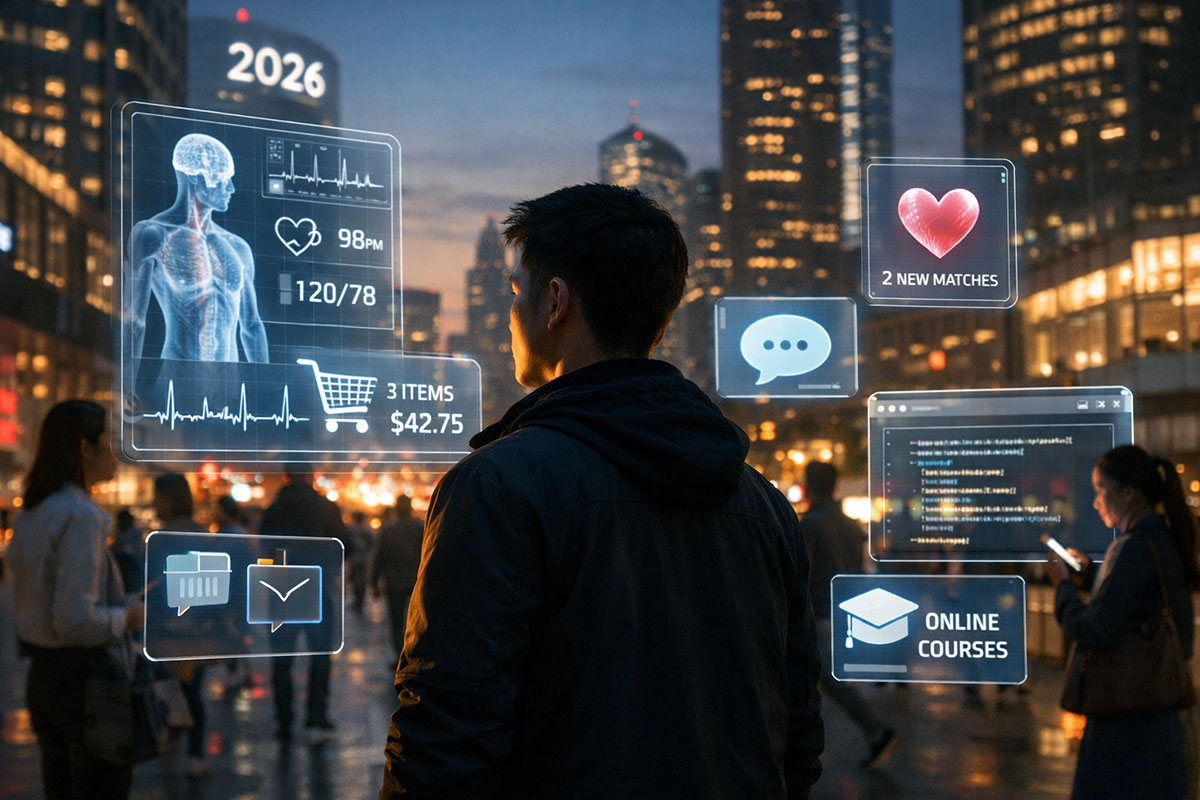
Introduction: 2026 Is The Year AI Stops Being “Interesting” And Starts Being Inevitable
Every year comes with big headlines about artificial intelligence. But 2026 is different. MIT experts are now pointing to a cluster of converging AI shifts that will not just tweak a few workflows – they will redefine how you work, shop, date, and stay healthy over the next 24–36 months.
Recent MIT-linked analysis highlights five major enterprise trends for 2026 – including AI “factories,” agentic AI, and the deflation of the AI bubble – that quietly support a much bigger story: AI is moving from experiments to infrastructure. At the same time, research labs and hospitals are publishing breakthrough results in AI-driven diagnostics, cancer detection, and drug discovery that will move from journals into mainstream care faster than most people expect.
This article breaks down 8 specific AI shifts that will define 2026:
| # | Shift | Where You’ll Feel It First | Timeline (Now–2028) |
|---|---|---|---|
| 1 | AI-first medical diagnosis | Hospitals, imaging centers, telehealth | Invisible in 2025, default triage by 2028 |
| 2 | AI-accelerated drug discovery | Pharma, biotech, clinical trials | Experimental in 2025, standard in new pipelines by 2028 |
| 3 | Voice as your default interface | Work apps, customer support, homes, cars | “Nice-to-have” in 2025, primary UX in many flows by 2027 |
| 4 | AI-optimized dating & relationships | Dating apps, social platforms, coaching | Niche in 2025, mainstream features by 2026–2027 |
| 5 | Shopping agents & agentic commerce | E‑commerce, marketplaces, retail media | Black Friday experiments in 2025, everyday usage by 2026–2028 |
| 6 | Work automation via agentic AI coworkers | Knowledge work, operations, finance, HR | Pilots in 2025, “AI coworker” standard in many teams by 2028 |
| 7 | Generative content as default | Marketing, education, entertainment | Ad hoc in 2025, baked into every tool by 2027 |
| 8 | AI-driven cancer detection | Screening programs, oncology, wearables | Early deployments in 2026, widespread by 2028 |
Underneath these shifts is a harder truth from MIT’s policy and workforce research: AI will transform a wider range of jobs and tasks than previous automation waves, pushing workers to either harness it or be displaced by it.
Key idea: By 2028, the big career divide will not be “AI vs no AI,” but who learned to work with agents, tools, and AI-first workflows – and who tried to opt out.
This guide is built for professionals, students, and business leaders who want to be on the right side of that divide. It connects what MIT and other researchers are seeing with practical “what to do now” moves – including interlinked deep dives you can explore across Trendflash.
Shift 1: AI-First Medical Diagnosis – From Second Opinion To First Line Of Defense
AI in medical diagnostics is no longer a sci‑fi pitch deck. Peer‑reviewed studies now show AI systems matching – and in some cases surpassing – clinician-level accuracy across multiple disease areas, from cancer and Alzheimer’s to diabetes. These models combine imaging, lab data, and patient history into risk scores and recommendations that would be impossible to compute manually.
Recent reviews forecast the AI diagnostics market reaching tens of billions of dollars by 2030, driven by deep learning systems for radiology, pathology, and multimodal analysis. Hospitals are already piloting AI to flag subtle patterns in scans that humans miss, cut reading time, and prioritize urgent cases.
Where you’ll see it first in 2026
- Radiology suites that auto-highlight suspicious regions on CT, MRI, and mammograms before a human even looks at the image.
- Emergency departments using AI triage tools to predict deterioration risk and route patients faster.
- Telehealth platforms that feed your symptoms, history, and sensor data into AI triage scores before you speak to a doctor.
If you want a broader context on how AI diagnostics fit into the bigger healthcare picture, it’s worth reading Trendflash’s breakdown of how smart diagnostics are transforming patient care.
Industries most disrupted
- Radiology, pathology, and lab diagnostics
- Telehealth and virtual care platforms
- Health insurance (claims, prior authorizations, fraud detection)
How to adapt your skills (2026–2028)
- Clinicians: move from “diagnostician” to “AI‑augmented decision maker.” Learn how these models are trained, where they fail, and how to challenge them.
- Data professionals: specialize in healthcare data standards, imaging formats, and regulatory constraints (HIPAA, EU AI Act, etc.).
- Product builders: explore the intersection of AI, UX, and trust – explainability, alerts, and hand‑offs matter more than clever models.
Shift 2: AI-Accelerated Drug Discovery – From Decade-Long Bets To Multi-Quarter Sprints
Drug discovery used to be a decade-long, billion-dollar gamble. AI is compressing that timeline by using deep learning to explore chemical space, predict molecule behavior, and simulate clinical outcomes much faster.
Reviews of AI in oncology and broader therapeutics show models optimizing nanocarrier design, predicting treatment response, and designing molecules that would have taken traditional methods years to discover. Other work integrates genomic, proteomic, and imaging data into unified models that suggest which patients respond best to which therapies.
For a more accessible overview of how this is playing out commercially, Trendflash has a practical explainer on AI-powered drug discovery in 2025.
Why this matters in 2026 (not 2035)
- Pharma companies are building internal “AI factories” – shared infrastructure, datasets, and models to support dozens of AI use cases at once.
- Regulators are publishing early guidance on AI‑assisted trials, clearing the path for broader adoption.
- Investors are pouring funding into AI‑native biotech startups that treat algorithms as core IP, not side projects.
Risk and opportunity
Risks: model bias across populations, over-reliance on simulations, and opaque decision making when patient lives are at stake.
Opportunities: faster go/no‑go decisions on candidate drugs, more personalized trial design, and entirely new classes of medicines discovered by generative models.
Skills to build before 2028
- For scientists: basic literacy in machine learning, model evaluation, and data engineering.
- For ML engineers: domain knowledge in biology, chemistry, or pharmacology – even at an introductory level – is a huge edge.
- For regulators and policy roles: understanding how to audit AI systems and validate evidence will be a premium skill set.
Shift 3: Voice Becomes Your Default Interface
MIT and industry observers are converging on one clear user-experience shift: voice is moving from novelty to default interface in many contexts. As multimodal models – that understand text, voice, and images together – improve, talking to your tools will feel as natural as typing, but faster.
By 2026, you can expect:
- Work apps that let you say, “Summarize yesterday’s customer calls and draft a follow‑up plan,” and get structured outputs back.
- Customer support flows redesigned around voice bots that can reason over your account history, not just read scripts.
- Home devices that coordinate across your calendar, health data, and shopping habits with continuous, context‑aware conversations.
If you want a hands-on primer, Trendflash’s guide on ChatGPT voice & vision shows exactly how these systems are already being used in 2025.
Industries and roles that change first
- Customer service and call centers
- Sales, support, and field operations
- Productivity and collaboration tool vendors
How to adapt
- Design for conversation: UX roles need to understand conversational design, turn‑taking, and failure states in voice interfaces.
- Develop “prompt-to-API” mental models: Developers should think in terms of mapping natural-language requests to safe, auditable actions.
- Get comfortable speaking to tools: As simple as it sounds, the professionals who naturally “talk to AI” will move faster than those who stay purely keyboard‑driven.
For a deeper NLP perspective, the explainer on how AI voice assistants are evolving connects voice trends with advances in natural language processing.
Shift 4: AI-Optimized Dating And Relationships
AI has already infiltrated your dating life – from profile photo filters to recommendation algorithms. But 2026 is likely to bring a step-change: AI shifting from passive matching to active relationship optimization.
Forward-looking analyses point to three layers where this will show up:
- Better discovery: models that learn your deeper preferences over time, not just your swipes.
- Real-time coaching: AI systems that help you interpret messages, suggest responses, or flag misaligned expectations.
- Wellness integration: tie‑ins with mental-health and wellness apps to detect unhealthy patterns earlier.
MIT and other research communities have already documented how people use AI for emotional support and relationship advice today – a trend that will only accelerate as tools become more personalized.
Risks that need honest attention
- Emotional dependence: people outsourcing difficult conversations or decisions to algorithms.
- Bias amplification: models reinforcing social and cultural biases present in training data.
- Privacy drift: extremely sensitive data being processed by models without users fully grasping the implications.
As AI mental-wellness tools grow, posts like AI mental health apps in 2025: revolution or risk? are critical reading before embracing these systems in intimate parts of life.
How to be ready by 2028
- Learn to treat AI as a mirror and a guide, not a replacement for human judgment.
- If you build products, bake in consent, transparency, and off‑ramps to humans from day one.
- For therapists and coaches, understand how clients already use AI so you can address it directly in your practice.
Shift 5: Shopping Agents And Agentic Commerce Take Over The Checkout
Black Friday 2025 quietly revealed the next era of retail: shopping agents that autonomously compare products, prices, policies, and even ethics on your behalf. Retail data shows AI-driven shopping experiences moving real revenue, not just clicks – a shift Trendflash has already documented in detail in its breakdown of how AI shopping agents won Black Friday 2025.
By 2026, expect:
- “Buy with my agent” buttons next to traditional checkout.
- Agents that know your size, style, shipping preferences, and budget – and negotiate bundles or discounts.
- B2B purchasing bots optimizing inventory and supplier choices with minimal human oversight.
Deeper dives like How agentic commerce is reshaping shopping and ChatGPT shopping and what retailers fear show how quickly this will become the default layer between buyers and brands.
Who gets disrupted hardest?
- Middle-layer aggregators whose value is comparison – agents will do that better and faster.
- Retailers with weak data infrastructure who can’t feed agents with clean, structured product and inventory data.
- Traditional ad funnels as agents filter out emotional hooks and push for rational value.
How to adapt (Q1 2026–2028)
- Retailers: invest in clean product data, open APIs, and agent‑friendly experiences now.
- Marketers: design for “agent‑aware” messaging – clear specs, guarantees, and value that an algorithm can parse.
- Consumers & prosumers: learn how to configure your own shopping agents, not just accept defaults.
Shift 6: Work Automation Via Agentic AI – Your New Virtual Coworker Becomes Standard
MIT’s AI and data science trends point to a world where AI is less a personal toy and more an organizational resource – embedded in what some call “AI factories.” Layered on top of that infrastructure are agentic AI systems that can plan, act, and coordinate across multiple tools.
On Trendflash, this story has already been told from multiple angles, including how autonomous systems are reshaping work, the rise of AI as your virtual coworker, and the AI agent playbook.
What changes between 2025 and 2026
- Agents move from isolated side tools to core workflow owners – handling onboarding flows, reporting, renewals, and more.
- Companies standardize on agent platforms that manage access, security, observability, and compliance across many agents.
- Metrics evolve from “time saved” anecdotes to hard productivity and revenue impact, driving CFO‑level buy‑in.
Jobs most exposed
- Repetitive knowledge work: reporting, status updates, basic analysis.
- Back-office operations: invoice matching, claims processing, HR data maintenance.
- Entry-level roles built around information routing instead of judgment.
Trendflash’s Agentic AI job survival guide goes into granular detail on which tasks to automate vs. double down on.
Your adaptation playbook
- Shift from “doing the task” to “designing the workflow.” The people who stay valuable are those who define, orchestrate, and improve AI‑driven workflows.
- Invest in AI-literate skills: prompt design, evaluation, guardrails, basic scripting, and data literacy.
- Use AI to build your moat: posts like AI career moat: 9 skills that make you impossible to replace are effectively survival handbooks for 2026–2028.
Shift 7: Generative Content Becomes The Default Layer Of The Internet
By now, everyone has seen AI write emails or generate images. But MIT’s broader ecosystem and industry reports suggest that 2026 is when generative content becomes the default layer beneath most digital experiences – not just a separate “AI tool.”
That includes:
- Marketing: dynamic copy and creative tailored per user, per channel, per moment.
- Education: personalized lessons, examples, and quizzes tuned to each student’s pace and style.
- Media & entertainment: on‑the‑fly variations of stories, visuals, and interactive experiences.
Trendflash has already covered this shift in pieces like Generative AI in creative industries and What’s new in generative media models.
Why this matters for you
- Content volume explodes. The bottleneck shifts from “producing something” to “deciding what’s worth producing at all.”
- Human taste becomes a superpower. Curating, editing, and setting standards will matter more than typing the first draft.
- Trust and authenticity become core UX problems. Users will increasingly ask, “Who actually said this?”
How to adapt
- Creators & marketers: learn to design systems – content engines, testing frameworks, and governance – not just single assets. The guide on automating your content workflow with free AI tools is a practical starting point.
- Students & educators: integrate AI into learning workflows ethically, as shown in the 2025 AI learning stack.
- Platform builders: make authenticity, provenance, and watermarking part of your baseline feature set.
Shift 8: AI-Driven Cancer Detection Reaches A Turning Point
Perhaps the most emotionally powerful shift is in cancer detection. Multiple studies now show AI surpassing traditional methods in sensitivity and specificity across several cancer types. These systems analyze imaging, pathology slides, and even blood biomarkers to flag cancers earlier and with more consistency.
MIT researchers recently unveiled AI-generated biosensors that design peptides targeted by enzymes overactive in cancer cells, opening new paths for early detection. Other work demonstrates AI models that handle dozens of cancer types simultaneously, moving diagnostics from one‑off tests to integrated risk profiles.
As one analyst put it, 2026 is likely to bring a high‑profile AI‑driven medical breakthrough that “changes minds” about the value of AI in healthcare – shifting public sentiment from suspicion to “why did this take so long?”
Near-term real-world impact (2026–2028)
- Screening programs that use AI to double‑check human readings, catching missed cases and reducing false positives.
- Liquid biopsies and blood tests interpreted by models trained on massive cancer registries.
- Personalized monitoring for high‑risk patients via smart diagnostics and wearables – connected to broader AI health monitors.
Ethical and practical questions
- How do we ensure equal access to AI‑powered screening across income levels and countries?
- Who is accountable when an AI misses a diagnosis – or makes a controversial call?
- How do insurers, employers, and regulators handle the influx of risk data?
These questions tie directly into broader governance debates already covered in pieces like AI global governance challenges and The AI safety report card.
Why Now? The Convergence Behind All 8 Shifts
These eight shifts are not separate stories. They sit on three converging foundations that MIT and other researchers have been tracking:
- Better models: Multimodal, agentic, and domain‑specific models moving beyond raw pattern matching toward more robust reasoning.
- Cheaper, more efficient infrastructure: AI “factories,” optimized data centers, and application-specific hardware cutting the effective cost of intelligence.
- Organizational readiness: executives who tried GenAI pilots in 2023–2024 are now ready to re‑architect whole workflows around AI.
The result: 2026–2028 will not feel like a single “AGI moment,” but like a thousand small switches flipping from “optional experiment” to “default expectation.”
MIT-affiliated forecasts on “powerful AI” suggest at least a 50% chance of systems reaching near-AGI milestones by 2028, with capabilities like Nobel-level reasoning in narrow domains and seamless movement between text, audio, and the physical world. Whether that exact timeline holds or not, the safe assumption for your career is that the curve is bending faster than traditional reskilling cycles.
How To Personally Adapt: A Practical Roadmap To 2028
Watching these trends from the sidelines is risky. The good news: the same tools driving disruption can massively accelerate your own learning and leverage.
Step 1: Pick Your Primary AI Arena
Use 2026 to choose where you want to go deep:
- Health & bio: diagnostics, drug discovery, health monitoring.
- Commerce & product: shopping agents, recommendation systems, pricing and inventory optimization.
- Work automation: agentic AI in operations, finance, HR, and customer support.
- Media & education: generative content, personalized learning, knowledge management.
Trendflash’s AI skills roadmap to 2030 is a strong macro guide if you’re still deciding.
Step 2: Automate 15–20% Of Your Current Work
Don’t wait for your employer to hand you tools. Start small:
- Identify repeatable tasks in your day: reporting, note‑taking, basic analysis.
- Use step‑by‑step tutorials like how to build an AI agent that works for you 24/7 or the 0$ AI stack guide.
- Document what you automate so you can show impact in reviews or job searches.
Step 3: Build Your “AI Literacy Stack”
By 2028, basic AI literacy will be as non‑negotiable as email and spreadsheets. Focus on:
- Concepts: prompts, tokens, embeddings, fine‑tuning, evaluation.
- Tools: at least one major foundation model, one agent platform, and one analytics stack.
- Ethics & governance: bias, privacy, safety, and regulation – covered in depth in Trendflash’s ethics & governance category.
Step 4: Position Yourself In The “AI Value Chain”
Across all eight shifts, high‑value roles generally fall into four buckets:
| Role Type | What You Do | Example Moves (2026–2028) |
|---|---|---|
| Inventors | Design new models, algorithms, architectures | Research roles, AI labs, deep tech startups |
| Integrators | Embed AI into workflows, products, and infra | Product managers, solution architects, “AI factory” builders |
| Interpreters | Explain and govern AI outcomes | Policy, compliance, AI risk, AI‑literate clinicians and lawyers |
| Influencers | Shape norms, education, and adoption | Educators, creators, community leaders, internal evangelists |
Content like top agentic AI careers in 2025 and the future of work shows how these buckets translate into real job titles and salaries.
Final Thought: Treat 2026–2028 As Your Personal “AI Inflection Window”
MIT’s reports and affiliated research don’t just describe technology; they describe shifts in power – between companies, between countries, and between workers who adapt and those who don’t. The eight AI shifts outlined here are not abstract trends. They’re visible in hospital pilots, e‑commerce dashboards, call center metrics, and internal IT roadmaps already.
If you’re reading this, you’re early enough. Use 2026 to:
- Pick where you want to play in the AI wave.
- Automate a meaningful slice of your own work.
- Invest in skills that make you the person who designs, supervises, and explains AI – not the person whose work it quietly replaces.
Explore more deep dives in the AI News & Trends category, learn how others are using agents in this ultimate guide to automating work and life, and, if you’re curious who’s behind all of this analysis, visit the About page.
The next three years won’t be about whether AI is “good” or “bad.” They’ll be about who learns to wield it with judgment, courage, and a clear sense of what kind of future they want to help build.
About the Author
Girish Soni is the founder of TrendFlash and an independent AI strategist covering artificial intelligence policy, industry shifts, and real-world adoption trends. He writes in-depth analysis on how AI is transforming work, education, and digital society. His focus is on helping readers move beyond hype and understand the practical, long-term implications of AI technologies.