The 11x Breakthrough: When AI Shopping Becomes the Default
In November 2025, Shopify announced numbers that should fundamentally reshape how retailers think about their digital presence. Since January 2025, traffic from AI tools to Shopify-powered stores has increased sevenfold. More dramatically, purchases attributed to AI-powered search have increased elevenfold—an 1100% increase in just ten months.
These are not marginal improvements in conversion rates or minor optimization gains. This represents a tectonic shift in consumer behavior and the emergence of an entirely new commerce paradigm that retailers were largely unprepared for.
Shopify President Harley Finkelstein didn't mince words during the earnings call: "If you take away one thing from this call, let it be this: AI is not just a feature at Shopify. It is central to the engine that powers everything we build." More dramatically, he positioned AI as "the biggest shift in technology since the internet" itself—a comparison that cuts through corporate hyperbole because Shopify has the data to justify it.
For decades, the e-commerce industry operated within a relatively fixed architecture: consumers visit websites, use search or browse categories, find products, and check out. This architecture was optimized for desktop browsing and mobile apps. In 2025, this architecture is being displaced by something fundamentally different: agentic commerce, where AI shopping agents discover products, negotiate with sellers, and complete transactions entirely within conversational interfaces.
Understanding Agentic Commerce: The Future of Shopping
To understand why the 11x increase in AI-driven orders matters so profoundly, we must first understand what agentic commerce actually is and how it differs from traditional e-commerce.
From Websites to Conversations: A Fundamental Shift
Traditional e-commerce operates through explicit user action: the consumer navigates to a website, uses search functionality or category browsing, examines product listings, reads reviews, and makes a decision. Each action requires deliberate effort and attention.
Agentic commerce inverts this model. Instead of consumers navigating toward products, AI agents navigate on behalf of consumers. These agents—powered by large language models like ChatGPT, Perplexity, or Google Gemini—can understand user intent expressed in natural language conversation, autonomously search across multiple retailers, compare options, and even complete purchases without human intervention.
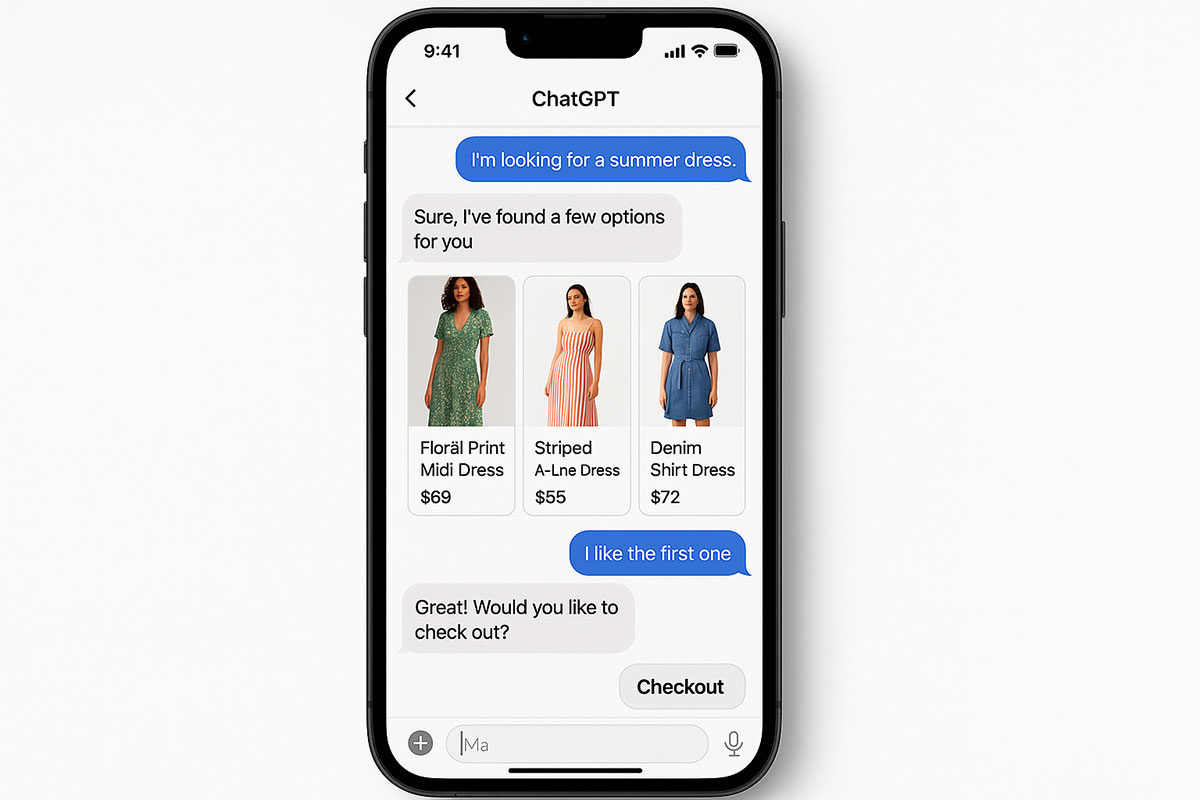
Consider a practical example: Instead of a consumer visiting multiple clothing retailers' websites, searching through hundreds of options, and manually comparing prices, they might simply tell ChatGPT, "I need running shoes for a marathon next month. I prefer cushioned soles, I'm a size 10, and I want to spend less than $150 if possible." The AI agent—without further user involvement—could search across dozens of retailers, compare options, check inventory and pricing in real-time, and present the consumer with ranked recommendations. Most remarkably, the consumer could authorize the purchase completion directly within the conversation.
This shift from destination-driven shopping (going to websites) to agent-driven shopping (conversing with AI) represents not a modification of e-commerce but a fundamental restructuring of its core architecture.
The Technology Stack: How Agentic Commerce Works
The machinery enabling agentic commerce involves several distinct technical components working in coordination:
Large Language Models (LLMs): Foundation models like GPT-4o, Claude, and Gemini provide the conversational interface and reasoning capability that enables agents to understand user intent, formulate shopping strategies, and communicate decisions.
API Integration & Knowledge Retrieval: Agents don't operate in isolation. They access real-time inventory, pricing, and product information through APIs connected to retailer databases. This real-time data access enables agents to make decisions based on current availability and pricing rather than stale information.
Retrieval-Augmented Generation (RAG): When users ask questions that require knowledge beyond what's in the base model's training data—"Are running shoes from Brand X good for marathon training?"—RAG systems retrieve relevant product reviews, specifications, and retailer descriptions, enabling agents to provide informed recommendations grounded in current, specific information.
Multi-Agent Orchestration: Complex shopping tasks require coordination between multiple specialized agents. One agent might handle product discovery, another might manage price comparison, another might handle payment processing. These agents communicate and coordinate to accomplish the user's goal.
Secure Payment & Authentication: Critical to transactional commerce is secure handling of payment information. Integration with systems like Shop Pay, PayPal, and major credit card processors enables agents to complete transactions securely without exposing user payment data.
The Commerce Everywhere Vision
Critically, agentic commerce is not limited to any single platform or interface. The vision underlying Shopify's partnerships with OpenAI, Perplexity, and Microsoft Copilot is "commerce everywhere"—enabling shopping within any conversational context a user frequents.
A consumer might discover products while chatting with ChatGPT about workout plans. They might find apparel recommendations while discussing fashion trends with Perplexity. They might discover home goods while planning renovations with Microsoft Copilot. Rather than requiring users to navigate to retail destinations, shopping capabilities are embedded within the conversational experiences users already inhabit.
This represents a profound competitive advantage for retailers integrated early into this ecosystem. Merchants on Shopify connected to these AI platforms gain access to users in moments of genuine purchase intent—when they're already actively thinking about a problem the merchant could solve.
The Data Behind 11x: What's Actually Driving This Explosion
Understanding the mechanism behind Shopify's dramatic 11x increase in AI-driven orders requires examining both the traffic and conversion data separately, as they reveal distinct dynamics.
The 7x Traffic Increase
Shopify reported that traffic from AI tools to Shopify-powered stores has increased sevenfold since January 2025. This dramatic traffic increase primarily reflects the rapid adoption of AI-integrated shopping tools and the growing traffic volumes through platforms like ChatGPT, Perplexity, and Microsoft Copilot.
To contextualize this: global digital ad spending by brands trying to capture attention continues rising, but the consumer attention supply is relatively fixed. Conversely, AI tools are providing a new channel for discovering merchants and products—one that was essentially unused in 2024 and is experiencing explosive adoption in 2025.
The 7x traffic increase reflects this channel emergence. More significantly, this traffic is coming from users in a fundamentally different mindset than traditional web search. Web searches are often exploratory—"show me running shoes"—or comparison-focused. AI agent-mediated shopping, by contrast, is often intention-driven: users are asking agents to solve a problem ("I need shoes for marathon training") rather than asking for options to consider.
The 11x Order Increase: Conversion Explosivity
The 11x increase in orders significantly exceeds the 7x increase in traffic, indicating that AI-driven traffic converts at dramatically higher rates than traditional web traffic. Multiple factors contribute to this conversion premium:
Intent-Driven Discovery: Users accessing products through AI agents are typically in problem-solving mode rather than browsing mode. This higher intent translates to higher conversion rates.
Personalized Recommendations: Unlike traditional search, where all users searching for "running shoes" receive identical results, AI agents can personalize recommendations based on conversation context, budget, preferences, and identified use case. This personalization dramatically improves relevance and conversion.
Simplified Friction: Traditional e-commerce checkout involves multiple steps: product discovery, detailed review, adding to cart, shipping address entry, payment information, etc. AI-mediated checkout can compress this dramatically, asking clarifying questions within conversation before presenting a unified checkout experience.
Agent-Driven Confidence: Research suggests consumers make purchasing decisions more readily when recommended by intelligent agents they trust. The AI agent's integration of multiple data points (reviews, specifications, price comparison, availability) creates confidence that the recommended product is the optimal choice given constraints.
Integration with Major Payment Systems: Shopify's integration with Shop Pay—which grew 67% year-over-year to process $29 billion in GMV in Q3 2025—enables one-click checkout directly within AI conversations. This frictionless payment option converts browsers into buyers.
Together, these factors explain why AI-driven traffic converts 11 times more frequently than the baseline. This isn't simply showing more products to more people; it's fundamentally restructuring the conversion funnel.
Shopify's Q3 2025 Performance: The Financial Validation
Shopify's Q3 2025 earnings revealed more than headline numbers about AI traffic; they demonstrated a company successfully monetizing the shift to agentic commerce.
Core Financial Metrics
In the third quarter of 2025, Shopify reported revenues of $2.84 billion, up 31.5% year-over-year. Gross Merchandise Volume (GMV) reached $92.01 billion, a 32% increase year-over-year. These figures reflect broad platform strength, but the detailed breakdown reveals the AI story more vividly.
Merchant Solutions Revenue: Increased 38.2% to $2.15 billion, outpacing overall revenue growth. This segment benefits most directly from AI-driven order increases, as merchants pay higher fees on increased transaction volumes.
Subscription Solutions Revenue: Grew 15% to $699 million, paced by expansion of higher-tier subscription plans as merchants increasingly adopt AI-focused features and require more sophisticated tools.
Operating Income: Adjusted operating income reached $465 million, up 15.7% year-over-year, demonstrating that growth is translating to profitability despite heavy AI investment.
The Shop Pay Phenomenon
Within these numbers, Shop Pay reveals perhaps the most striking story. This accelerated checkout system—integrated with major AI platforms—processed $29 billion in GMV in Q3 2025, representing 67% year-over-year growth and 65% penetration of total platform GMV. In the context of agentic commerce, Shop Pay is not just a payment system; it's the enabling infrastructure for one-click checkout within AI conversations.
The explosive growth of Shop Pay (67% YoY) significantly outpacing overall GMV growth (32% YoY) indicates that merchants and consumers are deliberately shifting toward Shop Pay for its frictionless integration with AI-mediated shopping. This is the commercial infrastructure of agentic commerce materializing in real financial performance.
International Expansion: Agentic Commerce Goes Global
Perhaps underappreciated in headlines about 11x AI-driven orders is Shopify's international expansion. International GMV grew 41% year-over-year, with Europe specifically seeing 49% growth. This global expansion is not incidental to the agentic commerce story—it reflects how AI shopping agents operate natively at global scale.
Unlike traditional e-commerce, where language, currency, and logistics create friction at international boundaries, AI agents handle these complexities abstractly. An English-speaking user in North America can shop at European retailers through a Perplexity search, with the AI agent handling currency conversion, international shipping options, and language translation. This global accessibility without boundary friction is expanding Shopify's addressable market substantially.
The Platform Partnerships: Commerce Embedded in Conversation
Shopify's strategic importance in the agentic commerce era emerges most clearly through its partnerships with leading AI platforms. These partnerships represent a deliberate strategy to embed commerce into the conversational experiences users already inhabit.
ChatGPT Partnership: Shopping in Conversations
In September 2025, Shopify and OpenAI announced a partnership enabling ChatGPT users to discover and purchase products from Shopify merchants directly within ChatGPT conversations. More recent developments have introduced "Instant Checkout," a ChatGPT feature enabling customers to complete purchases directly within the chat window—moving seamlessly from product discovery to payment without leaving the conversational interface.
The rollout began with Etsy merchants, with plans to extend to all Shopify merchants in the near future. This represents perhaps the most visible commercialization of agentic commerce to date, embedding transactional capability into a platform that many knowledge workers use dozens of times daily.
Perplexity Integration: Shopping Within Search
Perplexity has moved particularly fast in embedding commerce capabilities. The company initially launched "Buy with Pro," enabling users to browse products and complete one-click purchases directly from selected merchants. Subsequently, Perplexity integrated Firmly.ai, a connector platform that enables merchants to link their product catalogs to Perplexity, expanding the assortment available for in-platform checkout.
Perplexity's partnership with PayPal to enable secure, streamlined checkout directly within the chat interface represents a critical infrastructure component of agentic commerce. For merchants, this means their products become discoverable and purchasable within a search interface that users access hundreds of millions of times daily.
Microsoft Copilot Integration: Commerce in the Enterprise
Microsoft has integrated Shopify's commerce capabilities into Microsoft Copilot, positioning shopping within enterprise and productivity tools. This integration is particularly significant because it enables B2B commerce within business contexts—for example, procurement agents researching and ordering supplies while collaborating within Microsoft Teams.
Google's Expansion: Agentic Retail at Scale
Google announced plans to expand its AI Mode shopping interface in the US with advanced agentic capabilities. Beyond browsing and comparing products, the new update will enable price tracking and purchase confirmation directly within Google's interface, with Google Pay handling secure transactional processing. This represents Google—a platform with billions of daily users—embedding transactional commerce into core search and information experiences.
Conversational Commerce: The Customer Experience of Agentic Commerce
To understand why agentic commerce is driving such extraordinary conversion increases, it's helpful to examine the actual customer experience—how shopping plays out in these conversational contexts.
The Natural Language Shopping Experience
Traditional e-commerce search interfaces are fundamentally optimized for keyword matching: enter keywords, receive matching products, filter and sort results. This approach is efficient for users who know exactly what they're looking for but provides limited value for exploratory shopping or complex discovery.
Conversational commerce inverts this. A user might express complex, contextual requests in natural language:
"I'm training for a marathon in three months. My feet get blisters easily, and I have high arches. I prefer brands that are sustainable. I want something under $150, and I'm a size 10 men's."
A conversational commerce agent ingests this complex request, identifies relevant products, filters them against the user's constraints and values, and presents recommendations with reasoning: "I recommend Brand X shoes because they have excellent reviews from marathon runners with high arches, they're made from recycled materials, they're priced at $135, and they're in stock in your size."
This conversational discovery experience is fundamentally more intuitive than traditional search because it operates in the user's native language and reasoning mode rather than forcing them to translate their needs into database queries.
Personalization at Scale
Conversational commerce agents can access user data and preferences to provide personalized recommendations without requiring users to explicitly create profiles or navigate preference panels. If a user mentions previous purchases, interests, or constraints, the agent remembers and applies this context to subsequent recommendations.
This is particularly powerful in repeat shopping scenarios. A frequent user of running gear might tell Copilot, "I need new running socks. Something similar to what I bought last month." Rather than searching through options, the agent would identify the previous purchase and recommend similar products from current inventory.
One-Click Checkout: Eliminating Friction
The critical innovation enabling conversational commerce is frictionless checkout. Rather than redirecting users to external websites where they must enter shipping addresses and payment information, agents can complete transactions directly within the conversation.
When integrated with Shop Pay or similar payment systems, this reduces checkout friction to minimum. The consumer authorizes the purchase within the conversation ("Yes, I'm ready to check out"), and the transaction completes within seconds.
Real-Time Inventory and Pricing
Unlike static websites where inventory information can become stale, conversational commerce operates with real-time data. When an agent recommends a product, it's confirming current availability and price. If inventory sells out while the consumer is reading the recommendation, the agent can immediately inform them rather than directing them to a 404 page or "out of stock" message.
Why Now: The Convergence of Enabling Technologies
The sudden emergence of agentic commerce in 2025 reflects several technological and market factors converging simultaneously:
Multimodal AI Maturation
Current large language models like GPT-4o and Claude 3 demonstrate remarkable multimodal capabilities: understanding text, images, and sequences, and generating responses that combine these modalities. This enables conversational shopping experiences where agents can describe products in text, present product images, and synthesize user preferences expressed in conversational language.
Five years ago, LLMs lacked these capabilities. The convergence of multimodal understanding with scaled inference infrastructure now enables rich shopping conversations at scale.
API Ecosystem Maturity
Enabling agents to access real-time product information, inventory, and pricing requires robust API connections between AI platforms and retail systems. The maturation of REST APIs, GraphQL, and integration platforms has created the infrastructure enabling agents to query retailers and execute transactions.
Critically, this infrastructure is now standardized enough that a single platform (ChatGPT) can simultaneously integrate thousands of retailers' systems. This wasn't possible when each integration required custom engineering.
Consumer Adoption of AI Interfaces
Agentic commerce requires consumer comfort with AI-mediated transactions. In 2020-2022, this comfort was limited. By 2025, billions of people daily interact with AI-powered interfaces—ChatGPT, Copilot, Gemini—for research, writing, and problem-solving. Transactional commerce is a natural extension of these established relationships.
A recent Shopify survey found that 64% of shoppers said they're "likely" to use AI to some extent when making purchases. This represents sufficient consumer acceptance to drive mainstream adoption of agentic commerce.
Retailer Motivation: The 11x Opportunity
Finally, the 11x order growth creates compelling retailer motivation to integrate with agentic platforms. When retailers observe that commerce channeled through AI agents generates 11 times more orders than traditional channels, the ROI calculation becomes straightforward: integration with these platforms is not experimental; it's essential to remaining competitive.
B2B and International Implications: Beyond Consumer Retail
While Shopify's 11x AI-driven orders initially appear focused on consumer retail, the implications extend into B2B commerce and international markets in profound ways.
B2B Commerce Acceleration
Shopify's B2B GMV grew 98% year-over-year in Q3 2025—nearly triple the rate of overall GMV growth. A significant portion of this acceleration reflects B2B procurement agents adopting AI-mediated ordering.
For procurement professionals, AI agents represent transformative capabilities. Rather than manually searching multiple supplier catalogs, comparing specifications and pricing, and negotiating terms, procurement agents can orchestrate these tasks autonomously. An agent could research available suppliers for a component, retrieve quotes, compare terms, and recommend optimal choices based on the company's purchasing policies and budget constraints.
This B2B application may ultimately represent larger value than consumer retail, given the higher transaction values and frequency of B2B purchasing.
International Expansion Without Geographic Friction
One of e-commerce's persistent challenges has been international expansion. Shipping costs, currency conversion, customs complexity, and language barriers create friction that limits consumer willingness to purchase across borders. Conversational commerce agents abstract these complexities.
A consumer in Canada researching a product through Perplexity can purchase from a European retailer without confronting these barriers explicitly—the agent handles currency conversion, presents shipping options and costs transparently, and manages international payment processing. This reduces friction enough to enable cross-border commerce at scale.
Shopify's 41% international GMV growth (49% in Europe) reflects this emerging cross-border capability. As agentic commerce matures, expect further acceleration of international retail transactions.
The Competitive Landscape: Who's Winning in Agentic Commerce
Several companies are positioning themselves as leaders in the emerging agentic commerce ecosystem, each bringing distinct capabilities:
Shopify: The Platform Owner
Shopify's advantage stems from its position as platform owner for millions of merchants. By integrating merchants into agentic platforms, Shopify ensures its merchants gain access to these powerful new channels. This network effect—more merchants attract more shoppers, which attracts more partners—creates strong competitive defensibility.
The company's $6 billion in cash and marketable securities positions it well to invest in agentic commerce infrastructure. Finkelstein's statement that AI is "central to the engine that powers everything we build" suggests this investment will be substantial.
OpenAI and ChatGPT: The Conversational Interface
OpenAI's dominance in conversational AI gives ChatGPT an enormous lead in the conversational shopping interface. With over 200 million weekly active users, ChatGPT represents an unmatched platform for reaching consumers in moments of intent. ChatGPT's shopping integrations represent OpenAI's monetization strategy for this massive user base.
Perplexity AI: The Search Alternative
Perplexity positions itself as an AI-powered search alternative to Google and Bing, emphasizing up-to-date information and direct source attribution. Its "Buy with Pro" integration and partnership with PayPal enable transactional capabilities within search, potentially positioning it as a primary shopping interface for users who prefer AI-mediated search over traditional keyword search.
Google: The Incumbent Under Pressure
Google faces a complex competitive position. Its dominant search market share represents an existing channel for directing traffic to merchants. However, AI Mode and other initiatives suggest Google views agentic commerce as an eventual displacement of traditional search. Google's size and resources position it to compete effectively, but the company must cannibalize its existing search revenue to fully embrace agentic commerce.
Microsoft: The Enterprise Play
Microsoft's integration of shopping into Microsoft Copilot positions the company to dominate B2B and enterprise commerce. For businesses buying materials, equipment, and services, enterprise AI assistants integrated with procurement systems represent the agentic commerce interface of choice.
Investment Implications: The Financial Opportunity
The 11x order increase and emerging agentic commerce ecosystem represent significant investment opportunities across multiple categories:
E-Commerce Platform Providers
Companies providing infrastructure for agentic commerce—API management, real-time inventory systems, payment processing—are well-positioned for growth. The entire payment processing infrastructure, led by companies like Stripe and PayPal, will experience substantial volume increases as agentic commerce scales.
Specialized Agentic Commerce Providers
Several startups are emerging to provide specialized agentic commerce capabilities:
Commerce Layer: Provides infrastructure specifically designed for agentic commerce, including headless commerce APIs and the A2A (Agent-to-Agent) and AP2 (Agent Payments Protocol) protocols enabling agents to interact directly with merchant systems.
Firmly.ai: Specializes in connecting merchant catalogs to AI shopping agents, enabling seamless product discovery and transactional integration.
AI Platform Companies
OpenAI, Anthropic, and Google—the companies providing the foundational large language models and conversational interfaces—are positioned to capture significant value through increased transaction volumes and eventual transactional fees.
Retail and Merchant Enablement
Merchants that successfully adapt their infrastructure, product data, and customer service capabilities to agentic commerce will gain competitive advantage. This creates opportunities for service providers enabling merchant adaptation—from product data platforms to customer service AI systems.
Challenges and Risks: The Obstacles to Agentic Commerce Ubiquity
Despite the dramatic 11x growth and apparent inevitability of agentic commerce, significant challenges and risks remain:
Trust and Liability Questions
When an AI agent completes a purchase on a consumer's behalf, who bears responsibility if the transaction is incorrect, fraudulent, or produces unsatisfactory results? These questions remain legally ambiguous. Establishing clear liability frameworks will be essential to mainstream adoption.
Regulatory Uncertainty
How should regulators approach agentic commerce? Should transactions require explicit human authorization? What are the rules governing AI agents' behavior in competitive marketplaces? These questions remain largely unanswered, and regulatory clarity will likely be essential to mainstream adoption.
Data Privacy and Security
Enabling agents to access real-time inventory, pricing, and customer data creates security and privacy risks. How do merchants protect sensitive data? How do consumers protect payment information in these systems? Establishing robust security standards will be essential.
Merchant Concentration Risk
Agentic commerce may accelerate the concentration of retail in dominant platforms. If ChatGPT, Perplexity, and Google control the primary shopping interfaces, smaller merchants without integration resources may struggle to compete. This could paradoxically reduce consumer choice even as shopping experiences improve.
Cannibalization of Direct Consumer Relationships
For merchants, a significant advantage of owning branded e-commerce sites is direct relationships with customers. Agentic commerce—where customers discover products through AI agents—disintermediates this relationship. Merchants selling through agentic platforms lose the data and relationship advantages of direct retail.
The Future: From Explosive Growth to Market Maturity
If Shopify's 11x growth trajectory continues, agentic commerce will represent a majority of e-commerce transactions within five years. This implies several probable developments:
Consolidation of Shopping Interfaces
Rather than multiple distinct shopping platforms (websites, apps, social commerce), shopping may increasingly occur through a consolidated set of conversational AI interfaces. This concentration creates both opportunity and risk for merchants and platforms.
Shift in E-Commerce Economics
If agentic commerce captures 50%+ of transactions, merchant acquisition costs will shift dramatically. Rather than competing for paid search rankings and social media engagement, merchants will compete for favorable positioning and recommendations within agent algorithms. This fundamentally restructures marketing strategy.
Integration with Supply Chain and Logistics
As agentic commerce matures, the experience will integrate seamlessly with supply chain and logistics. Agents won't just enable purchase completion; they'll provide real-time shipment tracking, handle returns, manage subscriptions, and optimize reordering. The entire post-purchase experience will be agent-mediated.
Emergence of AI Commerce Standards
Just as HTTP and REST APIs standardized web commerce, emerging standards like the Agent-to-Agent (A2A) and Agent Payments Protocol (AP2) discussed in this article will formalize agentic commerce interaction models, enabling broader interoperability.
Conclusion: The Commerce Inflection Point
Shopify's 11x increase in AI-driven orders represents more than impressive growth; it signals an inflection point in retail. For decades, e-commerce was fundamentally structured around websites and apps—destination-based commerce where consumers navigated to retail locations.
Agentic commerce inverts this architecture. Commerce becomes embedded in the conversational experiences consumers already inhabit. Shopping transforms from an explicit navigation task to an implicit element of problem-solving conversations. AI agents become the primary interface between consumer intent and merchant fulfillment.
The retailers, platforms, and technologies that successfully navigate this transition will capture enormous value. Those that fail to adapt will find themselves increasingly marginalized. The companies positioned to serve this agentic future—from API platforms to payment processors to merchant enablement services—represent compelling investment opportunities.
For consumers, this transition offers genuine benefits: more personalized discovery, frictionless transactions, and shopping experiences optimized for their preferences and constraints. The question is not whether agentic commerce will dominate—Shopify's data suggests this transition is already underway. The question is who will successfully capture value in this fundamentally restructured retail landscape.
The 11x order boost is not an anomaly or a marketing story. It's evidence of a phase transition. The old era of destination-based e-commerce is not ending gradually; it's being displaced by agentic commerce with surprising speed. Merchants, platforms, and investors who recognize and adapt to this inflection will thrive. Those who treat it as incremental progress will likely find themselves disrupted.
About the Author
Girish Soni is the founder of TrendFlash and an independent AI strategist covering artificial intelligence policy, industry shifts, and real-world adoption trends. He writes in-depth analysis on how AI is transforming work, education, and digital society. His focus is on helping readers move beyond hype and understand the practical, long-term implications of AI technologies.