Introduction: The End of the Lone Chatbot
For a few years, the default way to “do AI” in a company was simple: plug a single chatbot into your website or internal tools and hope for the best. In 2026, that approach is starting to look as dated as dial‑up Internet. The real action has moved to multi‑agent ecosystems—systems where coordinated AI “teammates” work in parallel on different parts of a problem, share context, and hand results back to humans and each other.
Anthropic’s latest release, Claude Opus 4.6, is one of the clearest signals of this shift. It ships with a 1‑million‑token context window (beta) and native support for Agent Teams, where multiple Claude instances collaborate under an orchestrating “lead” agent. At the same time, Databricks’ 2026 State of AI Agents report shows multi‑agent workflows growing 327% in just four months on its platform, as enterprises move from simple chatbots to compound systems of agents coordinating across data, tools, and workflows.
This isn’t a cosmetic upgrade. It’s a fundamental change in how AI is built, deployed, and managed. If your current strategy is still “add a chatbot,” you are already behind the curve. The new question is: How do you design your business around agent teams?
Table of Contents
1. From Single Agent to Agent Teams: What Actually Changed?
To understand why Claude 4.6 and Agent Teams are such a big deal, it helps to contrast them with the classic single‑agent setup. A single chatbot is like one very smart intern who does everything sequentially. An agent team is closer to a small, well‑run startup: different people, different roles, working in parallel on a shared goal.
Single Agent vs. Agent Teams at a Glance
| Aspect | Single AI Agent (Old Model) | Agent Teams / Multi‑Agent Ecosystem (New Model) |
|---|---|---|
| Execution Style | Sequential: one task at a time, one thread of thought | Parallel: multiple agents work on different subtasks simultaneously |
| Roles | Generalist: same agent writes, analyzes, codes, plans | Specialists: planner, coder, data analyst, reviewer, etc. |
| Orchestration | Implicit, inside one model’s “head” | Explicit supervisor/lead agent coordinating sub‑agents and tools |
| Context Handling | Limited; long sessions drift, lose details | Shared long‑horizon memory plus local context per agent |
| Failure Modes | One bad chain of thought derails entire task | Redundancy and cross‑checks: reviewer agents can catch errors |
| Best For | Quick answers, short tasks, simple automations | Complex projects, multi‑step workflows, codebases, cross‑team work |
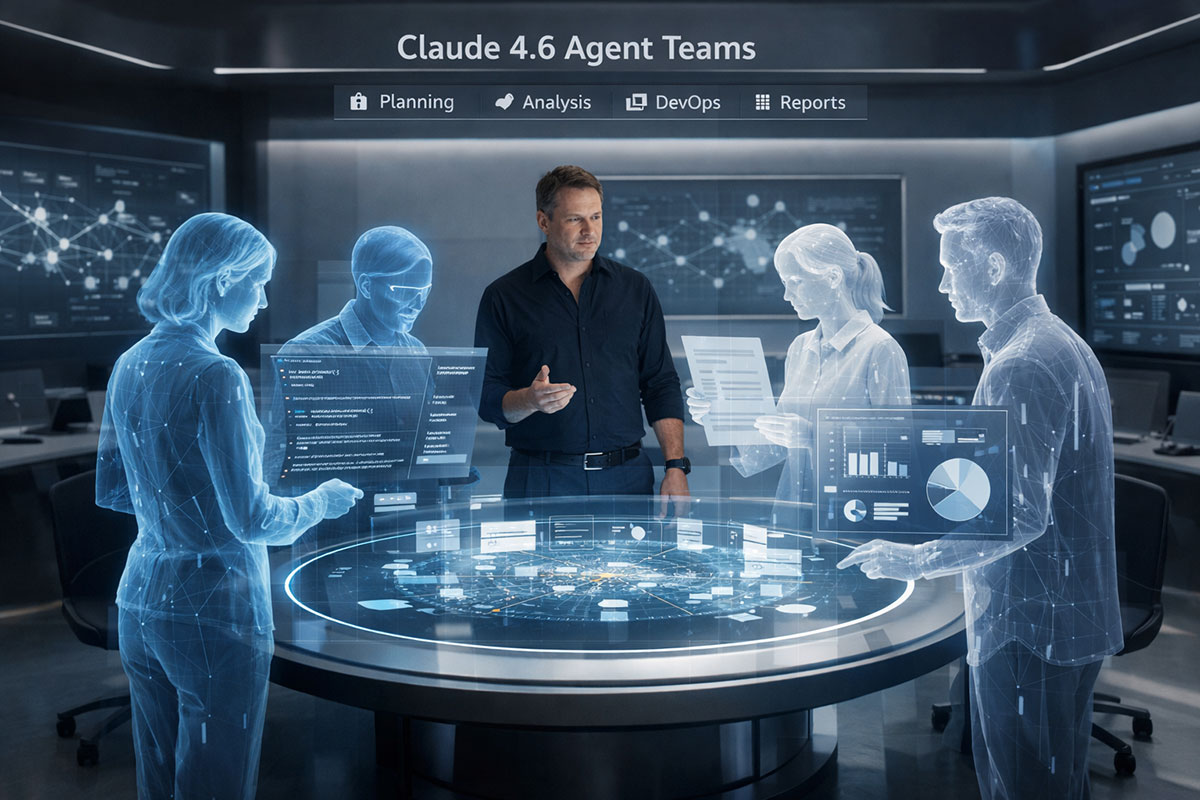
With Claude 4.6 Agent Teams, one Claude instance acts as a team lead and can spawn specialized teammates that handle focused tasks: updating specific parts of a codebase, running tests, reviewing security, or rewriting documentation, all at once. These agents have their own context windows and tools, communicate through a shared task list, and message each other when something blocks progress.
If you have been following the rise of agentic AI and how it is reshaping work, you can see this as the next logical step beyond the “virtual coworker” concept your readers met in Agentic AI: Your New Virtual Coworker Is Here. Instead of one AI “coworker,” you now have a team of them.
The mental shift is simple but powerful: stop thinking “What can my chatbot answer?” and start asking “What team structure would I design if these agents were real employees?”
2. Why the 1‑Million‑Token Window Matters: Shared Memory for Real Work
A flashy number like “1 million tokens” is easy to dismiss as marketing. But in practice, Claude 4.6’s million‑token context window is about something deeper: persistent shared memory across long, messy projects.
One million tokens is roughly the equivalent of:
- A large production codebase
- 10–15 dense research papers plus notes
- Or a full project history: specs, Slack transcripts, docs, and partial results
Earlier models with “long context” often struggled with what practitioners called context rot—the tendency to forget or misread information as the conversation grew. Reports on Claude 4.6 highlight much stronger long‑context retrieval performance, meaning it can still pull the right detail from hundreds of thousands of tokens deep into a session instead of hallucinating or drifting.
How Shared Memory Supercharges Agent Teams
For agent teams, this long context is the backbone of collaboration. It allows:
- Shared project state: Architecture decisions, coding conventions, and open issues are kept in one giant “workspace” instead of being re‑explained every 20 messages.
- Consistent decisions: A security review agent can see why a performance agent made a trade‑off 300K tokens ago and avoid undoing it blindly.
- Seamless hand‑offs: When a human steps in—or out—the agents still remember the full trail of constraints and reasoning.
Anthropic also added context compaction and extended output limits (up to 128K tokens) so long workflows don’t collapse under their own weight. Combined, this makes Claude 4.6 far more suited to real enterprise projects than earlier, short‑memory chatbots that forgot what you said 20 minutes ago.
In a multi‑agent world, context isn’t just “history”—it is your operating system. The more faithfully your agents can carry it, the more complex the work you can safely delegate.
3. Why This Shift Is Happening Now (And Not in 2023)
The move from single chatbots to agent teams isn’t just a feature drop from Anthropic. It sits on top of a broader market trend: agents are finally moving into production.
Databricks’ 2026 report shows multi‑agent workflows on its platform growing 327% in less than four months, as enterprises use agents to orchestrate supply chains, manage databases, and automate regulatory reporting—not just answer FAQs. At the same time, early adopters describe new design patterns like “supervisor agents” and “compound AI systems” where orchestration matters more than any single model.
On the model side, Claude 4.6 is explicitly positioned as an orchestration model—it excels at tracking sub‑agents, steering them, and knowing when to terminate work. The release of Agent Teams inside Claude Code is essentially Anthropic conceding what many practitioners already discovered: real products need systems of agents, not one monolithic bot.
If you have followed how agentic AI is reshaping jobs and workflows, this lines up with trends TrendFlash has been tracking in pieces like AI Agents Are Replacing Chatbots in 2025: The Complete Enterprise Guide and Google’s 2026 AI Agent Trends Report: 5 Ways Agents Will Reshape Your Work. The difference in 2026 is that the tooling, context windows, and data platforms have finally caught up with the vision.
4. Real Multi‑Agent Use Cases: Beyond Fancy Demos
It is easy to get lost in hype, so let’s make this concrete. Where do Claude 4.6 and multi‑agent ecosystems actually beat a single chatbot in practice?
4.1. Codebase‑Scale Engineering Workflows
In Claude Code with Agent Teams, one team lead can coordinate multiple coding agents working across different parts of a repository in parallel—frontend, backend, tests, documentation—while a reviewer agent continuously checks for regressions. This is fundamentally different from a chatbot that edits one file at a time based on your last message.
For a startup engineering team, that can mean:
- Faster refactors across large codebases
- Automated migration of old APIs
- Parallel bug‑hunting in independent modules
4.2. Research, Knowledge, and Strategy Work
With a 1M‑token context, it becomes possible to run parallel research agents:
- One agent scanning regulatory updates
- One summarizing academic literature
- One analyzing your internal data
A supervisor agent then synthesizes all this into a single strategy brief or slide deck. That is a far cry from “summarize this PDF” style use cases that defined early chatbot adoption.
4.3. Operations and Back‑Office Automation
The Databricks data shows a huge share of multi‑agent workflows in areas like customer onboarding, claims processing, and classification/routing tasks across large datasets. In practice, this looks like:
- A document intake agent extracting structured fields
- A rules agent checking compliance constraints
- A reconciliation agent matching against existing records
- An exception agent flagging cases for human review
Each agent focuses narrowly, but together they form an automated back‑office assembly line—a pattern you can see hinted at in many of the enterprise case studies covered under AI in Business & Startups.
5. How to Restructure Your Team for AI Agents
Here is the uncomfortable truth for leadership teams: you cannot bolt multi‑agent systems onto a 2019 org chart and expect magic. You need to adjust roles, responsibilities, and even how you think about “ownership” of work.
5.1. Introduce an “AI Orchestration” Function
In a world of agent teams, someone has to own the system—not just the model. This is where a new function comes in, often reporting into product or engineering:
- AI Orchestrator / AI Systems Lead: Designs agent workflows, defines where human oversight is required, and sets boundaries for what agents are allowed to do.
- Agent Product Owner: Treats internal agents like products, with roadmaps, KPIs, and user feedback loops.
- AI Ops / Agent Ops Engineer: Monitors cost, quality, drift, and incidents across multi‑agent pipelines.
If you have been following the rise of roles like the Chief AI Officer and agent‑focused careers highlighted in Agentic AI Market Growing from $52B to $200B: Where the Jobs Are in 2026, this orchestration track is a natural extension.
5.2. Redefine Developer and Analyst Roles
Developers and analysts will still write code and do analysis—but they increasingly operate as designers of workflows and guardrails instead of solo executors.
- Developers become agent architects: defining tasks, ownership boundaries, and how agent teams should modify codebases.
- Data analysts become evaluation designers: building automated checks that grade agent outputs for accuracy and quality.
- Ops teams become safety engineers: managing permissions, audit logs, and rollback plans when agents make mistakes.
5.3. Put “AI Literacy” Next to Domain Expertise
One pattern across companies adopting agentic workflows is that their highest leverage people are those who combine deep domain knowledge with agent literacy—they know how to talk to the AI in concrete, constraint‑rich ways.
If you are planning your capability roadmap, articles like AI Skills Roadmap to 2030 and Agentic AI & Your Job: The 2025 Survival Guide are good companions to this structural shift—they show how careers are already bending around agent systems.
Pro‑Tip: When you restructure for AI agents, don’t ask “Whose job does this replace?” Ask “Who owns the contract between humans and agents—and who is accountable when it breaks?”
6. A Practical Implementation Playbook for 2026
So how do you actually get from “We have a chatbot” to “We run multi‑agent ecosystems powered by Claude 4.6”? Here is a pragmatic roadmap that works especially well for AI‑curious startups and mid‑market firms.
Step 1: Map Multi‑Step Workflows, Not “Use Cases”
Start with processes that already span multiple tools and decision points: onboarding a customer, closing a month in finance, triaging incidents, launching a marketing campaign. Draw the steps on a whiteboard, including where humans make calls today.
This is the same mindset shift described in The AI Agent Playbook: How Autonomous Workflows Are Rewiring Products in 2025—you’re designing flows, not features.
Step 2: Define an Agent Team for One High‑Value Flow
Pick one workflow and ask: “If Claude 4.6 ran this, what would the team look like?”
- A lead agent that reads the full context (up to 1M tokens) and breaks the work into subtasks.
- Specialist agents for data gathering, analysis, drafting, and quality review.
- Explicit rules for when to stop and ask a human, and what must be logged.
Step 3: Start in “Human‑in‑the‑Loop” Mode
Early Databricks adopters note that governance and quality, not model capacity, are the main bottlenecks for scaling agents. So begin with agents proposing actions instead of executing them:
- Agents prepare drafts, suggested decisions, or data transformations.
- Humans approve, edit, or reject with feedback.
- Feedback becomes training signal for future evaluation rules and prompts.
This staged autonomy is similar to patterns explored in AI Agents in 2025: Your Ultimate Guide to Automating Work and Life, but now supercharged by Claude 4.6’s orchestration strengths.
Step 4: Automate Guardrails Before You Automate Decisions
Before you let an agent team move money, touch production data, or send customer emails, automate the checks around them:
- Schema validation and data quality checks on all inputs and outputs
- Approval policies for sensitive actions (e.g., any payment above a threshold hits a human queue)
- Logging, traceability, and rollback plans for every agent step
This is exactly why seasoned teams talk about transitioning from “writing code” to “orchestrating systems”—you are designing contracts between agents, humans, and data rather than one script at a time.
7. Risks, Governance, and How Not to Burn Yourself
The same power that makes multi‑agent ecosystems so attractive also makes them risky. A single misconfigured agent is annoying; a misconfigured team can move a lot of data—or money—very quickly in the wrong direction.
Key Risk Areas to Watch
- Compounding errors: If one agent misinterprets requirements, downstream agents can amplify the mistake.
- Token and cost blow‑ups: Multiple agents, each with large context windows, can burn through budget without careful monitoring.
- Shadow automation: Teams quietly wiring agents into production processes without central oversight.
- Regulatory exposure: Especially in finance, healthcare, and insurance, where “the model hallucinated” is not a legal defense.
Governance Patterns Emerging in 2026
The Databricks report highlights a “governance multiplier”: organizations with unified governance deploy 12x more AI projects to production compared with those stuck in ad‑hoc experiments. Practically, that means:
- Centralized policy engines for which agents can access which data and tools
- Standardized evaluation suites for every agent workflow before launch
- Audit trails tying agent actions back to accountable owners
If you are just starting this journey, it is worth studying responsible‑AI playbooks like those covered under AI Ethics & Governance and content such as The Ethics of Agentic AI: Who Controls Autonomous Machines?.
A useful rule of thumb: if you wouldn’t give a junior hire unsupervised access to a process, don’t give that access to an unsupervised agent team either.
8. Looking Ahead: From Agent Teams to the “Agent Internet”
Claude 4.6’s Agent Teams and Databricks’ exploding multi‑agent metrics are early indicators of a broader direction: AI will be less about one model and more about networks of agents talking to each other.
Over the next 12–24 months, expect to see:
- Standard protocols for “agent‑to‑agent” communication across vendors and platforms.
- Vertical agent ecosystems—pre‑built teams for finance, legal, engineering, marketing.
- Marketplace dynamics where best‑in‑class agents become plug‑and‑play components in other products.
TrendFlash has already touched on early versions of this “agent internet” in posts like The Agent Internet Is Here: How MCP and A2A Protocols Are Finally Making AI Agents Talk. Claude 4.6 doesn’t build the entire agent internet—but it gives you a serious, production‑ready way to run your own internal version.
The companies that will quietly separate from the pack in 2026 won’t be those that merely “add AI features.” They will be the ones that restructure their organizations around agent teams, treat orchestration and governance as first‑class disciplines, and design work so that humans and agents each do what they are uniquely good at.
9. Related Reading on TrendFlash
If you want to go deeper on agentic AI, multi‑agent workflows, and how this reshapes careers and companies, explore:
- The Rise of AI Agents in 2025: From Chat to Action
- AI Agents Are Replacing Chatbots in 2025: The Complete Enterprise Guide
- Agentic AI in 2025: How Autonomous Systems Are Reshaping Work
- The Future of Work in 2025: How AI Is Redefining Careers and Skills
- AI Agents in 2025: Your Ultimate Guide to Automating Work and Life
For more on how TrendFlash covers the evolving AI landscape—from tools and apps to ethics, careers, and regulation—visit our homepage and explore the full category index. If you are building or deploying agent teams and want to share your story, you can always reach out here.
About the Author
Girish Soni is the founder of TrendFlash and an independent AI strategist covering artificial intelligence policy, industry shifts, and real-world adoption trends. He writes in-depth analysis on how AI is transforming work, education, and digital society. His focus is on helping readers move beyond hype and understand the practical, long-term implications of AI technologies.