Introduction: The Death of the AI Walled Garden
For the past three years, the AI world has been defined by isolation. You had your favorite LLM, your specific set of custom GPTs, or perhaps a standalone agentic tool. But if you wanted your research agent on Claude to securely query a database and then "hire" a scheduling agent on Gemini to book a meeting, you were the bottleneck. You were the human bridge, manually moving data, translating prompts, and fixing broken API connections. This fragmentation was the "Dark Ages" of AI integration.
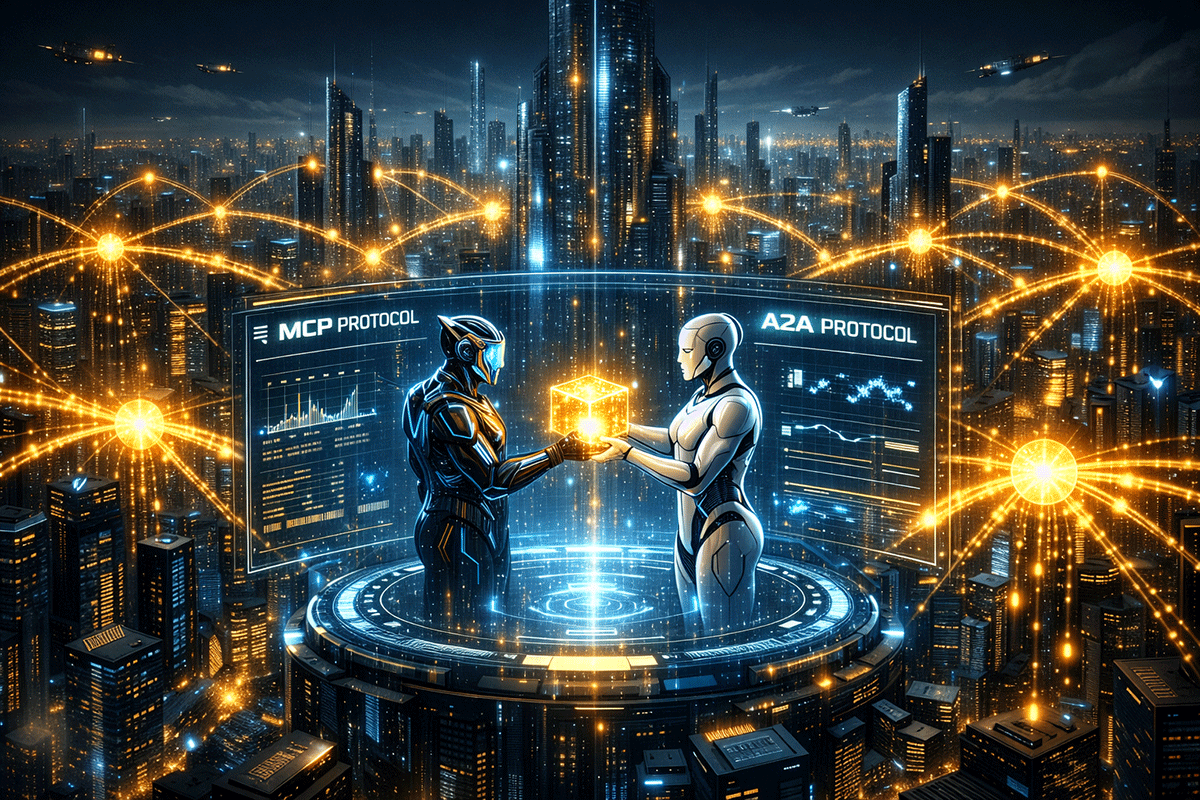
As we navigate through the early months of 2026, that era is officially over. We are witnessing the birth of the Agent Internet—a decentralized, interoperable web where AI agents aren't just talking to humans, but to each other. This revolution is powered by two foundational pillars: the Model Context Protocol (MCP) and the Agent-to-Agent (A2A) protocol. Together, they are doing for AI what HTTP and TCP/IP did for the early internet: providing a universal language for connection and collaboration.
"The transition from Natural Language Processing to true autonomous agency required more than just bigger models; it required a standard for how those models interact with the real world and each other."
The Interoperability Crisis: The "N x M" Problem
Before these protocols took hold, developers faced what was known as the "N x M" integration problem. If you had 10 different AI models (N) and 10 different enterprise tools (M), you needed 100 custom connectors to make them all work together. Every time a new tool or model was released, the workload grew exponentially. This was the primary reason the agentic AI market struggled to reach its full potential early on.
Companies like Anthropic and Google realized that the only way forward was to open-source the connection layer. This led to the creation of MCP and A2A, standards that allow any agent to "plug and play" with any tool or another agent, regardless of who built them.
1. MCP: The Vertical Connector (Agent-to-Tool)
The Model Context Protocol (MCP), originally introduced by Anthropic (who recently expanded their global footprint by opening a major office in India), is a universal adapter for AI tools. It standardizes how an agent "sees" and "uses" a resource, whether that resource is a local file, a SQL database, or a complex Jira workflow.
The Architecture of MCP
MCP operates on a simple but powerful Host-Client-Server model:
- The Host: The environment where the AI lives (e.g., Claude Desktop, a VS Code IDE, or a custom enterprise dashboard).
- The Client: The component that maintains a connection to specialized servers.
- The Server: A lightweight program that exposes specific "Tools," "Resources," and "Prompts" to the AI.
The genius of MCP is that the server doesn't need to know which AI is calling it. It simply says, "Here is a tool called 'Fetch_Market_Data' and here is the schema you need to use it." This level of abstraction is why breakthroughs in September 2025 were so focused on "context efficiency." By late 2025, MCP was donated to the Agentic AI Foundation (AAIF), ensuring it remains a vendor-neutral standard.
The 2026 "Sampling" Update: Bidirectional Intelligence
In early 2026, MCP received its most significant update yet: Sampling. Previously, communication was one-way—the AI asked the tool for data. Now, tools can "sample" the host LLM. For instance, a database MCP server can now ask the model, "I see you're trying to query the 'Orders' table, but the schema is ambiguous. Can you help me generate the correct SQL query before I execute it?" This turns simple tools into active, collaborative participants.
2. A2A: The Horizontal Connector (Agent-to-Agent)
While MCP handles the relationship between an agent and its tools (vertical integration), the Agent-to-Agent (A2A) protocol handles the social relationship between two autonomous entities (horizontal integration). Introduced by Google and now housed by the Linux Foundation, A2A is the "social protocol" of the Agent Internet.
Imagine your personal travel agent needs to book a flight. In the past, it would scrape a website. Today, it finds the "Airline Agent" through the A2A discovery endpoint (usually found at /.well-known/agent.json) and begins a structured negotiation.
Key Components of A2A
| Component | Function | Real-World Analogy |
|---|---|---|
| Agent Card | A JSON file describing an agent's skills, endpoint, and security requirements. | A business card or LinkedIn profile. |
| Task Object | A stateful unit of work that tracks progress (Submitted, Working, Completed). | A formal project contract. |
| Message Parts | Allows multi-modal communication (text, artifacts, UI components). | A shared collaborative workspace. |
| Discovery | The ability for agents to find each other on the open web. | The "Yellow Pages" for AI. |
The Synthesis: How MCP and A2A Create the "Agentic Web"
The true power of the "Agent Internet" lies in the combination of these two protocols. Let's look at a 2026 enterprise scenario:
A marketing manager asks their "Chief Strategy Agent" to launch a campaign. The Strategy Agent uses MCP to pull internal data from the company's Large World Model (LWM) to understand spatial constraints of a physical event. It then uses A2A to "hire" a specialized "Creative Copy Agent" and a "Media Buying Agent." These agents collaborate, exchange artifacts, and report back to the Strategy Agent—all without the manager needing to touch a single API.
This is why the DeAI Manifesto is gaining such traction. When agents can communicate via open protocols like A2A, the power of monolithic "walled gardens" diminishes. Smaller, specialized models like DeepSeek-R1 can now compete by offering high-quality specialized services on the open agentic market.
The Business Landscape: Meta, Manus AI, and the $3B Bet
The industry isn't just watching; it’s investing. Meta's recent $3 billion acquisition of Manus AI was a direct play for the agentic protocol layer. Manus AI was known for its "Universal Execution" framework, which aligns perfectly with A2A standards. Meta plans to turn every business on WhatsApp and Instagram into an A2A-compliant agent, creating the largest consumer-facing node of the Agent Internet.
Similarly, the rise of the Chief AI Officer (CAIO) role in 2026 is driven by the need to govern these multi-agent ecosystems. A CAIO doesn't just manage one AI; they manage a "fleet" of interconnected agents that must comply with corporate governance and security protocols.
The Technical Shift: From "Vibe Coding" to "Protocol Architecture"
In 2025, we saw the rise of "Vibe Coding," where developers used natural language to "vibe" their way into building apps. However, to build for the Agent Internet, the focus has shifted to rigorous protocol architecture. Developers are now specializing in building MCP Servers and A2A Endpoints.
This has opened up new career paths in agentic AI, such as "Agent Interoperability Engineers" and "Context Architects." These roles focus on ensuring that an agent can handle complex logic tasks—even when autonomous systems sometimes fail to solve logic tasks reliably in unpredictable environments.
Strategic Recommendations: How to Prepare for the Agent Internet
If you are a business leader or a developer, the window for preparation is closing. The "Agent Internet" will be the primary way commerce is conducted by 2027. Here is your roadmap:
- Standardize Your Data via MCP: Instead of building custom APIs for your customers, build an MCP server. This allows their AI agents to interact with your data in a way that is structured, permissioned, and ready for the "Agentic Web."
- Adopt "Agent SEO": Just as you optimized your website for Google's crawlers in 2010, you must now optimize your "Agent Card" (A2A) for discovery. If an agent can't find your service via a
/.well-known/agent.jsonlookup, you effectively don't exist on the Agent Internet. - Focus on Governance: As agents start talking to other agents, the risk of "prompt injection chains" increases. Implement strong "human-in-the-loop" mechanisms using Elicitation—an MCP feature that allows servers to pause and ask a human for approval on high-stakes tasks.
- Monitor the Evolution of Architectures: While Transformers remain dominant, new brain-inspired models and Yann LeCun's JEPA architecture are changing how agents process common sense, which will fundamentally change the types of "Agent Cards" we see in the future.
The Future: A Decentralized Intelligence Fabric
We are moving toward a future where the internet is no longer a collection of static pages, but a dynamic, living network of agents. The Agent Internet isn't just about efficiency; it's about emergent intelligence. When millions of specialized agents can collaborate via MCP and A2A, the collective output will be far greater than any single model—even a "GPT-6"—could ever achieve.
This shift is also reshaping global energy and infrastructure. Big Tech's push for "energy sovereignty," like Meta's massive nuclear gamble, is ultimately about powering the millions of handshakes happening every second on the Agent Internet. Each A2A negotiation and MCP tool call requires compute, and the companies that own the protocols and the power will lead this new era.
Conclusion
The "Agent Internet" is the most significant technological paradigm shift since the invention of the browser. By adopting the Model Context Protocol and Agent-to-Agent communication standards, we are finally breaking down the walls of the AI garden. We are moving from a world of "AI tools" to a world of "AI ecosystems." The question is no longer whether your AI is smart enough; it's whether your AI is connected enough.
Read More on the AI Revolution:
- Google's 2026 Report: 5 Ways Agents are Reshaping Work
- CMG’s 10 AI Trends: Why Brain-Inspired AI is Next
- The Top 7 ML Algorithms to Master for Agentic Coding
About the Author
Girish Soni is the founder of TrendFlash and an independent AI strategist covering artificial intelligence policy, industry shifts, and real-world adoption trends. He writes in-depth analysis on how AI is transforming work, education, and digital society. His focus is on helping readers move beyond hype and understand the practical, long-term implications of AI technologies.