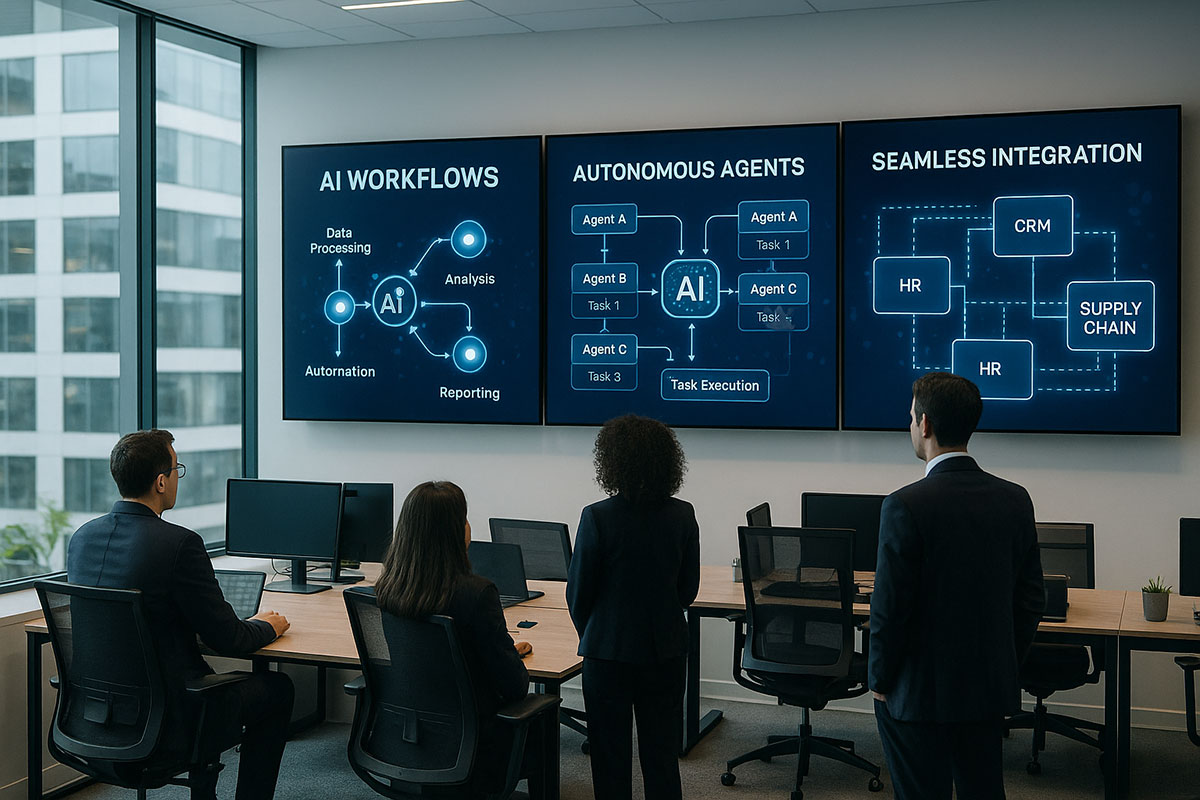
Introduction: The Death of Chatbots and the Rise of Autonomous Intelligence
The era of rule-based, reactive AI is ending. In 2025, we're witnessing a fundamental shift in how businesses automate workflows—from passive chatbots that answer questions to agentic AI systems that autonomously plan, execute, and optimize complex business processes without human intervention at every step.
This isn't incremental progress. This is a paradigm shift. While a traditional chatbot might help you schedule an appointment, an agentic AI system could manage your entire customer lifecycle: identifying prospects, personalizing outreach, negotiating terms, closing deals, onboarding customers, and resolving support issues—all autonomously.
The market data tells the story. The global AI agents market is projected to explode from USD 5.1 billion in 2024 to USD 47.1 billion by 2030, growing at a staggering 44.8% compound annual growth rate. Gartner projects that by 2028, 33% of enterprise software applications will incorporate agentic AI, up from less than 1% in 2024. This isn't hype—it's the inevitable evolution of enterprise automation.
Understanding Agentic AI: What Makes It Fundamentally Different from Chatbots
Before diving into implementation, it's critical to understand why agentic AI represents such a dramatic leap forward.
Traditional chatbots operate within severe limitations: They respond to individual user queries, they cannot access backend systems without explicit programming, they cannot make autonomous decisions, and they require human intervention to execute any action beyond providing information. They are passive, reactive, and fundamentally limited by their design.
Agentic AI breaks free from these constraints entirely. These systems combine sophisticated reasoning, tool integration, memory management, and autonomous decision-making into a unified architecture. Here's what sets them apart:
Autonomous Planning and Execution
Agentic systems understand high-level objectives and automatically decompose them into executable sub-tasks. If an AI agent receives the instruction "process this refund request," it autonomously: verifies the transaction in the payment system, checks return eligibility criteria, processes the refund through the payment gateway, updates inventory systems, sends confirmation emails, and creates a record for compliance purposes—all without human oversight.
Multi-System Integration
Unlike chatbots confined to a single conversational interface, agentic AI actively integrates with APIs, databases, CRM systems, ERP platforms, and third-party services. They can query data, execute transactions, modify records, and orchestrate workflows across your entire technology stack.
Contextual Memory and Continuity
Agentic systems maintain rich context across extended interactions. They remember customer history, past decisions, ongoing projects, and learned preferences. This enables them to handle complex, long-running workflows that unfold over days or weeks with full awareness of what has been completed and what remains.
Real-Time Adaptive Decision-Making
These systems analyze real-time data, evaluate multiple options, and make autonomous decisions within predefined parameters. A supply chain agent might detect a component shortage, evaluate alternative suppliers, compare costs and delivery times, negotiate pricing, and authorize an emergency purchase—all in seconds—without waiting for human approval.
Error Detection and Correction
Agentic AI doesn't just execute tasks; it validates outcomes, detects anomalies, and self-corrects. If a transaction fails, the agent investigates why, implements corrective actions, and escalates only when necessary—dramatically reducing the manual troubleshooting burden.
The Business Case: Why Enterprises Are Moving Rapidly to Agentic AI
The shift from chatbots to agentic AI is driven by concrete business imperatives and measurable ROI.
The Market Opportunity
Industry analysis reveals compelling statistics:
- The AI agents market grew from USD 5.1 billion in 2024 to a projected USD 47.1 billion by 2030
- McKinsey estimates enterprise AI could unlock USD 4.4 trillion in annual value—but only through autonomous execution models
- 85% of enterprises are expected to deploy AI agents by 2025
- Gartner predicts agentic AI will autonomously resolve 80% of customer service issues by 2029, reducing operational costs by 30%
These numbers reflect a fundamental recognition among enterprise leaders: chatbots are insufficient for competitive advantage. Agentic AI delivers measurable impact.
Quantified Business Impact
Real-world implementations demonstrate dramatic ROI:
-
Customer Service: Companies implementing agentic customer service see 70% autonomous resolution rates, 25% higher conversion rates, and 3× faster response times. A telecommunications company reduced average resolution time from 3.2 days to 4 hours for complex billing disputes using agentic AI.
-
Sales and Revenue: Sales teams deploying agentic AI report 67% increases in meeting conversion rates, 25% improvements in customer satisfaction, 30% reductions in sales cycle length, and 15% increases in average deal size. One B2B SaaS company experienced a 45% increase in qualified lead conversion after implementing agentic campaign routing.
-
Financial Services: Banks deploying agentic AI for KYC/AML workflows are seeing productivity gains of 200% to 2,000%. One regional bank reduced loan processing time from 3 days to 4 hours using AI agents that autonomously verify documentation, perform credit checks, and prepare approval packages.
-
Supply Chain: A global electronics manufacturer implemented agentic AI monitoring 200+ suppliers across 15 countries. When semiconductor shortages emerged, the system automatically identified alternative suppliers, negotiated emergency contracts, and rerouted shipments—delivering 30% reductions in inventory carrying costs, 25% improvements in on-time delivery rates, and 40% faster response to supply disruptions.
-
Manufacturing: Siemens' predictive maintenance agents decreased unplanned downtime by 30% and reduced maintenance expenses by 20%. Walmart's inventory automation agents achieved 35% reductions in excess inventory and 15% improvements in inventory accuracy.
-
Healthcare Administration: Healthcare providers deployed agentic AI that cut clinical documentation time by 60%, freeing physicians for patient care and reducing burnout.
These aren't theoretical projections. These are documented results from leading enterprises across industries.
Real-World Enterprise Use Cases: Agentic AI Delivering Tangible Results
Case Study 1: H&M's Virtual Shopping Assistant
Challenge: H&M faced high cart abandonment rates and slow response times that directly impacted conversion rates and revenue.
Solution: H&M deployed an agentic AI system capable of offering personalized product recommendations, addressing frequently asked questions in real-time, guiding customers through purchase processes, and proactively managing post-purchase engagement.
Results:
- 70% autonomous resolution of customer queries
- 25% increase in conversion rates
- 3× faster response and resolution times
- Significant reduction in customer support costs
- Measurable improvement in revenue per visitor
Case Study 2: IBM's AIOps Deployment
Challenge: IBM's IT teams were overwhelmed by alert fatigue—thousands of alerts daily, most of which were false positives. This drowned out genuine incidents and slowed critical issue resolution.
Solution: IBM deployed agentic AI operations systems to intelligently filter signals from noise, correlate related events, identify root causes, and recommend corrective actions in real-time.
Results:
- 40% decrease in false-positive alert volume
- 30% reduction in mean time to resolution (MTTR)
- Enhanced system uptime and reduced service disruptions
- Improved operational efficiency for IT teams
- Dramatic reduction in analyst labor hours dedicated to incident response
Case Study 3: Singapore's Ask Jamie Government Portal
Challenge: Singapore's government agencies faced overwhelming volumes of routine citizen inquiries, straining call center resources and slowing response times.
Solution: GovTech Singapore deployed "Ask Jamie," a multilingual agentic AI assistant across 70+ public service websites to autonomously resolve common inquiries using natural language understanding.
Results:
- 50% reduction in call-center volume
- 80% improvement in response time for frequently asked questions
- 15 million+ questions answered autonomously
- Significant decrease in operational support costs
- Major improvement in citizen satisfaction with digital services
Case Study 4: BenevolentAI and AstraZeneca Drug Discovery
Challenge: Early-stage drug discovery—specifically identifying new therapeutic targets—is typically slow and resource-intensive, taking months or years.
Solution: BenevolentAI deployed an agentic system that autonomously analyzed massive biological datasets, simulated molecular interactions, and identified viable drug targets for chronic kidney disease treatment.
Results:
- 70% reduction in time required for discovery
- Enabled fast-tracking of drugs for clinical development
- Massive savings in R&D spending
- Accelerated time-to-market for critical therapies
Implementation Roadmap: How to Deploy Agentic AI Successfully
Successful agentic AI implementation requires strategic planning, not just technical deployment. Here's the proven roadmap:
Phase 1: Workflow Identification and Analysis
Begin by auditing your business processes. Identify workflows that are:
- Repetitive and rule-based but involve multiple systems or applications
- Multi-step with decision points that follow logical patterns
- High-volume with consistent execution requirements
- Time-consuming for human employees
Ideal initial candidates include customer onboarding, invoice processing, supply chain exception handling, employee offboarding, and complaint triage. Avoid workflows requiring genuine creativity, ethical judgment, or unpredictable novel situations initially.
Phase 2: Define Autonomy Levels and Governance
Not every agent needs full autonomy. Implement a tiered approach:
- Assistive Level: The AI recommends actions for human approval. Useful for high-stakes decisions.
- Collaborative Level: The AI handles certain steps autonomously within human-supervised workflows. Effective for medium-risk processes.
- Fully Autonomous: The AI manages entire workflows from initiation to completion, reporting results. Appropriate for low-risk, high-volume processes.
Establish clear boundaries, escalation triggers, and human review mechanisms. Define when the agent must escalate to humans—for example, transactions above certain thresholds, decisions involving legal/regulatory risks, or situations outside its training parameters.
Phase 3: Select and Configure Your Orchestration Stack
Modern agentic AI relies on specialized frameworks:
- AutoGen (Microsoft): Enables multi-agent collaboration and orchestration
- CrewAI: Provides high-level abstractions for building autonomous teams
- LangGraph (LangChain): Offers graph-based workflow management for complex processes
- n8n and Zapier: Low-code platforms for connecting systems and defining workflows
Choose based on your technical team's expertise, existing infrastructure, and complexity requirements.
Phase 4: Integration Architecture and Data Strategy
Agentic systems require access to quality data:
- API Integration: Connect to your core systems (CRM, ERP, HR, Finance) via secure APIs
- Data Architecture: Establish clean data pipelines. Garbage data produces garbage results.
- Security and Compliance: Implement role-based access controls, audit trails, and compliance monitoring
- Real-Time Data Access: Ensure the agent can access current data for accurate decision-making
Phase 5: Define Evaluation Metrics
Establish quantified success metrics before deployment:
- Efficiency Metrics: Time saved per transaction, tasks completed autonomously, reduction in human intervention
- Accuracy Metrics: Error rates, rework frequency, compliance violations
- Cost Metrics: Cost per transaction, total cost reduction, ROI
- Quality Metrics: Customer satisfaction, stakeholder satisfaction, escalation rates
- Business Metrics: Revenue impact, conversion rates, customer retention
Phase 6: Continuous Monitoring and Refinement
Post-deployment success requires active management:
- Performance Dashboards: Monitor KPIs in real-time
- Anomaly Detection: Identify when agent behavior deviates from expectations
- Feedback Loops: Capture successful outcomes and use them to improve performance
- Regular Audits: Review escalated cases and failed scenarios to identify improvement opportunities
- Iterative Optimization: Refine decision logic based on performance data
Enterprise Architecture: Building Scalable Agentic Systems
Large-scale agentic AI deployments require enterprise-grade architecture:
Agent Mesh Architecture
Modern enterprises deploy multiple specialized agents working within a coordinated mesh:
- Customer Service Agents handle support tickets and inquiries
- Finance Agents manage approvals, reconciliation, and reporting
- Supply Chain Agents optimize inventory and manage supplier relationships
- HR Agents handle onboarding, offboarding, and benefits administration
- Compliance Agents monitor adherence to regulations and policies
These agents operate autonomously but communicate through standardized protocols, share information, and escalate complex situations to human teams.
Governance and Control
Enterprise deployments require robust governance:
- Policy Engines: Define rules agents must follow
- Audit Trails: Complete logging of all agent actions and decisions
- Approval Workflows: Route decisions requiring human oversight to appropriate personnel
- Performance Monitoring: Real-time dashboards tracking agent health and outcomes
- Rollback Capabilities: Ability to reverse agent actions if issues arise
Challenges, Risks, and Mitigation Strategies
Implementing agentic AI at scale presents real challenges:
Challenge 1: Complex Reasoning in Unpredictable Situations
Agentic AI excels in well-defined scenarios but can fail when confronted with novel situations requiring genuinely creative problem-solving or ethical judgment.
Mitigation: Start with structured, rule-based workflows. Include escalation triggers that route unusual situations to human experts. Establish confidence thresholds—if the agent's confidence in its decision falls below a threshold, escalate automatically.
Challenge 2: Hallucinations and Incorrect Reasoning
AI systems can confidently assert incorrect information or follow flawed reasoning paths.
Mitigation: Implement reality checks. Require agents to verify critical information before taking action. Use multiple independent approaches to validate conclusions. Establish human review for high-impact decisions.
Challenge 3: Integration Complexity
Real business processes involve legacy systems, incompatible data formats, and complex workflows.
Mitigation: Use API-first architectures. Invest in data integration. Start with modern, well-documented systems before tackling legacy infrastructure. Consider whether existing systems should be modernized before deploying agents.
Challenge 4: Organizational Resistance
Employees may fear replacement or resist changes to established workflows.
Mitigation: Communicate the human-machine collaboration model clearly. Demonstrate how agents handle tedious work, freeing humans for higher-value tasks. Involve teams in process improvement discussions. Measure and showcase productivity gains.
Challenge 5: Regulatory and Compliance Complexity
Certain industries (financial services, healthcare, government) face strict regulatory requirements around decision-making and liability.
Mitigation: Work with legal and compliance teams during design. Maintain complete audit trails. Ensure human oversight of regulated decisions. Stay current with evolving AI regulations.
Challenge 6: Cost and Skill Gaps
Building enterprise agentic systems requires specialized expertise (ML engineers, prompt engineers, systems architects) that many organizations lack.
Mitigation: Partner with experienced vendors. Invest in team training. Start with managed solutions before building custom systems. Consider build-vs-buy analysis carefully.
The Financial Impact: ROI and Cost Justification
Enterprises justifying agentic AI investments can point to concrete financial benefits:
Time Savings
Routine tasks typically require 40-70% less time when handled by agents. In financial services, loan processing dropped from 3 days to 4 hours. In healthcare, clinical documentation time fell by 60%. This time translates directly to cost reduction and productivity gains.
Direct Cost Reduction
- Manufacturing companies report average annual cost reductions of USD 1.8 million per deployed agent
- Financial institutions reduce support costs by 30% through autonomous case resolution
- Retailers decrease inventory carrying costs by 35% through automated optimization
Productivity Amplification
When human employees are freed from routine tasks, they contribute to higher-value work—strategy, innovation, customer relationships. This amplifies organizational capability without proportional headcount increases.
Revenue Enhancement
- E-commerce platforms increase conversion rates by 23% through personalized agent recommendations
- Sales teams see 15% average revenue increases through agentic lead management
- Customer retention improves through proactive agent-managed engagement
Scalability
Agentic systems scale without proportional cost increases. Processing 10× more transactions typically requires only incremental resource additions, not 10× more employees.
The Future: What's Next for Agentic AI
The trajectory is clear: agentic AI will become the dominant automation model. Here's what to expect:
Multi-Agent Collaboration at Scale
We'll see increasingly sophisticated ecosystems where multiple specialized agents work together, negotiate, and coordinate to solve complex problems that no single agent could handle alone.
Industry-Specific Solutions
Vertical solutions will emerge tailored to specific industries—financial services agents, healthcare agents, manufacturing agents—each incorporating domain expertise and regulatory knowledge.
Enhanced Reasoning Capabilities
Next-generation models will demonstrate superior reasoning abilities in complex domains, reducing false decisions and improving performance in novel situations.
Autonomous Decision Authority
As accuracy improves and governance models mature, organizations will grant agents authority over progressively higher-stakes decisions.
Human-AI Partnership Models
Rather than replacement, we'll see sophisticated collaboration where AI agents handle routine, data-driven decisions while humans focus on strategy, creativity, and judgment calls.
Conclusion: The Competitive Imperative
The shift from chatbots to agentic AI isn't optional—it's a competitive necessity. Organizations deploying agentic AI in 2025 will gain substantial advantages: faster processes, lower costs, improved customer experiences, and ability to scale operations without proportional headcount increases.
The technology is ready. The business case is proven. The market is moving. The question isn't whether your organization will adopt agentic AI, but how quickly you can move from pilot projects to enterprise-scale implementation.
The competitive advantage goes to the organizations that move decisively now, not those waiting for the technology to mature further.
Related Resources:
For deeper insights into AI transformation and emerging technologies, explore these related topics on our platform:
- The Rise of AI Agents in 2025: From Chat to Action
- The Future of Work in 2025: How AI is Redefining Careers and Skills
- 7 Ways Startups Are Using AI to Scale Faster in 2025
- How Agentic AI Is Reshaping Enterprise Operations
- The Ultimate Guide to Building AI Workflows: Automate Your Daily Routine in 2025
About the Author
Girish Soni is the founder of TrendFlash and an independent AI strategist covering artificial intelligence policy, industry shifts, and real-world adoption trends. He writes in-depth analysis on how AI is transforming work, education, and digital society. His focus is on helping readers move beyond hype and understand the practical, long-term implications of AI technologies.