Introduction: From Ten Tabs Open to “Just Let the AI Handle It”
Until recently, “smart shopping” meant opening ten tabs, checking prices across three sites, hunting for coupons, and then still wondering if you missed a better deal. In 2026, that workflow is starting to look as outdated as dialing a travel agent to book a flight. A new layer is appearing between shoppers and stores: agentic commerce, where AI agents don’t just recommend what to buy—they research, negotiate, optimize your budget, and increasingly, complete the purchase for you.
Retail and AI reports show that AI assistants have become a primary front door for shopping, especially around big events like Black Friday and Cyber Monday. In 2025, around 26% of US adults already used AI for product discovery, and AI ecommerce traffic grew by more than 500%, setting the stage for the 2026 rollout of fully agentic shopping flows. The question for everyday consumers now is simple: which AI agents can genuinely manage a budget and, with your permission, hit “Buy” so you don’t have to?
Agentic commerce is the shift from “I’m buying this product” to “solve this problem for me within my budget”—with an AI doing the heavy lifting.
Table of Contents
- The Rise of Agentic Commerce in 2026
- Why Shoppers Are Switching to AI Buyers
- 5 AI Shopping Agents That Can Actually Buy for You
- The Trust Gap: Letting an AI Touch Your Money
- Safety Guardrails: Limits, Virtual Cards, and Human-in-the-Loop
- How to Get Started: 3 Practical Setups for 2026
- What’s Next for Agentic Commerce
- Related Reading on TrendFlash
The Rise of Agentic Commerce in 2026
IBM defines agentic commerce as an approach where AI agents act on behalf of consumers or businesses to research, negotiate, and complete purchases—shifting work away from manual search and checkout to autonomous digital buyers. Instead of clicking through product pages, shoppers describe goals in natural language (“furnish my apartment under ₹50,000 by next month” or “renew my skincare routine within my monthly budget”), and AI agents handle discovery, comparison, and ordering. This evolution builds on 2025’s shift from simple AI recommendations to full agent workflows, something TrendFlash has already covered in depth in its pieces on agentic commerce in e-commerce and agent-based automation.
Behind the scenes, 2025 laid down crucial plumbing: standards like MCP for tool access, A2A for agent-to-agent collaboration, and ACP/AP2 for payments, plus new frameworks from Visa and Mastercard specifically designed to let AI agents initiate transactions securely. In 2026 those standards are moving from whitepapers into real products, with Amazon’s “Buy for me” features, Walmart’s Sparky assistant, and major platforms like ChatGPT and Google Gemini rolling out embedded shopping flows and agent payments.
Why Shoppers Are Switching to AI Buyers
AI shopping assistants are not just a novelty anymore; usage data shows they are becoming the default starting point for high-intent shopping. Reports on the 2025 holiday season found that AI assistants heavily influenced which retailers and products shoppers ultimately chose, with platforms like Amazon, Best Buy, and Walmart appearing in the majority of AI-generated suggestions. Another study reported a 515–520% year-over-year increase in AI ecommerce traffic leading into Black Friday 2025, a signal that consumers are comfortable delegating more of the research work to AI.
This shift is also driven by frustration: people are tired of “verification fatigue”—re-checking prices, reviews, and stock on multiple sites before every purchase. AI shopping tools now combine price comparison, promotion tracking, and timing optimization (when to buy) into a single workflow, often saving 20–40% when stacked with cashback and coupon automation. The most advanced agents go a step further: they track your budget, watch the market for you, and attempt checkout automatically once your conditions are met.
5 AI Shopping Agents That Can Actually Buy for You
Not every “AI shopping assistant” is truly agentic. Many still only answer questions or show product carousels. For this guide, the focus is on tools that can do three things: search across options, manage or respect a budget, and help complete checkout with minimal friction. Below is a snapshot of five key players shaping agentic commerce for consumers in 2026.
| Agent / Platform | What It Automates | Budget Control Style | Best Use Case |
|---|---|---|---|
| Google Agentic Checkout (Gemini + AI Mode) | Price tracking across retailers, alerts, and agentic checkout via Google Pay on eligible merchants. | User-defined price thresholds and merchant permissions; human confirmation before purchase. | Set-and-forget monitoring for specific items (phones, gadgets, flights) until they hit your target price. |
| ChatGPT Shopping with Embedded Commerce | Research, comparison, and direct purchasing from within a conversation for supported merchants. | Conversation-level instructions (budgets, preferences) and per-order confirmation. | Complex, multi-constraint purchases where you want recommendations plus a one-click way to act on them. |
| Perplexity Pro Shopping Assistant | Personalized shopping research, AI search across retailers, and native purchasing hooks inside the interface. | Implicit budget guidance via query (“under ₹X”), plus merchant-specific settings and human approval. | High-intent “what’s the best X for my budget?” scenarios where you want answers, not ten blue links. |
| Amazon Rufus + “Buy for Me” Stack | Conversational product discovery inside Amazon, cart building, and accelerated checkout using saved details. | Account-level spending patterns and category constraints, guided by your existing Prime and payment settings. | Everyday shopping in the Amazon ecosystem—especially big sales where speed and stock matter. |
| Card Network–Backed Budget Agents (Visa / Mastercard Frameworks) | Agent payment rails that let third-party AIs initiate payments within pre-defined limits. | Hard caps, merchant whitelists, and transaction rules embedded at card or bank level. | Connecting independent shopping agents or finance apps to your wallet without giving them full card access. |
1. Google Agentic Checkout: AI Mode Meets Your Wallet
Google’s AI shopping experience combines its Shopping Graph with Gemini-powered “AI Mode” to watch products for you and step in when the price finally makes sense. The core feature, known as Agentic Checkout, lets users set precise tracking rules: a specific product, a target price, optional preferences (seller, condition, color), and whether they want just alerts or automatic purchasing when conditions are met. Instead of repeatedly searching and re-checking prices, the AI continuously monitors listings and pings you the moment the deal aligns with your constraints.
When Agentic Checkout is enabled, Google’s AI can go beyond alerts and complete the purchase on eligible merchants using Google Pay, but only after you confirm the final price and shipping details. The system is tightly linked to Google’s Shopping Graph, which tracks billions of listings and validates pricing to reduce errors, and to Google Pay’s security stack so your card data never has to be handed over to a random extension or store. For consumers, this feels like having a patient personal buyer who never stops watching your wish list—perfect for big-ticket items where timing matters.
2. ChatGPT Shopping: From Research to One-Click Action
Throughout 2025, ChatGPT evolved from a research assistant into a shopping interface that can actually trigger purchases for supported merchants inside the conversation. Commerce-focused analyses describe how ChatGPT can now surface shoppable product grids, detailed comparison tables, and then allow users to complete a transaction without leaving the chat, powered by integrations with retailers and emerging agent payment standards. This compresses the classic funnel—research, compare, click, checkout—into a single dialogue.
Budget management in ChatGPT is prompt-driven: you specify ranges (“under ₹25,000,” “max ₹3,000 per month”) and constraints (brands, sustainability, refurbished-only), then the agent filters recommendations and purchase options accordingly. Because the system currently requires explicit user confirmation before placing orders, it functions as a collaborative buyer rather than a fully free-running one, a dynamic TrendFlash has explored in its post on whether consumers will actually buy from ChatGPT in 2026. The sweet spot is complex, multi-step goals—travel planning, home office upgrades, or bundled purchases—where a conversational agent outperforms search.
3. Perplexity Pro Shopping: AI Search That Knows What to Buy
AI search intelligence platforms point to Perplexity’s personalized shopping assistant as a signal of how fast behavior is changing: shoppers are starting sessions with AI, not search engines. Perplexity’s Pro shopping features guide users from discovery to decision by collating product specs, expert reviews, and retailer availability into concise, conversational answers. More recent retail analyses on agentic AI note that Perplexity supports native purchasing hooks within its interface, allowing users to move from “What should I buy?” to “Place this order” without juggling multiple tabs.
Unlike retailer-locked agents, Perplexity sits closer to an impartial “shopping brain” that compares options across the open web. Users can anchor queries around a strict budget (“build a gaming setup under ₹80,000 including monitor”) and get optimized configurations that balance performance, reliability, and cost, then click through or trigger purchases on preferred merchants. For consumers overwhelmed by choice and noise, this is the closest thing to a neutral advisor that still respects their wallet.
4. Amazon Rufus + “Buy for Me”: The Inside-the-Store Agent
On the retailer side, Amazon has steadily pushed its AI assistant Rufus deeper into the shopping journey, especially around high-stakes events like Black Friday. Analyses of 2025 holiday data show that AI-guided sessions involving Rufus saw significantly higher conversion rates compared with non-AI sessions, with some reports citing a 100% surge in purchase sessions when Rufus was part of the journey. Rufus doesn’t just answer questions; it helps users navigate dense catalogs, refine needs, and drop the right items into carts faster.
When combined with Amazon’s “Buy for me” initiatives and one-click checkout, Rufus effectively acts as an in-house agent that knows your purchase history, Prime benefits, and preferred delivery options. While it is limited to Amazon’s ecosystem, that ecosystem covers a massive chunk of consumer spending, which is why AI-focused reports repeatedly find Amazon dominating retailer visibility inside AI search results. For everyday items—household essentials, electronics, last-minute gifts—this is the agent most consumers will encounter first, whether they realize it or not.
5. Card Network–Backed Budget Agents: Visa and Mastercard Prepare for AI Buyers
Some of the most important agentic commerce innovation is invisible to consumers but crucial for safety. In 2025, Visa and Mastercard introduced agent payment frameworks (often referenced as ACP/AP2) explicitly designed for AI agents that will initiate payments on behalf of users. These frameworks support concepts like transaction-level spending caps, merchant allow-lists, and delegated authority, so that an AI agent can move money without ever possessing raw card details. That infrastructure is now rolling out into banks and fintech apps, enabling “budget guardian” agents that can approve or deny attempted purchases from other AIs.
Practically, this means users will increasingly connect independent shopping agents or finance tools to their card or wallet via these standardized rails, rather than sharing card numbers or passwords. For people interested in building their own agents—something TrendFlash covers in guides like how to build an AI agent that works for you 24/7—these frameworks are what make safe automation possible. Over the next year, expect to see mainstream banking apps quietly introduce “AI budgeting co-pilots” powered by these rails, with default protections baked in.
The Trust Gap: Letting an AI Touch Your Money
The biggest barrier to agentic commerce is not capability—it is trust. Surveys and expert commentary repeatedly flag the “trust deficit” when it comes to giving AI systems direct access to payment methods or meaningful spending authority. Consumers worry about overspending, unauthorized purchases, and opaque decision‑making, especially when AI models can hallucinate or misinterpret instructions. IBM’s overview of agentic commerce stresses that successful deployments must combine automation with transparent controls, clear opt‑ins, and easy reversibility.
Platforms building agentic checkout know this and are deliberately conservative. Google’s Agentic Checkout, for example, cannot make purchases without explicit user confirmation and requires users to review the final price, address, and order details before completing payment. Similarly, AI shopping flows emphasize human-in-the-loop controls: users can revoke merchant permissions, adjust thresholds, or switch agents back into “assist-only” mode. That aligns with the design principles TrendFlash explores in its ethics of agentic AI coverage, which argues for tight human oversight over autonomous systems.
Safety Guardrails: Limits, Virtual Cards, and Human-in-the-Loop
Effective agentic commerce in 2026 is not “hands off, hope for the best.” It is structured delegation. Payment frameworks from card networks are explicitly designed for constraint-based automation: hard caps per transaction, monthly limits, and merchant whitelists or blacklists that apply regardless of what the AI tries to do. Combined with AI platform-level rules (such as mandatory confirmation steps in Google’s Agentic Checkout), this creates layered defense: even if an agent behaves unexpectedly, the underlying rails can block out-of-policy charges.
On the shopping tools side, many consumer-facing AI assistants are still closer to advanced advisors than fully autonomous buyers, which paradoxically increases their safety. They help with research, price optimization, and cart building while still requiring a human to press the final “Buy” button, much like how earlier AI coupon finders and cashback tools such as PayPal Honey and other browser extensions automated savings without taking over the wallet entirely. As agentic commerce matures, the winning products are likely to be those that let users dial autonomy up or down based on comfort, category, and transaction size.
The safest way to use AI buyers in 2026 is to treat them like junior assistants: give them a clear budget, narrow scope, and a firm “ask before spending” rule.
How to Get Started: 3 Practical Setups for 2026
For most people, the goal is simple: save time and money without losing control. Here are three practical ways to connect an AI agent to your browser or wallet in 2026, using today’s tools and the emerging agentic commerce stack.
Setup 1: “Watch and Alert” with Google Agentic Checkout
- Pick 3–5 high-value targets. Big tech purchases, flights, or appliances where a 10–20% price swing really matters.
- Configure detailed tracking rules. In Google’s AI shopping experience, define the exact product, your maximum budget, acceptable sellers, and whether refurbished or used items are allowed.
- Enable alerts first, then test Agentic Checkout. Start with notifications only, then for one low‑risk item, enable automatic purchasing with Google Pay so the AI can complete the checkout once your exact criteria are met.
Setup 2: “Research + Human Approval” with ChatGPT or Perplexity
- Frame your goals like a brief. Instead of “best phone,” ask “best camera-centric phone under ₹45,000 with good battery life and 3 years of updates.”
- Use AI to compress the research. Let ChatGPT or Perplexity compare models, surface trade‑offs, and generate shortlists of 3–5 options with reasons, instead of drowning in 30 tabs.
- Act inside the AI, pay on your terms. When native purchasing links appear, you can either use them directly or copy the recommendations into your own manual checkout flow—whichever level of autonomy feels right today.
Setup 3: “Budget Guardrails” via Your Bank or Card
- Check if your bank supports AI-linked spending controls. Many are quietly rolling out features based on Visa and Mastercard’s agent frameworks, even if they don’t use that branding in marketing.
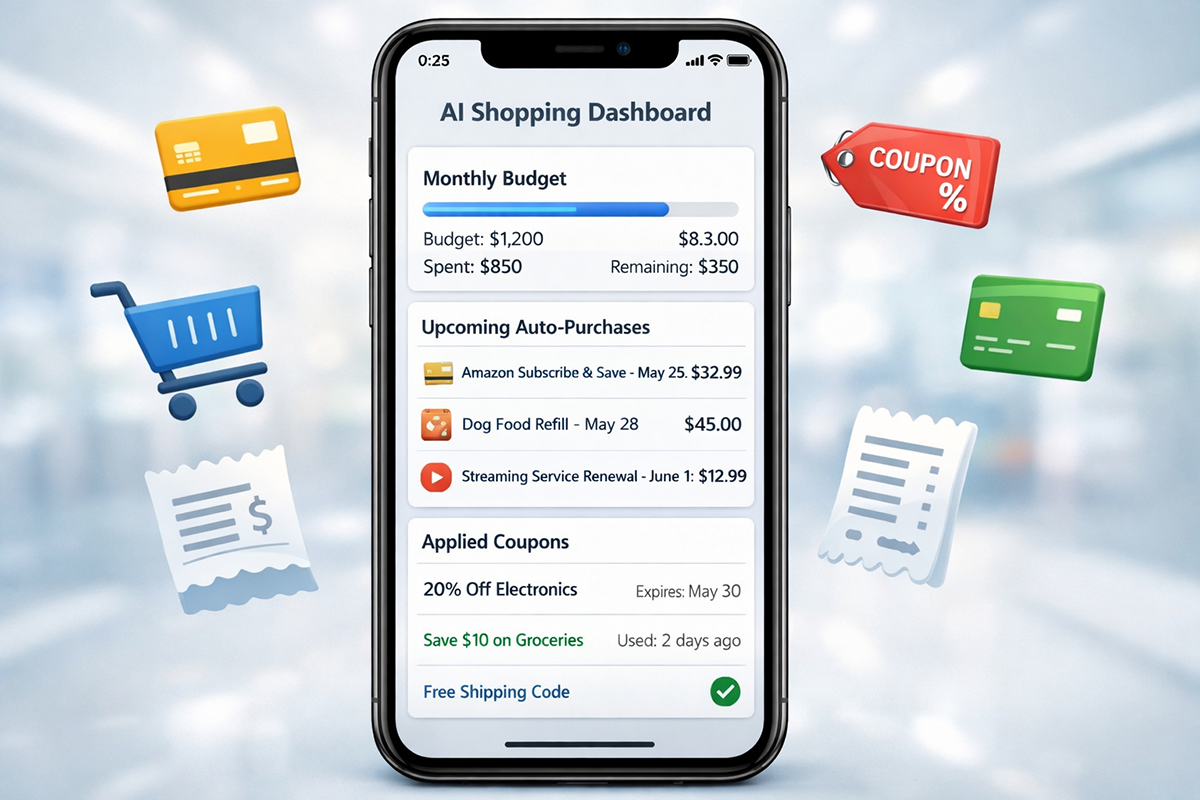
- Create AI‑specific virtual cards. Issue a virtual card with a low monthly cap and limited merchant scope, and use that card only for AI-initiated purchases or AI shopping flows.
- Connect independent agents with confidence. When trying third‑party tools or agent platforms covered in TrendFlash posts on the agent internet or agentic AI in 2025, route their spending through these constrained cards so your main accounts stay insulated.
What’s Next for Agentic Commerce
Industry analyses increasingly describe 2026 as the year agentic commerce moves from experiment to default option. Retail-focused research notes that AI-driven traffic to retailers has already jumped over 1,000% in some segments, forcing brands to optimize not just for human search engines but for AI agents that read structured data, understand natural language, and can trigger orders autonomously. That’s why TrendFlash has highlighted “AI shopping agents” and “agentic commerce” as core themes in posts like AI shopping agents winning Black Friday 2025 and the AI shopping revolution for brands.
For consumers, the near future looks like this: AI agents will increasingly understand your financial goals, spending history, and lifestyle, then proactively suggest, schedule, and sometimes execute purchases on your behalf within guardrails you control. The smartest move in early 2026 is not to go all‑in blindly, but to experiment at the edges—let agents watch prices, build carts, and execute low‑risk orders while you fine‑tune your preferences. As comfort and tooling mature, “send my AI to handle it” will feel as normal as “add to cart” does today.
Related Reading on TrendFlash
- AI Shopping Agents Won Black Friday 2025: Here’s How Much They Boosted Sales and How to Use Them
- AI in E‑Commerce: The 11x Order Boost & How Agentic Commerce Is Reshaping Shopping
- 2026 AI Checkout: Will You Actually Buy from ChatGPT This Year?
- How to Build an AI Agent That Works for You 24/7 (No Coding Required)
- Agentic AI: Your New Virtual Coworker Is Here
To explore more on how these tools fit into the broader AI ecosystem, readers can also browse the AI Tools & Apps and AI in Finance & Trading archives, or learn about the publication’s mission on the About page before reaching out via the Contact section.
About the Author
Girish Soni is the founder of TrendFlash and an independent AI strategist covering artificial intelligence policy, industry shifts, and real-world adoption trends. He writes in-depth analysis on how AI is transforming work, education, and digital society. His focus is on helping readers move beyond hype and understand the practical, long-term implications of AI technologies.