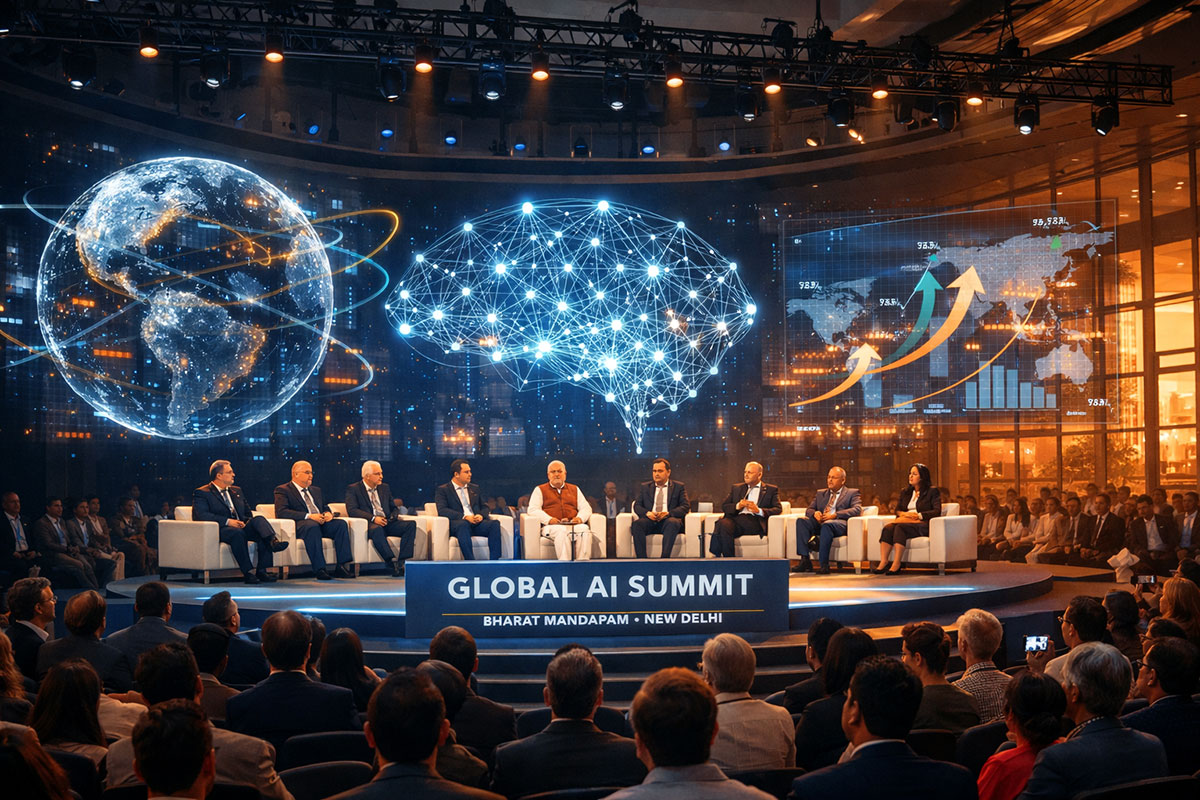
Introduction: Delhi’s AI Week Begins
From tomorrow, February 16, Bharat Mandapam in New Delhi turns into the densest concentration of AI power on the planet. Over five days, the India AI Impact Summit 2026 will bring together heads of state, CEOs of frontier AI labs, Big Tech founders, and policymakers from across the Global North and South. This is not a developer conference or a routine industry expo—it is the first truly global AI summit hosted in the Global South, and it lands at a moment when AI is moving from experiments to full-scale deployment.
The official agenda spans February 16–20, with the main high-level summit convening on February 19–20. Around this core, India is staging an ecosystem of events: an AI Impact Expo, a research symposium, and flagship global challenges like AI by HER and AI for ALL that have been running for months. The goal is explicit: move from lofty statements about “AI for good” to measurable impact on people, planet, and progress.
For readers who have followed our previous coverage of the summit announcement, this week is where all those intentions collide with reality. The India AI Impact Summit 2026 agenda now includes the release of knowledge compendiums on AI in health, energy, education, gender, agriculture, and accessibility, alongside high-stakes discussions on compute, safety, and sovereign AI infrastructure.
This deep-dive preview goes beyond headlines to unpack five reasons why this “Bharat Mandapam AI Summit” is a turning point for the global tech economy—and what it signals for founders, investors, and policymakers worldwide.
1. The Global South Shift: Why the AI Center of Gravity Is Moving to Delhi
For years, global AI policy conversations were tightly clustered around Washington, London, Brussels, and Silicon Valley. Hosting the first full-scale AI Impact Summit in New Delhi signals a structural shift: the Global South is no longer just a “market” for AI products; it is a co-author of the rules, infrastructure, and impact agenda.
India’s positioning is not symbolic. At the ET Now Global Business Summit days before the event, Wipro’s Global Chief Privacy & AI Governance Officer highlighted that India generates nearly 20% of the world’s data and has the second‑largest AI talent base globally. Combine that with over 700 million digitally connected citizens and a track record of building population-scale platforms (UPI, Aadhaar, ONDC), and Delhi starts to look less like a “host city” and more like a natural operating system for applied AI.
“We are moving from a phase of experimentation to a phase of systemic embedding of artificial intelligence,” one speaker noted ahead of the summit, arguing that India’s real edge is its capacity to absorb and govern AI at population scale, not just to build models.
Government data backs this up. By 2024, India accounted for nearly 19.9% of AI projects on GitHub and ranked among the top three countries in Stanford’s Global AI Vibrancy Tool, reflecting the depth of its AI workforce and infrastructure. That workforce is projected to more than double by 2027. For global firms spending billions on AI R&D, the calculus is simple: models may be trained in the US and Europe, but the growth engine—from services to deployment—is increasingly in India and the wider Global South.
Delhi’s summit also crystallizes a narrative that has been building for months. Earlier this year, commentary around India’s “data paradox” pointed out that while the country produces about one‑fifth of the world’s digital data, it historically held only a small fraction of global data center capacity. The AI Impact Summit arrives precisely as this capacity gap begins to close, with massive cloud and GPU investments rushing in.
For readers mapping this to long-term trends, this week in Delhi is essentially the on-the-ground sequel to broader themes we explored in our deep dive on the global AI divide. The difference now is that India is not lobbying for a seat at the table; it is co‑chairing the meeting.
2. The Big Three (and Beyond): How Delhi Reframes Global AI Governance
One of the most consequential aspects of the Bharat Mandapam AI Summit is who is in the room together. Coverage from Indian and global outlets confirms that Sundar Pichai (Google & Alphabet), Sam Altman (OpenAI), and Dario Amodei (Anthropic) are all expected in Delhi, alongside Demis Hassabis (Google DeepMind), Arthur Mensch (Mistral), and other frontier lab leaders. For the first time, the “Big Three” of frontier AI will be debating impact and safety in a Global South capital, not a Western one.
They will not be alone. Lists of confirmed or expected attendees also include Bill Gates, Jensen Huang, senior Microsoft leadership, and leading AI researchers such as Yann LeCun and Yoshua Bengio. On the policy side, over 20 heads of state and dozens of ministers are slated to attend, along with the UN Secretary General. Put bluntly, Delhi will host the densest cluster of AI decision-making power since the UK’s Bletchley Park AI Safety Summit in 2023.
For global governance, the symbolism matters. Past summits—Bletchley, Seoul, and Paris—were criticized for being heavy on Frontier AI safety rhetoric but light on concrete implementation for the Global South. India’s framing is intentionally different: the three “Sutras” of People, Planet, Progress are operationalized into seven “Chakras” (working groups) that include Safe & Trusted AI, Democratising AI Resources, and Economic Growth & Social Good. These aren’t side panels; they are expected to produce actionable recommendations.
The table below highlights a few of the most closely watched global figures—and why their presence in Delhi matters.
| Leader | Role | Why Their Presence Matters |
|---|---|---|
| Sundar Pichai | CEO, Google & Alphabet | Controls Gemini, search, Android, and cloud infra that shape how billions experience AI. |
| Sam Altman | CEO, OpenAI | Faces intense scrutiny over safety, access pricing, and how much policy influence OpenAI should wield; his Delhi visit is watched as a signal of how OpenAI will engage the Global South. |
| Dario Amodei | CEO, Anthropic | Already investing heavily in India operations; expected to push for interoperable global safety standards rooted in “Constitutional AI.” |
| Demis Hassabis | CEO, Google DeepMind | Bridges frontier research and applied products; key voice on AI for science and long-term risk. |
| Bill Gates | Co‑Chair, Gates Foundation | Represents the development lens—health, agriculture, and education in low- and middle-income countries. |
| Yann LeCun & Yoshua Bengio | AI pioneers, research leaders | Bring credibility on foundational research, open science, and alternative paths beyond pure scaling. |
What makes this convergence different is the agenda. The official India AI Impact Summit 2026 agenda devotes entire working tracks to Safe & Trusted AI, cross-border compute access, and shared evaluation frameworks for high‑risk AI systems. For regulators seeking a middle path between the EU AI Act and light-touch US approaches, Delhi becomes the reference point.
For readers who have been following our analyses on AI global governance challenges and AI safety scorecards, this week will test whether voluntary commitments can evolve into something closer to a shared, enforceable playbook.
3. Breakthroughs to Watch: Knowledge Compendiums and the AI by HER Challenge
If the CEOs and ministers are the summit’s “headline layer,” the knowledge compendiums are its lasting infrastructure. On February 17, IndiaAI will release a suite of Knowledge Compendiums—casebooks documenting real-world AI deployments in health, energy, education, agriculture, gender empowerment, and disability inclusion.
Unlike glossy white papers, these casebooks are designed as operational manuals for governments and institutions in emerging economies. For example:
- The AI in Health Casebook (co‑developed with WHO) curates diagnostics, telemedicine, and public health AI deployments across the Global South, with lessons on validation, ethics, and procurement.
- The AI for Energy Casebook (with the International Energy Agency) focuses on grid stability, demand forecasting, and renewable integration in resource‑constrained settings.
- The Education Compendium gathers AI use cases that improve foundational learning and teacher support while staying mindful of bias, connectivity constraints, and offline‑first delivery.
- The Gender-Transformative AI Compendium (with UN Women India) showcases AI for women’s safety, financial inclusion, skilling, and climate resilience, with explicit guidance on avoiding embedded bias.
In effect, these compendiums turn “pilot projects” into policy playbooks—reducing guesswork for officials who have to design tenders, frame RFPs, and measure outcomes in sectors like health, power, and education.
Another flagship to watch is the AI by HER: Global Impact Challenge. Positioned as a dedicated pipeline for women-led AI innovation, AI by HER mobilizes founders and teams across sectors like agriculture, cybersecurity, healthcare, education, energy, and climate. Government briefings peg the combined award pool across AI for ALL, AI by HER, and YUVAi at about ₹5.85 crore, including grants, mentorship, and scale‑up support, with shortlisted teams invited to showcase at the summit itself.
Why does this matter beyond the feel-good narrative? Because AI capital is still overwhelmingly concentrated in a handful of labs and a small set of Western VC ecosystems. A challenge like AI by HER does three things at once:
- It de-risks early-stage impact startups through grants and public validation.
- It plugs them directly into a global network of investors, multilaterals, and government buyers.
- It embeds equity-by-design into the official AI Impact Summit story, rather than leaving inclusivity to side events.
For founders, this is more than prize money. A slot in these compendiums or challenges effectively becomes a “credential” when selling to ministries, multilateral banks, or climate funds. For a deeper sense of how these kinds of initiatives can change startup trajectories, it is worth revisiting our analysis of how startups used AI to scale faster in 2025 and what that implies for 2026 deal flow.
4. Economic Shockwave: $100 Billion Bets and Microsoft’s $17.5B India Push
Behind the speeches and photo ops lies a harder metric: capital. Indian officials have publicly suggested that the summit could catalyze up to $100 billion in AI‑related investment commitments over the coming years, spanning data centers, energy, skilling, and sovereign cloud infrastructure. That figure is not pulled out of thin air; it builds on confirmed moves already in motion.
Most prominently, Microsoft has announced a record $17.5 billion investment in India over four years, focused on AI and cloud infrastructure—its largest-ever commitment in Asia. The company plans new hyperscale regions (including a massive Hyderabad build-out by mid‑2026) and expansions of existing data centers in Chennai, Hyderabad, and Pune, while working with the government to embed AI into platforms like e‑Shram and India’s National Career Service.
Other hyperscalers are not far behind. Reporting around the summit notes that global cloud and chip giants are racing to lock in land, power, and regulatory clearances in India, with multi‑billion‑dollar data center deals from companies like Google and Amazon already underway. For GPU manufacturers, India’s incentives for data centers and its sheer energy demand profile make it an attractive bet for next‑generation AI compute hubs.
Where does the Bharat Mandapam AI Summit fit into this? Think of it as a deal concentrator. Over the next five days, three layers of economic conversation will be happening in parallel:
- Macro‑level commitments: Sovereign cloud regions, green energy tie‑ups, and AI skilling pledges (Microsoft alone aims to train 20 million Indians in AI skills by 2030).
- Sector deals: Health, agriculture, logistics, and education pilots seeded through the casebooks and expo showcases.
- Startup and fund flows: Partnerships and cheques that rarely make official communiqués but define which Indian startups become regional or global players.
For India’s domestic ecosystem, this is the moment when years of groundwork—documented in posts like “AI in India 2025: What Happened & What’s Coming in 2026”—collide with unprecedented external demand. For global investors, Delhi becomes the testing ground for a thesis many have whispered about: if AI is the new electricity, will India be its largest demand center?
5. From Bletchley to Bharat: Will We See a “Delhi Declaration” on AI Impact?
The UK’s 2023 AI Safety Summit at Bletchley Park culminated in the Bletchley Declaration, a landmark but high‑level statement on frontier AI risks and international cooperation. Subsequent summits in Seoul and Paris nudged that agenda toward voluntary safety frameworks and broader conversations about AI’s role in society. The open question for 2026 has been: what comes next?
Delhi is emerging as the answer. Pre‑summit briefings hint at multiple outcome documents, including a “Delhi Declaration on Inclusive AI and the Future of Work” from a dedicated conclave on AI for inclusion, which explicitly aims to feed into the official summit deliberations. That declaration is expected to spell out principles on worker transitions, portable social protection, inclusive skilling, and equity‑by‑design AI systems—areas previous summits largely left to footnotes.
Within the summit itself, the Safe & Trusted AI working group has been running consultations for over a year on topics like AI risk thresholds, safety evaluations, and red‑line capabilities. Reports from these processes suggest an ambition to go beyond mood music and into detailed templates that countries can adopt or adapt—especially around:
- Baseline safety tests for high‑risk foundation models deployed in critical sectors.
- Shared incident reporting mechanisms that make AI failures more transparent and learnable.
- Compute and data access principles that reduce the concentration of AI power in a few regions.
Expect Delhi to pivot the global AI conversation from “How do we avoid catastrophe?” to “How do we share the upside—and the guardrails—of AI impact more fairly?”
Will there be a single, headline‑grabbing “Delhi Declaration on AI Safety and Impact” endorsed by all major players? It is too early to say. But the ingredients are in place: a Global South host, the Big Three labs in the room, a year of preparatory working groups, and a clear bridge to earlier declarations from Bletchley, Seoul, and Paris.
Compared to the UK summit—where India was a signatory but not the host—the shift is profound. A Delhi‑anchored declaration, even if less sweeping in language, would embed the perspectives of countries that are net importers of AI systems but net exporters of data and talent. That alone would reshape how future regulations, safety institutes, and cross‑border AI flows are designed.
Why This Week in Delhi Is a Strategic Moment for You
For builders, operators, and policymakers who don’t have a front‑row seat at Bharat Mandapam, it can be tempting to treat this as “distant geopolitics.” That would be a mistake. The decisions, norms, and deal patterns emerging from this summit will directly influence:
- The cost and availability of AI infrastructure in India and neighboring markets.
- The kind of guardrails enterprises must implement around AI agents, data usage, and safety—topics we’ve unpacked in posts like “The Ethics of Agentic AI”.
- Which use cases attract concessional capital and policy support (health, climate, education, inclusion) versus which are left purely to private markets.
- The emerging playbook for AI governance in democracies that want innovation without replicating EU‑style regulation.
If you operate in AI, technology, or policy, this is the week to follow not just the keynotes, but the details: compendium launches, working‑group communiqués, and the fine print of investment announcements. These will determine whether AI in India becomes a story of a few mega‑players and imported platforms—or a broad‑based ecosystem where startups, universities, and state governments have real leverage.
As the summit unfolds, expect to see follow‑up coverage across our AI News & Trends section, as well as deeper dives on AI governance, infrastructure, and the future of work. For now, the headline is simple, but historic:
For the first time, the epicenter of the AI conversation has shifted—from code, models, and benchmarks to people, institutions, and impact—and it is happening not in Silicon Valley, but in Delhi.
Related Reading
- India’s AI Impact Summit 2026: The New Center of Gravity for AI
- AI in India 2025: What Happened & What’s Coming in 2026
- The Global AI Divide: Optimism, Regulation, and the Race for Leadership
- The AI Safety Report Card: Who’s Making the Grade?
For more about our mission, visit the About page, or reach out via Contact if you’re working on AI projects that intersect with the summit’s themes and want to share your story.
About the Author
Girish Soni is the founder of TrendFlash and an independent AI strategist covering artificial intelligence policy, industry shifts, and real-world adoption trends. He writes in-depth analysis on how AI is transforming work, education, and digital society. His focus is on helping readers move beyond hype and understand the practical, long-term implications of AI technologies.