Introduction: India's Dual AI Revolution
India's artificial intelligence story in 2025 took a shape that nobody quite expected. While Silicon Valley chased AGI headlines and Europe crafted AI regulation, India was executing something far more pragmatic: building sovereign AI capacity while simultaneously cracking down on the technology's most immediate harms.
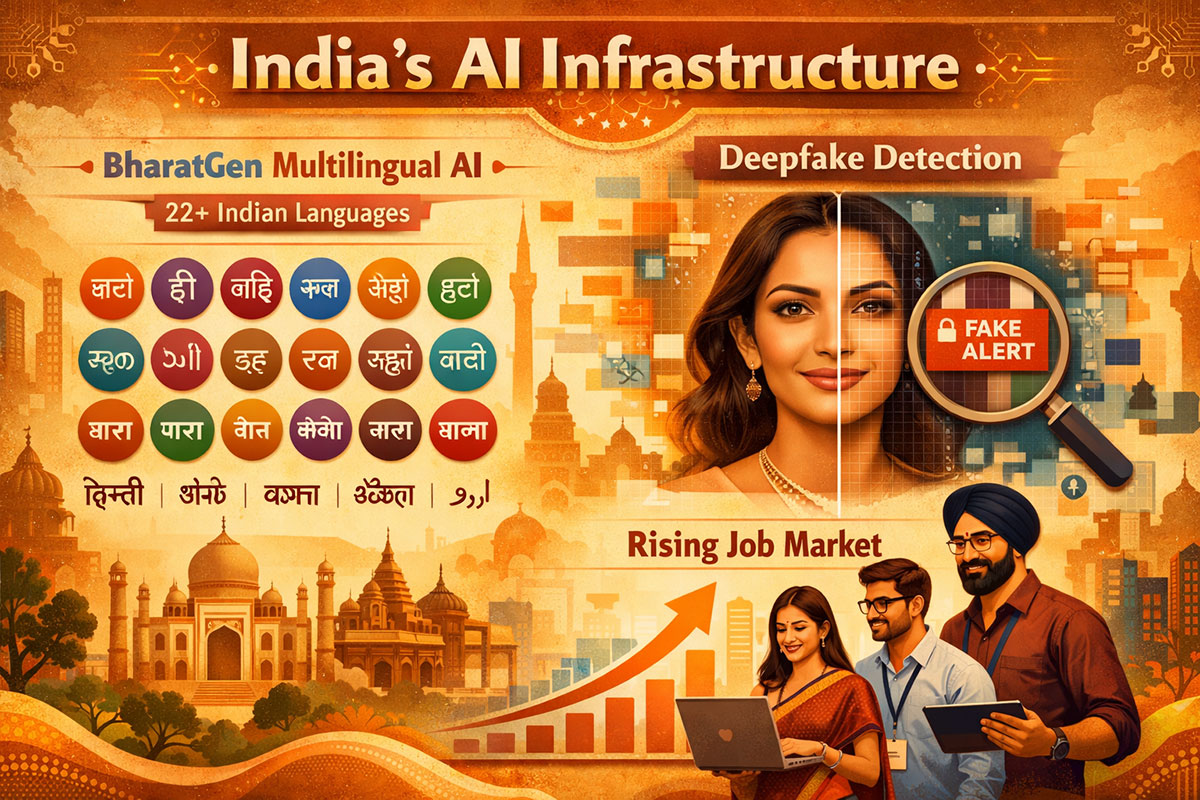
In October 2025, the Ministry of Electronics and Information Technology proposed some of the world's strictest rules on deepfake regulation. In June, the government approved BharatGen, a multimodal AI model trained on 22 Indian languages and India-specific datasets. And throughout the year, something invisible but seismic happened in the job market: demand for AI professionals hit crisis levels, salaries exploded, and for the first time, India had a genuine talent shortage in tech rather than a talent surplus.
For students, professionals, and entrepreneurs watching India's tech ecosystem, 2025 was the year the narrative shifted from "India consumes AI" to "India is building AI." And the implications for 2026 are massive.
The BharatGen Story: India's Sovereign AI Initiative Gets Real
If you haven't heard of BharatGen, there's a reason—not because it's unimportant, but because most tech coverage defaults to what's happening in Silicon Valley. But BharatGen might matter more to India's economic future than any single American AI company.
Here's the straightforward version: BharatGen is India's government-supported initiative to build a large language model specifically designed for India. Not a translation layer over an English model. Not an API wrapper. An actual foundational model trained on Indian languages, Indian data, and Indian use cases.
The announcement came with some eye-catching numbers. A one-trillion parameter model under development. Support from IIT Bombay, the National Mission on Interdisciplinary Cyber-Physical Systems, and collaborations with major organizations including IBM. The goal? Make AI accessible not just to English-speaking urban professionals, but to rural farmers, government service recipients, and the hundreds of millions of Indians who interact with technology primarily in regional languages.
What makes BharatGen different from other localized AI projects is the institutional commitment. This isn't a startup. This isn't a research paper. This is India's government saying: "We're not going to be dependent on foreign AI companies for critical digital infrastructure."
The core differentiator is data sovereignty. BharatGen's "Bharat Data Sagar" (literally "India Data Ocean") represents the world's largest dataset of Indian linguistic and cultural content. By Q4 2025, it included 15,000+ hours of annotated voice data across Indian languages, with plans to expand massively. This matters because AI models trained on global datasets often perform poorly on Indian use cases. A weather prediction model trained on European data doesn't understand the Indian monsoon. A medical assistant trained on English health data might miss conditions more common in India.
By the end of 2025, BharatGen had released early versions of text-to-speech models and was working with IBM and other partners to develop domain-specific applications for agriculture, banking, healthcare, and government services. In other words, by late 2025, it went from "approved project" to "actively deployed in production systems."
For 2026, the implications are concrete. Organizations deploying AI across India—from state governments to agricultural extension services to private banks—will increasingly have the option to use Indian models instead of relying on OpenAI, Google, or other foreign providers. That shift has economic (India keeps AI talent and revenue locally) and strategic (India doesn't depend on foreign AI companies for critical services) implications.
The Deepfake Reckoning: India Gets Serious About Synthetic Media
The other headline story of 2025 was less optimistic but perhaps more urgent. After years of viral deepfakes—the 2023 incident that sparked the initial conversation, recurring cases of fake celebrity content, and growing evidence of deepfakes being used for fraud—India moved from advisory mode to regulation mode.
On October 22, 2025, the Ministry of Electronics and Information Technology released draft amendments to the Information Technology Rules, 2021. The rules proposed something straightforward-sounding but logistically complex: mandatory labeling of all AI-generated content on social media platforms.
The technical requirements are specific. For visual content, labels must cover at least 10% of the visible frame and remain permanently embedded. Audio content gets labeled for the first 10% of duration. Platforms must also embed unique metadata that allows detection of synthetic content. And critically: users must declare whether they're uploading AI-generated content, with platforms required to verify these declarations using automated tools.
This might sound like overkill for "just" labeling requirements. But implementation reveals the complexity. Platforms exceeding five million Indian users face heightened obligations. Smaller services that enable content creation tools must still comply. And if platforms don't comply, they lose the legal immunity they normally enjoy as intermediaries—meaning they become liable for third-party deepfakes.
Put plainly: this is India saying, "You (platforms and AI companies) are going to need to solve this problem, not wait for government to solve it."
The regulation also includes enforcement teeth. The 36-hour removal requirement upon notice is aggressive. The penalties for non-compliance can include blocking content, removing platforms from operation in India, and civil liability.
Is this heavy-handed? Debatable. India's internet user base of nearly a billion people, combined with a history of deepfakes being weaponized for electoral manipulation and harassment (particularly against women), created genuine urgency. The government looked at what was happening in the EU and China and essentially said, "India needs its own approach."
What matters for 2026: this regulation isn't aspirational. By mid-2026, all major platforms operating in India will have had to implement detection and labeling systems. For tech professionals and startups, this creates immediate demand for AI/ML engineers specializing in synthetic media detection, "AI Trust & Safety" specialists who understand content authenticity, compliance and governance experts who can build responsible AI systems, and watermarking and verification specialists.
India's deepfake regulation, despite being controversial in some quarters, has inadvertently created a new job category.
The Job Market Explosion: What Changed in 2025
Numbers tell the story most clearly. India's AI market was forecast to reach $28.8 billion by 2025. That's massive. But the more important metric is employment.
In 2025, India faced an acute shortage of AI talent. For every 10 open positions in generative AI, only one qualified engineer was available. By 2026, forecasts predict the talent gap will widen to 53%. This isn't abstract—this is a supply-and-demand crisis that's driving salary increases.
Here's what senior AI engineers actually earned in 2025:
Generative AI Engineering: ₹58-60 LPA AI/ML Specialist roles: ₹45-55 LPA depending on experience Data Science & Analytics: ₹40-50 LPA Cloud Architecture (with AI focus): ₹45-50 LPA
For context, a senior software engineer in traditional roles earned ₹35-45 LPA. The AI premium is real. And that's base salary before stock options or performance bonuses.
Year-over-year salary growth for AI roles is 18-20%—almost double the growth in traditional tech roles. A Generative AI Engineer with 7-10 years of experience commanding ₹58-60 LPA in 2025 would likely see that push toward ₹70-75 LPA by 2026 if they have the right specializations.
The jobs are coming from expected and unexpected places. Major IT consulting firms—TCS, Accenture, Infosys, Wipro—were actively hiring for AI-specific roles throughout 2025, with focused hiring plans for 2026. But also: financial services companies, healthcare systems, manufacturing, and even government departments were recruiting.
Where are the best opportunities in 2026?
Specialized AI Skills (where scarcity premium is highest):
- Prompt Engineering and LLM Tuning
- AI Orchestration and Agent Design
- LLM Safety and Alignment
- AI Compliance & Risk Operations
- Digital Watermarking and C2PA Implementation
Supporting Infrastructure:
- MLOps and Model Deployment
- Cloud Architecture (especially on the scale needed for large models)
- Data Engineering (because you need high-quality data for training)
- Cybersecurity for AI Systems
Emerging Roles:
- "Blue-collar tech" workers (combining digital literacy with hands-on technical work)
- AI Ethics and Governance Specialists
- Content Moderation and Trust & Safety (accelerated by deepfake regulation)
Salary growth in these roles is 15-25% YoY, meaning someone starting at ₹30 LPA in 2025 could reasonably expect ₹45-50 LPA by 2027 if they specialize effectively.
Why This Matters for Your Career in 2026
If you're a student: the path into AI is more accessible than it's ever been. You don't need a PhD. You don't need to have worked at a major tech company. You need specific skills. Start now. Learn prompt engineering fundamentally. Learn Python and data basics. Learn one domain deeply—agriculture, finance, healthcare, law. By 2026, a student with "AI skills + domain knowledge" has far better employment odds than a student with "just AI skills."
If you're a professional looking to transition: 2026 is your window. Companies are desperate for people willing to shift from traditional software engineering to AI/ML work. The barrier to entry is lower than it's ever been because demand is so high that companies are willing to invest in training. Get certified. Build a portfolio project. Move. The salary increase alone—from ₹40 LPA in traditional roles to ₹55+ LPA in AI roles—justifies the effort.
If you're in a non-tech field wondering if AI affects you: yes. Agriculture (weather prediction, crop optimization). Healthcare (diagnostics support, administrative automation). Law (document review, research). Finance (fraud detection, trading strategy). Every field is hiring AI people. You don't have to become an engineer. But understanding how AI works in your domain—that's now table stakes for career advancement.
India Versus the Global AI Ecosystem: A Shift in Power
For years, India's role in AI was straightforward: talent export. Indian engineers worked at OpenAI, Google, DeepMind. Indians did the skilled labor and sent the profits to Silicon Valley.
BharatGen and the ecosystem it's enabling changes that equation. Not immediately, and not completely, but measurably.
India isn't going to out-compete America in frontier AI research in the next five years. The compute requirements are too high, the capital requirements are too large, and the early-stage advantage is too entrenched. But India is building something equally valuable: the ability to deploy and adapt AI for its own use cases, the capability to build models that work for Indian languages and Indian problems, and the foundation to keep more of the economic value locally.
That shift has implications. Indian startups building AI solutions for Indian problems—agriculture, education, healthcare, government services—are positioned to serve a massive market. The opportunities for building AI products that 500 million+ people interact with are more real now than ever.
What's Actually Changing in 2026
Okay, enough context. What should you actually expect to change in 2026 because of what happened in India's AI story in 2025?
Job Market Acceleration
The talent shortage that existed in 2025 will be worse in 2026. Salaries will keep rising. Companies will keep struggling to find people. The opportunity window is open, but it narrows as more people recognize it. The people who move into AI in early 2026 will have an advantage over those who wait until mid-2026 or later.
AI Deployment Acceleration
Organizations across India will accelerate AI adoption. Not because they're visionary, but because their competitors are. You'll see AI agents in customer service, HR, finance, supply chain. By end of 2026, "using AI" shifts from "competitive advantage" to "table stakes." Companies that haven't deployed any AI by late 2026 will be considered behind.
Regulatory Implementation
The deepfake rules will go from draft to enforcement. Platforms will complain. Some will delay. But by mid-2026, you'll start seeing labeled AI content on Indian social media. Detection tools will improve. The "synthetic media" industry will emerge as a real sector with real career opportunities.
Institutional Investment in Education
More universities (beyond IITs) will launch AI programs. More coding bootcamps will offer AI specialization. IBM's partnership with BharatGen will expand. More domain-specific models will be released. The infrastructure for learning AI in India will finally match the demand.
Global Shift in India's Position
India will start being viewed not just as a talent source, but as a market. AI companies that want access to 500+ million internet users will need to build for India. That means Indian language support, Indian regulatory compliance, and Indian technical talent. That's leverage.
The Uncomfortable Reality Check
This is good news for AI professionals and optimistic for India's tech future. But it's worth acknowledging what's also happening: AI adoption is creating winners and losers fast. People in jobs that AI can automate (data entry, basic customer service, routine coding) face genuine risk. Companies that don't adapt to AI will struggle. The transition is messy.
The deepfake regulation, while necessary, is also something to watch. Regulation always has unintended consequences. Startups building innovative AI tools might get caught in compliance requirements meant for large platforms. Censorship concerns are real. The regulation seems well-intentioned, but implementation matters enormously.
The Bottom Line: Opportunity, Not Destiny
India in 2025 made strategic moves that position the country for a different role in AI. Not as an equal to America yet—the compute gap and capital gap are still enormous—but as a stakeholder building for Indian contexts.
For you, that means 2026 is a moment. Not because AI is new (it's not). But because the Indian AI ecosystem is at an inflection point. The talent shortage is real. The job growth is real. The salary growth is real. The regulatory clarity is actually (finally) happening.
If you've been thinking about moving into AI, or deepening your AI skills, or building an AI product for India—2026 is the year to execute. The window is open. But it won't stay open forever. Every quarter you delay is a quarter where someone else is building expertise, creating portfolio projects, and positioning themselves for the opportunities coming.
Related Reading: For the global AI timeline and what 2028 means, see (https://www.trendflash.net/posts/the-2026-2028-ai-prediction-nobody-wants-to-hear-but-should). For a detailed skills roadmap including India-specific opportunities, explore - https://www.trendflash.net/posts/ai-skills-roadmap-to-2030-what-ibm-tcs-and-accenture-are-quietly-betting-on. For understanding AI agents and how they're transforming work, read - https://www.trendflash.net/posts/deep-learning-in-indian-agriculture-how-ai-is-helping-farmers-predict-monsoons-boost-yields.
About the Author
Girish Soni is the founder of TrendFlash and an independent AI strategist covering artificial intelligence policy, industry shifts, and real-world adoption trends. He writes in-depth analysis on how AI is transforming work, education, and digital society. His focus is on helping readers move beyond hype and understand the practical, long-term implications of AI technologies.