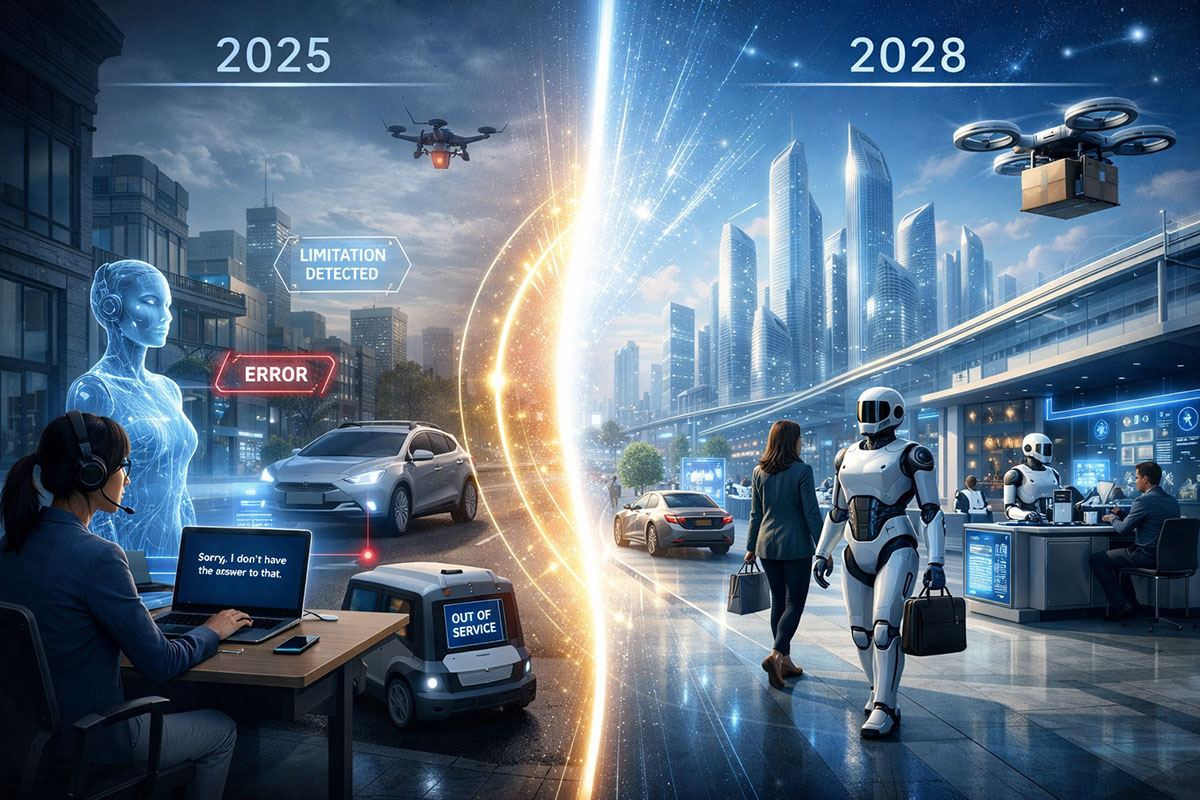
Introduction: The Uncomfortable Forecast
In March 2025, Anthropic quietly included a line in their recommendations to the U.S. government that most people missed: "We expect AGI by early 2027." A few months later, an ex-OpenAI researcher published a detailed month-by-month forecast that made the case for superintelligence arriving by 2028. And in the background, three of the world's most advanced AI labs—OpenAI, DeepMind, and Anthropic—have independently converged on a similar timeline: AGI-class capabilities arriving between 2027 and 2030.
This isn't fringe speculation. This is institutional prediction from the organizations building the technology.
Most people hear "AGI by 2028" and think one of two things: either they dismiss it as hype, or they imagine the Terminator. Neither is correct. But the actual scenario—autonomous AI agents embedded in every workflow, capable of long-term planning and independent problem-solving at scales that make human expertise look like training wheels—might be even more disruptive than either extreme suggests.
This is the prediction nobody wants to hear. But the math keeps pointing to 2028.
Why 2028? The Inflection Point Everyone's Quietly Betting On
To understand why 2028 matters, you need to understand exponential progress. Not as a buzzword, but as a mathematical reality that AI labs have been experiencing since 2022.
When GPT-3 launched in 2020, it was impressive but clumsy. By 2023, GPT-4 could pass the bar exam. By 2024, we saw AI systems outperforming humans on specialized benchmarks like coding. By 2025, the jump isn't just in capability—it's in autonomy. Agents can now plan multi-step workflows, use tools independently, and recover from failures without human guidance.
The pattern is clear: each generation isn't just 10% better. It's exponentially better at doing harder things.
Here's where 2028 comes in. According to the "AI 2027" scenario developed by ex-OpenAI researcher Daniel Kokotajlo and economist Scott Alexander, AI systems won't just get incrementally more capable. They'll reach an inflection point where they can automate AI research itself. Imagine a machine learning engineer, but one that never sleeps, never gets tired, and runs at computational speed. That inflection point—when AI starts accelerating its own progress—is predicted for 2027. By 2028, the compounding effect hits.
This isn't speculation for speculation's sake. Anthropic, in their official documentation, describes the 2027-2028 scenario as a "country of geniuses in a datacenter"—meaning enough computational power and algorithmic capability concentrated to match the combined intelligence output of thousands of brilliant researchers, all working in parallel, all day, every day.
And critically: this isn't superintelligence or dangerous AGI in the sci-fi sense. It's ubiquitous competence. AI agents that can reliably do most white-collar work, solve novel problems, and coordinate complex projects without human micromanagement.
The 2025 Proof Points: It's Already Starting
The skeptics will say, "We've heard these predictions before." That's fair. But 2025 is different. We can actually see the first signs of the inflection point forming.
Across multiple sectors, we're seeing the same pattern: AI agents moving from experimental pilots to production deployments in customer-facing systems. In software development, AI coding agents are reaching performance levels that make junior engineers redundant for specific tasks—not perfectly, but increasingly. In customer service, companies are deploying AI agents handling the vast majority of inquiries autonomously. In sales and marketing, teams are deploying agents that manage outreach, qualification, and follow-up with minimal human oversight.
More importantly, we're seeing the speed of iteration accelerate. The gap between major model releases wasn't just a capability jump—it was a shift in what "possible" means. By the time recent models shipped, the benchmarks for hard reasoning tasks were being reset every quarter, not every year.
The broader metric shows the real story: 70% of business leaders now say AI agents are "strategically vital and market-ready," according to recent surveys. Not experimental. Not in the lab. Ready now. And by 2026, analysts forecast that 80% of enterprise applications will have embedded AI agents. This isn't a prediction about the future. This is what's already locked in for the immediate next year.
That's not a hockey stick curve. That's already past the bend.
The 2026-2027-2028 Timeline: What Actually Happens
Let's be concrete about what experts are predicting for each stage:
2026: The Acceleration Phase
AI agents move from supporting human work to increasingly autonomous execution. Software engineering shifts—entire teams of junior developers get replaced by small teams managing multiple AI coding agents. Customer service centers start closing because the economics flip. A company doesn't need 50 people in a call center if an AI agent can handle 95% of contacts. Early entrants see dramatic cost reductions (40-50% cuts in operations reported throughout 2025).
This is also the year the labor market starts to visibly split. Some jobs (creative, strategic, human-facing) get a productivity boost from AI assistants and see wages rise. Others (routine, decision-tree-based, easily automated) start seeing wage compression and reduced hiring. The wage divergence that economists predicted is becoming real.
By 2026, professionals should understand: if your job is primarily solving problems from existing decision trees and templates, AI represents an existential threat to your role. If your job requires judgment, synthesis, and dealing with novelty, AI is a force multiplier.
2027: The Normalization Phase
By this point, the AI agents aren't novelties. They're infrastructure. Every major software platform has agents built in. Every large organization has multiple agent deployments. The question has shifted from "Should we adopt agents?" to "Which 50 agents should we be running, and how do we coordinate them?"
This is also when the competence ceiling gets pushed. An agent that can write code adequately in 2025 is, by 2027, one that can architect systems, debug complex issues, and handle projects end-to-end. The Anthropic "country of geniuses" scenario describes this phase as when the feedback loop really kicks in: AI automating AI research, leading to faster capability gains, leading to more automation, in accelerating cycles.
2028: The Inflection Point
This is the year the cumulative effects become undeniable. Autonomous systems are handling 15-50% of routine business work. Not with perfect accuracy, but with good enough accuracy that the economics force a reckoning. Education is disrupted—why hire a tutor when an AI agent can deliver personalized instruction to thousands simultaneously. Knowledge work looks fundamentally different. The economy structurally shifts.
Critically, by 2028, the prediction isn't "AI becomes superintelligent." It's "AI becomes ubiquitously competent." There's a difference. Superintelligence is sci-fi. Ubiquitous competence is a restructuring of the economy.
The Sectors That Change Fastest
Not every industry gets disrupted at the same speed. Some sectors are optimized for agent replacement. Others are actually made more efficient by agents but less prone to full replacement.
Software Development
Already showing acceleration. AI agents handling coding tasks went from experimental in 2024 to standard by 2025. By 2028, the role of "developer" has likely split—senior architects and system designers remain; junior and mid-level roles get compressed. For professionals in this space, the opportunity is real but time-bound. Develop system architecture skills now. Learn to work with AI agents as collaborators. By 2028, pure coding ability is a commodity.
Customer Service and Support
This sector is primed for >90% automation by 2028. Agents can handle triage, FAQ resolution, billing questions, and issue escalation. What remains is genuinely complex human judgment, which is a smaller percentage of inbound volume than most companies realize. Organizations that don't automate will get outcompeted. This is the sector where disruption is fastest and most visible.
Content Creation and Marketing
Partially disruptable. AI agents can generate, A/B test, and optimize content at scales humans can't. But strategy, voice, and brand positioning remain human domains. The biggest shift: marketing teams get 5-10x smaller but vastly more productive. You want to be the person who understands strategy and brand voice, not the person who writes 10 blog posts a week.
Education
A potential flashpoint. Personalized AI tutoring could outperform average classroom instruction. The role of the teacher shifts from "knowledge delivery" to "mentor and socialization facilitator." But implementation lags behind capability, so the timeline here might extend beyond 2028.
Finance and Decision-Making
AI agents for fraud detection, portfolio optimization, and risk assessment are already operational. By 2028, expect agents handling 70%+ of routine transactions and flagging anomalies faster than any human. For financial professionals, specialization in areas requiring judgment (client relationship management, complex strategy, regulatory interpretation) becomes critical.
Healthcare Administration
A massive opportunity. Medical coding, insurance processing, patient intake, discharge planning—all potentially automatable to 90%+ accuracy. Actual clinical decision-making remains more nuanced, but the administrative load that buries doctors now can be eliminated.
What You Actually Need to Do Now
If 2028 really is an inflection point, the question isn't whether to prepare. It's how fast you can move.
For Students
You have 2-3 years to develop competencies in three categories. First: things AI can't do well yet (complex judgment, empathy, novelty). Second: things that require deep AI expertise (you can't be replaced by AI if you build and train AI). Third: human-facing, creative work (mentoring, design, content strategy). The old "study computer science and you'll be fine" playbook is insufficient. You also need domain expertise—know something deeply that goes beyond what an LLM can generate.
For Professionals
Audit your job. What percentage is actually irreplaceable? For most people, it's 30-40%. Start building competency in the parts that are. Learn prompt engineering, not as a trick, but as a fundamental skill (the same way learning Excel became fundamental in the 1990s). Start using agents as collaborators now—not defensively, but proactively. By 2028, people who've spent three years working alongside AI agents will have a significant advantage over people learning in 2028.
For Entrepreneurs and Business Leaders
The macro shift is real. Cost structures are changing. The question is whether you get to be the one implementing that or whether you get disrupted by someone who does. Invest in agent deployment now, even if the ROI isn't obvious. By 2027-2028, the competitive pressure will be immense. Pilot projects, test different automation scenarios, build the operational muscle to handle AI agents at scale.
For Technologists
This is, frankly, the most interesting time to be in AI since the 2017 transformer revolution. We're not at the end of the journey. The inflection point coming makes this a moment to choose your bet. Companies and teams building the coordination layers (the "orchestrators" that manage multiple AI agents) will likely win. The ones only building agents for single tasks might get absorbed or made redundant.
The Elephant in the Room: What Could Go Wrong
Every timeline like this assumes a few things that might not hold. Compute scaling could hit a wall sooner than expected. Physics and power consumption are real constraints. Algorithmic breakthroughs might surprise us in either direction—either faster or slower. Geopolitics could matter a lot. If countries enter into intense competition, timelines could accelerate or derail.
And there's a human element. Every major technology transition creates winners and losers. The cost to displaced workers is real. The concentration of wealth and power in AI companies is a genuine concern. The systems that actually get built might embed biases or harms that don't show up until they're at scale.
None of these unknowns change the mathematical prediction. But they matter for how we should prepare. The inflection point coming is an opportunity. But like any transition, how we navigate it determines whether the outcome is broadly beneficial or narrowly concentrated.
The Bottom Line
2028 isn't a date when "AGI arrives and everything breaks." It's a date when AI agents become so capable that every sector of the economy has to make hard choices about how to integrate them. By that point, the companies and people who started experimenting in 2025 and 2026 will have built institutional knowledge. The ones waiting until 2028 will be playing catch-up.
The uncomfortable prediction? 2028 is coming. The evidence is already clear if you look at the math. The question isn't whether to believe it. It's what you do with that belief for the next three years.
Related Reading: For more on how AI agents are reshaping business, see (- https://www.trendflash.net/posts/ai-agents-took-over-in-2025-heres-what-theyll-do-for-your-business-in-2026). For career preparation strategies, explore (- https://www.trendflash.net/posts/ai-skills-roadmap-to-2030-what-ibm-tcs-and-accenture-are-quietly-betting-on). For India-specific opportunities in this shift, read (https://www.trendflash.net/posts/ai-in-india-2025-what-happened-whats-coming-in-2026).
About the Author
Girish Soni is the founder of TrendFlash and an independent AI strategist covering artificial intelligence policy, industry shifts, and real-world adoption trends. He writes in-depth analysis on how AI is transforming work, education, and digital society. His focus is on helping readers move beyond hype and understand the practical, long-term implications of AI technologies.