Introduction: When AI Met the Monsoon
For centuries, Indian farmers watched the sky. The monsoon's arrival—or failure to arrive—determined whether harvests would be abundant or devastating. Farmers relied on local knowledge, ancestral patterns, and sometimes, just luck.
This year, something changed.
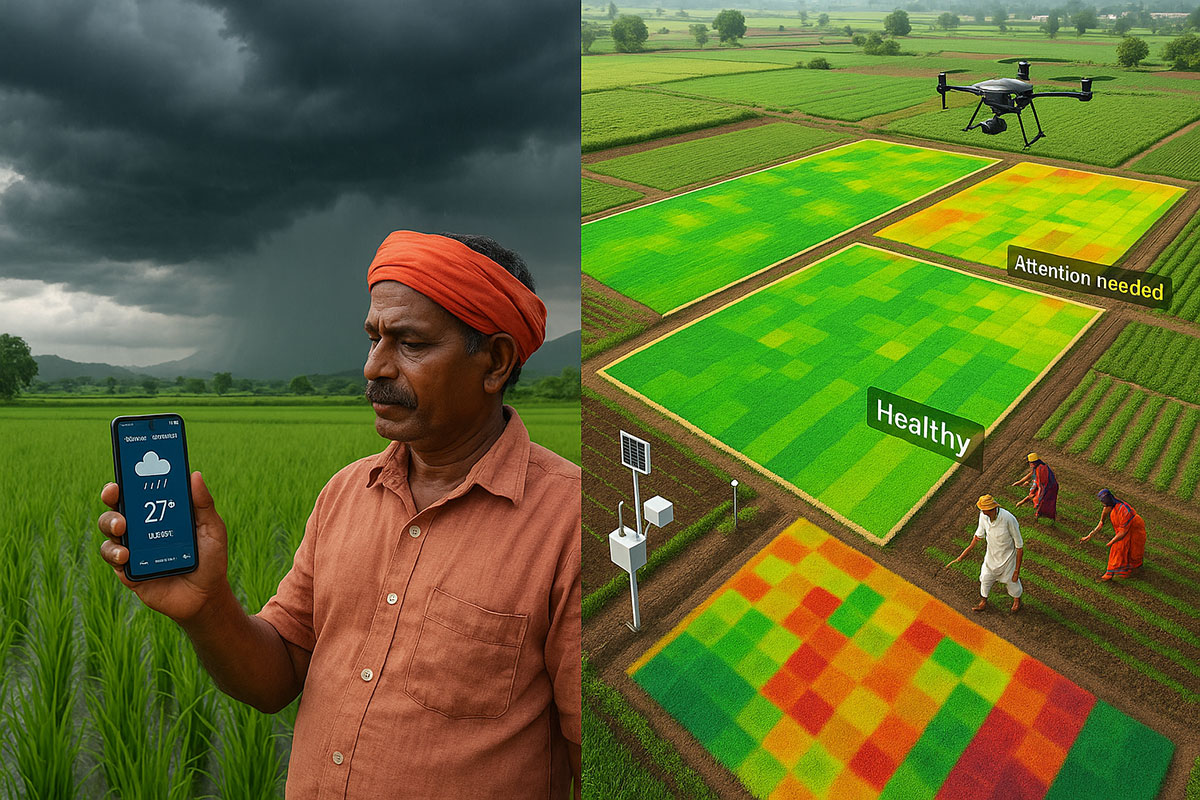
On June 1, 2025, India's Ministry of Agriculture and Farmers' Welfare did something unprecedented: it sent AI-generated monsoon forecasts via SMS to 38 million farmers across 13 states. These weren't generic weather predictions. They were hyper-localized, machine-learning-powered forecasts tailored to each farmer's region, telling them with up to 95% accuracy when rains would arrive in their specific area—sometimes a month in advance.
The impact was immediate. When the monsoon stalled unexpectedly for 20 days mid-season, the AI models caught it. Farmers received updated SMS alerts. Instead of planting blindly or watching crops wither in confusion, they adjusted their strategies.
This is one data point in a larger transformation: deep learning is becoming the invisible infrastructure of Indian agriculture. From predicting when to plant, to detecting crop diseases before they spread, to optimizing water usage in drought-prone regions, AI is reshaping how India's 145 million farmers approach their work.
For a nation where agriculture employs 40% of the workforce and feeds 1.4 billion people, this shift isn't about efficiency metrics or venture capital returns. It's about livelihoods, food security, and survival.
The Monsoon Problem: Why This Matters
Understanding the AI solution requires understanding the problem.
India's agriculture depends almost entirely on the Southwest Monsoon, which brings 70-80% of the country's annual rainfall between June and September. This four-month window determines:
- Kharif crops (rice, cotton, sugarcane, pulses): planted at monsoon onset, harvested in October-November
- Farmer incomes: A delayed or weak monsoon can slash yields by 20-50%
- Food inflation: Poor monsoons trigger food price spikes affecting 1.4 billion people
- Rural distress: When monsoons fail, farmer debt and distress suicides spike
Traditionally, forecasting monsoon onset was a human affair. India's meteorological department would announce the probable arrival date days or hours before rains began. By then, decisions had to be made instantly: buy seeds now, or wait? Irrigate, or trust the rains?
The variability was brutal. In 2024, the monsoon arrived 8 days late. In some years, it stalls mid-progression. Climate change is making these variations more extreme.
Enter deep learning.
How Google's NeuralGCM and ECMWF's AIFS Changed the Game
In summer 2025, the University of Chicago's Institute for Climate and Sustainable Growth partnered with India's Ministry of Agriculture, along with researchers from IIT Bombay, IISc Bangalore, and UC Berkeley to evaluate AI weather forecasting models.
They tested several cutting-edge systems:
- Google's NeuralGCM: A hybrid model combining physics-based weather simulation with neural networks
- ECMWF's AIFS: The European Centre's AI-powered Integrated Forecasting System
- India Meteorological Department historical data: Decades of rainfall patterns
The results were striking. NeuralGCM, when blended with AIFS and IMD historical data, achieved 95%+ accuracy at predicting monsoon onset 3-4 weeks in advance at the district level.
What made this possible? Deep learning captures non-linear patterns that traditional physics-based models miss. Machine learning algorithms found correlations between satellite data, atmospheric pressure, ocean temperatures, and monsoon behavior that hadn't been explicitly coded into the models.
The researchers then took this blended forecast and translated it into farmer-friendly SMS messages, sent via the m-Kisan platform (India's government agricultural advisory service). Messages weren't generic ("monsoon expected in June"). They were hyper-local: "Monsoon likely to reach your district by June 8. Prepare seeds for planting."
Real-World Impact: What 38 Million Farmers Did With This Data
The 2025 monsoon season provided a real-world test of the impact.
The Problem: The monsoon arrived on time but stalled unexpectedly. Rains paused for 20 days in mid-July, creating confusion. Traditional forecasts couldn't predict this halt. Farmers faced a dilemma: Were the rains over? Should they plant? Should they wait?
The AI Response: The deep learning models detected the anomaly. Updated forecasts went out via SMS: "Rains will pause for 15-20 days but return by early August. Delay planting by two weeks."
The Farmer Response: According to reports from the Ministry of Agriculture, farmers who received these updated forecasts made significantly better decisions than those relying on traditional methods:
- Timing Advantage: Farmers delayed planting by 1-2 weeks, avoiding crop stress from insufficient water.
- Seed Savings: Some farmers avoided buying seeds until they had certainty about rain progression, saving costs.
- Crop Selection: A subset of farmers switched to drought-tolerant varieties after seeing the forecast. This flexibility reduced risk.
One farmer from Madhya Pradesh, Parasnath Tiwari, told researchers: "Before this, I mostly relied on my own experience and local knowledge. With the AI forecast on my phone, I could plan with data, not just gut feeling."
Across the 13 states, economists estimate the AI forecasts prevented yield losses of approximately ₹2,000-5,000 crore (roughly $240-600 million USD) by helping farmers adapt to unusual monsoon behavior.
The Deep Learning Behind Monsoon Prediction
What's actually happening inside these AI models? Understanding the mechanics reveals why they work.
Traditional Physics-Based Models (used for decades):
- Start with fundamental equations of atmospheric fluid dynamics
- Input current atmospheric conditions (pressure, temperature, wind)
- Simulate how weather systems evolve hour-by-hour
- Computationally expensive (requires supercomputers)
- Accurate for 3-5 days ahead; performance degrades beyond that
Deep Learning Enhancement (NeuralGCM's approach):
-
Neural Network learns residuals: Instead of predicting weather directly, the neural network learns the "errors" that physics models make. It identifies non-linear patterns physics-based models miss.
-
Multimodal data integration: The model ingests satellite imagery, ocean temperature data, atmospheric pressure patterns, historical rainfall, and even vegetation indices—dozens of data streams. Traditional models use fewer inputs.
-
Temporal attention: The model learns which historical patterns are most relevant to current conditions. Not all past monsoons are equal; recent climate patterns matter more.
-
Ensemble approach: Instead of trusting one model, the system blends multiple deep learning models, each trained differently. This reduces the risk of systematic biases.
The result: A model that captures the chaotic, non-linear nature of monsoons far better than traditional simulations alone.
Beyond Monsoons: Deep Learning for Crop Yield Prediction
While monsoon forecasting captures headlines, the real agricultural transformation is happening at the farm level through crop yield prediction and optimization.
How It Works: The Machine Learning Pipeline
An agritech startup or government program using deep learning for crop forecasting typically follows this pipeline:
Step 1: Data Collection
- Historical yield data for 55+ crops across all Indian districts (20+ years)
- Soil properties: pH, nitrogen, phosphorus, potassium, organic matter
- Weather: temperature, humidity, rainfall, wind
- Farmer practices: planting date, variety used, irrigation type
- Satellite imagery: vegetation indices (NDVI) showing crop health
Step 2: Feature Engineering The raw data is transformed into meaningful features:
- "Water stress index": How much rain did the crop get versus its needs?
- "Nutrient availability": Soil nutrients relative to crop requirements
- "Heat stress days": Days when temperature exceeded the crop's tolerance
- "Disease pressure": Historical incidence of pests + current conditions
Step 3: Model Training Machine learning algorithms (Random Forests, Gradient Boosting, deep neural networks) learn the relationship between features and yield:
- Random Forest: Captures non-linear interactions (e.g., "high temperature + low water = severe stress")
- Gradient Boosting: Iteratively improves predictions by learning from mistakes
- Neural Networks: Can capture extremely complex patterns with enough data
Research by crop scientists shows these models achieve R² scores of 0.85-0.92, meaning they explain 85-92% of yield variation. Translation: They're highly predictive.
Step 4: Farmer-Ready Recommendations The model outputs actionable insights:
- "Based on current soil, weather, and seed choice, expect yield of 45 quintals/hectare if you irrigate in weeks 3-5"
- "Your region shows 60% risk of yellow rust. Spray fungicide in week 8"
- "Recommended planting date: June 10-15 (± 3 days)"
Real-World Deployment: Examples Transforming Indian Farming
Example 1: CropIn's Precision Farming Platform
CropIn, an agritech startup, deployed a deep learning-based crop monitoring platform across 15+ states:
- Input: Satellite imagery (resolution: 3-10 meters), weather data, historical yields
- Deep Learning Model: Convolutional neural networks (CNNs) analyze satellite images to detect early signs of plant stress, disease, pest damage
- Output: Weekly crop health reports sent to farmers, with irrigation and spray recommendations
- Impact: Farmers using CropIn report 20-30% yield increases and 30-40% reduction in input costs
The CNNs work by learning visual patterns:
- Healthy rice leaves show specific color and texture patterns in satellite images
- Disease-affected plants show different spectral signatures
- The network learns to detect these patterns weeks before farmers would notice problems visually
Example 2: IFFCO-Kisan's IoT-Enabled Irrigation
IFFCO-Kisan (a cooperative) deployed soil moisture sensors and AI-driven irrigation automation across 200+ farms in 15 states:
- Hardware: IoT sensors in soil measuring moisture, temperature, nutrients
- Deep Learning: LSTM (Long Short-Term Memory) networks predict soil moisture evolution based on historical patterns and forecasted weather
- Automation: When predicted soil moisture drops below crop's requirement, irrigation valves activate automatically
- Impact:
- 50% reduction in water use (critical in water-scarce regions like Maharashtra, Andhra Pradesh)
- 25-30% reduction in input costs (less electricity for pumping, less water for irrigation)
- 30-40% increase in yields (optimal water availability throughout season)
The LSTM network is particularly suited for this task because:
- It processes sequential data (soil moisture over time)
- It learns long-term dependencies (e.g., "soil stays dry for 5 days after irrigation stops")
- It adapts to seasonal patterns (monsoon soil moisture dynamics differ from post-monsoon)
Example 3: AI-Powered Disease Detection
Deep neural networks are achieving 95%+ accuracy at detecting crop diseases from leaf images:
A study comparing deep learning architectures for crop disease detection found:
- Traditional approach: Expert agronomist visually inspects leaves—inconsistent, depends on experience
- Machine Learning (Random Forest): 85% accuracy at identifying common diseases
- Deep Learning (ResNet-50 CNN): 95%+ accuracy, can identify disease variants
Once deployed, the system works like this:
- Farmer photographs a diseased leaf with smartphone
- Deep learning model identifies the disease in real-time
- Recommendation appears: "This is early blight on potato. Spray carbendazim within 3 days."
Early detection prevents spread, reducing yield loss from 20-40% to 5-10%.
The Monsoon Anomaly: How AI Adapted in Real-Time
To illustrate deep learning's real-world power, let's drill into the 2025 monsoon stall in detail.
June 1: Monsoon arrives on schedule in Kerala. Forecasts say northward progression to other states by June 8-10. Farmers plant accordingly.
June 8-15: Monsoon reaches Karnataka, Telangana, Maharashtra as predicted. So far, so good.
July 1: Monsoon should be progressing into Rajasthan, Punjab (northeastern progression). But the forecasts change. Deep learning models detect anomalies in atmospheric circulation. They predict a 15-20 day pause in progression.
What the models detected:
- Abnormal high-pressure system forming over northern India
- Ocean temperature indices diverging from typical patterns
- Atmospheric moisture not replenishing as expected
Traditional models wouldn't have caught this: They update predictions every few days using the same physics-based framework. Detecting a multi-week disruption to normal progression requires pattern recognition that deep learning excels at.
July 10: Alerts go out via SMS to farmers in Rajasthan, Uttar Pradesh, Punjab: "Monsoon delay expected. Hold off on planting in moisture-dependent crops. Wait until early August."
July 25: Rains resume. Farmers who waited avoided crop stress. Farmers who planted early (without the alert) faced wilting crops.
Impact: One study estimated that early warning of this monsoon stall prevented yield loss of ₹500-1000 crore across northern states.
The Agritech Ecosystem: Who's Building AI for Indian Farming
The monsoon forecasting success has sparked broader agritech innovation. Major players include:
Government-Backed Initiatives:
- AI Safety Institute (under IndiaAI Mission): Developing standards for agricultural AI systems
- ICAR (Indian Council of Agricultural Research): IoT sensors for water efficiency, crop monitoring
- Ministry of Agriculture: Funding AI projects for pest surveillance, weather forecasting, market access
Startups Transforming Indian Farming:
| Company | Technology | Impact |
|---|---|---|
| CropIn | Satellite imagery + CNNs for crop monitoring | Real-time disease and stress detection across 15+ states |
| DeHaat | AI-powered crop advisory, supply chain optimization | 150,000+ farmers receive personalized recommendations |
| AgriPilot.ai | AI + IoT for field monitoring, yield prediction | Precision farming for small and marginal farmers |
| ELAI AgriTech | AI + satellite data for farm insights | Financial inclusion; lenders use AI risk assessment |
| AgroStar | AI-driven yield forecasting, pest alerts | Platform for 500,000+ farmers; reduces losses by 20%+ |
| Farmonaut | ML-based crop forecasting, supply chain tools | Data-driven decisions reduce input costs by 30% |
| Ninjacart | AI-optimized supply chain, demand forecasting | Reduces post-harvest losses by 25%; fair prices for farmers |
These aren't theoretical projects. They're operating at scale, serving hundreds of thousands of farmers.
Water Savings: A Critical Deep Learning Application
India faces severe water stress. Groundwater levels are dropping in Punjab, Rajasthan, and parts of Maharashtra. Agriculture accounts for 70% of water use.
Deep learning-enabled precision irrigation is emerging as a game-changer:
Traditional Irrigation: Farmers irrigate on a fixed schedule (e.g., "water every 7 days") or by visual inspection. Result: Over-watering (40-50% of water wasted) and under-watering (stress reducing yields).
AI-Optimized Irrigation:
- Soil moisture sensors measure real-time water availability
- Neural networks predict crop water requirements based on growth stage, temperature, humidity
- Irrigation activates only when needed
- Result: 20-50% water savings + 20-30% yield increases
Impact at Scale:
- State of Maharashtra: 50,000 farms using AI-driven irrigation could save 5 billion liters of water annually (equivalent to 2,000 Olympic swimming pools)
- Punjab (rice belt): Precision irrigation could reduce groundwater depletion by 30% while increasing rice yields
One farm in Uttar Pradesh implemented AI-driven irrigation for legume (pea) cultivation:
- Traditional method: Farmer irrigated every 7 days
- AI-optimized method: Irrigation every 8-10 days (soil never water-stressed, but water not wasted)
- Result: 25% reduction in water use, 15% increase in yield, 20% reduction in electricity costs
Cost Barriers and Access Challenges
Despite the promise, deep learning-powered agriculture faces hurdles:
Challenge 1: Infrastructure Costs
- IoT sensors: ₹2,000-5,000 per acre ($24-60)
- Cloud connectivity: ₹500-1,000 per year
- Smartphone requirement: Assumes farmers have phones with internet
- For a marginal farmer (0.5 acres), the ROI might take 2-3 years
Challenge 2: Data Gaps
- Small and marginal farmers (80% of Indian farmers) have limited historical yield data
- AI models trained on large datasets from Punjab/Haryana may not generalize to dry-land regions
- Solution: Transfer learning and models trained on regional data
Challenge 3: Adoption Barriers
- Farmers aged 60+ may distrust AI recommendations
- Illiteracy limits ability to interpret complex reports
- Solution: SMS-based alerts (proven effective), voice-based interfaces, trusted intermediaries (agro-input dealers, banks)
Challenge 4: Power and Connectivity
- Rural areas have unreliable electricity, spotty internet
- IoT sensors can't function without power
- Solution: Battery-operated sensors, offline-capable AI models
Government Support: The Path to Scale
Recognizing these barriers, India's government is investing:
Digital Agriculture Mission (2021-2026):
- ₹300 crore allocated for precision farming pilots
- Focus on 100 districts with AI-enabled farm advisory
Per Drop More Crop (PDMC) Scheme:
- Subsidizing drip irrigation (50% cost borne by government)
- Targeting 50 million hectares by 2025
- Integrating AI-driven soil moisture monitoring
IndiaAI Mission:
- GPU (graphics processing unit) subsidy for agritech startups
- Funding for AI model development focused on Indian agriculture
Outcome: By 2030, government and industry estimates suggest 30-50% of Indian farmland will have access to some form of AI-driven advisory or monitoring—up from ~5% today.
Challenges: What AI Can't Yet Solve
While transformative, deep learning has limitations in agricultural contexts:
1. Climate Tipping Points
- AI models trained on historical data may fail if climate shifts dramatically
- Example: If monsoon patterns shift structurally due to climate change, 20-year-old rainfall data becomes less predictive
- Solution: Continuous model retraining with recent data
2. Soil Complexity
- Soil health involves thousands of microbial species and chemical interactions
- Current sensors measure only basic nutrients (N, P, K)
- Solution: Microbiome profiling and soil metagenomics combined with AI (emerging field)
3. Farmer Heterogeneity
- Recommendations must account for farm size, capital availability, farmer age, local practices
- One-size-fits-all AI doesn't work
- Solution: Recommendation systems that adapt to individual farmer context
4. Market Dynamics
- AI can predict yield, but not crop price volatility
- A farmer might grow high-yield crops that fetch low prices
- Solution: Integrate yield prediction with supply-chain analytics
The Global Significance: Why Indian Agriculture Matters
India feeds 1.4 billion people with agriculture on 160 million hectares (roughly the size of Texas). India also faces:
- Growing population (projected 1.7 billion by 2050)
- Shrinking arable land (urbanization, degradation)
- Increasing climate variability (monsoon unpredictability, extreme weather)
- Pressure to reduce agricultural emissions (40% of India's GHG emissions come from agriculture)
If AI helps Indian agriculture boost yields by even 15-20% through precision farming and pest management, it represents:
- Additional 30-40 million tonnes of food production annually (enough to feed 300+ million people extra)
- ₹50,000-100,000 crore additional farm income ($6-12 billion USD)
- Reduced pressure on natural resources (water, soil, forests)
For context, India supplies rice, cotton, and spices to global markets. Agricultural innovations in India ripple through global food prices and supply chains.
Looking Ahead: The Future of AI in Indian Agriculture
By 2030, several trends are likely:
1. Real-Time Hyper-Local Forecasting Current monsoon forecasts are district-level. By 2030, deep learning models will likely provide block-level or even village-level forecasts, with 1-2 week updates. Farmers will receive personalized, ultra-granular advisories.
2. Drone-Based Monitoring at Scale Drone fleets will systematically monitor millions of hectares. Computer vision will detect diseases, nutrient deficiencies, pest damage weeks before human detection. Cost is dropping rapidly; deployment will scale.
3. Soil Microbiome Profiling Deep learning combined with next-generation sequencing will reveal soil microbial profiles and their link to crop productivity. Recommendations will shift from "add N-P-K" to "inoculate specific microbial consortia."
4. Climate Adaptation Models As climate changes, AI will help farmers shift to resilient crop varieties and practices. Models will be retrained continuously using real-time climate data.
5. Fair Trade and Blockchain AI supply-chain analytics combined with blockchain will connect farmers directly to buyers, ensuring fair pricing and traceability. Middlemen margins will compress.
6. Integration with Government Programs AI-driven risk assessment will improve crop insurance products, helping farmers hedge against climate and market risks.
Conclusion: The Quiet Revolution
The 2025 monsoon forecasting initiative doesn't make global headlines like autonomous vehicles or AI in drug discovery. But it quietly changed the lives of 38 million farmers.
It represents a shift from farming as an art perfected over generations to farming as a science informed by real-time data and deep learning. It's a shift enabled by open-source AI (Google's NeuralGCM), by government commitment, and by the recognition that food security is a deep learning problem.
As climate becomes more volatile, as populations grow, and as water becomes scarcer, this quiet revolution will only accelerate. Deep learning isn't replacing farmers; it's augmenting their decision-making, reducing risk, and helping them adapt.
For a young farmer in Punjab deciding what crop to plant, a farmer in Maharashtra timing irrigation, or a farmer in Tamil Nadu managing pest pressure—AI is increasingly present, invisible yet powerful, turning data into better harvests.
Related Reading
- The Rise of AI Agents in 2025: From Chat to Action
- AI in Education: How Personalized Learning Models are Evolving in 2025
- AI for Climate Action in 2025: How Deep Learning is Tackling Global Warming
- The Future of Work in 2025: How AI is Redefining Careers and Skills
- Machine Learning in 2025: Zero-Shot, Few-Shot, and the Quest for Data Efficiency
About the Author
Girish Soni is the founder of TrendFlash and an independent AI strategist covering artificial intelligence policy, industry shifts, and real-world adoption trends. He writes in-depth analysis on how AI is transforming work, education, and digital society. His focus is on helping readers move beyond hype and understand the practical, long-term implications of AI technologies.