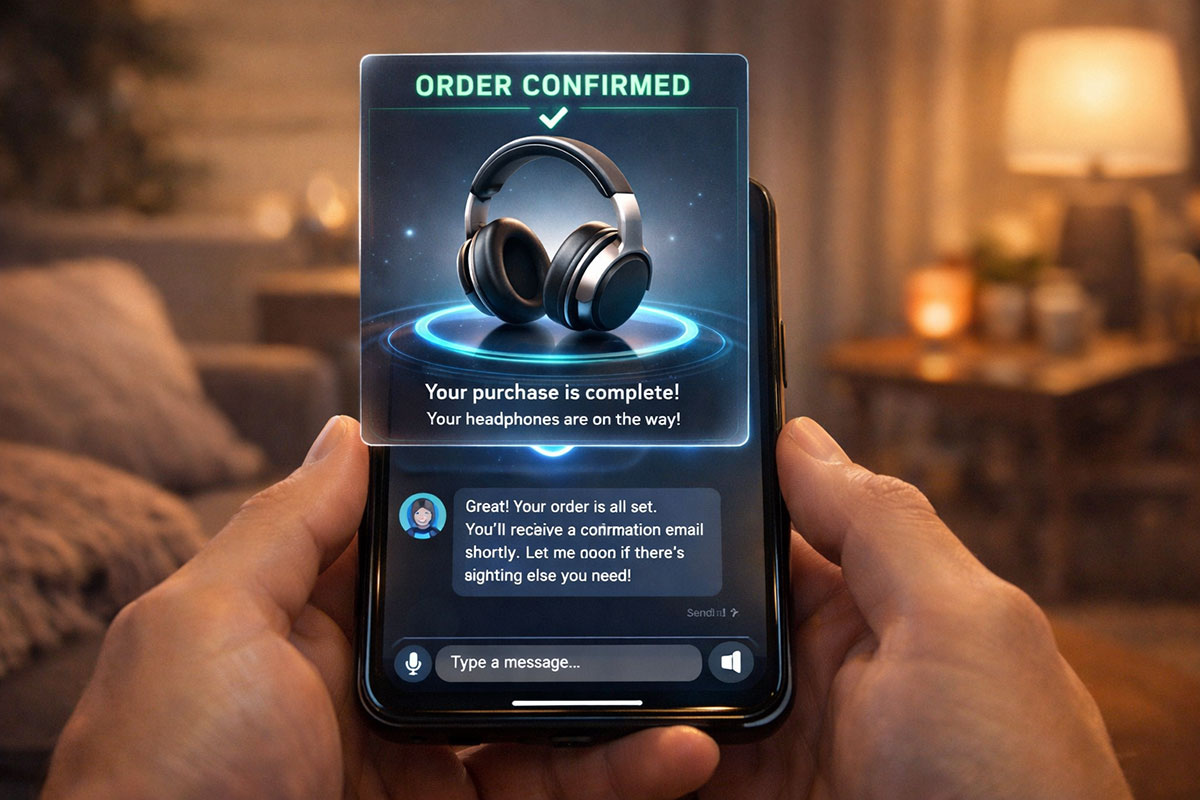
Introduction: The Wallet Moves to the Prompt
For the last two years, we have lived in the era of "AI Window Shopping." We asked ChatGPT for gift ideas, used Perplexity to compare noise-canceling headphones, and queried Gemini about the best running shoes for flat feet. But when it came time to actually spend money, we clicked a link. We left the AI. We went to a website, scrolled through photos, added to cart, and typed in our credit card numbers.
In 2026, that friction is vanishing. We are standing at the precipice of Agentic Commerce—a fundamental shift where your AI assistant doesn't just act as a research analyst, but as your personal shopper, negotiator, and buyer.
"The most valuable real estate in 2026 isn't a storefront on Fifth Avenue or a homepage on Amazon. It is the context window of an AI agent that has your credit card on file."
The data is undeniable. While 2025 was the year of "search," with 33% to 83% of consumers using AI for product discovery during the holidays, actual conversion rates within AI platforms remained low. Trust gaps and clunky interfaces held shoppers back. But with the launch of "Instant Checkout" features across major platforms, the barrier has fallen. This year, the question isn't if you will buy from an AI, but which one you will trust with your wallet.
The 2025 Baseline: A Year of Discovery, Not Purchase
To understand where we are going, we must look at the data from the holiday season we just wrapped up. 2025 was a massive year for AI traffic. Retailers saw an explosion in referrals from "generative sources," dwarfing traditional social media growth in some sectors. However, the behavior was strictly bifurcated:
- High Research Volume: Consumers loved using AI to aggregate reviews and summarize specs. It saved time.
- Low Transaction Trust: When the "Buy" button appeared, hesitation kicked in. Was this the real price? Was the seller legitimate? What about returns?
This behavior gap is typical of early technology adoption. We saw it with mobile commerce in 2012 ("I'll look on my phone, but buy on my laptop"). We are seeing the same pattern now. But just as mobile commerce eventually dominated, AI commerce is poised to take over as the friction of "logging in" and "checking out" becomes obsolete.
Why 2026 is the Inflection Point
Three converging trends are turning 2026 into the year of the AI Checkout:
1. The Rise of "Agentic" Protocols
We are moving beyond chatbots to agentic AI. In 2025, an AI could tell you where to buy a coffee maker. In 2026, an agent can navigate the checkout flow, apply the best coupon code it found on Reddit, select your preferred shipping address, and authorize the payment via biometric verification—all without you opening a browser tab.
2. Identity and Payment Integration
The "trust gap" is being bridged by familiar heavyweights. OpenAI's partnership with Stripe and the integration of Apple Pay and Google Pay into agent interfaces means you aren't giving your credit card to a "robot." You are authorizing a trusted processor to complete a transaction initiated by the robot. This subtle distinction is crucial for consumer confidence.
3. The "Zero-Click" Expectation
Gen Z and Alpha consumers, who are increasingly using AI for emotional support and daily tasks, view friction as a product failure. If they have to leave the chat to buy the item the chat just recommended, the experience is "broken." Platforms are racing to fix this to capture the impulse buy.
The Battle of the Shopping Bots: A Competitive Landscape
The market for AI commerce is projected to exceed $50 billion this year alone. Four major players are fighting for dominance, each with a different strategy. Here is how they stack up.
| Platform | Key Feature | Commerce Strategy | The "Killer App" |
|---|---|---|---|
| ChatGPT (OpenAI) | Instant Checkout | Direct Integration: partnering with platforms like Shopify and Etsy to create a "universal cart" inside the chat. | Buying unique, long-tail items (gifts, crafts) without creating new accounts. |
| Amazon Rufus | Deep Inventory Data | Ecosystem Lock-in: Leveraging billions of verified reviews and Prime shipping speeds. | "Buy the best one for me" – absolute trust in fulfillment and returns. |
| Perplexity | Buy with Pro | Frictionless Research: One-click purchasing for Pro users, acting as a concierge service. | Visual search ("Snap to Shop") combined with immediate purchase. |
| Google Gemini | Agentic Monitoring | Price Patience: Agents that watch prices and buy automatically when they drop below a threshold. | Strategic buying for high-ticket items like electronics and flights. |
ChatGPT: The Universal Cart
OpenAI's "Instant Checkout" is arguably the most disruptive. By integrating with the "Agentic Commerce Protocol," ChatGPT is attempting to become the browser and the wallet. The recent surge in ChatGPT shopping usage suggests that users are ready for this. The ability to buy from a Shopify merchant directly within a conversation removes the "bounce" risk that plagues e-commerce analytics.
Amazon Rufus: The Sleeping Giant Wakes Up
While startups grab headlines, Amazon's Rufus has quietly become a conversion monster. Data from the recent holiday season showed that AI shopping agents won Black Friday, with Rufus driving conversion rates 5x higher than standard browsing. Amazon's advantage is logistics; an AI can order a toothbrush, and you know it will arrive tomorrow. No other AI can promise that yet.
Perplexity: The Concierge Experience
Perplexity is betting on the "Pro" consumer—the power user who values time over everything else. Their "Buy with Pro" feature is essentially a concierge service. You pay a subscription, and the AI handles the dirty work of filling out shipping forms and checking guest checkout boxes. It's a premium experience for the busy professional.
The Merchant's Dilemma: SEO vs. AIO
For retailers, this shift is terrifying and exhilarating. The old playbook of SEO (Search Engine Optimization) is dying. We are entering the era of AIO (Artificial Intelligence Optimization).
In traditional SEO, you wanted to rank #1 on Google so a human would click your link. In AIO, you want to be the only recommendation the AI trusts enough to purchase. If a user asks Rufus to "buy me the best organic dog food," being the second-best option means you get zero sales. There is no "Page 2" in a voice command.
To survive, brands must shift their content strategy:
- Structured Data is King: AI needs to know stock levels, exact dimensions, and shipping times in real-time. Vague product descriptions will be ignored.
- Authority Over Keywords: Agents look for consensus. They read Reddit threads, expert reviews, and safety certifications. Brands need to build "reputation moats" rather than just keyword density. You can learn more about ranking in this new era in our guide on writing content that ranks in the AI search era.
- Video and Visuals: With multimodal AIs like Gemini and GPT-4o, your product needs to "look" good to the AI's computer vision.
Friction Points: What Still Needs Solving?
Despite the hype, 2026 will not be without its headaches. The "AI Checkout" model faces three significant hurdles that companies are scrambling to fix:
1. The Returns Nightmare
If an AI buys a shirt that doesn't fit, who initiates the return? The user? The AI? Integrating return logic into the chat interface is the next big technical challenge. Consumers will not use AI checkout if they feel trapped with the purchase.
2. "Hallucinated" Deals
AIs can sometimes hallucinate prices or discount codes that don't exist. If ChatGPT promises you a TV for $200 that is actually $500, the checkout fails, and trust is broken. Platforms are implementing rigorous "fact-check layers" specifically for pricing data to prevent this.
3. Privacy and Data Leaks
We have already seen concerns about how employees leak data into AI tools. The same fear applies to personal financial data. Will your purchase history be used to train the next model? Platforms are rolling out "Zero-Data Retention" commerce modes to assuage these fears, ensuring financial data is processed but never memorized.
The Verdict: Who Wins and Who Loses?
As we move through 2026, the winners will be the Integrators—the platforms that can connect desire (the user's thought) to fulfillment (the delivery truck) with the fewest clicks. Shopify, Stripe, and Amazon are positioned to win because they own the "plumbing" of commerce.
The losers will be the Gatekeepers. Traditional affiliate blogs, coupon sites, and even generic search engines that rely on users clicking ten blue links will see their traffic evaporate. Why visit a "Top 10 Toasters" blog when Perplexity can summarize the top three and buy the winner for you in seconds?
The AI shopping revolution is no longer a prediction; it is a logistics reality. The only question left for you, the consumer, is simple: Are you ready to let the robot take the wheel?
Related Reading
- AI Shopping Made $73 Billion This Holiday: Here's What Happened in Retail
- Google Gemini Was #1 Trending Search of 2025: Here's Why Google Actually Won the AI War
- AI Agents Took Over in 2025: Here's What They'll Do For Your Business in 2026
- ChatGPT Shopping: How AI Is Changing Holiday Shopping and What Retailers Fear
- How Google's AI Mode Will Change SEO in India (2025 Playbook)
About the Author
Girish Soni is the founder of TrendFlash and an independent AI strategist covering artificial intelligence policy, industry shifts, and real-world adoption trends. He writes in-depth analysis on how AI is transforming work, education, and digital society. His focus is on helping readers move beyond hype and understand the practical, long-term implications of AI technologies.