The Number One Trending Search That Changed the Game
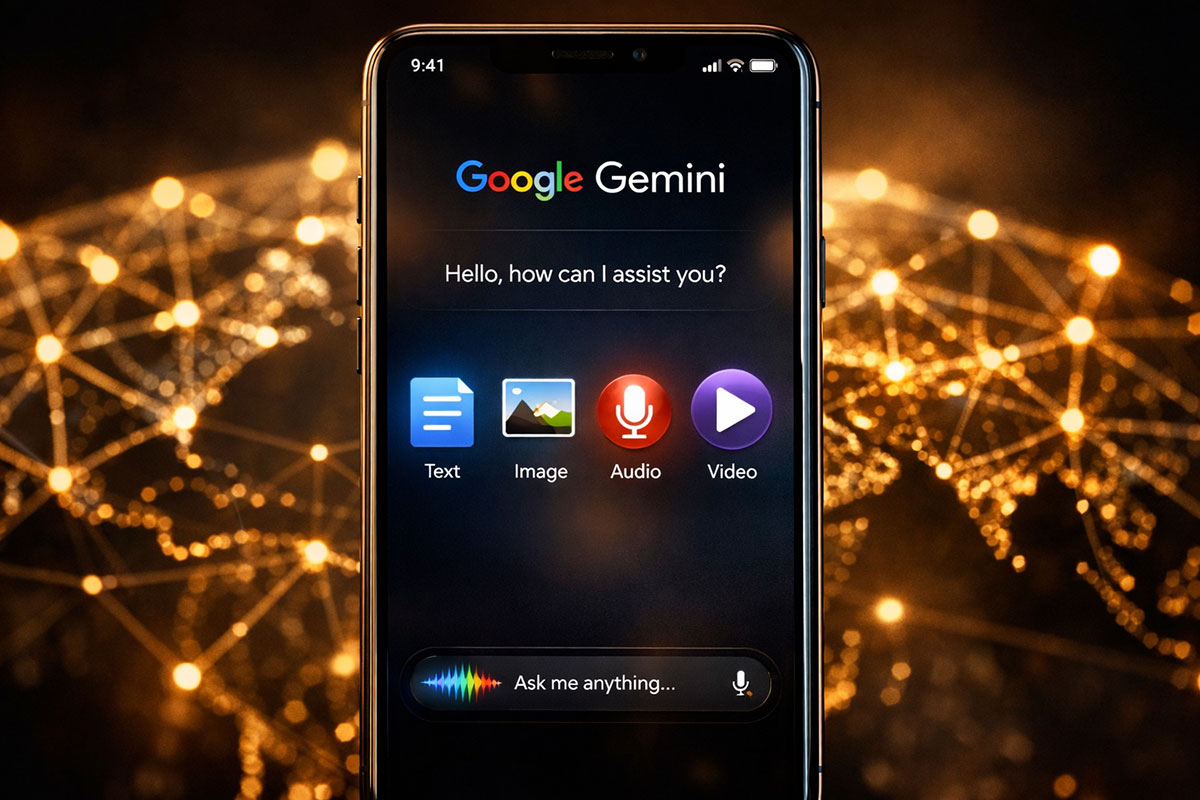
Google's "Year in Search" report, released in December 2025, came with a chart-topper nobody expected. Not a celebrity scandal. Not a major news event. Not even a sports moment (though India vs England in men's cricket grabbed second place). The number one globally trending search of 2025 was a single word: Gemini.
That's not just a milestone for a product launch. That's a signal that AI has crossed a threshold from "exciting technology" to "part of everyday curiosity." And it tells a story about how power shifts in technology—not through superiority in a lab, but through omnipresence in how people actually search.
The implications are bigger than Google winning a quarter. They're about how AI becomes infrastructure, what skills matter in 2026, and why billions of people are now making a single choice: which AI to trust with their questions.
Part 1: Why Gemini Topped a Billion Searches
The spike in Gemini searches started in September 2025. That's not random. That's when Google released a cascade of updates across its core services: Chrome got AI features. Android got AI integration. Search itself became an "intelligence engine" instead of a keyword-matching system.
In other words, Gemini didn't trend because it was brilliant in a demo. It trended because suddenly, millions of people encountered it whether they were looking for it or not.
The Native Integration Strategy
Unlike ChatGPT, which requires deliberate choice—you have to open the site, sign up or log in, and explicitly start a conversation—Gemini came pre-installed in billions of devices. Chrome users saw it. Android users saw it. Google Search users saw it. That's distribution that no standalone product can compete with.
When Google baked Gemini into Search's native "AI mode," the friction dropped to zero. You searched for something, and instead of a list of blue links, you got synthesis. Analysis. An answer that acknowledged sources but presented the information the way a knowledgeable person would.
This is the difference between "here's a tool you might want to use" and "this is now how search works." Google chose the latter.
The Multimodal Advantage
Gemini 3, released in November 2025, represented a genuine capability jump. It's natively multimodal in a way GPT-5 and Claude 4 still aren't quite there yet.
Feed Gemini text, images, audio, and video simultaneously. It understands spatial relationships, reads text overlays in video, contextualizes everything together. GPT-5 is spectacular, but it requires separate modules for image understanding and audio handling. Claude is incredible for text and reasoning, but it's text-first.
Gemini 3 was designed from the ground up as "everything simultaneously." That matters for real-world use cases: a student uploads a photo of a handwritten math problem, a chart from a textbook, and an audio clip from a lecture, asking for an explanation. Gemini gets the full context in one pass.
On benchmarks, they're competitive. Gemini 3 slightly leads on multimodal tasks (MMMU-Pro and Video-MMMU), while ChatGPT maintains advantages in certain coding domains, and Claude wins on sustained long-document analysis. But for most users, the capability difference is invisible. What's visible is which one they encounter first, and which one doesn't require switching apps.
Part 2: India-Specific Dominance and the Viral Features
The global story of Gemini's rise masked something more interesting happening in India.
Gemini AI Photo became the second-most-trending AI-related search in India. That's not because it was the most advanced. It's because it solved a visible problem: people wanted to create stunning portrait photos without Photoshop skills.
The feature worked like this: upload a selfie, give Gemini a description of what you want ("make this look like a magazine cover," "transform this into a luxury saree portrait," "make this a cinematic couple photo"), and it does the work. The resulting images looked professionally shot—the kind of thing that would take hours in Photoshop or thousands in hiring a photographer.
For India's creator economy, that's huge. YouTubers needed thumbnails. E-commerce sellers needed product shots. Couples wanted engagement-announcement photos. Dating app users wanted better profile pictures. All of that became accessible through Gemini AI Photo.
The third trending search was the "Ghibli-style art" prompt. Users discovered they could ask Gemini to generate any image in the style of Studio Ghibli's soft, dreamy aesthetic. Suddenly, millions of people created anime-adjacent artwork of themselves, their pets, and their dreams. That became a social media trend, which drove more searches, which drove more awareness.
This is how technologies become mainstream—not through technical superiority alone, but through cultural virality. Gemini wasn't trending because it was the best reasoner. It was trending because it made something people wanted accessible.
Part 3: The Competitive Landscape—Who's Actually Winning?
Here's where the narrative gets interesting, because it's not as simple as "Gemini won."
In the same period, DeepSeek became #4 in India's trending AI searches. That's remarkable for a model that costs 1/100th as much as OpenAI's. ChatGPT remained visible and widely used. Perplexity gained traction among people who wanted search-like AI responses.
But here's the difference: they were all being used. Gemini was omnipresent.
The Distribution vs. Capability Trade-Off
When people talk about who "won" the AI war, they usually mean who has the best model. By that metric, it's genuinely unclear. Gemini 3 is slightly sharper on multimodal tasks. GPT-5 is fractionally better at certain reasoning problems. Claude Opus 4.5 is potentially the safest and most consistent.
But models don't win wars. Distribution does. And that's where Gemini has become nearly unbeatable.
Think about the average user in 2025:
- They search on Google every day. (2+ billion people)
- They use Chrome or Android as their primary browser or phone OS. (billions)
- They encountered Gemini integrated into those experiences.
- They didn't have to make an active choice to try it.
Compare that to OpenAI's path: You have to know ChatGPT exists. You have to visit a website or download an app. You have to create an account (or log in). You have to remember to use it instead of search.
For the average person, that friction is real. OpenAI has a user base estimated at 100+ million people. But Google has 4+ billion search users. The overlap is huge, but the comparison is revealing.
Where ChatGPT Still Dominates
ChatGPT held its own in categories where integration doesn't matter as much. Professionals using AI for creative work, coding, research, and problem-solving often prefer ChatGPT's interface and conversation structure. The subscription model lets them pay for premium reasoning (ChatGPT Pro with o1 features).
But even that is shifting. Gemini's integration with Google Workspace means it can draft emails in Gmail, create slides in Google Slides, and write docs in Google Docs without switching contexts. That's a different kind of winning—not being the best at one thing, but being available in every application someone already uses daily.
The Cost Factor Nobody Talks About
Here's something that hasn't gotten enough attention: Gemini is free. ChatGPT requires a subscription for advanced features. Claude requires subscription for Claude Pro. DeepSeek is free but requires explicit download and setup.
For the vast majority of the world, "free" wins. Whether it's the best or not becomes secondary.
Part 4: Gen Z's Shopping Revolution—The Real Business Story
The search rankings tell one story. The behavioral change tells the real one.
In 2025, over 50% of Gen Z started using AI for product discovery instead of traditional search or social browsing. Instead of typing "black sneakers," they started asking Gemini or other AI tools: "Show me trendy black sneakers that would go with my style."
This represents a seismic shift in how retail works.
Visual Search Became the Default
Gen Z never liked typing keywords. They grew up with Instagram, TikTok, and Pinterest—platforms where images are the language. When visual search became mainstream (through Gemini, Google Lens integration, and similar tools), it felt natural, not like a new feature.
The workflow changed:
- Old: See something cool in real life → Remember the name → Search for it → Find it online
- New: See something cool → Take a photo → Upload to Gemini/Google Lens → Get similar products instantly
This speed advantage isn't marginal. It's massive. The friction dropped from a multi-step process to a single tap.
Brands like H&M integrated visual search into their apps. Instead of browsing categories, users could upload a photo of an outfit they loved and find matching items in H&M's catalog within seconds. Conversion rates went up. Customer satisfaction went up.
AI Styling Became Personalization at Scale
The next wave: AI styling tools that analyze your preferences and generate personalized outfit recommendations in real time. Gen Z loved this because it combined personalization (something Instagram influencers do) with speed (instant gratification), without requiring human stylists (access without gatekeeping).
Some brands started offering virtual try-ons powered by AI. Upload a photo of yourself in a shirt, and the AI will show you how different colors and styles would look on you. It's not perfect, but it's 80% accurate and infinitely faster than going to a store.
The Job Market Signal
Here's what matters for 2026: companies are hiring for roles that didn't exist in 2024. "AI shopping specialist," "visual search strategist," "AI merchandiser." These aren't engineer roles. They're business roles that require understanding how AI changes customer behavior.
If you're a business student, this is the skillset that makes you valuable in 2026: understanding how AI changes the customer journey, how to experiment with new interfaces, and how to interpret what AI recommendations are actually doing to your business.
Part 5: What This Means for Your Skills in 2026
The Gemini dominance reveals something important: the AI war isn't about the best model anymore. It's about context and access.
The Skills That Matter
Understanding which tool solves which problem. In 2025, everyone still acted like there would be "one AI to rule them all." By the end of the year, it was obvious that's not happening. Gemini is best for search and multimodal tasks. ChatGPT is best for extended reasoning and conversation. Claude is best for long documents and code. DeepSeek is best for cost-sensitive operations. You need to know which to reach for when.
Knowing how to prompt for what you actually want. This isn't "prompt engineering" (which implies there's a secret syntax). It's the ability to clearly explain to an AI what problem you're solving. That's a communication skill, not a technical skill.
Understanding the legal and ethical boundaries. What's fair use when you're training on your data? What's allowable when you're using AI to make business decisions? What's the difference between using AI responsibly and just using it? These are the questions that separate professionals from people who just copy-paste prompts.
Knowing how to use AI for augmentation, not replacement. The professionals making money with AI in 2026 aren't replacing themselves with AI. They're amplifying themselves. They use AI to do research faster, draft content quicker, analyze data more broadly. Then they add judgment, creativity, and context. That human layer is what's valuable.
Building in public about your AI experiments. If you're trying to understand how AI changes your field, the fastest way to learn is to experiment publicly and let feedback guide you. That visibility becomes your resume in 2026.
Part 6: The Predictions That Matter for 2026
Gemini will be the default search experience for most people by mid-2026. Not because it's the best at everything, but because it's the default and it's good enough at most things.
OpenAI will respond with integration into Microsoft products. ChatGPT will become harder to ignore because it'll be in Word, Outlook, and Teams by default. Microsoft has the leverage to play the distribution game too.
Visual AI will become standard in commerce. Brands that don't offer visual search and AI-powered product discovery will look outdated by the end of 2026. It's becoming table stakes for retail.
Cost will drive adoption of open models for businesses. While consumers use free Gemini, companies will increasingly run open-source models to avoid per-token costs. That flips the power dynamic for enterprise software.
The job market for "AI skills" will split. There will be jobs for people who build AI systems (increasingly rare, highly paid, concentrated at a few labs). There will be massive demand for people who implement AI into existing businesses and workflows. The bottleneck will shift from "who can build the AI" to "who can make the AI useful to a real business."
AI tutoring will finally work. In 2025, AI tutoring was still broken because it requires sustained interaction and personalization. By 2026, we'll see the first tutoring systems that actually adapt to how each student learns, at scale, at low cost. Education changes faster than people realize once you remove the constraint of physical classrooms.
Part 7: What Gemini's Victory Means for You
If you're reading this, you're probably thinking: "Okay, so Gemini won the search battle. Cool. What does that actually mean for my life?"
It means the default AI you encounter is getting smarter and more useful. You don't have to be deliberately choosing to use AI anymore. It's in the tools you already use.
It means the AI you encounter was trained on your language and culture. Google trained Gemini on massive amounts of diverse data. It understands idioms, cultural context, and local knowledge better than earlier models. That's not because Google is benevolent—it's because global users demand it.
It means competition is pushing all models toward better reasoning and reliability. When the number-one AI is constantly being challenged, everyone raises their game.
It means distribution matters more than capabilities. This is the important one for 2026 and beyond. The best AI in the world doesn't matter if nobody's using it. That has real implications for which companies will win, which technologies will spread, and which skills will matter.
Conclusion: The Victory That Looks Like Defeat
If you're rooting for underdog AI companies, Gemini's dominance looks like the big player crushing the competition. If you're paying attention to what actually matters, it's the opposite.
Gemini's victory proved that openness beats hype. That distribution beats innovation theater. That integration beats feature superiority. That accessibility beats elitism.
That's good news for everyone, because it means AI gets better when it's used widely. And it gets used widely when it's accessible. And it becomes accessible when it's part of the tools you already depend on.
2026 won't be about which AI is smartest. It'll be about which AI is most useful in the context where you actually work. And that's a far more interesting competition than a benchmark showdown.
The year Gemini won the search wasn't the year one company defeated another. It was the year AI stopped being optional and became inevitable.
About the Author
Girish Soni is the founder of TrendFlash and an independent AI strategist covering artificial intelligence policy, industry shifts, and real-world adoption trends. He writes in-depth analysis on how AI is transforming work, education, and digital society. His focus is on helping readers move beyond hype and understand the practical, long-term implications of AI technologies.