Table of Contents
- Breaking: OpenAI Goes Hardware — 200+ Engineers, Three Devices, One Mission
- The $200 OpenAI Smart Speaker: What We Know So Far
- The Jony Ive Connection: How a $6.5 Billion Acquisition Made This Possible
- OpenAI Smart Glasses: The 2028 Play That Could Rival Meta
- Physical AI vs. Digital AI: Why OpenAI Needs Eyes and Ears in Your Home
- The Competitive Landscape: OpenAI vs. Meta vs. Apple
- The Privacy Question Nobody Is Ignoring
- India's Sovereign AI Push: A Different Kind of Hardware Race
- What This Means for You — And What Comes Next
Breaking: OpenAI Goes Hardware — 200+ Engineers, Three Devices, One Mission
Something massive just leaked. On February 20, 2026, The Information reported that OpenAI has quietly assembled a team of more than 200 people dedicated entirely to building consumer hardware. Not software updates. Not API improvements. Actual physical devices you'll hold in your hands and place in your homes.
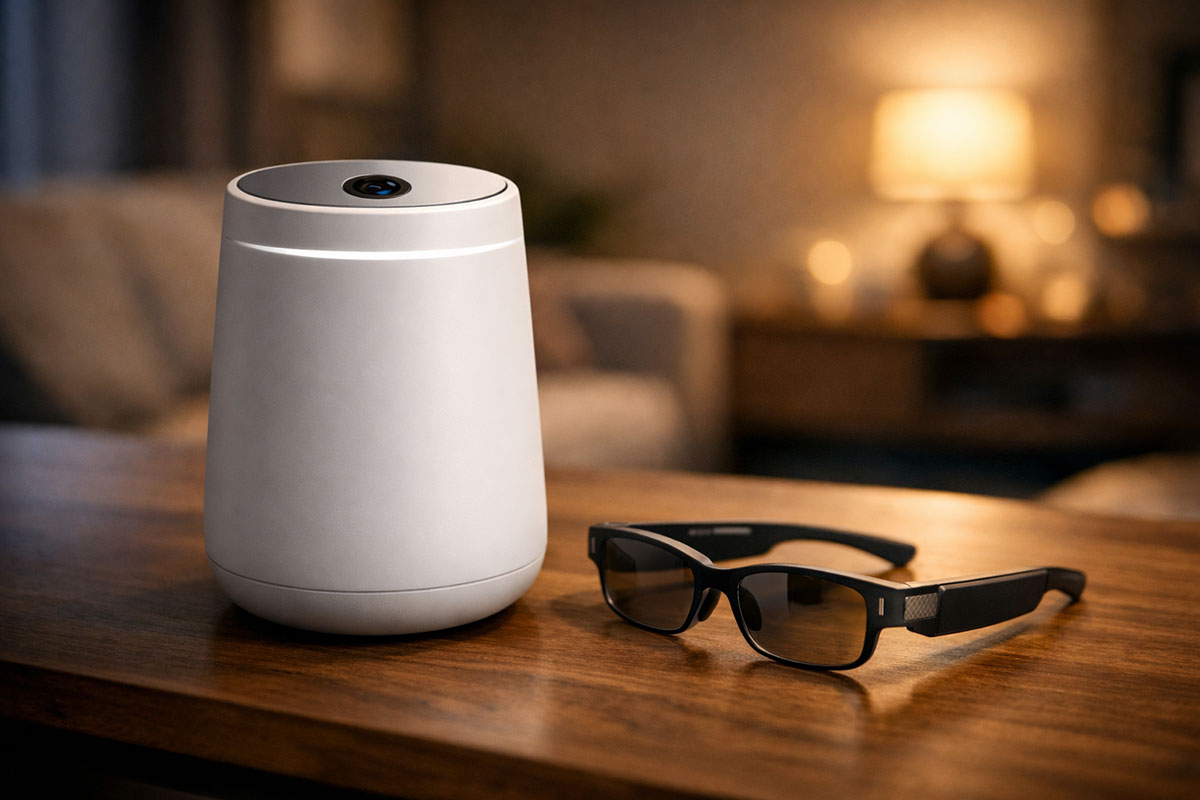
The lineup? A smart speaker with a built-in camera, a smart lamp, and — eventually — AI-powered smart glasses. The smart speaker comes first, likely priced between $200 and $300, with a launch window of February 2027 at the earliest. The glasses won't hit mass production until 2028. And the smart lamp? Prototypes exist, but a commercial timeline is still unclear.
This isn't a side project. This is OpenAI's clearest signal yet that the company behind ChatGPT believes the future of artificial intelligence isn't trapped behind a screen — it's woven into the physical world around you. And with legendary designer Jony Ive at the helm of design, a former Apple hardware chief running manufacturing, and a $6.5 billion acquisition backing the whole thing, this pivot is dead serious.
Let's break down everything we know — the devices, the strategy, the competition, and what it all means for the future of how humans interact with AI.
The $200 OpenAI Smart Speaker: What We Know So Far
Forget what you know about Alexa or Google Home. OpenAI's smart speaker isn't just another voice-activated cylinder that plays music and sets timers. This device is designed to see, hear, and understand the world around it in real time.
Key Features Revealed
According to The Information's report, the speaker will feature an integrated camera that allows it to take in visual information about its users and their surroundings. Think about that for a second. The speaker can identify items sitting on your kitchen table, understand who's in the room, and even interpret ongoing conversations happening nearby.
It gets more interesting. The device will include a facial recognition system similar to Apple's Face ID, which means it can identify individual users. This isn't just for personalization — OpenAI plans to let users make purchases directly through the speaker by verifying their identity with their face. Imagine glancing at your speaker and saying, "Order more coffee pods," and it just... does it. No phone needed. No app needed.
In an internal presentation to employees, OpenAI described the speaker as a device that would actively observe users and suggest actions to help them achieve their goals. One example given: if the speaker detects you're up late working the night before an important morning meeting, it might suggest you head to bed early. This is agentic AI stepping off the screen and into your living room — an autonomous assistant that doesn't wait for commands but anticipates your needs.
Pricing and Launch Timeline
The target price of $200 to $300 is deliberately aggressive. For context, Amazon's Echo Show 10 with a camera retails for around $250. Apple's HomePod sits at $299. OpenAI is positioning this speaker to compete directly on price while offering fundamentally deeper AI capabilities — backed by ChatGPT's multimodal reasoning that no current smart speaker can match.
The device is not expected to ship before February 2027. That timeline has already slipped from the original 2026 target, suggesting OpenAI is prioritizing product refinement over speed-to-market. Given the privacy sensitivities around a camera-equipped device in people's homes, this caution makes strategic sense.
"The products that we're using to deliver and connect us to unimaginable technology, they're decades old. It's just common sense to at least think surely there's something beyond these legacy products." — Jony Ive, on why AI needs new hardware
The Jony Ive Connection: How a $6.5 Billion Acquisition Made This Possible
None of this would be happening without one of the most consequential acquisitions in recent tech history. In May 2025, OpenAI announced it was buying io Products — the hardware startup founded by former Apple design legend Jony Ive — for approximately $6.5 billion. The deal was finalized in July 2025, officially merging io's team into OpenAI.
Who Is Jony Ive and Why Does He Matter Here?
For anyone who's ever used an iPhone, an iMac, an iPad, or an Apple Watch — you've used a Jony Ive product. As Apple's chief design officer for decades, Ive was the creative force behind virtually every iconic device Apple ever produced. When he left Apple in 2019 to start his own firm LoveFrom, the tech world held its breath waiting to see what he'd do next.
What he did next was partner with Sam Altman. io Products was founded quietly by Ive alongside former Apple veterans Scott Cannon, Tang Tan, and Evans Hankey. Tang Tan, who spent 25 years at Apple, now serves as OpenAI's chief hardware officer and reports directly to Altman. At least 25 former Apple employees have joined OpenAI through this pipeline in 2025 alone, bringing deep expertise in audio engineering, wearable design, and manufacturing.
Here's the kicker: OpenAI paid $6.5 billion for io, making it the company's largest acquisition to date — dwarfing even the $3 billion Windsurf deal. That's not the kind of money you spend on a nice-to-have experiment. That's a company-defining bet that AI hardware is the future of OpenAI's business.
What Ive and Altman Have Said About Their Vision
In November 2025, Ive and Altman gave a rare joint interview where they described the device as "peaceful" and an "active participant" that's not annoying. They said the goal was to create something that would "make people feel joy" — language that sounds very Apple-circa-2007, and that's probably intentional.
While Ive's design firm LoveFrom remains independent, it has taken over what OpenAI calls "deep design and creative responsibilities" across the entire company — including its software. This means Ive's influence extends beyond hardware. The look and feel of ChatGPT itself could evolve under his creative direction. For a deeper look at how tech giants are competing for AI dominance through design and infrastructure, check out our analysis of the Apple vs. Google vs. Microsoft AI war in 2026.
The Manufacturing Backbone
Design is one thing. Actually building millions of units is another. OpenAI has signed a manufacturing agreement with Luxshare — a Chinese electronics giant that also builds components for Apple's AirPods and iPhones — to produce the smart speaker. Goertek, another major Apple supplier, is in talks to supply speaker modules. OpenAI is also actively seeking U.S.-based suppliers for component manufacturing, likely in response to ongoing tariff and supply chain pressures.
OpenAI Smart Glasses: The 2028 Play That Could Rival Meta
The smart speaker is just the opening act. The real ambition? AI glasses that could fundamentally change how we interact with the world — and with AI itself.
According to The Information's report, OpenAI's smart glasses are in development but not expected to be ready for mass production until 2028. The project is still in early stages, and there's a possibility it could be canceled depending on how the speaker performs. But the strategic intent is unmistakable: OpenAI wants to put its AI on your face.
Why Glasses Matter More Than a Speaker
A smart speaker stays in one room. Glasses go everywhere you go. They see what you see. They hear what you hear. For an AI system like ChatGPT — which is rapidly evolving into a multimodal reasoning engine capable of understanding text, images, video, and audio simultaneously — glasses represent the ultimate data interface. They transform a text-based chatbot into an always-present, always-aware companion that understands your world in real time.
This is also why the comparison to Meta's Ray-Ban glasses is so important. Meta has already proven that consumers will wear AI on their faces. The question is whether OpenAI can offer something deeper — not just cameras and social sharing, but genuine intelligence that understands context, anticipates needs, and acts autonomously. As we covered in our piece on Large World Models and spatial reasoning, this is exactly where AI's next frontier lies.
Physical AI vs. Digital AI: Why OpenAI Needs Eyes and Ears in Your Home
There's a deeper strategic question underneath all these product announcements: Why does a software company that prints money from API subscriptions and ChatGPT Plus memberships even need hardware?
The answer is data — specifically, the kind of data that no chatbot interface can capture.
The Limits of Screen-Based AI
ChatGPT is extraordinarily capable within the boundaries of a text box or voice conversation. But it's fundamentally blind. It can't see your kitchen. It doesn't know what's on your desk. It has no idea whether you're stressed, tired, or rushing to get out the door. Every interaction requires you to describe your world in words before the AI can help you navigate it.
A camera-equipped speaker changes that equation entirely. With visual input, OpenAI's models can identify objects, read body language, understand spatial context, and take proactive action. This is what the industry calls Physical AI — artificial intelligence that perceives and interacts with the real world, not just a digital one.
As we discussed when covering the rise of Agentic AI, the logical next step for these autonomous agents is a physical body — starting with the devices OpenAI is building today. A smart speaker with a camera is, in many ways, an AI agent's first set of eyes and ears in your home.
The Data Flywheel
There's also a business logic here that's hard to ignore. OpenAI's models get better with more data. Hardware devices that sit in millions of homes and ride on millions of faces generate a constant stream of real-world visual, audio, and contextual data — the exact kind of training signal that makes multimodal AI models smarter. It's a flywheel: better hardware gathers better data, which trains better models, which make the hardware more useful, which sells more hardware.
This is precisely why every major AI company is racing toward hardware. Not because speakers and glasses are inherently profitable — but because they're the gateway to the most valuable AI training data on earth: how humans actually live.
The Competitive Landscape: OpenAI vs. Meta vs. Apple
OpenAI isn't entering an empty market. The AI hardware space already has formidable players with real products and real sales numbers. Here's how the landscape looks right now.
Meta Ray-Ban AI Glasses: The Market Leader
Meta's Ray-Ban glasses have been a breakout consumer hit. EssilorLuxottica, Meta's manufacturing partner, reported that more than 7 million units of AI-powered Ray-Ban and Oakley glasses were sold in 2025 alone — more than tripling the combined total of 2023 and 2024. The global smart glasses market grew 110% year-over-year in the first half of 2025, with AI-powered glasses accounting for 78% of total shipments.
Meta has set a target of selling 10 million glasses per year by the end of 2026. In September 2025, the companies launched the Ray-Ban Display — a $799 model with a small display integrated into one lens, controllable via hand gestures and neural inputs. Demand for that model has been so strong that the international launch was delayed due to unprecedented U.S. demand. Meta and EssilorLuxottica are reportedly in talks to double production to at least 20 million units.
Apple: The Ecosystem Powerhouse
Apple is developing its own AI-powered home hub with an integrated camera and speaker, reportedly set to launch in 2026. Additionally, Apple is working on smart glasses, a camera-equipped wearable pendant, and upgraded AirPods with advanced AI capabilities. Apple's approach emphasizes on-device AI processing and privacy — a stark contrast to OpenAI's cloud-dependent model.
AI Glasses Comparison: Meta vs. OpenAI (Projected)
| Feature | Meta Ray-Ban AI Glasses | OpenAI AI Glasses (Projected) |
|---|---|---|
| Status | Available now (since Oct 2023) | In development, mass production ~2028 |
| Core Focus | Photos, video, calls, Meta AI assistant | Deep multimodal reasoning, agentic AI |
| AI Engine | Meta AI (Llama models) | ChatGPT / GPT models |
| Camera | Yes — photo and video capture | Expected — real-world context capture |
| Display | Ray-Ban Display model: small in-lens screen ($799) | Unknown — likely minimal or screenless |
| Sales Record | 7 million+ units in 2025 | N/A — not yet launched |
| Price Range | $299 – $799 | Unknown — likely competitive |
| Design Partner | EssilorLuxottica / Ray-Ban | Jony Ive / LoveFrom |
| Key Advantage | Market-proven, massive install base | Industry-leading AI reasoning capabilities |
The takeaway? Meta has a two-year head start and millions of glasses already on people's faces. But OpenAI brings something Meta can't easily replicate — the world's most advanced reasoning AI model. The race will ultimately come down to whether consumers value social features and availability (Meta's strength) or deep, contextual intelligence (OpenAI's bet).
The Privacy Question Nobody Is Ignoring
Let's address the elephant in the room. A smart speaker with a camera that has "always-on" ambient awareness capabilities — sitting in your living room, watching your family, listening to your conversations — is a privacy minefield.
The device's ability to identify people via facial recognition, observe surroundings, and even facilitate purchases raises legitimate concerns about biometric data storage, consent, and security. OpenAI has not yet clarified how it intends to handle these issues.
This is exactly the kind of challenge we've explored in our coverage of how AI is redefining privacy and security. For OpenAI, getting privacy right isn't just an ethical obligation — it's a commercial necessity. After the backlash that Meta faced over its AI data privacy changes, consumers are more privacy-conscious than ever. A single major privacy scandal could sink the entire hardware venture before it launches.
Apple's competitive positioning here is also worth noting. Apple has historically marketed its devices on the promise of on-device processing and data privacy. If OpenAI's speaker needs to send video and audio to the cloud for processing — as is likely, given the computational demands of advanced multimodal AI — it could face a tough comparison against Apple's privacy-first approach.
India's Sovereign AI Push: A Different Kind of Hardware Race
While OpenAI bets on consumer hardware in the West, India is making a parallel — and equally massive — play on the infrastructure side of AI.
The India AI Impact Summit 2026, which concluded on February 20 at Bharat Mandapam in New Delhi, secured over $250 billion in infrastructure investment commitments and nearly $20 billion in venture capital and deep-tech investments. Union IT Minister Ashwini Vaishnaw described the summit as a "grand success," with participation from over five lakh visitors and 86 nations endorsing the summit declaration.
Among the headline announcements: Tata Group and OpenAI revealed a joint 100 MW AI infrastructure project, scalable to 1 GW. Google's Sundar Pichai committed to building a full-stack AI hub in Visakhapatnam. Reliance Jio's Mukesh Ambani announced gigawatt-scale sovereign compute capacity, with 120 MW set to go live in 2026.
The government also announced AI Mission 2.0, which will focus on developing next-generation AI models, shared compute infrastructure, and safety standards — with 12 institutes working in a network on safety frameworks. The foundation for a new semiconductor plant in Uttar Pradesh will be laid soon, and commercial production from the Micron facility begins February 28.
This matters for the OpenAI hardware story because it reveals a fundamental split in how different parts of the world are approaching the AI revolution. The U.S. and its tech giants are racing to build the consumer devices — the speakers, glasses, and wearables. India and other emerging economies are racing to build the underlying compute infrastructure that these devices will depend on. For a deeper dive into India's AI trajectory, read our full coverage of the India AI Impact Summit 2026 and the Bharat Mandapam breakthrough on AI sovereignty.
What This Means for You — And What Comes Next
If you're reading this and thinking, "So should I care about a smart speaker that won't ship for another year?" — the answer is a resounding yes. Here's why.
The Post-Smartphone Thesis Is Getting Real
Sam Altman has talked openly about his belief that the smartphone era is ending. Not tomorrow. Not next year. But the seeds are being planted right now. OpenAI's hardware push, Apple's wearable AI pin, Meta's glasses empire — all of these products are early experiments in what comes after the phone. The smart speaker is OpenAI's Trojan horse into your home. The glasses are the play for the world outside your door.
The AI Agent Gets a Body
We've been covering the explosive growth of the agentic AI market — autonomous systems that don't just answer questions but take actions on your behalf. Until now, those agents have been confined to software environments: booking flights, writing code, managing workflows. OpenAI's hardware gives those agents physical presence. A speaker that watches your home and anticipates your needs is an AI agent made tangible. Glasses that see the world as you see it are an agent that walks with you.
What to Watch For
- February–March 2027: Earliest possible launch of the OpenAI smart speaker. Watch for pre-orders and developer previews.
- 2027 Hardware Events: Expect OpenAI to hold its first-ever hardware launch event — likely modeled on Apple's legendary keynotes, given Ive's involvement.
- 2028: If the speaker succeeds, smart glasses enter mass production. If it doesn't, the glasses program could be canceled.
- Privacy Regulation: Watch how the EU, U.S., and India respond to always-on AI cameras in consumer devices. This will shape what OpenAI can and can't do with these products.
- Meta's Response: With 7 million glasses already sold and a $20 million/year production target in sight, Meta won't sit idle. Expect Meta to deepen AI integration in Ray-Ban glasses aggressively.
The AI hardware wars have officially begun. And while the smartphone isn't dead yet, OpenAI, Meta, and Apple are all building the devices they believe will eventually replace it. The question isn't whether this transition will happen — it's which company will own it.
Related Reading
- CES 2026: What Physical AI Really Means and Why Tech Just Changed
- ChatGPT Voice & Vision Explained: How to Use AI Hands-Free
- The Rise of AI Agents in 2025: From Chat to Action
- AI-Powered Home Security: How Smart Cameras Are Changing the Game
- Building Trust: Why Responsible AI Matters in 2025
About the Author
Girish Soni is the founder of TrendFlash and an independent AI strategist covering artificial intelligence policy, industry shifts, and real-world adoption trends. He writes in-depth analysis on how AI is transforming work, education, and digital society. His focus is on helping readers move beyond hype and understand the practical, long-term implications of AI technologies.