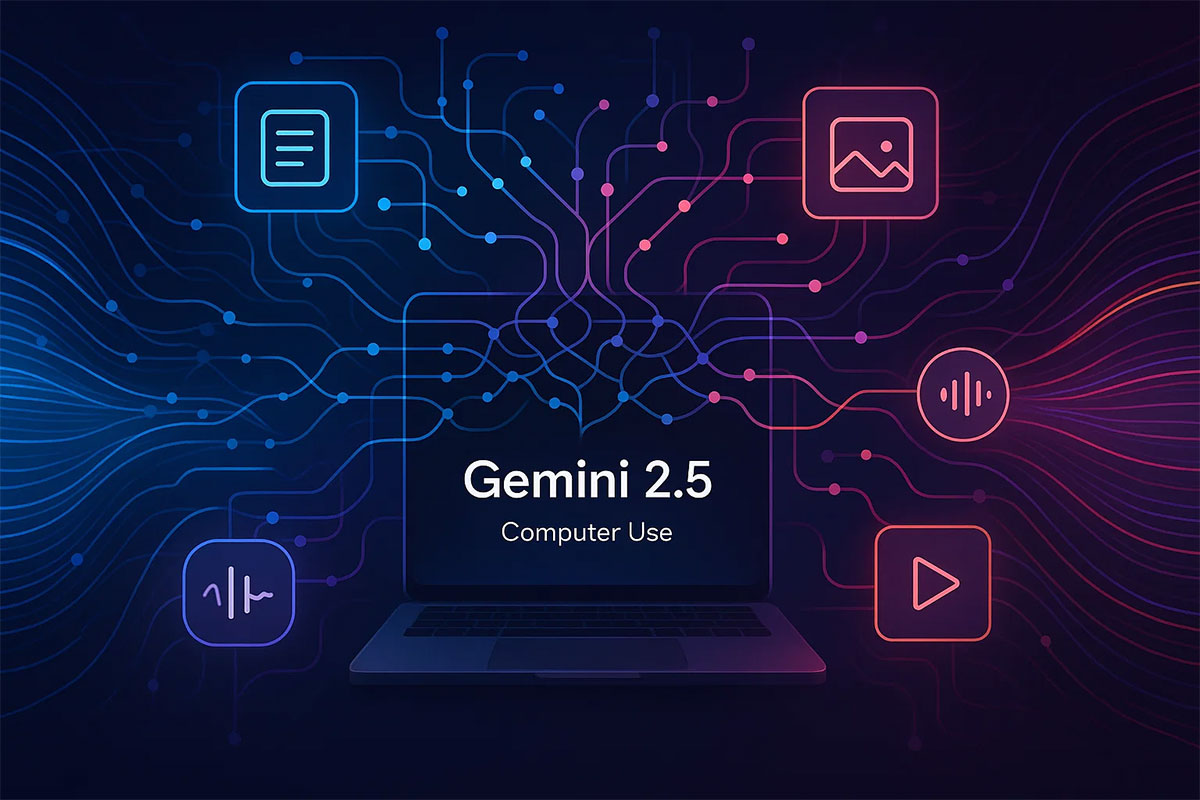
Artificial intelligence has evolved far beyond processing a single type of data. In 2025, multimodal AI has emerged as the defining trend, and with good reason. These systems don't just read text or analyze images in isolation—they simultaneously process text, images, video, and audio within a single unified model. Google's Gemini 2.5 Computer Use, released in October 2025, represents a watershed moment where multimodal capabilities have moved from theoretical promise to production-ready systems that deliver measurable business value.
Understanding Multimodal AI: The Fundamental Shift
Multimodal AI refers to artificial intelligence systems that can process, understand, and generate multiple types of data—text, images, audio, video, and code—within the same model architecture. Unlike traditional AI systems that handled each data type separately, multimodal models create a unified representation of information, allowing the system to reason across different data modalities simultaneously.
The fundamental breakthrough here involves converting all data types into a universal mathematical representation. When you input text, the model tokenizes your words and processes them through transformer networks, producing numerical vectors representing semantic meaning. Images undergo similar processing through convolutional neural networks that extract visual features. Audio is converted into spectrograms—visual representations of sound frequencies—and video combines frame-level visual data with temporal sequence understanding.
The magic occurs when the system aligns these different vector spaces through training on paired examples. During training on millions of examples—images with captions, videos with transcripts, documents with visual elements—the model learns that the word "sunset," an actual sunset photograph, and the sound of ocean waves at sunset all represent the same underlying concept. This cross-modal alignment enables the system to understand that these diverse inputs convey the same information, just in different formats.
How Multimodal Models Process Multiple Data Types
The architecture powering multimodal AI involves several sophisticated components working in concert. Consider Gemini 2.5, which processes all modalities natively within the same foundation model. Unlike earlier approaches that stitched together separate models for text, vision, and audio, native multimodal architecture means these capabilities aren't tacked on afterward—they're fundamental to how the model represents and processes information.
Early fusion approaches combine different modalities at the input stage, extracting features from text, images, and audio and then merging them into a single unified representation. This allows the model to capture relationships between data types from the earliest processing stages. Late fusion approaches, by contrast, process each modality separately and combine the results at the output stage, useful when different data types require specialized processing architectures.
Hybrid fusion approaches take the best of both worlds. For instance, in video understanding, a multimodal model might process visual frames through specialized computer vision layers while processing audio through speech recognition networks, then combining these at intermediate layers to capture both the spatial information in visual content and temporal patterns in audio.
The cross-attention mechanism is crucial in this process. When the model receives a query—such as "What color is the car in this image?"—it doesn't simply scan the image blindly. Instead, cross-attention mechanisms allow the model to focus on specific regions relevant to the query. The attention system computes relationships between every part of the text query and every region of the image, determining where to direct processing resources. This mimics human cognition, where asking about a car's color automatically draws your visual attention to the vehicle.
Architecture and Core Technologies Behind Multimodal Models
Multimodal AI models leverage several cutting-edge architectural innovations. Transformers, originally designed for text, have proven remarkably effective for multimodal processing. Vision Transformers break images into patches and process them as sequences, much like tokenizing text. This allows the same attention mechanism that powers language understanding to power visual understanding.
For video understanding, multimodal models employ temporal transformers that capture how visual content changes across frames, combined with attention mechanisms that sync visual and audio information. This temporal modeling is essential for understanding motion, scene transitions, and synchronizing speech with lip movements—a non-trivial task that requires the model to learn associations between visual and auditory patterns.
Generative Adversarial Networks (GANs) and Variational Autoencoders (VAEs) remain important for generative multimodal tasks. When a multimodal model generates video content from a text description, it must synthesize realistic visual frames that align with the narrative, maintain consistent character appearances across frames, and synchronize audio content. GANs achieve this through a generator creating content while a discriminator judges realism, creating a feedback loop that improves output quality.
The key innovation in 2025 involves diffusion models, which have become the standard for high-quality multimodal generation. These models learn to gradually denoise random noise into coherent content, allowing precise control over output characteristics. Unlike earlier GAN approaches that sometimes produced artifacts, diffusion models generate remarkably clean, photorealistic multimodal outputs.
Real-World Applications Transforming Industries Today
The practical applications of multimodal AI in 2025 extend far beyond research labs and proof-of-concepts. Real organizations are deploying these systems to solve concrete business problems.
Healthcare Diagnostics: Hospitals are implementing multimodal AI systems that combine medical imaging (X-rays, MRIs, CT scans) with clinical text records and patient history. These systems achieve 15-30% higher diagnostic accuracy compared to single-modality approaches. A radiologist can feed a patient's MRI scan, lab results, and clinical notes into a multimodal diagnostic system, which synthesizes this information to identify rare diseases that might be missed when analyzing each data type separately. This represents a paradigm shift in precision medicine, where AI augments physician expertise by considering all available patient information simultaneously.
Hawaii Department of Transportation Climate Resilience Platform: The Hawaii DOT implemented a multimodal AI system combining satellite imagery, weather data, historical infrastructure records, and real-time sensor data to predict climate impacts on transportation infrastructure. By processing visual data from Earth satellites with numerical climate predictions and text-based infrastructure maintenance logs, the system forecasts where coastal erosion will be most severe, where flooding patterns will shift, and which roads face imminent climate-related deterioration. This AI-driven foresight enables proactive maintenance and policy decisions that protect island communities.
Autonomous Vehicle Perception: Companies developing self-driving cars increasingly rely on multimodal perception systems that combine LiDAR point clouds, camera vision, and radar data into a unified scene understanding. Rather than having separate systems process each sensor type and then vote on decisions, multimodal systems fuse this data at the representation level, achieving superior object detection, localization, and tracking. This unified perception approach enables vehicles to navigate complex, dynamic environments with greater safety.
Retail Analytics and Computer Vision: Retailers deploy multimodal AI systems combining customer video footage with transaction data and product metadata. These systems identify which products customers examine, how long they pause at particular shelves, and whether they purchase items they considered. Computer vision combined with transactional data enables retailers to optimize store layouts, product placement, and inventory based on actual shopper behavior. The global computer vision market in retail alone reached approximately $2.05 billion in 2025, projected to reach $12.56 billion by 2033.
Content Generation and Media Production: Multimodal generative systems now produce synchronized video and audio content. Creators can input text descriptions of scenes, and the system generates realistic video with matching audio, eliminating the need for costly video shoots. This democratizes content creation, enabling smaller teams to produce professional-quality multimedia.
Gemini 2.5 Computer Use: The Industry Benchmark
Gemini 2.5 Computer Use, released in October 2025, deserves special attention as it represents a breakthrough in agentic multimodal AI. This specialized model processes text instructions along with screenshots of the user interface and generates specific UI actions—clicks, typing, scrolling—to accomplish tasks autonomously.
What makes this significant is the native multimodality. The model simultaneously understands the user's textual request, analyzes the visual layout of the interface, understands the relationship between text labels and UI elements, and generates appropriate actions. Google's internal testing showed Gemini 2.5 Computer Use outperforms competitors on multiple web and mobile control benchmarks with lower latency.
Real-world deployment shows remarkable results. Google's Payment Platform team used Gemini 2.5 Computer Use to fix fragile end-to-end UI tests—a task that would have required days of manual work. The system successfully fixed over 60% of test execution failures autonomously. Similarly, Autotab, an AI agent service, reported that Gemini 2.5 Computer Use surpasses other models in reliably parsing complex UI contexts, with performance improvements up to 18% on difficult evaluations.
The technical capability extends beyond web browsers. The model demonstrates strong promise for mobile UI control and shows potential for enterprise automation scenarios including form filling, workflow automation, and data collection across multiple systems.
Comparing Multimodal Leaders: Gemini 2.5, Claude 3.5, and OpenAI Vision
Understanding how leading multimodal models compare helps organizations choose the right technology for their needs. Gemini 2.5 Pro brings true native multimodality across text, code, images, audio, and video. The model achieves impressive benchmarks: 86.7% on AIME 2025 mathematics, 84% on GPQA Diamond science questions, and 63.8% on SWE-Bench Verified for code generation. Its massive context window of 1 million tokens (expanding to 2 million) enables processing vast documents, entire codebases, or comprehensive video transcripts in single requests.
Claude 3.5 Sonnet excels at reasoning tasks and handles multimodal inputs through powerful text and image processing. While its multimodal capabilities focus primarily on text and images rather than audio and video, it performs exceptionally well in document analysis, code review, and complex reasoning tasks. Its 200,000-token context window supports extensive document processing, though less than Gemini 2.5.
OpenAI's GPT-4V brings multimodal vision capabilities but maintains text as the primary focus. It processes text and images effectively but doesn't natively handle audio or video modalities like Gemini 2.5.
For organizations prioritizing true multimodal capabilities—especially video and audio processing—Gemini 2.5 represents the clear technical advantage. For teams emphasizing reasoning and complex logic across text and images, Claude 3.5 offers competitive advantages.
Market Impact and Business Applications
The convergence of multimodal capabilities creates immediate business value. According to Gartner's 2025 analysis, organizations implementing multimodal AI report 27% faster campaign deployment in marketing, 40% time savings in healthcare administrative workflows through automation, and 78% autonomous handling of complex customer service inquiries across multiple systems.
The market opportunity extends across industries. In autonomous vehicles, multimodal perception systems enable safer navigation through better environmental understanding. In healthcare, multimodal diagnostic systems improve accuracy while reducing time to diagnosis. In retail, multimodal customer analytics optimize operations and personalization. In manufacturing, multimodal quality control systems combining visual inspection with sensor data reduce defects.
Cost considerations remain important. Processing multimodal content typically costs more than single-modality inputs due to higher computational requirements. However, the superior accuracy and ability to solve problems that single-modality systems cannot handle often justify the cost premium. Organizations report median ROI of 51% within three years of deploying multimodal AI systems.
Implementation Roadmap for Organizations
Successfully deploying multimodal AI requires strategic planning. Organizations should start by identifying high-value problems where multimodal approaches provide clear advantages—scenarios where single-modality solutions miss critical patterns or require manual synthesis of information from multiple sources.
The initial implementation phase focuses on pilot projects with well-defined scope and measurable success metrics. Rather than attempting comprehensive transformation immediately, organizations pilot multimodal solutions on specific workflows, measure results, and then expand to additional use cases.
Data preparation represents a critical implementation step. Organizations need to ensure they can feed multiple data types to the model in synchronized, high-quality formats. This might involve establishing data pipelines that combine disparate systems—medical imaging systems with electronic health records, for instance—into unified inputs for the multimodal model.
Security and privacy considerations require attention, particularly when handling sensitive data like medical images or customer video footage. Organizations must ensure multimodal models process sensitive data securely, maintain compliance with regulations like HIPAA or GDPR, and implement access controls preventing unauthorized data usage.
Challenges and Limitations in Current Multimodal Systems
Despite remarkable progress, multimodal AI still faces meaningful challenges. Data alignment remains difficult—ensuring that information across different modalities represents the same underlying concept requires careful training on paired examples. In healthcare, aligning medical images with clinical narratives requires domain expertise to ensure the model learns correct associations.
Interpretability challenges magnify with multimodality. When a model makes a diagnosis based on synthesizing imaging data, lab results, genetic information, and clinical history, explaining which factors drove the decision becomes more complex. This creates governance challenges in regulated industries like healthcare and finance where explainability is mandatory.
Model bias can amplify across modalities. If training data for vision components contains certain biases and training data for text components contains related biases, the multimodal model might exhibit compounded bias. Ensuring diverse, representative training data across all modalities requires substantial effort.
Computational requirements scale with multimodality. Processing text alone requires less computation than processing text plus images plus video. This creates cost considerations for organizations deploying multimodal systems, particularly at scale.
The Future: 2025 and Beyond
The trajectory of multimodal AI points toward several key developments. First, increasingly specialized multimodal models will emerge targeting specific domains. Rather than general-purpose models processing all modalities, organizations will deploy multimodal models fine-tuned for particular industries—healthcare-specific models combining medical imaging with clinical text, autonomous vehicle-specific models fusing LiDAR with camera data and radar, retail-specific models combining customer video with transaction data.
Second, multimodal models will become more efficient. While current models require substantial compute, research into model compression, knowledge distillation, and optimized architectures will enable multimodal capabilities on edge devices and mobile platforms. This will democratize multimodal AI access, moving these capabilities from cloud-only processing to on-device, privacy-preserving inference.
Third, agentic multimodal systems like Gemini 2.5 Computer Use will proliferate. These systems that can autonomously take actions based on understanding multiple data types will automate increasingly complex workflows, creating new categories of AI-powered automation.
Fourth, regulation and governance frameworks will mature around multimodal AI. As these systems handle more critical decisions in healthcare, finance, and autonomous systems, regulatory frameworks will emerge requiring explainability, bias auditing, and safety testing specific to multimodal capabilities.
The convergence of text, image, video, and audio processing into unified multimodal systems represents the next evolutionary step in artificial intelligence. Organizations that successfully implement multimodal AI strategies will gain significant competitive advantages through superior analysis, more sophisticated automation, and decision-making that accounts for all available information rather than siloed single-modality analysis. The time to begin planning multimodal AI integration is now.
Related Reading:
- Deep Learning Architectures That Actually Work in 2025: From Transformers to Mamba to JEPA Explained
- The Future of Multimodal AI in 2025: How Text, Image, and Video Models Are Converging
- AI Reasoning Explained: How Machines Are Learning to Think in 2025
- AI in Healthcare 2025: How Smart Diagnostics Are Transforming Patient Care
- Agentic AI in 2025: How Autonomous Systems Are Reshaping Work
About the Author
Girish Soni is the founder of TrendFlash and an independent AI strategist covering artificial intelligence policy, industry shifts, and real-world adoption trends. He writes in-depth analysis on how AI is transforming work, education, and digital society. His focus is on helping readers move beyond hype and understand the practical, long-term implications of AI technologies.