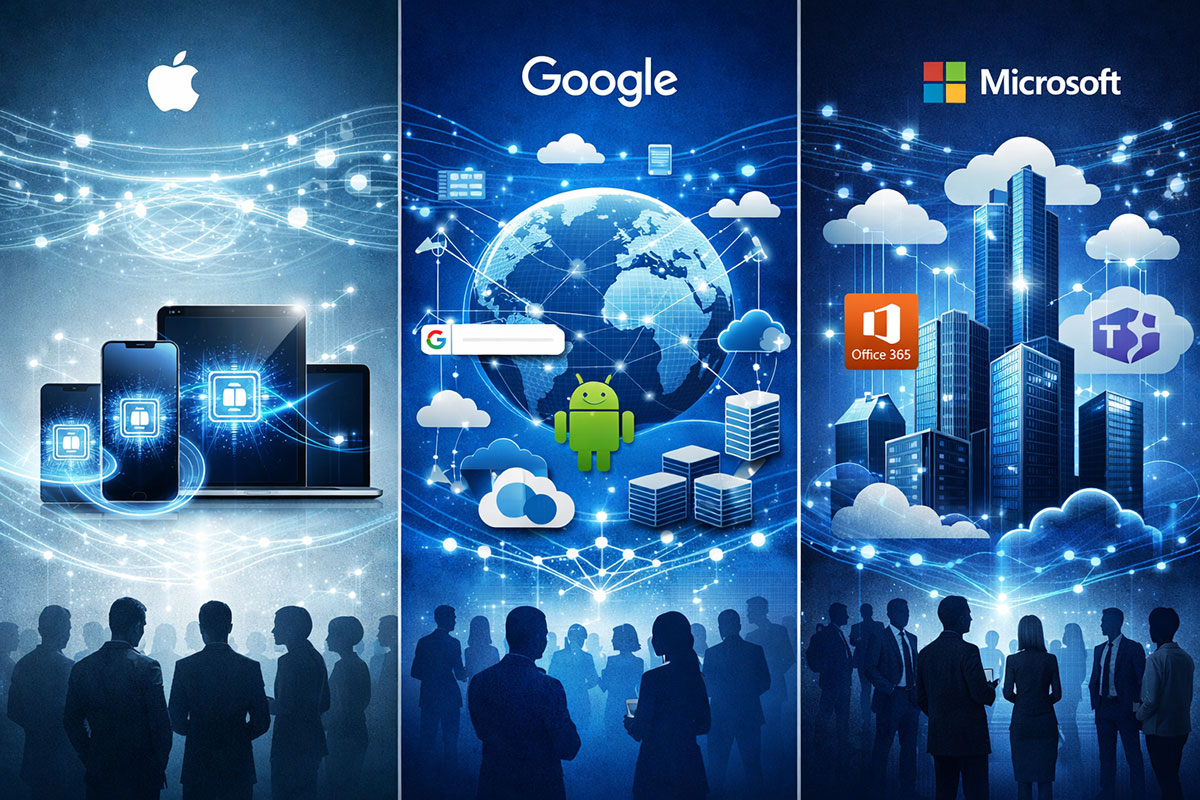
The AI War Has No Single Winner—Just Different Battlegrounds
We've reached an inflection point in 2026 where the narrative of "who's winning the AI race" has become almost meaningless. Apple, Google, and Microsoft aren't competing for the same prize. They're competing for different markets entirely, and remarkably, all three are winning.
This is the uncomfortable truth that Wall Street analysts struggle to articulate: the AI landscape isn't consolidating around a single dominant player. Instead, it's fracturing into distinct competitive zones where Apple dominates the premium consumer ecosystem, Google controls the distributed open web, and Microsoft captures enterprise productivity. Each strategy is radically different. Each strategy is working.
The real question for 2026 isn't who's winning overall—it's understanding which market matters most to your business and which company actually controls it.
Apple's Play: Premium Privacy and Ecosystem Lock-In
The Strategy
Apple entered the AI race not as a model builder but as an ecosystem integrator. Apple Intelligence isn't positioned as a standalone assistant competing with ChatGPT. It's positioned as the operating system's new nervous system—baked directly into iOS, iPadOS, macOS, and visionOS with near-invisibility.
The company made a deliberate architectural choice: run AI on-device whenever possible, keep data off servers, and when cloud processing is necessary, route it through Apple's Private Cloud Compute—an infrastructure Apple explicitly designed with limited server exposure and inspectable code that Apple publishes for security audits.
This isn't neutral engineering. It's a business strategy built around a single insight: privacy is becoming a luxury good, and Apple's 2 billion active devices represent the wealthiest, most privacy-conscious consumers on Earth.
Where Apple Actually Wins
| Market | Position | Strength |
|---|---|---|
| Personal Device AI | Dominant | On-device processing, no data exposure, system-level integration |
| Premium Consumers | Dominant | $300+ average selling price, willingness to pay for privacy |
| Creative Professionals | Strong | Image Playground, video tools, Genmoji, writing assistants |
| Ecosystem Lock-in | Dominant | Single unified experience across iPhone, iPad, Mac, Vision Pro |
| Enterprise (limited) | Weak | No MDM features, limited B2B focus, device restrictions |
The Numbers: Apple Intelligence rolls out across devices with A17 Pro chips and newer M-series Macs. That's roughly 350 million devices eligible immediately, growing to over 500 million by late 2026. Each device upgrade cycle now includes AI as a purchasing factor. iPhone 16 Pro pre-orders showed a measurable increase in upgrade velocity attributed to Apple Intelligence features, signaling that AI features are now actively driving hardware sales.
The Risk That Could Unravel Everything
Apple's approach has a fundamental vulnerability: capability lag. By late 2025, Google's Gemini 2.5 Pro had demonstrated superior multimodal capabilities (supporting text, image, audio, and video in ways Apple Intelligence currently can't match). Google's reasoning depth exceeded Apple's on-device models. Microsoft's enterprise agents outperformed Apple's consumer-focused Siri enhancements.
Apple promised advanced Siri with true agentic AI capabilities by 2026. This deadline matters. If Apple misses this window—if advanced Siri in 2026 doesn't meaningfully close the capability gap with Gemini and Copilot—the luxury of privacy won't save the platform. Users want both privacy AND capability. Apple's bet is that it can deliver both by 2026. If it can't, the "Apple Intelligence" narrative collapses.
Additionally, Apple's device-first approach means slower deployment and limited experimentation. Changes that take Google 48 hours to ship globally take Apple iOS update cycles—creating a cycle lag that could compound over time.
Google's Strategy: Distributed Dominance and the Multimodal Lead
The Architecture
Google is playing a different game: become the AI layer of the internet itself. Rather than concentrating AI within an ecosystem, Google is distributing Gemini everywhere—search, Android, web, workspace, Maps, Photos, YouTube—with the assumption that ubiquity beats perfection.
Gemini 2.5 Pro represents the current technical high watermark: it processes text, images, audio, and video simultaneously with a million-token context window—meaning it can process and understand 10 research papers, a 2-hour video transcript, and complex diagrams in a single request. This isn't a toy. This is what enterprise research teams and professional creators are actually using.
Google is also offering Gemini in three configurations:
- Gemini Nano (on-device, for privacy and speed)
- Gemini Pro (cloud, for complex reasoning)
- Gemini Ultra (advanced reasoning, for specialized domains)
This hybrid approach gives Google coverage across all use cases—privacy-conscious users, speed-focused consumers, and advanced professionals.
Where Google Dominates
| Market | Position | Strength |
|---|---|---|
| Open Web Search | Dominant | 8.5B daily searches, AI-integrated results |
| Multimodal AI | Dominant | Gemini 2.5 Pro (audio, video, text, images in one model) |
| Developer Ecosystem | Dominant | Google AI Studio, Vertex AI, extensive APIs |
| Free Tier Accessibility | Dominant | Free Gemini available globally, lowest barrier to entry |
| Mobile AI | Strong | Gemini Nano on Android, 1B+ Android devices |
| Workplace Productivity | Strong | Google Workspace integration (Docs, Sheets, Gmail) |
| Enterprise Agents | Emerging | Vertex AI agents, growing technical advantage |
The Numbers: Google reported 650 million Gemini users by late 2025. Gemini was Google's most-searched term in 2025, indicating massive consumer awareness. Android's 3.8 billion devices provide an installed base that dwarfs iOS. Google's cloud infrastructure spending ($100B+ annually) ensures technical capacity no other company matches.
The Existential Risk: The Search Gamble
Google's entire strategy depends on one enormous bet: AI-powered search is better than traditional search. This isn't certain. In fact, it's contested.
Early 2026 signals suggest that when Google integrated AI results directly into search results, some users found it:
- Hallucination-prone: AI models confidently stating incorrect information
- Incomplete: Google's tendency to be comprehensive threatened by summarization
- Unreliable for certain queries: Medical, legal, financial searches requiring certainty don't benefit from probabilistic AI responses
If advertisers flee AI-integrated search, if users complain that search quality declined, if regulatory pressure around AI integration increases—Google's entire value proposition collapses. The company that could lose the most from bad AI integration is Google, because search is 80% of Alphabet's revenue.
Remarkably, this is exactly the risk Google is taking in 2026. The company is betting that short-term disruption and user complaints will give way to long-term superiority. That's a high-stakes gamble with no guaranteed outcome.
Microsoft's Approach: Enterprise Dominance Through Office Infiltration
The Fundamental Advantage
Microsoft has something neither Apple nor Google can easily replicate: 380 million Office 365 users who pay subscription fees specifically to use Microsoft's productivity suite. This is a captive, corporate audience with existing workflow integration and budget allocation.
Microsoft's strategy is deceptively simple: embed Copilot so deeply into Office 365 that it becomes indispensable. Not as an optional add-on, but as the logical extension of how workers already use Excel, Word, Teams, and Outlook.
Examples of this already shipping:
- Excel: Copilot analyzes data, suggests insights, creates pivot tables through natural language
- Word: Drafting, editing, rewriting, and tone adjustment built into the writing experience
- Teams: Meeting transcripts, action item extraction, follow-up email generation—all automatically
- Outlook: Email composition, response suggestions, calendar optimization
- Power BI: Natural language queries on business data, dashboard creation through conversation
This is the Graph integration advantage: Microsoft owns the enterprise data layer (calendars, emails, files, chat history, project data, customer relationships). Copilot can access this entire graph to provide context-aware assistance that competitors can't match.
Where Microsoft Actually Dominates
| Market | Position | Strength |
|---|---|---|
| Enterprise Productivity | Dominant | Office 365 (380M users), deep integration, existing budget allocation |
| Business Process Automation | Dominant | Power Automate, integration with 1000+ business apps |
| Data Analysis & BI | Dominant | Power BI, Excel, SQL integration with AI agents |
| Unified Communications | Dominant | Teams + Copilot, meeting intelligence, organizational data access |
| Cloud Infrastructure | Dominant | Azure AI, 25% global cloud market share, $80B datacenter investment |
| Enterprise Agentic AI | Emerging Leader | Copilot Studio, GPT-5 integration, multi-step workflow automation |
| Consumer Reach | Weak | Bing integration, but limited consumer awareness |
The Numbers: Microsoft reported Azure AI revenue growing 175% year-over-year. Enterprise customers are committing to multi-year Copilot contracts worth hundreds of millions. Microsoft's market cap advantage over Apple ($3.79T vs $3.74T) is being driven substantially by investor confidence in enterprise AI monetization.
A financial services firm using Copilot reported 30% cost reduction in administrative tasks. An insurance company reported 25% productivity boost. These are the stories driving enterprise adoption.
The Vulnerability: OpenAI Dependency
Here's the uncomfortable reality: Microsoft's AI strategy still leans heavily on partnership with OpenAI rather than proprietary models. While Microsoft has improved its own models and is developing alternatives, the dependency on OpenAI's innovation creates strategic risk.
If OpenAI's technical direction diverges from Microsoft's needs, if OpenAI pivots toward consumer products that compete with Microsoft, or if regulatory pressure targets the Microsoft-OpenAI partnership—Microsoft's AI advantage evaporates.
Additionally, enterprise customers are increasingly sophisticated about vendor lock-in. Purchasing teams that once accepted bundled solutions now demand flexibility to use competing AI models within Microsoft infrastructure. This trend could compress Microsoft's margins over time.
The Market Breakdown: Who Wins Where in 2026
Consumer/Personal Computing: Apple Intelligence Leads (But Challenged)
For individual users prioritizing privacy and seamless experience, Apple Intelligence is currently winning. The on-device processing and Private Cloud Compute philosophy aligns with consumer sentiment around data protection.
However, this lead is being aggressively challenged. Google Gemini on Pixel phones offers superior AI capabilities. If consumers conclude that capability matters more than privacy, this advantage evaporates. The critical test: do iPhone users demand Gemini-level capabilities on iPhones? Early signals suggest yes—users want both privacy and power.
Prediction for 2026: Apple maintains the lead in premium consumer segment, but erosion at the edges.
Open Web & Search: Google Gemini Dominance (At Risk)
Google's distribution advantage is unmatched. The company controls search, Android, and free Gemini access. This makes Google the default AI interface for billions of people globally.
But the AI-powered search experiment is creating friction. If this continues, Google's lead weakens dramatically. The company is betting this is a temporary adoption curve issue that resolves by mid-2026.
Prediction for 2026: Google maintains dominance, but faces its most significant competitive threat in this market.
Enterprise Productivity: Microsoft Copilot Clearly Ahead
There is no real competition here. Microsoft's Office 365 installed base, Graph integration, and explicit focus on enterprise workflows create an advantage Apple and Google can't match in the near term.
Apple doesn't have 380 million paying enterprise users on a productivity suite. Google doesn't have organizational data access at the level Microsoft does.
Prediction for 2026: Microsoft extends lead in enterprise.
Mobile/Android: Google Gemini Advantage (Expanding)
Android devices outnumber iPhones by roughly 3:1. Google's native Gemini integration on Android, plus Pixel's hardware optimization, gives Google an advantage in the mobile market that extends beyond premium consumers.
Prediction for 2026: Google grows mobile AI market share as lower-cost Android devices gain Gemini capabilities.
The Wildcard: Agentic AI Deployment
In 2026, the real competitive differentiation will shift from chatbot capability to autonomous agent deployment—systems that can reason, plan, and execute complex multi-step workflows without human intervention.
Apple's Position: Limited agentic AI in 2026, focused on consumer-grade automation (scheduling, email management). Advanced agent capabilities dependent on delayed Siri updates.
Google's Position: Gemini agents in Workspace, search integration, and third-party app integration. Google is positioning Vertex AI agents as the enterprise solution.
Microsoft's Position: Copilot Studio enabling custom agents, Power Automate integration, and GPT-5 access. Microsoft is moving fastest toward production agentic AI in enterprise workflows.
Winner in Agentic AI: Microsoft in enterprise, Google in open ecosystem, Apple behind.
The China Problem: All Three Must Answer It
Here's what neither Apple, Google, nor Microsoft publicly discusses but all are grappling with: Chinese AI models are closing the capability gap faster than expected.
Baidu's Ernie Bot reached 100 million users in 4 months. Alibaba's Qwen is competitive on programming benchmarks. Zhipu's GLM-4 outperforms on certain reasoning tasks.
While Chinese models still trail American models in overall capability, they're no longer two years behind—they're one year behind and closing. Moreover, China is shifting focus toward embodied AI (robots, hardware integration, inference optimization) rather than competing on model size alone. This is potentially a smarter strategy.
The regulatory environment compounds this: US export restrictions on advanced AI chips are limiting China's progress but also creating incentives for Chinese companies to build their own chips and optimize models for constrained hardware.
By 2026, all three companies—Apple, Google, and Microsoft—will face genuine Chinese competitors in specific markets:
- Alibaba competing in Asia-Pacific enterprise
- Baidu competing in consumer AI in China and Southeast Asia
- Huawei competing in hardware + AI integration in developing markets
- ByteDance competing in creative AI (image, video, music generation)
This isn't a US-centric battle anymore. The AI war of 2026 is increasingly global with regional champions emerging.
2026 Specific Predictions: Where the Competitive Tension Will Peak
Q1-Q2 2026: Apple's Advanced Siri Deadline
Apple must deliver meaningfully improved Siri with genuine agentic capabilities (understanding multi-step requests, accessing device data and app integrations). This is the critical test. If Siri in 2026 is only incrementally better than 2025 Siri, the Apple Intelligence narrative loses credibility.
Outcome Impact: Success maintains premium positioning; failure creates opening for competitors on premium devices.
Q2 2026: Google Search AI Results Stabilize (or Don't)
By mid-2026, enough data will exist to determine whether AI-integrated search is genuinely superior or merely disruptive. If user satisfaction metrics decline, advertisers become nervous, and click-through rates drop—Google faces a strategic reset.
Outcome Impact: Success justifies Google's approach; failure forces retreat to traditional search.
Q3-Q4 2026: Enterprise Agentic AI Goes Mainstream
By late 2026, early adopters will have production agentic AI systems generating measurable ROI. Microsoft's Copilot agents will show concrete financial impact. Google's Vertex AI agents will prove viability. Apple will still be positioning 2027 solutions.
Outcome Impact: Microsoft extends lead; Google establishes credibility; Apple falls further behind in enterprise.
Throughout 2026: Chinese Models Close the Gap
Each quarter will bring new benchmarks showing Chinese AI models improving. By year-end, leading Chinese models will be functionally equivalent to Western models for many use cases, particularly in Asia-Pacific markets.
Outcome Impact: Market fragments further; regional competition emerges; pricing pressure increases.
The Real Winner: Not One Company, But Market Bifurcation
Here's the actual answer to "who's winning the AI war in 2026": Nobody is winning decisively because the markets are bifurcating.
Premium Consumer Privacy: Apple wins
Open Web + Mobile: Google wins
Enterprise Productivity: Microsoft wins
Asia-Pacific Regional: Hybrid—local champions gain ground
Creative/Multimodal: Google's technical advantage
Infrastructure: Microsoft's cloud leadership
Hardware Integration: Apple's ecosystem advantage
The companies aren't even really competing for the same customers anymore. A privacy-conscious iPhone user isn't considering an Android phone as an alternative. An enterprise locked into Office 365 isn't abandoning it for Google Workspace. A Google Search user isn't likely to switch to Apple-only search.
This is market segmentation, not competition.
The strategic implications are profound:
- Valuations will be driven by segment dominance, not overall market leadership
- Pricing power varies dramatically by segment (Apple can charge premium; Microsoft has enterprise adoption; Google must compete on free)
- Competitive threats are now local and specific rather than existential across all markets
- Chinese competitors will fragment the market further by owning specific regions and use cases
What This Means for Investors, Users, and Businesses
For Investors
The "best" AI stock in 2026 depends entirely on market perspective:
- Microsoft for enterprise exposure and recurring revenue (Copilot subscriptions)
- Google/Alphabet for scale and search dominance (despite risk)
- Apple for premium consumer positioning and ecosystem lock-in (despite capability concerns)
Each company wins in distinct ways. A diversified tech portfolio benefits from all three. Picking a single winner is a category error.
For Consumers
In 2026, your choice of AI platform should reflect your priorities:
- Privacy + Ecosystem: Apple Intelligence
- Power + Multimodal Capability: Google Gemini
- Integration + Productivity: Microsoft Copilot (if in Office ecosystem)
The "best" AI doesn't exist. The "best for you" depends on your values and existing infrastructure.
For Businesses
Enterprise buyers should pressure all three companies for:
- Flexibility to use competing models
- Clear ROI metrics for AI investments
- Data privacy guarantees
- Training and change management support
The enterprises that extract value from AI in 2026 won't be those using the "best" AI. They'll be those that understand their specific workflow problems and apply the right tool to each problem.
The Final Verdict: 2026 Is the Year of Strategic Clarity
By the end of 2026, the AI landscape won't be clearer in terms of a "winner." It will be clearer in terms of who owns which market and why.
Apple dominates premium consumers willing to trade some capability for privacy. Google dominates the open internet and multimodal intelligence. Microsoft dominates enterprise productivity and workflow automation. Each strategy is internally consistent, externally defensible, and simultaneously winning and losing depending on which market you examine.
The companies that understood this—that winning the AI war means dominating your lane rather than dominating everyone—are the ones positioned well for 2027 and beyond.
Those expecting a single victor are missing the actual story: markets fragment, competition localizes, and winners are determined by specificity, not generality.
Related Resources & Further Reading
Explore deeper insights on AI competition and enterprise transformation:
- Microsoft, Google Rule AI Vendor Market for Enterprises - The Enterprise AI Race
- Agentic AI: Your New Virtual Coworker is Here
- Beyond Chatbots: The Quiet Rise of Agentic AI
- AI Agents in 2025: Your Ultimate Guide to Automating Work and Life
- The Rise of AI Agents in 2025: From Chat to Action
- Google's 2026 AI Agent Trends Report: 5 Ways Agents Will Reshape Your Work
- The Future of Work in 2025: How AI is Redefining Careers and Skills
- Beyond Automation: How Agentic AI Is Rewiring Business for a 2025 Workforce
- AI in Business: Strategic Implementation Guide
- AI News & Trends Category
Explore by Category
- AI in Business & Startups
- AI News & Trends
- AI Tools & Applications
- Machine Learning
- Natural Language Processing (NLP)
Navigation
About the Author
Girish Soni is the founder of TrendFlash and an independent AI strategist covering artificial intelligence policy, industry shifts, and real-world adoption trends. He writes in-depth analysis on how AI is transforming work, education, and digital society. His focus is on helping readers move beyond hype and understand the practical, long-term implications of AI technologies.