Introduction: The Most Important AI Story Almost Nobody Wants To Say Out Loud
If you talk to founders in San Francisco right now, you’ll hear the same two complaints about AI: it’s too expensive and it changes too fast. Underneath those complaints, something bigger is happening – and MIT-linked writers are finally saying the quiet part out loud.
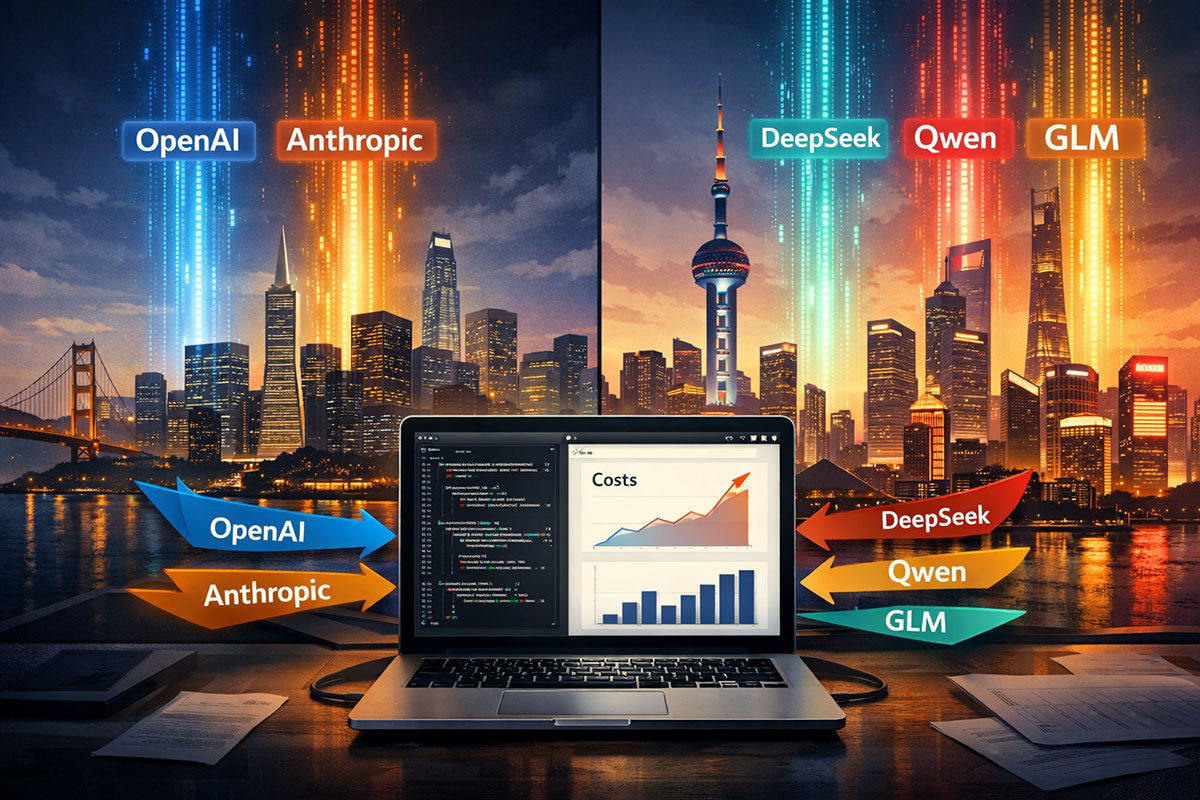
In a January 5th outlook on what’s next for AI in 2026, MIT Technology Review writers predict that more Silicon Valley apps will quietly ship on top of Chinese open models, even if the marketing pages still shout “GPT‑5” and “Claude”. The reason is brutally simple: money.
Recent pricing and market analyses show Chinese open-weight models like DeepSeek and Alibaba’s Qwen now offer GPT‑5‑class performance at a fraction of the cost – in some cases around 1/20th to 1/30th of top US APIs. At the same time, China’s Cyberspace Administration (CAC) confirms that 700+ generative AI large-model products have completed their official filing procedures, an industrial-scale ecosystem of regulated models that no other country can match right now.
Short version: US companies may still lead on absolute cutting-edge capabilities, but Chinese open models are winning on price, openness, and sheer volume. That combination is exactly what scrappy US startups care about.
This article breaks down what’s really going on – from cost curves and regulatory filings to developer choices and geopolitical risk – and why 2026–2028 could be remembered as the period when American software quietly moved onto Chinese AI foundations.
If you’ve already been tracking this through pieces like “China’s Open Models Won in 2025” and Trendflash’s deep dives on DeepSeek, this is the next chapter – zoomed out, quantified, and aimed at developers, investors, and policymakers who can’t afford to be surprised by it.
1. The MIT Signal: Silicon Valley Will Quietly Run On Chinese Open Models
One of the clearest flags came not from a political think tank, but from the MIT Technology Review ecosystem. In a widely shared 2026 trends piece, MIT-aligned writers describe a “most underestimated shift” in AI:
“In 2026, many Silicon Valley startups will quietly build products on top of Chinese open models, even if they never say it out loud. Not because of ideology — but because it makes economic and technical sense.”
There are three core arguments behind that line:
- Performance gap is shrinking. Analyses of frontier capability show that Chinese models now trail US systems by an average of around seven months – sometimes as little as four. That’s a gap, but not an abyss.
- Open weights are the norm in China. DeepSeek, Qwen, Baichuan and others increasingly ship open-weight releases, which means companies can self-host, fine-tune, and deeply customize.
- Cost pressure is brutal. As margins compress in SaaS and AI-native products, “good enough at 1/10th the price” beats “slightly better at 10x the price” almost every time.
Trendflash readers saw this building throughout 2025 in stories like “The Great AI Cost Crash” and the breakdown of DeepSeek vs OpenAI’s reasoning models. MIT’s 2026 outlook simply connects the dots: the economic gravitational pull is now pointing east.
2. 700+ Regulated Chinese Models: CAC’s Filing System At Scale
The second piece of the puzzle is less talked about in Silicon Valley but extremely important: China is industrializing AI supply.
China’s Cyberspace Administration (CAC) confirmed in late December 2025 that over 700 generative AI large-model products have completed mandatory filing procedures under its regulatory framework.
| Metric | China (CAC filings) | Implication |
|---|---|---|
| Number of filed models | 700+ generative AI products by end of 2025 | Unprecedented breadth of options for domestic and foreign developers |
| Regulatory regime | Mandatory filing, security reviews, content controls | Strong state oversight, but clear “rules of the game” for providers |
| Application domains | Language, multimodal, domain-specific, industrial AI | Push beyond chatbots into logistics, rural services, and embedded devices |
| OS/device layer | HarmonyOS in 1.19B+ devices | On-device and embodied AI stack ready to consume these models |
This is not a loose collection of research demos. It’s a regulated model marketplace at national scale. For Western observers used to more chaotic open-source ecosystems, this combination of volume + regulation is easy to underestimate.
If you want a broader picture of how governance pressure is shaping AI globally, posts like “AI Global Governance Challenges in 2025” and “The Global AI Divide” give useful context on how China’s structured filing approach contrasts with the more fragmented US and EU debates.
3. The Cost Advantage: 80–90% Cheaper Is Not A Rounding Error
Now to the part that actually makes founders switch providers: money.
Detailed pricing comparisons show three clear facts:
- Top US proprietary models like GPT‑5/4.1, Claude Opus, and Gemini Pro still command premium prices per million tokens – often $1–$5 for input and $10–$20+ for output on flagship tiers.
- Chinese open-weight models like DeepSeek and Qwen now offer competitive performance at a fraction of that cost, e.g. around $0.28/$0.42 per million tokens in some deployments vs GPT‑5.1’s $1.25/$10 – roughly a 20–30x gap in output pricing.
- Across the board, open models (many of them Chinese) show an average 86% cost advantage over proprietary APIs – about 7.3x cheaper per million tokens.
| Provider / Model Type | Typical Input / Output (per 1M tokens) | Relative Cost |
|---|---|---|
| US proprietary (GPT‑5 family, GPT‑4.1, Claude Opus, Gemini Pro) | ~$1–$5 input, $10–$20+ output | Baseline (1x) |
| Chinese open-weight (DeepSeek, Qwen) | As low as ~$0.2–$0.4 effective per 1M tokens | ~5–30x cheaper, depending on tier |
| Open-source average (global) | $0.83 per 1M tokens | 7.3x cheaper than proprietary avg ($6.03) |
MIT/Hugging Face–linked data goes further: Chinese developers now control around 17.1% of the open AI market, versus about 15.8% for US companies, with DeepSeek and Qwen together holding roughly 14.2%. In other words, China already leads the open-model economy by share, even as US labs dominate frontier closed systems.
For a startup: if your marginal cost of intelligence drops by 80–90%, your entire product roadmap changes. Features that were “too expensive” at GPT‑5 rates suddenly become default.
This is exactly what Trendflash chronicled in “The Great AI Cost Crash” and the analysis of DeepSeek as a free, high-performance alternative.
4. Why Developers Love Chinese Open Models: Openness, Modifiability, Control
Cost is only part of the story. For developers, three other factors make Chinese open models increasingly hard to ignore:
- Open weights and self-hosting. Instead of sending every token to a US cloud, teams can run DeepSeek, Qwen, or GLM on their own infrastructure or preferred providers.
- Fine-tuning and domain adaptation. Open-weight models are easier to adapt to niche tasks – from legal drafting in a specific jurisdiction to robotics control systems.
- Vendor independence. With open models, your entire product isn’t hostage to a single US company’s roadmap, pricing, or political fights.
That’s why a16z partners and other investors now openly say that 80%+ of startup pitches rely on open-source foundations, many of them Chinese. MIT-aligned commentary notes that “the best models are free, the biggest raises are for compute, and the startups winning are the ones who stopped caring which flag flies over the weights.”
On Trendflash, this open-versus-closed tension has already been explored through lenses like SLMs vs LLMs and the on-device revolution and the AI infrastructure arms race. Chinese open models fit neatly into that story: they give you strong performance without locking you into US hyperscale APIs.
5. Where The US Still Leads – And Why That Might Not Be Enough
None of this means China has leapfrogged the US across the board. Capability indices still show a consistent pattern: US models hit new frontiers first, Chinese models catch up months later.
One analysis based on the Epoch Capabilities Index finds:
- Since early 2023, Chinese frontier models typically match US capabilities with about a seven-month lag, ranging from four to fourteen months depending on the benchmark.
- No Chinese model has yet matched OpenAI’s most advanced o3‑class systems as of early 2026.
- The performance gap mirrors the open-weight vs proprietary divide: nearly all leading Chinese models are open-weight, most US frontier models are closed.
From a geopolitical or national-security lens, that seven-month lag matters. From a startup economics lens, it matters much less:
For most products, the question is not “who has the single best model on earth?”, but “what’s the cheapest, controllable model that’s good enough for my use case?”
MIT’s broader framing, echoed in the Trendflash piece “The Breakthroughs Defining AI in 2025”, is that AI is becoming commoditized intelligence. Once you have many models that are “good enough,” the game shifts to:
- Who controls distribution (app stores, devices, operating systems)?
- Who owns the data and workflows on top of the models?
- Who can run intelligence at the lowest marginal cost?
On those dimensions, Chinese open models are suddenly very competitive, especially when combined with on-device ecosystems like HarmonyOS and low-cost domestic compute.
6. Business Implications: Margin Compression And A Coming AI Price War
If Chinese open models offer 5–30x cheaper intelligence, what does that mean for US AI businesses?
1. SaaS and AI-native products see margin pressure
Companies that quietly built GPT‑4/5-based products with juicy gross margins now face hard questions from CFOs and procurement teams:
- Why are we paying 10–30x more per token than we need to?
- What happens to our unit economics if a competitor switches to DeepSeek or Qwen?
- Can we renegotiate our contracts, or should we re-platform?
Trendflash’s coverage of the AI cost crash and AI tools that actually generate income already showed early versions of this phenomenon at the solo-creator and SMB level. 2026 is when it hits enterprise P&Ls at scale.
2. API vendors lose pricing power
MIT-linked analysis notes that once companies benchmark Chinese models against US APIs, US providers lose their ability to charge premium rates just on brand and benchmarks. They’ll have to defend every renewal against open-weight alternatives.
Expect to see:
- More aggressive tiered pricing (cheap “mini” models to fight open-weight competition).
- Bundled discounts tied to cloud infrastructure commitments.
- Greater emphasis on enterprise support, security, and compliance as differentiators.
3. The “invisible China risk” on cap tables
Investors now have to ask a new category of question in diligence: “What’s your AI dependency stack?”
- If a US startup quietly depends on DeepSeek or Qwen, geopolitical shocks could suddenly disrupt their core product.
- Conversely, if they are overexposed to expensive proprietary APIs, their unit economics might crumble in a price war.
This is where Trendflash’s macro pieces like “AI Infrastructure Arms Race” connect directly to startup risk: whoever controls cheap compute and flexible model access controls the economic battlefield.
7. Developer Reality: Chinese Models As The Default Choice
On the ground, developer behavior is already shifting in three ways:
- Default experimentation. New projects often start by benchmarking DeepSeek, Qwen, and GLM alongside US models. If performance is roughly equal, cost and openness decide.
- Hybrid stacks. Teams use US frontier models for the hardest reasoning tasks, and Chinese/open models for bulk workloads, background jobs, and low-stakes use cases.
- Agentic architectures. As more teams adopt agentic AI patterns (described in Trendflash’s agentic AI guides), they care less about any single model and more about orchestrating multiple cheap, specialized models together.
In other words, the “default model” for a US startup in 2026 may well be Chinese – not because they switched sides, but because they followed the spreadsheet.
For developers who want to stay ahead of this, resources like “Build your first generative AI model” and practical guides to building agents are increasingly relevant regardless of which country’s weights you start from.
8. Geopolitical Concerns: Who Owns The AI Backbone?
From a policymaker’s angle, this is where the story turns from interesting to uncomfortable.
If US startups run critical workflows – finance, logistics, education, even parts of government – on top of Chinese open models, three big concerns emerge:
- Data exposure and jurisdiction. Even if models are self-hosted, training histories, update channels, and tooling ecosystems may touch Chinese infrastructure or legal regimes.
- Dependency risk. Sanctions, export controls, or domestic regulations in China could suddenly make certain models unavailable or unmaintained.
- Standards and alignment. If the de facto “language layer” of US software is trained and updated elsewhere, questions arise about values, alignment, and content control.
These are exactly the kinds of questions explored in Trendflash’s global governance analysis and AI safety report cards. What’s new is that they’re no longer abstract: the same DeepSeek model that powers an indie coding assistant in California could be subject to Chinese regulatory oversight due to its origin and training stack.
9. 2026–2028: What Actually Happens Next?
Putting all of this together, a realistic (not sensational) forecast looks something like this:
| Year | What Changes In Practice | Who Feels It |
|---|---|---|
| 2026 | US startups quietly adopt Chinese open models for non-critical workloads; procurement teams start pushing back on premium API pricing. | Founders, infra teams, investors |
| 2027 | Hybrid stacks become normal (US + Chinese + European open-weight). AI price war intensifies; margins compress across AI-native products. | Public SaaS companies, cloud providers, model labs |
| 2028 | Regulatory responses escalate (export controls, sanctions, disclosure rules). Many US apps still rely on Chinese-origin weights under various wrappers. | Regulators, national-security community, late adopters |
MIT-style forecasts don’t say “Chinese AI takes over everything.” They say something subtler: AI becomes an international commodity, and the countries willing to ship powerful open-weight models at scale will quietly shape the foundations of other people’s software.
10. How To Respond: Practical Moves For Developers, Leaders, Investors, Policymakers
For developers
- Get comfortable benchmarking multiple model families (US, Chinese, European open-weight) for your use case.
- Design your architecture to be multi-model and swappable. Agentic design patterns from posts like “AI agents are replacing chatbots” help here.
- Build your own “AI literacy stack” – Trendflash’s AI skills roadmap to 2030 is a solid compass.
For business leaders and founders
- Ask for a clear map of your AI dependency stack: which models, which clouds, which jurisdictions.
- Run total-cost-of-ownership comparisons between proprietary US APIs and open-weight alternatives (including Chinese models).
- Start scenario planning: what happens if a key Chinese model becomes restricted? What if US regulation suddenly tightens?
For investors
- Add “AI supply-chain risk” to your diligence checklist: model origin, license, regulatory exposure.
- Favor companies that design for model portability – not hard-locked to one vendor or one country’s ecosystem.
- Track macro signals in pieces like “The Global AI Divide” to understand where policy may move next.
For policymakers
- Recognize that dependency doesn’t only mean “where the data is hosted” – it also means whose weights you rely on.
- Craft rules that increase transparency (disclosure of model origin, safety evaluations) without forcing startups into a corner they can’t afford.
- Look closely at China’s CAC filing system as a strategic industrial policy tool, not just a censorship mechanism.
Closing Thought: The AI Cold War Won’t Look Like The Last One
The easy narrative is “US vs China in an AI cold war.” The reality looks messier: US apps running partly on Chinese models, Chinese devices running partly on US chips, European open-weight labs offering a third path. In that world, pretending Chinese open models aren’t already part of the US AI stack is simply bad strategy.
If you build or bet on software, the right question for 2026 isn’t “Are Chinese models good or bad?” It’s:
“Where do Chinese open models already sit in my stack today, and what am I going to do about it before 2028?”
Use this moment to audit your dependencies, re-think your cost structure, and design for a world where intelligence is cheap, abundant, and geopolitically entangled. Then, if you want to keep going deeper, explore more in the AI News & Trends category and the broader Trendflash collections – because the story of who owns the AI backbone is just getting started.
About the Author
Girish Soni is the founder of TrendFlash and an independent AI strategist covering artificial intelligence policy, industry shifts, and real-world adoption trends. He writes in-depth analysis on how AI is transforming work, education, and digital society. His focus is on helping readers move beyond hype and understand the practical, long-term implications of AI technologies.