Introduction: The Agentic AI Shift in 2025
For business leaders and developers in 2025, the conversation around Artificial Intelligence is rapidly shifting from conversational chatbots to autonomous Agentic AI. Unlike systems that simply respond to prompts, AI agents are designed to understand high-level goals, reason through multi-step plans, and take autonomous action to achieve them. The market is taking note: the global agentic AI market is projected to grow from $28 billion in 2024 to $127 billion by 2029, and Gartner predicts that by 2029, agentic AI will autonomously resolve 80% of common customer service issues. This post cuts through the hype with concrete enterprise use cases and a practical guide to start building.
What is Agentic AI? From Prompting to Action
At its core, Agentic AI represents a fundamental leap in capability. Think of the difference between a tool and a coworker. A standard AI tool might summarize a document when asked. An AI agent, tasked with "preparing the quarterly sales report," would autonomously: access the CRM and data platforms, analyze performance metrics, generate insights, draft the report, and even distribute it to stakeholders. This is made possible by key capabilities:
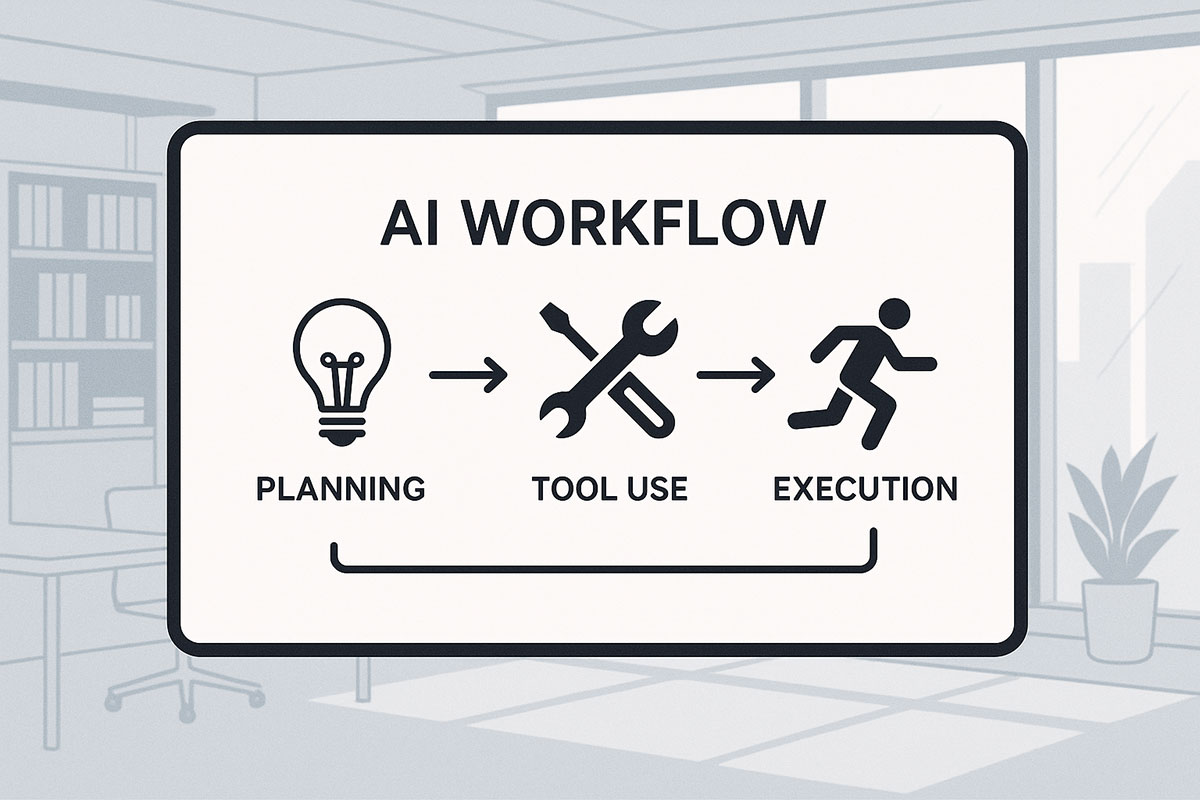
- Reasoning and Planning: Breaking down complex objectives into a logical sequence of sub-tasks.
- Tool Use: Independently using software tools, executing code, and interacting with APIs to interact with other systems.
- Autonomy: Operating with minimal human intervention, making decisions to advance its goal.
Real-World Enterprise Use Cases for Agentic AI in 2025
The promise of Agentic AI is being realized in tangible ways across industries. Here are concrete examples of how organizations are deploying agents today.
1. Sales Operations: The Proactive Sales Partner
Imagine an AI agent that acts as a strategic clone of your best sales rep. In sales, Agentic AI is moving beyond simple automation to become a proactive partner. These agents can access your CRM, emails, and market data to surface the most promising leads based on intent signals and buying behavior. They can autonomously update the CRM in real time, summarize call notes, and flag risks or opportunities based on conversation patterns. As one Harvard Business Review article notes, these agents can "identify, nurture, and even close deals by engaging customers across channels," anticipating next steps and adapting to changing conditions.
2. Customer Support Triage: The Autonomous Resolution Engine
In customer service, Agentic AI is revolutionizing triage and resolution. Traditional chatbots often trap users in rigid scripts. In contrast, AI agents can manage complete service tasks autonomously. For example, to update a billing address, an agent can: authenticate the user, detect missing information like a postal code, execute the change in the billing system, and proactively flag a related issue like an undelivered invoice. This end-to-end autonomy reduces manual ticket handling, cuts cost per contact, and shortens resolution times, allowing human agents to focus on high-value, empathetic interactions.
3. IT and HR: The Intelligent Service Desk
Agentic AI is making internal service functions profoundly more efficient. In IT, agents can go beyond scripted troubleshooting to dynamically adapt to new issues. For instance, an agent can handle complex VPN troubleshooting or software access requests by integrating data from various IT systems and learning from previous incidents. In HR, agents can autonomously assist employees with questions about paid time off, company policies, and benefits, and even help with tasks like resume analysis for recruitment, freeing HR professionals for strategic work.
4. Legal and Healthcare: Automating Complex Documentation
Specialized domains with complex paperwork are seeing major gains. International law firm Allen & Overy uses an AI agent named 'Harvey' to autonomously handle contract drafting, legal research, and due diligence reviews. The agent averages around 40,000 requests per day, cutting down research and drafting time by up to 60%. In healthcare, agents are automating Revenue Cycle Management (RCM), handling everything from eligibility verification to payment posting. One provider, Easterseals Central Illinois, deployed specialized agents and achieved a 35-day reduction in average accounts receivable days and a 7% reduction in primary claim denials.
How to Build Your First AI Agent: A Practical Blueprint
Deploying Agentic AI successfully requires a focus on workflow, not just the technology. As McKinsey insights highlight, "It's not about the agent; it's about the workflow." Focusing on fundamentally reimagining processes involving people, processes, and technology is the path to value.
Step 1: Identify and Map the Workflow
Don't start with the agent; start with the process. Choose a well-defined, multi-step workflow that is repetitive and rule-based but may require handling variance. Examples include employee onboarding, lead qualification, or IT ticket triage. Map out every step, identify key user pain points, and pinpoint where an agent could reduce unnecessary work.
Step 2: Select the Right Level of Autonomy
Agents aren't always the answer. Evaluate the task's demands: how standardized is the process, and how much variance does it need to handle? For low-variance, high-standardization workflows, simpler automation might be more reliable. Agentic AI shines in high-variance, low-standardization scenarios. You can implement a tiered approach, from assistive (AI suggests actions) to collaborative (AI handles some steps) to fully autonomous.
Step 3: Architect Your Stack: Orchestration, Memory, Tools, and Guardrails
Your agent's effectiveness depends on its underlying architecture. Here is a blueprint for the core components:
- Orchestration: This is the "conductor" of your workflow. Open-source frameworks like AutoGen, CrewAI, and LangGraph are popular choices for orchestrating multi-step processes and managing interactions between multiple agents.
- Tools: These are the agent's hands. Equip your agent with a curated set of tools and APIs it can use to interact with the world, such as search, code execution, database queries, or software integrations. Document these tools clearly for the AI model.
- Memory: This allows the agent to maintain context across a conversation and learn from past interactions. This can be short-term (within a session) or long-term (storing knowledge for future use).
- Guardrails: Essential for safety and trust. Implement evaluations, monitoring, and controls to ensure the agent performs as expected and can be audited. This includes tracking every step of the workflow to quickly identify and fix errors.
When starting, you can begin with simple LLM APIs directly and add complexity with frameworks as needed. No-code platforms like n8n.io or Zapier can also be used to build simpler, workflow-based agents, as demonstrated by one developer who built an AI calendar assistant in about two hours.
Step 4: Implement, Evaluate, and Build Trust
Treat onboarding an agent like hiring a new employee. This involves:
- Develop Evals (Evaluations): Create rigorous performance tests. Experts should label desired outputs for thousands of inputs to create a benchmark for how much the agent got right or wrong.
- Monitor and Verify: Build observability tools to track every step of the agent's process, not just the final outcome. This allows you to catch mistakes early and refine the logic.
- Iterate with Feedback: Create feedback loops. Just as the alternative-legal-services provider logged every user edit to improve its agents, use human feedback to continuously teach and improve your system.
Key Evaluation Metrics for Your AI Agent
To measure success, go beyond simple task completion. Focus on a blend of technical and business metrics:
| Metric Category | Specific Metrics | Why It Matters |
|---|---|---|
| Task Performance | Task success rate, Accuracy, Reduction in human validation needed | Measures the agent's core competency and reliability in its assigned job. |
| Efficiency | Time to resolution, Process cycle time, Cost per contact/task | Quantifies the operational efficiency gains and ROI delivered by the agent. |
| User Trust & Adoption | Escalation rate, User satisfaction (CSAT), Number of manual interventions | Indicates whether users find the agent helpful and trustworthy enough to rely on. |
Conclusion: The Future is Agentic
Agentic AI is not a distant future concept; it is a practical tool delivering value in 2025. The journey begins by focusing on a specific workflow, thoughtfully designing the agent's role and capabilities, and prioritizing rigorous evaluation and trust-building. As these systems mature, they will become less like tools and more like collaborative teammates, fundamentally reshaping enterprise productivity. The time to start building and learning is now.
Related Reading
- The Rise of AI Agents in 2025: From Chat to Action
- AI in Business: The 2025 Strategic Imperative
- Building Trust in AI: How to Govern Your Autonomous Systems
About the Author
Girish Soni is the founder of TrendFlash and an independent AI strategist covering artificial intelligence policy, industry shifts, and real-world adoption trends. He writes in-depth analysis on how AI is transforming work, education, and digital society. His focus is on helping readers move beyond hype and understand the practical, long-term implications of AI technologies.