The Year Everything Changed
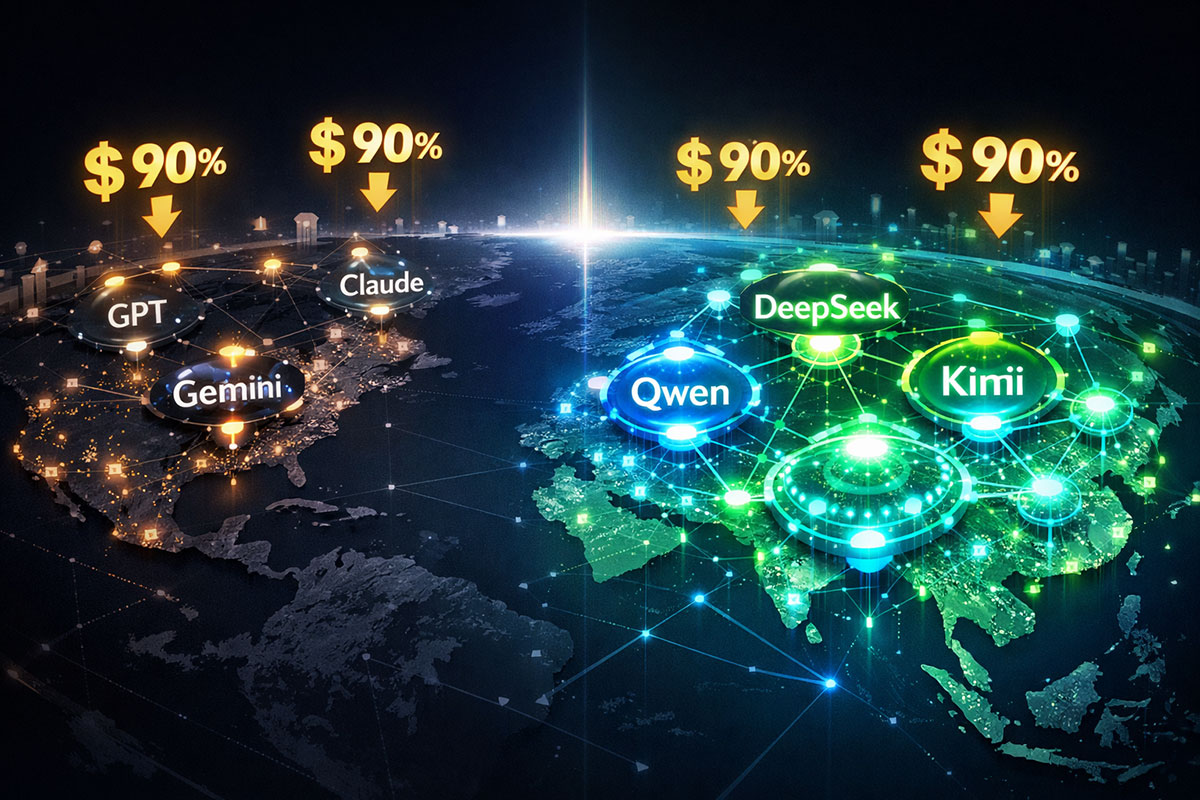
If 2024 was the year everyone agreed OpenAI and Anthropic controlled the AI market, 2025 was the year that agreement collapsed. It didn't happen with announcements or controversy. It happened with one quietly released model that did something nobody expected: matched the best proprietary AI in the world while costing 1/100th as much.
That model was DeepSeek V3.2. And it broke the business model that had seemed unshakable just months before.
By the end of 2025, the numbers tell a story that venture-backed AI companies are still processing: Chinese open-source models captured nearly 30% of global AI token usage. DeepSeek alone processed 14.37 trillion tokens in a single measurement period. Qwen (Alibaba's model) processed 5.59 trillion. Meta's LLaMA: 3.96 trillion. These aren't niche players—they're moving more compute than the entire proprietary AI industry combined.
OpenAI, Google, and Anthropic didn't fail to innovate. They innovated brilliantly. What happened was simpler and more damaging: they got undercut so aggressively on price that their fundamental business model—charging premium prices for premium models—started to look like a vulnerable position rather than a safe bet.
How We Got Here: The Open-Source Reversal
A year ago, the narrative was locked in: open-source AI was interesting for researchers, but proprietary models would always be more capable. Closed companies had more data. More compute. More talent. They could charge premium prices because you couldn't get the same quality anywhere else.
That narrative died in 2025, and it died because of three specific breakthroughs from DeepSeek:
First: Architectural Innovation
DeepSeek didn't build a bigger model. It built a smarter one. The company introduced Sparse Mixture-of-Experts (MoE) architecture refined to activate only 8 expert networks out of 256 for each token, drastically reducing computational overhead. They added DeepSeek Sparse Attention (DSA), a fine-grained indexing system that identifies important parts of long contexts and skips unnecessary computation.
The practical result: DeepSeek's models deliver frontier-class performance while using 50% less compute than competitors. This isn't an incremental improvement. This is a fundamental rethinking of how to build large language models.
Second: Training Cost Revolution
DeepSeek trained V3 for $5.5 million. OpenAI, Google, and Anthropic reportedly spend $100 million or more on equivalent models. That's not a 10% difference. That's an 18x difference in input cost that somehow resulted in equivalent or better output.
How? Precision. DeepSeek used FP8 mixed-precision training (lower numerical precision that reduces memory requirements without sacrificing quality). They invented novel parallelism techniques. They optimized every aspect of the training pipeline for efficiency rather than raw speed.
What matters: Training cost that's 1/18th of competitors means the company can iterate faster, release more versions, and still maintain profitability at 1/100th the pricing.
Third: Inference Cost Optimization
Training cost doesn't matter if running the model costs a fortune. But DeepSeek optimized that too. Through their architectural innovations, the company reduced inference costs so dramatically that V3.2 with a cache hit costs just $0.028 per million input tokens.
To put this in perspective: GPT-5 costs $3.25 for the same task. That's a 116x difference. Even OpenAI's cheaper model (GPT-5-mini) costs roughly 8x more.
For a typical enterprise workload—say, processing 100 million tokens per month—the difference is stark:
- DeepSeek: ~$2,800/month
- GPT-5: ~$325,000/month
If you're a startup, that's the difference between sustainable and impossible. If you're an enterprise, that's the difference between one model or a fleet.
The Qwen Expansion: China's Ecosystem Multiplies
DeepSeek grabbed the headlines, but the real shift was bigger. Alibaba's Qwen family of models proved that DeepSeek's success wasn't a fluke—it was the beginning of an ecosystem.
Qwen models are available on Hugging Face as completely open-source, under permissive licenses. The latest versions are competitive with or exceed proprietary models on multiple benchmarks. And the developer adoption tells the story: Qwen accounted for 5.59 trillion tokens of global usage in just one measurement period.
What's remarkable isn't that Qwen exists. It's how quickly it reached scale. Five years ago, open-source models were 2-3 years behind proprietary ones. Today, the gap is months—and in some cases, the open-source models are ahead.
Moonshot AI's Kimi, another Chinese model, followed similar trajectory. By late 2025, the landscape had shifted from "DeepSeek is impressive" to "Oh, there's a whole ecosystem of competitive Chinese models now."
The Performance Question: Are They Actually As Good?
This is the question that determines whether the shift is real or just marketing. The answer: it depends on the task, but for most tasks, yes.
DeepSeek V3.2 scored 96% on AIME 2025 (American Invitational Mathematics Exam), matching or exceeding proprietary models on mathematical reasoning. On coding benchmarks, it's competitive with GPT-4. On complex reasoning tasks, it matches Claude Opus in many domains.
The benchmarks where proprietary models still maintain an edge:
- Frontier reasoning: OpenAI's o3 still leads on pure reasoning-heavy tasks
- Niche specialized performance: Some tasks were designed around proprietary model behavior
- Multimodal consistency: Vision + text tasks sometimes favor models with more multimodal training data
But here's what the data shows: the gap is closing faster than anyone predicted. Open-source models that were 30% behind 18 months ago are now 5-10% behind. And they're improving monthly.
For any real business workload—customer service, content generation, code assistance, data analysis—open-source models are already good enough. "Good enough" that paying 100x more for marginal improvements doesn't make economic sense.
Why Developers Switched: It Wasn't Just Price
Price alone doesn't explain the shift. If it were just about cost, companies would have switched to cheaper proprietary tiers. But what happened was more fundamental: developers switched to open-source because open models enable things proprietary APIs never could.
Complete Control and Customization
With an open model, you don't use it through an API. You download it, run it on your own infrastructure, fine-tune it on your data. A pharmaceutical company can fine-tune DeepSeek on 10 years of internal research data. A financial services firm can optimize it for risk analysis. A healthcare organization can customize it for clinical decision support. None of this is possible with OpenAI's API.
No Vendor Lock-In
When you're on OpenAI's API, you're on their pricing schedule. They cut prices when they need to defend market share (which they did in 2025). They raise prices when they can. You're subject to their rate limits, their API changes, their business priorities. With an open model running on your infrastructure, you control the cost, the availability, the evolution.
Privacy and Security
For sensitive use cases—healthcare data, financial information, proprietary research—running models on your own hardware means data never leaves your system. That's not just compliance. For some organizations, it's the only way to use AI legally.
Speed and Latency
API calls have network latency. Your local model runs with millisecond response times. For applications where speed matters (high-frequency trading, real-time personalization, autonomous systems), on-premise models are technically superior.
Community and Transparency
Open-source models live on platforms like Hugging Face where thousands of researchers fine-tune them, optimize them, and publish improvements. You get community-driven innovation at no cost. With proprietary models, you get what the company decides to give you.
OpenAI's Response: The Price War Arrives
OpenAI wasn't caught flat-footed. The company responded aggressively. In 2025, OpenAI cut prices by roughly 80% on flagship models. They added generous free tiers. They incorporated more o1 queries into cheaper subscriptions. They moved from "we're the only good model" to "we're the best model, and we're priced accordingly."
But here's the problem: even at 80% price cuts, OpenAI's models cost significantly more than open alternatives. A company that was spending $1 million annually on OpenAI APIs might reduce that to $200k after cuts. But running DeepSeek on your own hardware might cost $50k (including infrastructure). The math still heavily favors open-source.
This creates a dilemma for OpenAI's business model: The company needs to charge enough to fund the massive training costs. But at prices that cover those costs, open-source becomes an obvious alternative. The company can't out-compete on price because its business model requires margin. All they can do is out-compete on capability—and on that axis, the gap is shrinking monthly.
The Geopolitical Angle: Why This Matters Beyond Technology
The fact that the winning models come from China isn't coincidental. It reflects a different R&D strategy.
Chinese tech companies—operating under different constraints and regulations—optimized for efficiency rather than market dominance. They were competing in a market with lower budgets, so they had to get good at doing more with less. That constraint forced innovation.
Meanwhile, Western AI companies optimized for market position. They built bigger models, trained them longer, competed on benchmark supremacy. The assumption: bigger and better would command premium prices forever.
China's efficiency-first approach proved more resilient. The models work. They're open. They can be deployed anywhere. And they cost nearly nothing to run.
The geopolitical implications are significant: the countries that control frontier AI are shifting. This isn't about one company. It's about the global AI infrastructure moving toward open models, and open models being developed primarily in China.
Policymakers in the US and Europe are noticing. There's talk about "AI sovereignty"—the idea that countries need indigenous AI capability they can rely on. But when the most capable indigenous open models come from China, that creates a different kind of geopolitical dependency.
The Business Case: Why Companies Actually Switched
If you're trying to decide whether to evaluate open-source models for your business, here's what the companies that already switched are reporting:
Cost Reduction
The most obvious. Companies report 70-90% reductions in AI infrastructure costs when switching from proprietary APIs to self-hosted open models. A software company spending $500k/month on API calls might reduce that to $50-75k with open models running on equivalent hardware.
Performance Improvements
This surprises people, but in many cases, fine-tuned open models outperform out-of-the-box proprietary models on company-specific tasks. A customer service team fine-tuned DeepSeek on 100,000 support tickets is going to get better results than generic GPT-4, even if GPT-4 is technically more capable.
Speed and Reliability
API-dependent systems are subject to rate limits, API changes, and service disruptions. Self-hosted models run with 100% availability (assuming your infrastructure is solid). For mission-critical applications, this alone justifies the switch.
Rapid Iteration
With proprietary models, you're waiting for the company to release new versions. With open models, you have new versions available constantly. The community is improving open models faster than proprietary vendors can maintain market leadership.
The 2026 Implications: The Proprietary Model Question
Here's what's becoming clear heading into 2026: The question isn't "will open-source models catch up?" They already have, in most domains. The real question is "what's the competitive advantage of proprietary models?"
Possible Answer 1: Sustained Capability Lead
OpenAI, Google, Anthropic, and Anthropic invest billions in research. Maybe that investment compounds into a permanent capability lead. Maybe their models will always be 10-20% better than open alternatives. If so, paying 10-20% more makes sense. But paying 100x more? Not unless the capability gap grows significantly.
Possible Answer 2: Ecosystem and Integration
OpenAI isn't just a model. It's an ecosystem: ChatGPT, API integrations, plugins, enterprise features. Maybe the value is in that ecosystem, not the model itself. Companies might pay for the platform even if cheaper models exist.
Possible Answer 3: Security and Trust
Enterprise customers might pay premium prices for models they can audit, trust, and legally hold accountable. Open-source models are free but might lack the governance and warranty that enterprises require.
Possible Answer 4: Proprietary Models Become Niche
The most likely scenario: OpenAI, Anthropic, and Google's models remain in premium positions—used by organizations where cost is irrelevant or where cutting-edge performance is genuinely required. But the mass market, the middle market, and most practical applications shift to open-source.
Skills and Implications for Your Organization
If 2025 was the year to watch open-source models, 2026 is the year to make actual deployment decisions. Here's what that means:
For CIOs and Infrastructure Leaders
Open-source models need infrastructure. You'll need GPU capacity, containerization, monitoring, and integration with your existing systems. That's not free, but it's typically 40-60% cheaper than equivalent API spending. The decision point: Is the infrastructure investment worth the ongoing cost savings?
For Data Science and ML Teams
Open-source models enable fine-tuning and customization. Your ML teams should be evaluating how to fine-tune open models on your proprietary data to exceed proprietary model performance on your specific use cases. This is the competitive advantage of open-source: customization.
For Product Teams
Product differentiation increasingly comes from how you use AI, not which model you use. An application using DeepSeek optimized through careful prompt engineering and fine-tuning will outperform an application using GPT-4.1 out-of-the-box. The strategic question: How can AI be embedded into your product in a way competitors can't easily replicate?
For Finance and Operations
This is where the business impact crystallizes. If you're currently using proprietary AI APIs, running the numbers on an open-source alternative is no longer optional—it's essential due diligence. A mid-size company could reduce AI costs by $500k-$2M annually by switching to open models.
The Regulation Question: Why This Matters Legally
One detail that regulators and enterprises are just beginning to understand: Open-source models are often more auditable and compliant than proprietary ones.
With a closed model, you don't know exactly how it was trained, what data it learned from, or what biases it might have. You trust the vendor's claims. With open models, the weights are available, academic papers explain the architecture, and community researchers can audit for bias, safety issues, and performance characteristics.
For heavily regulated industries—healthcare, financial services, legal—this transparency advantage is significant. An open model you can audit, debug, and document might be more legally defensible than a proprietary model where you can't explain the decision-making process.
The Bottom Line: The AI Market Just Transformed
2025 was the year the AI market structure changed. It wasn't a gradual shift. It was a compression: proprietary models lost 70% of their pricing power in months. Open models went from interesting to industry-standard. Chinese models went from alternative to dominant.
The companies that recognize this shift early—that evaluate open-source options, that reduce dependency on proprietary APIs, that invest in infrastructure to run models locally—will have significant cost and capability advantages over those that stay locked into expensive proprietary platforms.
The window for this decision is open right now. By 2026, it will close. Companies that make the switch in Q1 2026 will have months to optimize before their competitors realize they need to. Companies that delay another year will be paying 5-10x more than they need to for equivalent or inferior results.
DeepSeek didn't beat OpenAI because it was smarter or better funded. It won because it solved a different problem: how to build frontier-class AI efficiently and release it openly. That solution is now available globally, and it's forcing the entire industry to reckon with a new reality: the expensive, proprietary model era might be ending.
Related Reading
- DeepSeek AI Just Challenged OpenAI (And It's Free)
- GPT-5.2 Reached 71% Human Expert Level: What It Means for Your Career in 2026
- Claude Opus 4.5 vs ChatGPT 5.1 vs Gemini 3: Which AI Should You Actually Use in 2026?
- OpenAI's Code Red Declared: Why Sam Altman Panicked Over Gemini 3 (And What It Means for You)
- Efficient AI Models vs. Mega Models: Why Smaller May Be Better in 2025
- AI Agents Are Automating Jobs, But Here's How To Stay Ahead in 2025
About the Author
Girish Soni is the founder of TrendFlash and an independent AI strategist covering artificial intelligence policy, industry shifts, and real-world adoption trends. He writes in-depth analysis on how AI is transforming work, education, and digital society. His focus is on helping readers move beyond hype and understand the practical, long-term implications of AI technologies.