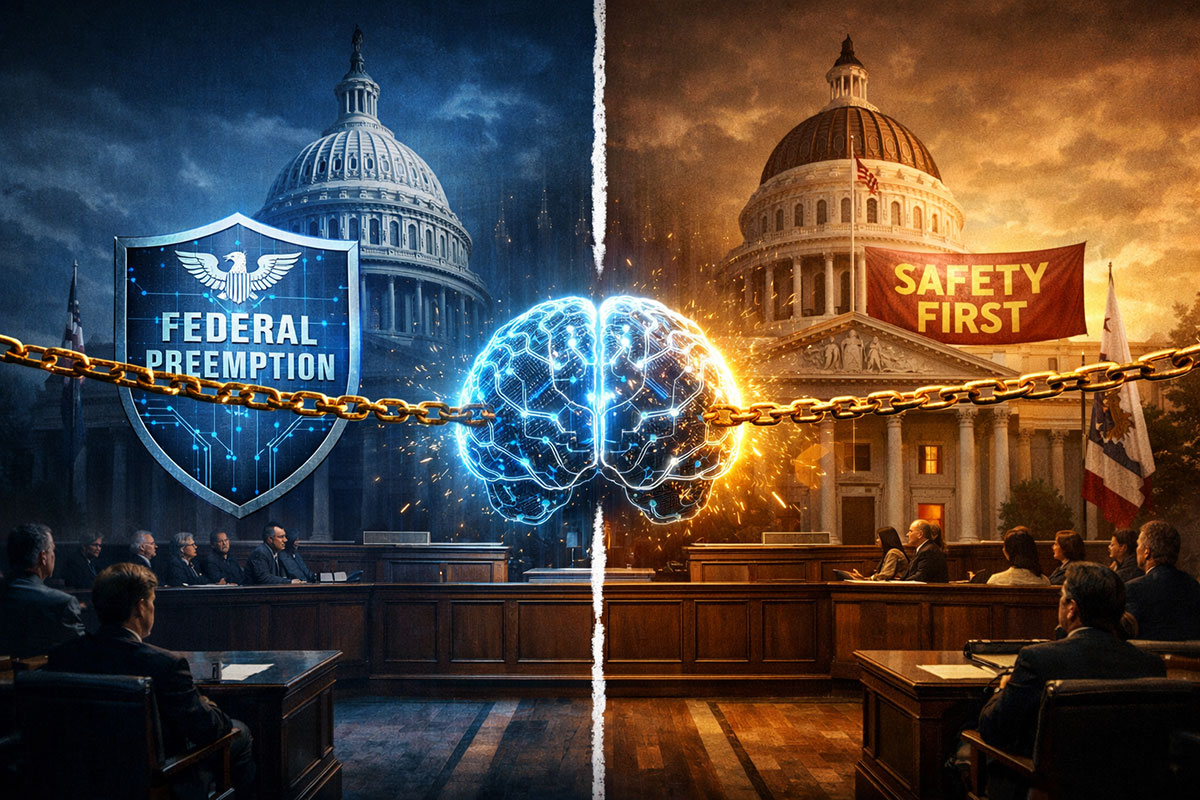
AI Regulation in Chaos: Trump’s Executive Order vs. State Laws – The 2026 Legal War
The "wild west" of artificial intelligence is no longer just a metaphor; it has become a literal legal battleground where the federal government and state legislatures are drawing lines in the sand. As we enter the first quarter of 2026, a massive constitutional crisis is brewing. At the center of this storm is President Trump’s recent Executive Order 14365, titled “Ensuring a National Policy Framework for Artificial Intelligence,” which was signed in late December 2025 with one primary goal: to dismantle what the administration calls a "suffocating patchwork" of state-level AI regulations.
For tech giants, startups, and policy analysts, this isn't just a political skirmish—it's a war for the regulatory soul of the United States. While Washington D.C. pushes for a "minimally burdensome" national standard to ensure America wins the global AI race, states like California and Colorado are digging in their heels, claiming that federal overreach is leaving their citizens vulnerable to catastrophic risks and algorithmic discrimination.
"We are witnessing the most significant federalism conflict of the 21st century. The question isn't just about AI safety; it's about whether a state has the right to protect its residents from a technology that knows no borders." — Chief AI Policy Strategist at TrendFlash
The Federal Gambit: Preemption as a Weapon
The Trump administration’s stance is clear: AI is a matter of national security and interstate commerce. Therefore, individual state laws—like California’s Transparency in Frontier Artificial Intelligence Act (SB 53)—are viewed as obstacles to the unified national strategy required to compete with global adversaries. The December 2025 Executive Order is a multi-pronged attack designed to centralize power in the hands of federal agencies.
1. The AI Litigation Task Force
Perhaps the most aggressive move in the EO is the creation of the AI Litigation Task Force within the Department of Justice. Beginning in January 2026, this task force is charged with suing states whose AI laws unconstitutionally burden interstate commerce or violate federal preemption. The target? Any law that requires AI models to "alter their truthful outputs" or mandates "onerous" disclosures that the administration argues violate the First Amendment rights of developers.
2. Financial "Guns to the Head": The BEAD Funding Lever
In a move reminiscent of past federal-state showdowns, the administration is using financial leverage to force compliance. The EO instructs the Department of Commerce to condition $42 billion in Broadband Equity, Access and Deployment (BEAD) funding on the repeal of state AI regulations deemed inconsistent with the national policy. States like California and New York now face a choice: keep their safety mandates or lose billions intended for high-speed internet infrastructure.
This "financial coercion" has already led to threats of lawsuits from state attorneys general, citing NFIB v. Sebelius, which limits the federal government's ability to pull existing funding to force states into new policy regimes.
The California Resistance: Why SB 53 and SB 942 Matter
While the federal government pushes for deregulation, California has established itself as the world’s "shadow regulator." Having pioneered the California AI Transparency Act (SB 942) and the safety-focused SB 53, the state argues that the federal government is failing in its duty to protect the public. Unlike the broad and controversial SB 1047 that was vetoed in 2024, the new 2026-era laws are more surgical, yet equally offensive to the deregulatory wing in D.C.
California’s current framework focuses on several key areas that directly conflict with the new federal order:
- Kill Switches: SB 53 requires developers of "Frontier" models—those trained with massive compute—to have a "kill switch" capability to shut down models if they show signs of catastrophic autonomous behavior. The federal EO views this as a security vulnerability that could be exploited by foreign hackers.
- Training Data Transparency: AB 2013 requires public disclosures of datasets used to train models. D.C. argue this exposes trade secrets and weakens the competitive edge of American firms.
- Algorithmic Audits: States are mandating independent third-party audits to prevent bias in hiring and healthcare. The federal government has labeled these "ideological filters" that force models to produce "false" or "biased" results in the name of equity.
Comparison: Federal Vision vs. State Realities (2026)
| Regulatory Pillar | Trump Executive Order (Federal) | California/State Safety Laws |
|---|---|---|
| Primary Goal | Global dominance & innovation speed. | Public safety & catastrophic risk prevention. |
| Testing | Voluntary reporting and industry self-regulation. | Mandatory 3rd-party audits for frontier models. |
| Funding | Conditional on state alignment with D.C. | State-funded "CalCompute" initiatives. |
| Compliance | Minimally burdensome national standard. | "Highest common denominator" requirements. |
The Impact on the AI Industry: A Fractured Ecosystem
For the Chief AI Officers (CAIOs) of 2026, this conflict is a nightmare. Companies are now operating in a "Compliance Purgatory." If they follow the federal order and ignore California’s safety protocols, they risk massive fines and lawsuits in one of the world’s largest economies. If they follow California, they may lose federal "Innovation Zone" grants and face scrutiny from the DOJ.
This is particularly difficult for companies working on Agentic AI and A2A protocols. Autonomous agents that can execute tasks across state lines are the first to be hit by these conflicting rules. An AI agent might be "legal" in Texas but "non-compliant" the moment it processes data for a user in Los Angeles.
Furthermore, the rise of Decentralized AI (DeAI) is being seen as an "escape hatch" for developers tired of this legal crossfire. The DeAI Manifesto has gained traction in early 2026, as developers move their models to peer-to-peer networks where neither Trump’s DOJ nor California’s regulators can easily pull the plug.
The Lobbying War: Silicon Valley vs. The Safety Lobby
Behind the scenes, the money is flowing faster than the code. The lobbying battle in 2026 is split into two camps:
- The "Accelerationists": Led by major venture capital firms and the "Little Tech" movement, they are pouring funds into D.C. to support the Executive Order. They argue that state laws are a "death by a thousand cuts" for startups that can't afford a 50-state legal team.
- The "Guardrail Coalition": This group includes safety researchers, civil rights organizations, and—surprisingly—some of the largest tech incumbents like Microsoft and Google. These giants often prefer some regulation because they have the capital to comply, creating a "moat" that keeps smaller competitors out. This tactical use of AI Ethics & Governance as a business strategy is a defining feature of the 2026 landscape.
Constitutional Showdown: The Supremacy Clause on Trial
Legal experts predict that this conflict will reach the Supreme Court by the end of 2026. The arguments are already being drafted:
- The Federal Argument: "The Supremacy Clause dictates that federal law is the supreme law of the land. AI models are national assets used in global competition, and state interference is a violation of the Dormant Commerce Clause."
- The State Argument: "The 10th Amendment reserves powers to the states that are not specifically delegated to the federal government. Protecting our citizens from unsafe software, biased hiring practices, and deepfake nudes is a core exercise of state police power."
As this plays out, we are seeing a "Domestic Brain Drain." Talent is shifting from California to "Regulatory Havens" like Texas, where the local government has aligned itself with the federal "Innovation First" approach. Yet, the Great 2026 Robotics Jobs Fight shows that states will continue to legislate around AI’s physical impact on local labor markets, regardless of what the federal government says about the "digital" models.
The Global Perspective: Looking at the Divide
While the U.S. fights internally, the rest of the world isn't waiting. The Global AI Divide is widening. The EU is moving forward with its AI Act implementation, and India’s new AI regulation framework is becoming a model for the Global South. International companies are looking at the U.S. legal chaos and wondering if America is still a stable place to build frontier technology.
In many ways, the "chaos" of 2026 is the natural result of a technology moving faster than our legal institutions can adapt. The AI governance challenges we faced in 2025 have only intensified as the stakes have shifted from "chatbots" to autonomous agents capable of crashing markets or influencing elections.
Conclusion: What Now for Businesses and Developers?
The 2026 AI Regulation War is far from over. For now, the safest bet is to build with "Jurisdictional Awareness." This means designing AI systems that can dynamically adjust their safety and disclosure protocols based on where the user is located—a concept we call "Geofenced Compliance."
As the DOJ prepares its first round of lawsuits against Sacramento, and as California prepares to withhold its massive market access from non-compliant firms, the industry must prepare for a long, expensive, and chaotic transition. The dream of a unified global—or even national—AI standard is dead for the foreseeable future. Welcome to the era of the AI Legal War.
Further Reading on AI Trends and Law:
- The 2026-2028 AI Prediction: A Warning for Investors
- Energy Sovereignty: Why Big Tech is Going Nuclear in 2026
- The Hallucination Crisis: Can Lawsuits Fix AI Errors?
- Explore the Latest AI News and Trends
About the Author
Girish Soni is the founder of TrendFlash and an independent AI strategist covering artificial intelligence policy, industry shifts, and real-world adoption trends. He writes in-depth analysis on how AI is transforming work, education, and digital society. His focus is on helping readers move beyond hype and understand the practical, long-term implications of AI technologies.