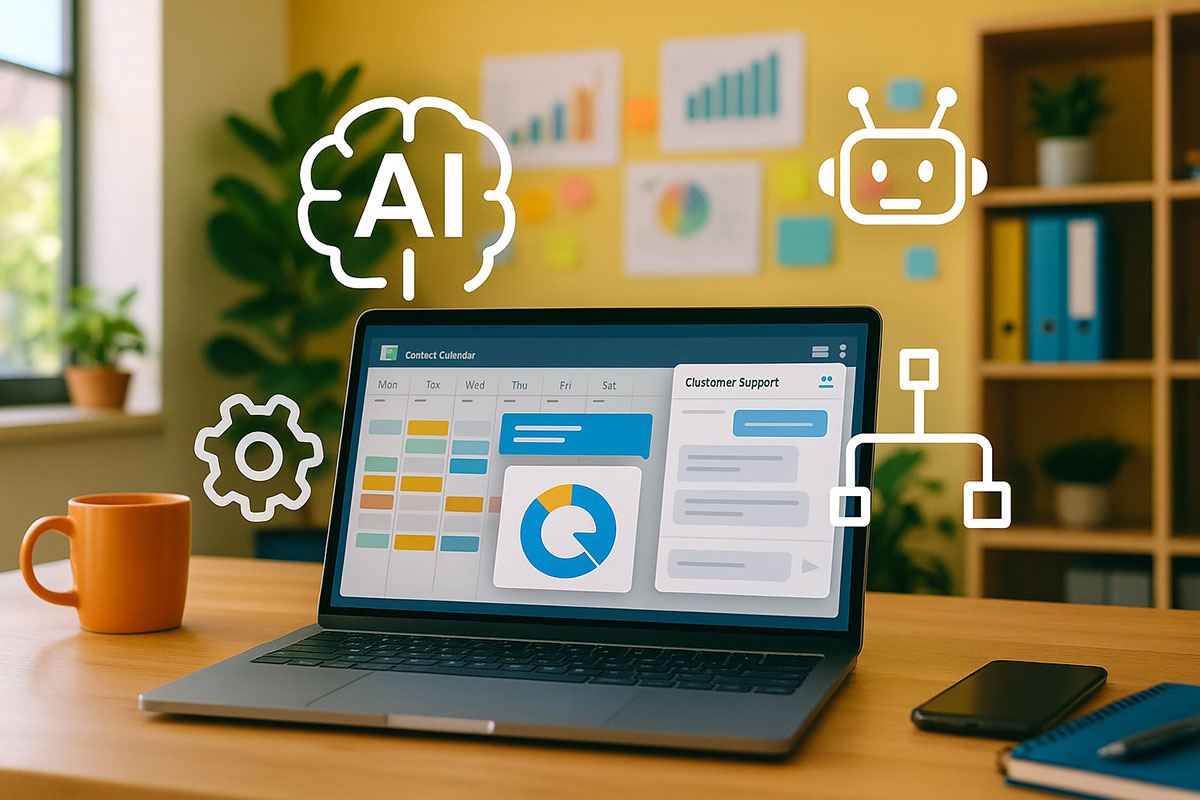
Introduction: Doing More with Less in 2025
In the current economic climate, small businesses are under more pressure than ever to tighten budgets while still delivering exceptional customer experiences. The challenge is universal: how do you compete with the resources of larger companies without the budget to hire a full marketing, support, and design team? The answer is no longer just "work harder," but "work smarter" with generative AI. In 2025, AI has evolved from a novelty to a core operational tool, enabling solopreneurs and small teams to automate complex tasks, personalize at scale, and punch far above their weight. This guide will walk you through the practical, actionable ways to integrate AI across your business, freeing you up to focus on growth and strategy.
The "Why Now": The Unavoidable Shift to AI Efficiency
The adoption of AI is no longer a forward-thinking strategy; it's a present-day necessity for staying competitive. According to Stanford's AI Index, 78% of organizations reported using AI in 2024, a significant jump from the year before. This trend has only accelerated in 2025. Businesses are actively searching for "AI for small business" solutions to solve real market needs: cutting costs, improving efficiency, and maintaining quality with limited personnel. The tools have become more affordable, user-friendly, and powerful, making this the ideal time to integrate them into your workflow.
Automating Your Marketing Engine with AI
Marketing is the lifeblood of any small business, but it's also a major time-sink. Generative AI can take on the heavy lifting of content creation and campaign management.
1. AI-Powered Content Marketing
High-quality content is the foundation of modern marketing, and AI can help you generate blog posts, video scripts, and social media copy in minutes, not hours.
Tool to Use: ChatGPT (Custom GPTs) or Copy.ai. These tools can be prompted to write in your brand's tone of voice, ensuring consistency across all your content.
How to Implement:
- Use ChatGPT to generate outlines and first drafts for blog posts based on keyword research.
- Repurpose a single blog post into a dozen social media captions and a video script for YouTube or TikTok.
- Maintain a consistent content calendar by using AI to overcome writer's block and speed up production time.
2. Hyper-Personalized Email Marketing
Email marketing offers a high ROI, and AI takes it to the next level by enabling deep personalization at scale. You can move beyond just using a first name to generating tailored content and offers based on user behavior.
Tool to Use: AI-powered features within platforms like Klaviyo or using ChatGPT via API to generate dynamic copy.
How to Implement:
- Create segmented email sequences for new subscribers, inactive customers, and loyal advocates, with AI generating the specific copy for each group.
- Use AI to A/B test subject lines and email content to continuously improve open and click-through rates.
- Automate trigger-based emails, like abandoned cart reminders or post-purchase follow-ups, with personalized messaging.
3. Social Media Management
Staying active and engaging on social platforms is a full-time job in itself. AI can streamline the entire process, from content creation to performance analysis.
Tool to Use: ChatGPT Plus with DALL·E for image generation, or integrated social management tools.
How to Implement:
- Generate a month's worth of post ideas and captions for Instagram, TikTok, and LinkedIn in one sitting.
- Use AI image generators like DALL·E to create unique, on-brand graphics for your posts without a designer.
- Leverage AI analytics to understand which types of content are driving the most engagement and double down on them.
Transforming Customer Support from Cost Center to Advantage
Providing fast, 24/7 support is a key differentiator for small businesses. AI allows you to offer this level of service without hiring a round-the-clock team.
AI Chatbots and Virtual Agents
Modern AI shopping assistants and virtual agents have evolved far beyond simple, reactive chatbots. They can now proactively guide users, answer complex product questions, and provide personalized recommendations.
Tool to Use: Custom GPTs deployed as support agents, or dedicated no-code chatbot platforms like Landbot or Chatbase that are powered by GPT.
How to Implement:
- Build a GPT trained on your FAQ, product documentation, and policy information. Embed it on your website to handle common inquiries instantly.
- Use the AI to qualify leads by asking preliminary questions before routing complex issues to a human agent.
- Offer multilingual support to cater to a global customer base without the need for multilingual staff.
The impact is tangible: some brands have seen 70% of customer queries handled entirely by an AI assistant, leading to significant cost savings and freeing up human agents for more complex, high-value interactions.
Democratizing Design and Content Creation
A strong visual identity is crucial, but professional designers are expensive. Generative AI in the creative realm allows you to produce high-quality visuals and media in-house.
1. AI for Graphic Design and Branding
From logos to social media graphics, AI design tools can execute your visual ideas quickly and affordably.
Tool to Use: Canva's AI features or DALL·E for advanced image generation. Gamma App is also excellent for AI-generated presentations and pitch decks.
How to Implement:
- Use a tool like Logo Creator to brainstorm and generate initial logo concepts for a new product line.
- Generate multiple variations of a banner ad to see which visual style performs best.
- Use Gamma App to create a stunning investor pitch deck or client proposal in minutes instead of days.
2. AI for Video and Audio Production
Video content is king, but editing is complex. AI is radically simplifying the process.
Tool to Use: Descript for editing audio and video by editing a text transcript, or ElevenLabs for generating human-quality voiceovers.
How to Implement:
- Use Descript to easily edit podcast episodes or webinar recordings—just delete the text of any mistakes, and the audio/video is edited automatically.
- Generate auto-subtitles for your social media videos to improve accessibility and engagement.
- Create a professional-sounding voiceover for an explainer video using ElevenLabs, even cloning your own voice for brand consistency.
Your Downloadable AI Tool Stack for SMBs (2025)
Here is a categorized list of essential AI tools, both free and paid, to build your automated business.
| Business Function | Tool Name | Key Use Case | Pricing Tier |
|---|---|---|---|
| Content & Writing | ChatGPT / Custom GPTs | Drafting emails, blog posts, scripts, brainstorming | Freemium/Paid |
| Copy.ai | Marketing copy, ad variants, product descriptions | Paid | |
| Customer Support | Landbot / Chatbase | Building no-code, GPT-powered support chatbots | Paid |
| Design & Visuals | Canva | AI-powered graphic design, template creation | Freemium/Paid |
| DALL·E | Generating unique images and artwork from text | Paid | |
| Video & Audio | Descript | Editing video via text transcript, subtitle generation | Freemium/Paid |
| ElevenLabs | Generating realistic voiceovers and audio clips | Freemium/Paid | |
| Productivity & Research | Perplexity AI | Fast, source-based market and competitor research | Freemium/Paid |
| Fireflies.ai | Automatically transcribing and summarizing meetings | Freemium/Paid |
Getting Started: A 3-Step Implementation Plan
Adopting AI can feel overwhelming. Break it down into manageable steps:
- Identify Your Biggest Bottleneck: Is it creating enough marketing content? Handling customer inquiries after hours? Creating visuals? Start with the single biggest pain point in your business.
- Choose One or Two Tools: Select the most relevant tool from the list above. Don't try to do everything at once. Master one tool and integrate it deeply into your workflow before adding another.
- Build Systems, Not Just Habits: Integrate the AI tool into a repeatable process. For example, make it a rule that every blog post outline is first generated by AI, then refined by a human. Systematizing the use of AI ensures it becomes a sustainable part of your operations, not just a temporary experiment.
Conclusion: Embrace the AI Co-Pilot
Generative AI is not about replacing human creativity and intuition; it's about augmenting it. For small businesses, it acts as a force multiplier, allowing you to automate the tedious, scale the personal, and create the professional. By strategically deploying the tools outlined in this guide, you can significantly cut operational costs, improve customer satisfaction, and build a more resilient and competitive business—all without making a single new hire. The future of small business is automated, personalized, and powered by AI.
Related Reading
- 7 Ways AI is Transforming Business Productivity
- The Ultimate Guide to Building AI Workflows: Automate Your Daily Routine in 2025
- Best AI Tools in 2025 for Work, Study, and Creativity
About the Author
Girish Soni is the founder of TrendFlash and an independent AI strategist covering artificial intelligence policy, industry shifts, and real-world adoption trends. He writes in-depth analysis on how AI is transforming work, education, and digital society. His focus is on helping readers move beyond hype and understand the practical, long-term implications of AI technologies.