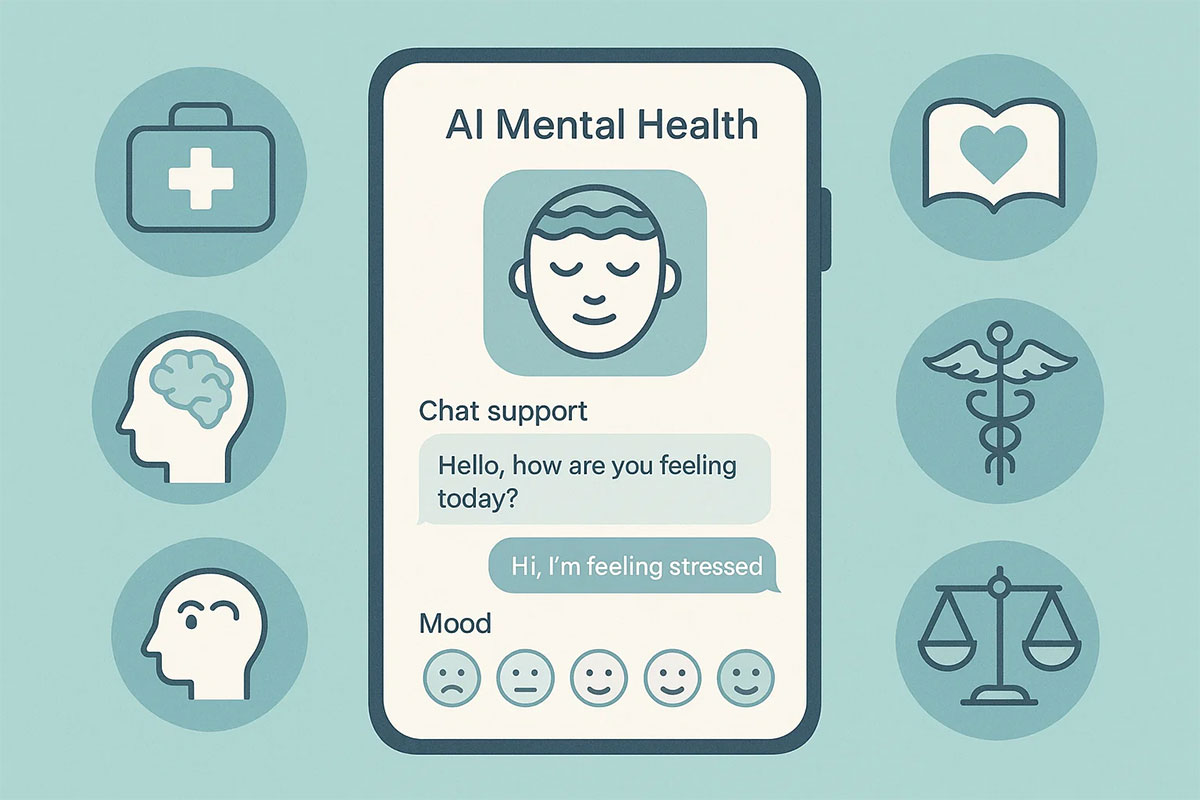
The AI Mental Health Revolution: From Novelty to Necessity
AI mental health applications have evolved from experimental chatbots into essential healthcare tools backed by clinical evidence and regulatory frameworks. In 2025, these platforms offer personalized, evidence-based therapy support that's accessible 24/7, addressing the critical gap between mental health service demand and insufficient provider availability. The global AI mental health market, valued at $1.5 billion in 2024, is projected to reach $25.1 billion by 2034, representing a 32% CAGR that reflects both the urgent need and proven effectiveness of these technologies.
The Access Crisis Driving Innovation
Mental health disorders affect tens of millions globally, yet traditional care models face systemic barriers: long wait times for appointments, geographic limitations, affordability challenges, and persistent stigma. In one recent study, 33% of psychiatrists reported using ChatGPT to assist with clinical care, while 75% believed patients are likely to consult generative AI before seeking medical providers. This reality has accelerated development of AI mental health solutions that complement human therapists rather than replace them, offering immediate support for mild-to-moderate symptoms while reserving professional intervention for complex cases.
Clinical Effectiveness: What the Research Actually Shows
Rigorous studies demonstrate measurable benefits from leading AI mental health apps, though effectiveness varies significantly by platform and clinical application.
Woebot: The Evidence Leader
Woebot stands out for its randomized controlled trial (RCT) evidence, with college students showing significantly reduced depression symptoms in just two weeks of daily use. In comparative studies, Woebot achieved mean depression score reductions of 10.67-11.00 points and anxiety reductions of 7.50-8.33 points. The platform's cognitive behavioral therapy (CBT) approach delivered through conversational AI has proven more effective than World Health Organization self-help materials in head-to-head comparisons. However, some studies critique design limitations, noting Woebot didn't show significant differences compared to other behavioral intervention technologies when comprehensive control conditions were applied.
Wysa: Hybrid AI-Human Effectiveness
Wysa has helped over 5 million users across 90+ countries, earning FDA Breakthrough Device Designation for demonstrating potential to improve treatment faster than traditional methods. Clinical studies show Wysa effective in reducing anxiety up to 31% and negative affects up to 15%, with mean depression reductions of 7.00-8.33 points. The platform's hybrid model combining AI chatbot support with optional human therapist access has proven particularly valuable, with AI providing immediate intervention while human professionals handle complex escalations. Wysa's focus on workplace mental health and insurer partnerships demonstrates scalability beyond consumer applications.
Other Validated Platforms
Youper demonstrates effectiveness in delivering low-cost support for anxiety and depression, with users showing measurable symptom reduction over time through daily mood tracking and personalized interventions. While platforms like Replika show promise for emotional support and companionship, achieving anxiety reductions of 7.33-8.01 points in studies, clinical evidence remains less extensive compared to therapy-focused apps.
Regulatory Landscape: Ensuring Safety and Compliance
The regulatory environment for AI mental health apps is rapidly evolving, with federal and state governments establishing frameworks to protect users while encouraging innovation.
FDA Oversight and Clearance
The FDA is actively developing regulatory pathways for generative AI-enabled digital mental health medical devices, with the Digital Health Advisory Committee meeting in November 2025 to discuss benefits, risks, and evidence requirements. Currently, no FDA-approved or FDA-cleared AI therapy apps exist specifically in psychiatry, though several apps like Wysa have received FDA Breakthrough Device Designation indicating promising potential. The FDA distinguishes between wellness apps (outside regulatory purview) and medical devices requiring prescription and clinical validation for treating psychiatric conditions. Approved pathways include Premarket Approval (PMA), De Novo classification, and 510(k) clearance for devices treating ADHD, substance use disorders, insomnia, depression, anxiety, and autism.
HIPAA Compliance Requirements
Apps handling Protected Health Information (PHI) must comply with HIPAA Security Rule requirements, implementing technical safeguards for data encryption, access controls, and transmission security. Healthcare organizations using AI for clinical decision support must incorporate these systems into risk analysis and management processes, documenting how AI software interacts with electronic PHI. HIPAA compliance extends beyond data protection to encompass permissible use cases: AI analyzing patient records for treatment optimization falls under permitted purposes, while training models with PHI for research typically requires explicit patient authorization.
State-Level Regulations
Multiple states including Illinois, Utah, and Nevada have enacted laws restricting or placing parameters around mental health chatbot use, addressing concerns about deployer liability, safety protocols, and transparency requirements. A comprehensive 50-state legislative review identified four thematic domains: professional oversight (including licensure obligations), harm prevention (safety protocols and malpractice exposure), patient autonomy (disclosure, consent, and transparency), and data governance (with notable gaps in privacy protections for sensitive mental health data).
Top 10 AI Mental Health Platforms in 2025
| Platform | Key Features | Clinical Validation | Best For |
|---|---|---|---|
| Woebot | CBT chatbot, 24/7 support, personalized interventions | RCT evidence, significant depression/anxiety reduction | Depression and anxiety management with consistent use |
| Wysa | AI + human therapist hybrid, mood tracking, CBT techniques | FDA Breakthrough Device, 5M+ users, clinical studies | Hybrid support seekers wanting AI convenience with human backup |
| Youper | Daily mood tracking, CBT/ACT/DBT techniques, personalized therapy | Clinical studies showing anxiety/depression reduction | Self-reflective individuals seeking personalized guidance |
| Mindstrong | Neural data-powered diagnostics, AI coaching, passive monitoring | Emerging clinical data, focus on severe mental illness | Individuals needing continuous monitoring and early intervention |
| BetterHelp | AI-human hybrid, licensed therapists, messaging/video sessions | Extensive user base, licensed professional oversight | Those seeking affordable access to licensed therapists |
| Talkspace | AI-powered triage, licensed therapists for complex cases | Clinical validation, insurance partnerships | Users needing professional therapy with AI efficiency |
| Sonia | Voice sessions, 6-week GAD program, breathing exercises | Y Combinator-backed, emerging effectiveness data | Anxiety management with structured, voice-based support |
| Happify | Science-based games, activities, resilience training | Academic research-backed interventions | Building resilience and positive psychology practices |
| 7 Cups | Peer support, AI mood monitoring, trained listeners | Large user community, peer-reviewed model | Emotional support and peer connection with AI augmentation |
| Replika | AI companion, emotional support, privacy-focused | User satisfaction data, limited clinical trials | Companionship and emotional support without clinical focus |
Ethical Considerations and Critical Limitations
Despite impressive advances, AI mental health tools must operate within clearly defined ethical boundaries, particularly regarding their role as supplements rather than replacements for human care.
When Human Intervention Is Essential
AI mental health apps are not appropriate for severe mental illness, acute crisis situations, suicidal ideation, or complex diagnostic challenges requiring professional judgment. Current apps lack FDA approval to diagnose or treat mental health disorders, and their effectiveness decreases significantly for users with severe symptoms or co-occurring conditions. The most effective implementations position AI as a first-line support for mild-to-moderate symptoms while maintaining clear escalation pathways to human professionals when needed.
Algorithmic Bias and Representation
Mental health AI systems trained primarily on Western populations may not adequately serve diverse cultural contexts, languages, or socioeconomic backgrounds. Developers are addressing these limitations through expanded training data, culturally adaptive interventions, and multilingual capabilities, but gaps remain.
Privacy and Data Security Concerns
Mental health data represents some of the most sensitive information individuals share, yet many apps collect extensive personal data for training and improvement purposes. While leading platforms implement encryption and anonymization, state legislative reviews identified notable gaps in privacy protections for sensitive mental health information, particularly for apps outside HIPAA jurisdiction. Users should verify data handling practices, third-party sharing policies, and whether conversations are used for AI model training before sharing personal information.
The Multi-Billion Dollar Business Opportunity
The convergence of clinical validation, regulatory maturation, and market demand creates exceptional opportunities for entrepreneurs, investors, and healthcare organizations.
Market Size and Growth Projections
The global mental health apps market is experiencing explosive growth across multiple analyses: $7.48-8.87 billion in 2025 projected to reach $15.95-23.80 billion by 2029-2032 depending on methodology (14.6-18.7% CAGR). The broader AI mental health market shows even more aggressive projections: $1.5 billion in 2024 growing to $25.1 billion by 2034 at 32% CAGR. Digital mental health platforms specifically are anticipated to grow from $0.89 billion in 2025 to $2.49 billion by 2034 at 12.37% CAGR.
Revenue Models and Monetization Strategies
Successful platforms employ multiple revenue streams simultaneously. Subscription models range from $10-50 monthly for consumers to $500-2,000 monthly for enterprise licenses. Hybrid models combining AI chatbots (free or low-cost) with paid human therapist access enable tiered pricing that maximizes addressable market while maintaining clinical quality. Corporate wellness partnerships provide B2B revenue through employee assistance programs, with insurers increasingly covering digital mental health interventions that demonstrate cost savings through reduced claim volumes.
Investment and Acquisition Activity
Mental health tech continues attracting significant venture capital, with startups like Feeling Good App raising $8 million in August 2024 and platforms like Yana expanding from Mexico to US markets. The sector's attractiveness stems from recurring revenue models, strong unit economics, and growing payer acceptance as evidence demonstrates clinical effectiveness and cost-effectiveness compared to traditional care.
Founding Playbook: Building an AI Mental Health Startup
Successful digital mental health companies share common characteristics that de-risk development and accelerate market adoption.
Clinical Validation First
Build relationships with clinical psychologists, psychiatrists, and mental health researchers from day one. Design interventions based on evidence-based therapy modalities (CBT, DBT, ACT) rather than novel approaches lacking validation. Plan for clinical trials early, even if starting with pilot studies, to establish effectiveness claims that differentiate your platform in increasingly crowded markets.
Regulatory Strategy and Compliance
Determine whether your app qualifies as a medical device requiring FDA oversight or operates as a wellness tool outside regulatory purview. This decision fundamentally impacts development timelines, clinical evidence requirements, and go-to-market strategy. Engage regulatory consultants early to navigate De Novo, 510(k), or breakthrough device designation pathways. Implement HIPAA compliance infrastructure regardless of regulatory classification to build user trust and enable enterprise sales.
User Experience and Engagement
Mental health apps face unique challenges: users often seek help during vulnerable moments, require immediate support, and may disengage if experiences feel robotic or unhelpful. Invest heavily in conversational design, empathy training for AI models, and seamless escalation to human support when needed. The most successful platforms report 2-4 week engagement periods showing measurable symptom improvement, creating positive feedback loops that drive retention.
Related Reading
- AI Mental Health Apps in 2025: Revolution or Risk
- AI in Mental Health: Chatbots as Digital Therapists in 2025
- AI-Powered Mental Wellness Apps in 2025: Can Algorithms Truly Support Your Mind
- How to Choose an AI Mental Health App in 2025: A 5-Step Safety Checklist
- AI in Health & Education
- AI Ethics & Governance
About the Author
Girish Soni is the founder of TrendFlash and an independent AI strategist covering artificial intelligence policy, industry shifts, and real-world adoption trends. He writes in-depth analysis on how AI is transforming work, education, and digital society. His focus is on helping readers move beyond hype and understand the practical, long-term implications of AI technologies.