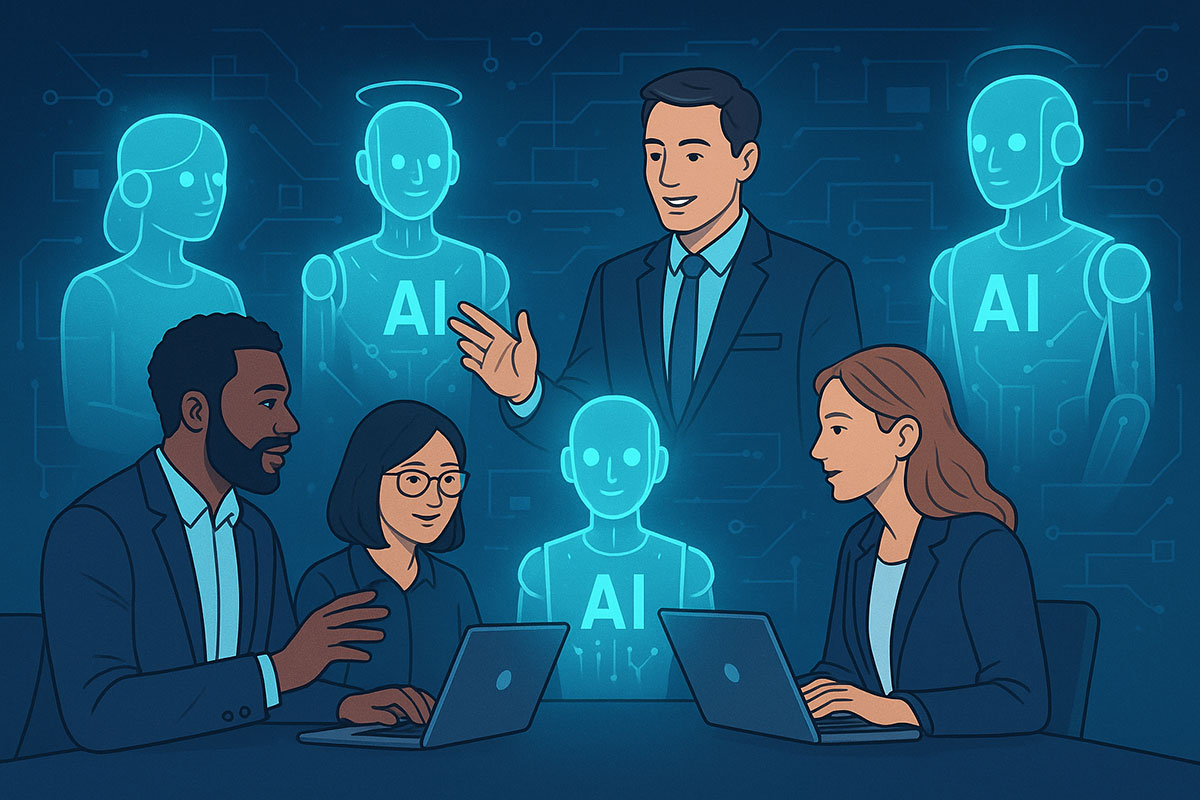
Introduction: Humans + AI Together > Either Alone
The future of work isn't "humans vs. AI." It's humans and AI working together, each doing what they do best. The most productive companies in 2025 are those mastering hybrid human-AI teams.
This guide explores how to build and manage AI-human hybrid teams effectively.
The Hybrid Team Concept
What Is Hybrid Work?
Traditional: Humans do work, AI is tool
Hybrid: Humans and AI are true collaborators with complementary strengths
- Humans handle judgment, creativity, relationships
- AI handles volume, speed, pattern recognition
- Together they're exponentially more effective
Real-World Examples
Healthcare:
- AI: Analyzes imaging, detects anomalies quickly
- Doctor: Interprets AI findings, makes diagnosis, treats patient
- Result: Better outcomes, faster diagnosis
Law:
- AI: Reviews contracts, flags issues, finds precedents
- Lawyer: Understands business context, negotiates, builds relationships
- Result: Faster turnaround, lower costs
Customer Service:
- AI: Handles routine questions, resolves 80% of issues
- Human: Handles complex issues, builds loyalty, solves problems
- Result: Better customer satisfaction, happier agents
The Collaboration Pattern
Step 1: AI Processes (high volume, fast)
Step 2: AI Flags for Human (edge cases, judgment needed)
Step 3: Human Decides (adds judgment, context)
Step 4: System Learns (feedback improves AI)
Building Effective Hybrid Teams
Organizational Structure
Old Model (AI-Free):
- Manager → Team Members
- Hierarchy: Linear, top-down
New Model (AI-Hybrid):
- Manager → Team Members + AI Systems
- Hierarchy: Matrix, AI integrates with team
Role Changes
Manager becomes:
- AI system curator (choosing right tools)
- Human skill maximizer (letting humans focus on high-value)
- Workflow designer (integrating AI into processes)
Team members become:
- AI augmented workers (using AI to work smarter)
- Judgment makers (handling edge cases AI misses)
- Continuous learners (adapting to new tools)
Key Success Factors
1. Clear Division of Labor
- Define what AI does (quantifiable, repeatable)
- Define what humans do (judgment, creativity, relationships)
- No ambiguity
2. Feedback Loops
- Humans provide feedback on AI decisions
- System improves from feedback
- Virtuous cycle of improvement
3. Tool Integration
- AI tools integrated into existing workflows
- Not clunky add-ons, but seamless integration
- Minimal context switching
4. Training & Support
- Team trained on tools
- Ongoing support when issues arise
- Culture that embraces tools (not resists)
The Productivity Gains
Real Metrics
- Customer service reps: 2-3x faster response with AI assistance
- Radiologists: 15-20% accuracy improvement with AI second opinion
- Software developers: 30-40% faster coding with Copilot
- Content writers: 50% faster first draft with ChatGPT
The Key Insight
It's not about replacing humans. It's about making humans exponentially more productive.
The Challenges
Challenge 1: Employee Resistance
Fear: "AI will replace me"
Reality: AI augments, doesn't replace (if designed right)
Solution: Transparent communication, training, career development
Challenge 2: Quality Control
Problem: Humans might over-rely on AI (trust it too much)
Solution: Spot-checking, feedback loops, accountability
Challenge 3: Skill Gaps
Problem: Team doesn't know how to work with AI
Solution: Training, clear documentation, support
Challenge 4: Integration Complexity
Problem: AI tools don't integrate smoothly with legacy systems
Solution: Choose tools that integrate well, custom integration if needed
The Future of Work (2027-2030)
Prediction 1: Hybrid Becomes Standard
By 2028, most knowledge workers will use AI as standard tool (like email)
Prediction 2: New Job Categories Emerge
- AI-Human Coordinators (manage interaction)
- AI Quality Assurance (ensure AI decisions are good)
- AI Trainers (teach humans to work with AI)
Prediction 3: Productivity Explosion
Companies mastering hybrid teams will see 30-50% productivity gains vs. competitors
Implementing Hybrid Teams
Step 1: Audit Current Processes
Where is AI helpful? Which tasks are repetitive enough for automation?
Step 2: Choose Right Tools
Don't try to do everything with ChatGPT. Find specialized tools for domain.
Step 3: Pilot with Early Adopters
Find enthusiastic team members to pilot first, generate success stories
Step 4: Train Everyone
Once pilot succeeds, roll out with proper training
Step 5: Monitor and Iterate
Track metrics, gather feedback, improve continuously
Conclusion: The Future Is Hybrid
The companies winning in 2025-2030 aren't those replacing humans with AI. They're those multiplying human capability with AI tools. Hybrid teams are the future.
Explore more on future of work at TrendFlash.
About the Author
Girish Soni is the founder of TrendFlash and an independent AI strategist covering artificial intelligence policy, industry shifts, and real-world adoption trends. He writes in-depth analysis on how AI is transforming work, education, and digital society. His focus is on helping readers move beyond hype and understand the practical, long-term implications of AI technologies.