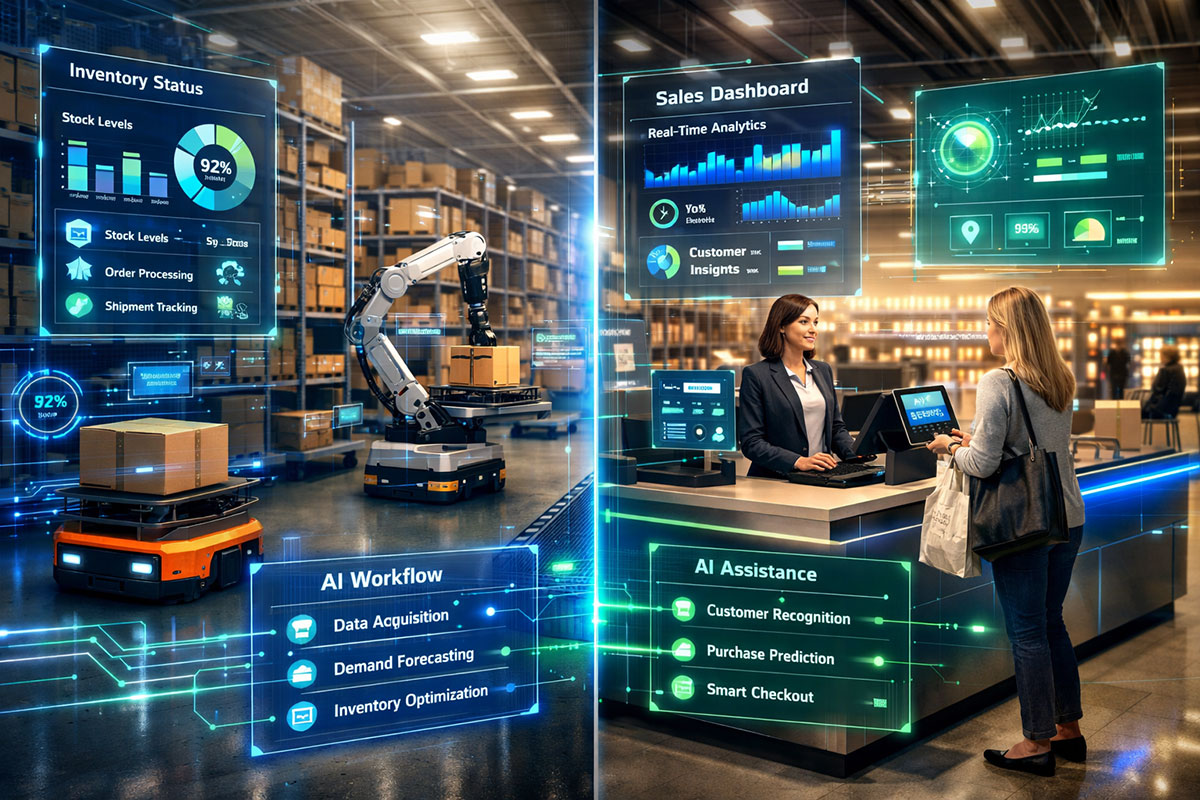
The 91% Reality: Retail's AI Investment Surge Has Officially Begun
When Nvidia released its third annual State of AI in Retail and Consumer Packaged Goods survey on January 6, 2026, it sent a clear message through the retail industry: the age of AI experimentation is officially over. What followed was a cascade of validation for retail leaders who've been quietly building their AI infrastructure. Nine out of ten retailers are now increasing their AI budgets—a statistic that transforms the conversation from "if" to "how much" and "where."
This isn't hype. This is structural change. The survey gathered responses from hundreds of industry professionals, revealing a maturation that typically takes decades to unfold. Companies are moving AI projects from pilot phases into full production across every department—and they're not looking back.
The real story isn't just the 91% adoption rate. It's what happens next: where exactly are these companies directing their capital, what returns are they expecting, and which use cases are winning the investment battle? Let's dig into the data.
The Money Allocation: Where Retailers Are Placing Their Chips
When it comes to budget allocation, retail leaders aren't spreading investment evenly. The Nvidia report reveals a clear hierarchy of priorities—and it tells us a lot about how the industry views competitive advantage in 2026.
Supply Chain Excellence: The Dominant Force
The biggest pressure valve in retail right now isn't flashy customer-facing technology. It's supply chain operational efficiency. Fifty-one percent of respondents identified supply chain optimization as their top AI priority, creating the most immediate ROI opportunity. This makes sense: supply chain challenges have intensified over the past five years. Geopolitical instability, labor constraints, evolving consumer expectations for speed, and regulatory complexity across global operations have created a perfect storm.
The investment here focuses on:
- Demand forecasting systems that reduce supply chain errors by 20-50%
- Inventory allocation algorithms that prevent both stockouts and overstock situations simultaneously
- Automated rebalancing that adjusts stock levels in real-time across distribution networks
- Logistics optimization that streamlines routing and reduces delivery costs
For context, one consumer packaged goods manufacturer saw a 30% reduction in lost sales after implementing AI demand planning. Another retailer improved product availability by 6.7% while freeing up £1.86 million in working capital—simply by forecasting 43,000 SKUs more accurately.
This is why supply chain investment dominates. The math is undeniable.
Meeting Customer Expectations: The Second Priority
The next tier, cited by 45% of respondents, centers on meeting customer expectations. Here's where the investment splits into multiple channels:
- Personalized shopping experiences and real-time product recommendations
- Intelligent digital shopping assistants (chatbots and conversational AI)
- Dynamic catalog enrichment that localizes product information for different markets and customer segments
- Checkout automation that reduces friction and cart abandonment
The ROI metrics here are equally compelling. When asked specifically about return on investment, personalized marketing and advertising drove the highest returns at 23%, followed by customer analysis and segmentation at 19%, and hyperpersonalized recommendations at 18%.
To understand the scale: ASOS, with 25.7 million active customers and 150,000 products in their inventory, deployed Nvidia-powered recommendation systems that generate 500,000 recommendations per second and 5 billion recommendations daily. The level of personalization at that scale was impossible before GPU-accelerated AI.
Transparency and Traceability: The Emerging Priority
Thirty-eight percent of survey respondents identified solving for traceability and transparency as a top-three priority. This reflects a seismic shift in consumer behavior and regulatory requirements. Customers increasingly demand to know the origin of products, and regulators are mandating supply chain visibility for everything from food safety to conflict minerals.
AI is solving this through:
- Automated tracking systems across supply chain networks
- Real-time transparency dashboards
- Regulatory compliance automation
- Consumer-facing origin verification systems
Agentic AI: The 2026 Wildcard That Changes Everything
While traditional AI applications dominate current investment, something more fundamental is beginning to reshape retail operations: agentic AI. This is the category that deserves your attention in 2026.
What Agentic AI Actually Is
Agentic AI systems go far beyond ChatGPT-like chatbots. These are autonomous systems that can reason, plan, and execute complex multi-step tasks with minimal human intervention. Unlike traditional AI that responds to specific commands, agents understand objectives, break them into sub-tasks, and work across multiple systems to achieve goals.
In retail, this means an AI agent could autonomously:
- Rebalance inventory across 500 store locations based on real-time demand signals
- Negotiate pricing with vendors while optimizing for margin
- Manage customer inquiries that require access to multiple backend systems
- Execute promotional campaigns in real-time based on customer behavior
Current Adoption and Trajectory
Forty-seven percent of survey respondents are either using or assessing agentic AI. More importantly:
- 20% have AI agents already active in their organizations
- 21% report that agents are coming within the next year
- 57% of agentic AI adopters cite increased process speed and efficiency as the primary goal
- 40% are targeting enhanced customer experience and personalization
- 40% want improved decision-making with real-time data
This is significant. For a technology that didn't exist in production environments five years ago, reaching 47% assessment or adoption in a single year signals extraordinary momentum.
Where Agentic AI Delivers Impact
The truly disruptive impact of agentic AI is hitting three operational zones simultaneously:
Internal Operations: Autonomous inventory rebalancing, dynamic pricing optimization, vendor negotiations, and supply chain orchestration. This is where the measurable ROI emerges first because the cost structure is immediately visible. An agent that reduces negotiation cycles from days to hours—across hundreds of vendors—generates measurable savings within weeks.
Employee and Customer Support: Agents that resolve complex, multi-issue tickets by accessing inventory systems, customer databases, payment processors, and logistics platforms simultaneously. Instead of requiring a human agent to navigate five different systems, the AI agent handles the entire workflow and reports the outcome.
Customer Engagement: Agents that move beyond analytics to real-time action. Instead of recommending a product, agents adjust messaging, recommend alternatives, guide purchase decisions based on individual customer context, and can even orchestrate cross-channel experiences (email, SMS, in-app, social media) simultaneously.
Physical AI: The Quiet Revolution in Warehousing
While digital AI dominates the conversation, physical AI—the integration of computer vision, robotics, and AI reasoning in the physical world—is gaining ground in retail operations.
Seventeen percent of survey respondents report using or evaluating physical AI technology.
The applications here include:
- In-warehouse robotics that improve pricing accuracy and inventory presentation
- Automated sortation systems that organize products for picking and packing
- Computer vision systems for real-time shelf monitoring and stock-out detection
- Autonomous mobile robots that handle high-volume, repetitive tasks while workers focus on exception handling
The early movers report that physical AI delivers more than just task automation. When thoughtfully integrated, these systems enhance flexibility and throughput while responding to workforce pressures and rising logistical complexity.
The Financial Reality: Revenue Growth and Cost Reduction
Retailers aren't investing in AI as a vanity project. The financial returns are substantial and measurable:
| Metric | Percentage | Impact |
|---|---|---|
| AI increasing annual revenue | 89% | Companies reporting revenue growth from AI |
| Revenue increase >10% | 30% | Substantial revenue acceleration |
| AI decreasing annual costs | 95% | Near-universal cost reduction |
| Cost reduction >10% | 37% | Significant bottom-line improvement |
| Employee productivity improvement | 54% | Internal efficiency gains |
| Operational efficiency improvement | 52% | Process optimization benefits |
| Customer service improvement | 41% | Customer-facing impact |
What's striking about these numbers is the consistency. Multiple independent benefits are accruing to the same investments. An AI system that reduces inventory costs simultaneously improves product availability (which increases revenue) and reduces employee time spent on manual inventory counts (which improves productivity).
This is why 90% of companies plan to increase AI budgets in 2026. The ROI isn't theoretical—it's already visible in quarterly results.
The Open-Source Revolution in Retail AI
An often-overlooked detail from the Nvidia report: 79% of survey respondents identified open-source models and software as moderately to extremely important to their AI strategy.
This is a dramatic shift from five years ago, when proprietary AI platforms dominated enterprise thinking. The move toward open source reflects several dynamics:
Strategic Control: Retailers using proprietary AI platforms initially felt locked into vendor ecosystems. Open-source models flip the equation—companies can leverage their proprietary retail data, avoid vendor lock-in, and benefit from open-source community innovation simultaneously.
Cost Efficiency: Training custom models on proprietary data using open-source frameworks costs a fraction of what custom proprietary systems demand. This democratizes advanced AI capabilities to retailers of all sizes.
Interoperability: Open-source models integrate more easily with existing retail systems—point-of-sale platforms, inventory management software, supply chain tools. This dramatically reduces implementation timelines.
Community-Driven Innovation: Open-source AI communities iterate rapidly. Retailers benefit from improvements without waiting for vendor roadmaps.
The Workforce Transformation Nobody Is Discussing
When 54% of companies report improved employee productivity from AI, that number carries hidden complexity. Retail employment is about to fundamentally transform.
The AI implementations winning budget approval aren't replacing workers in the traditional sense. Instead, they're:
- Automating repetitive cognitive tasks so employees handle exception cases and high-value activities
- Enabling faster decision-making so planners can evaluate more scenarios and optimize faster
- Reducing manual data entry so employees spend time on strategic work rather than spreadsheets
- Creating new job categories around AI model management, prompt engineering, and agent oversight
However, the skills mix is shifting. Retailers need fewer people doing traditional inventory management and significantly more people who can train AI models, interpret machine learning outputs, and oversee autonomous systems.
This creates an opportunity window. Retailers investing in workforce upskilling in 2026 will have significant competitive advantages by 2027. Those who don't will face talent shortages in critical roles.
Regional Differences and Competitive Dynamics
While the Nvidia survey doesn't break down geographic variance in detail, the broader market context suggests important regional variations:
North America and Western Europe are leading in agentic AI adoption and physical AI implementation. Retailers here have invested heavily in technology infrastructure and have access to skilled technical talent.
Asia-Pacific is moving faster in certain categories, particularly in mobile-first personalization and dynamic pricing, reflecting consumer behavior patterns that differ from Western markets.
Emerging markets are leapfrogging traditional infrastructure investments, directly adopting cloud-based AI solutions without building on-premise systems.
For businesses with global operations, this creates a fragmented technology landscape. Successful retailers are designing flexible AI infrastructure that adapts to regional capabilities while maintaining global consistency in core processes.
Vendor Positioning: Why This Matters for Retailer Strategy
Nvidia released this report as a market leader in GPU computing and AI infrastructure. The positioning is strategic: retailers need massive computational power to run these AI systems, and Nvidia provides the semiconductors that enable this compute.
But the report's focus on open-source models, agentic systems, and physical AI reflects a broader competitive dynamic. Traditional enterprise software vendors (SAP, Oracle, Microsoft) are offering AI through proprietary platforms with vendor lock-in. Nvidia's positioning—hardware-agnostic, software-flexible, supporting open standards—reflects a different bet on the market's future.
For retailers, this matters because:
The best AI infrastructure 2026-2028 won't be a single monolithic platform. It will be a combination of best-of-breed tools connected through APIs and cloud infrastructure. Retailers who build flexible, modular AI stacks will outmaneuver those locked into single-vendor ecosystems.
2026 Reality Check: Pilots Become Production
A critical insight from the Nvidia report: the industry is moving from "piloting" to "scaling." When 91% of companies are actively using or assessing AI, we've crossed the adoption threshold.
What this means in practical terms:
Q1-Q2 2026: Companies finalize business cases and approve budgets for major AI infrastructure investments.
Q2-Q3 2026: Implementation of agentic AI systems in supply chain operations begins. These projects typically take 4-6 months from kickoff to production.
Q3-Q4 2026: Results become visible in operational metrics—inventory accuracy, demand forecast improvement, employee productivity gains.
Q4 2026: Companies with successful 2026 implementations begin planning expansions into new use cases and departments.
Retailers still in "evaluation" mode in early 2026 will face significant competitive disadvantage by year-end. The strategic window for decisions is now.
The Competitive Imperative: Why 2026 Matters More Than 2025
The Nvidia report lands at an inflection point. For the first time, AI adoption in retail isn't about competitive advantage—it's about competitive necessity.
Consider the math:
- 90% of competitors are increasing AI budgets. Not increasing budgets means accepting that you're losing ground on automation, cost optimization, and personalization.
- The top 10% adopting agentic AI will have operational advantages that compound. By the time competitors catch up, these leaders will be applying AI to their next-generation challenges.
- Employee retention becomes critical. Companies without advanced AI tooling will struggle to retain technical talent as they watch peers deploy sophisticated systems.
The companies that will dominate retail in 2027-2028 are making decisions now about AI infrastructure, vendor partnerships, and workforce investment.
Key Takeaways for Retail Leadership
The strategic imperative is clear: retail companies not increasing AI investment in 2026 are betting that their competitors won't either. The Nvidia data suggests that's a losing bet.
First: Supply chain optimization and demand forecasting remain the highest-priority use cases. If your organization hasn't deployed AI for inventory management and demand planning, that's where investment should start.
Second: Agentic AI is moving from speculation to production. Companies implementing autonomous workflows in 2026 will establish operational advantages that take competitors years to match.
Third: Open-source models provide strategic flexibility that proprietary platforms can't match. Investing in open-source-based infrastructure now provides flexibility for future changes that proprietary bets don't.
Fourth: Physical AI is no longer a future consideration—it's a 2026 decision point for warehouse and fulfillment operations.
Fifth: Workforce transformation is happening whether you plan for it or not. Companies actively upskilling employees in AI oversight, model management, and agent configuration will outcompete those reacting to changes after the fact.
Looking Forward: 2027 and Beyond
The Nvidia report provides visibility into 2026. But what's the trajectory beyond?
Nvidia itself has guided for 65% AI market growth in 2026, and the company's visibility into customer capital expenditures extends into 2027. This suggests AI infrastructure investment is a multi-year commitment, not a single-year spike.
For retailers, this means:
- AI budgets will continue increasing through 2027-2028
- The gap between leaders and laggards will widen significantly
- New use cases (supply chain financing, autonomous stores, emotion-aware customer service) will move from pilot to production
- Regulatory frameworks around AI transparency and bias will require infrastructure investment
The companies that treat 2026 as a year to finalize strategy and infrastructure decisions will move quickly into scaling in 2027. Those still evaluating in 2026 will be fighting for position in a crowded field.
Final Word: The 91% Verdict
When nine out of ten companies in an industry commit to the same strategic direction, it's not a trend—it's a structural shift. The 91% figure in the Nvidia report represents the moment retail executives stopped asking "should we invest in AI?" and started asking "how do we win with AI?"
The answers are becoming clear: invest in automation that directly improves unit economics, build flexible technology infrastructure that avoids vendor lock-in, and start building the technical workforce that will manage autonomous systems at scale.
The retailers who get these decisions right in 2026 will be the ones setting strategy for the entire industry in 2027.
Related Reading & Internal Links:
For deeper context on AI's role in business transformation, explore these related articles:
- AI Agents in 2025: Your Ultimate Guide to Automating Work and Life
- Agentic AI: Your New Virtual Coworker is Here
- How AI Is Transforming Retail in 2025
- AI in E-Commerce: The 11x Order Boost
- Supply Chain AI and Automation
- Best AI Tools for Productivity and Business
- AI in Business: The Complete Enterprise Guide
- AI News & Trends Category
Browse by Category:
General Links:
About the Author
Girish Soni is the founder of TrendFlash and an independent AI strategist covering artificial intelligence policy, industry shifts, and real-world adoption trends. He writes in-depth analysis on how AI is transforming work, education, and digital society. His focus is on helping readers move beyond hype and understand the practical, long-term implications of AI technologies.