Introduction: A New Laureate in the Lab
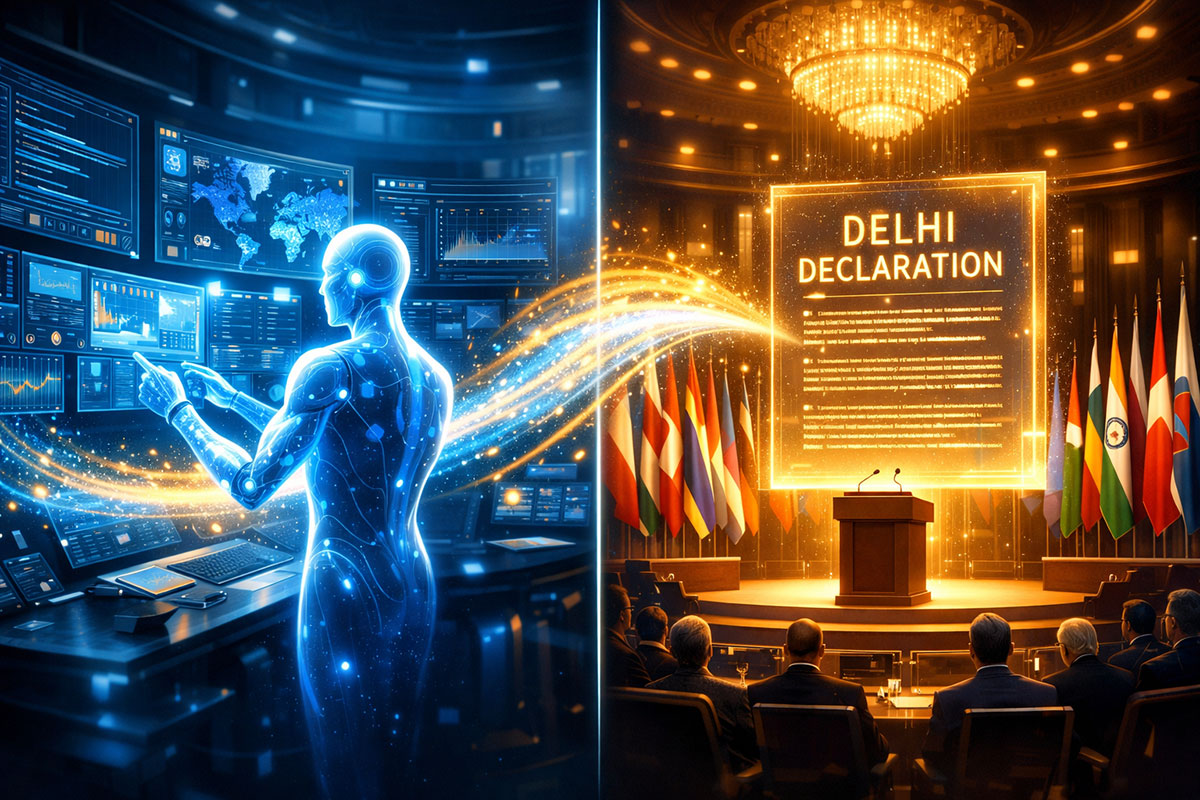
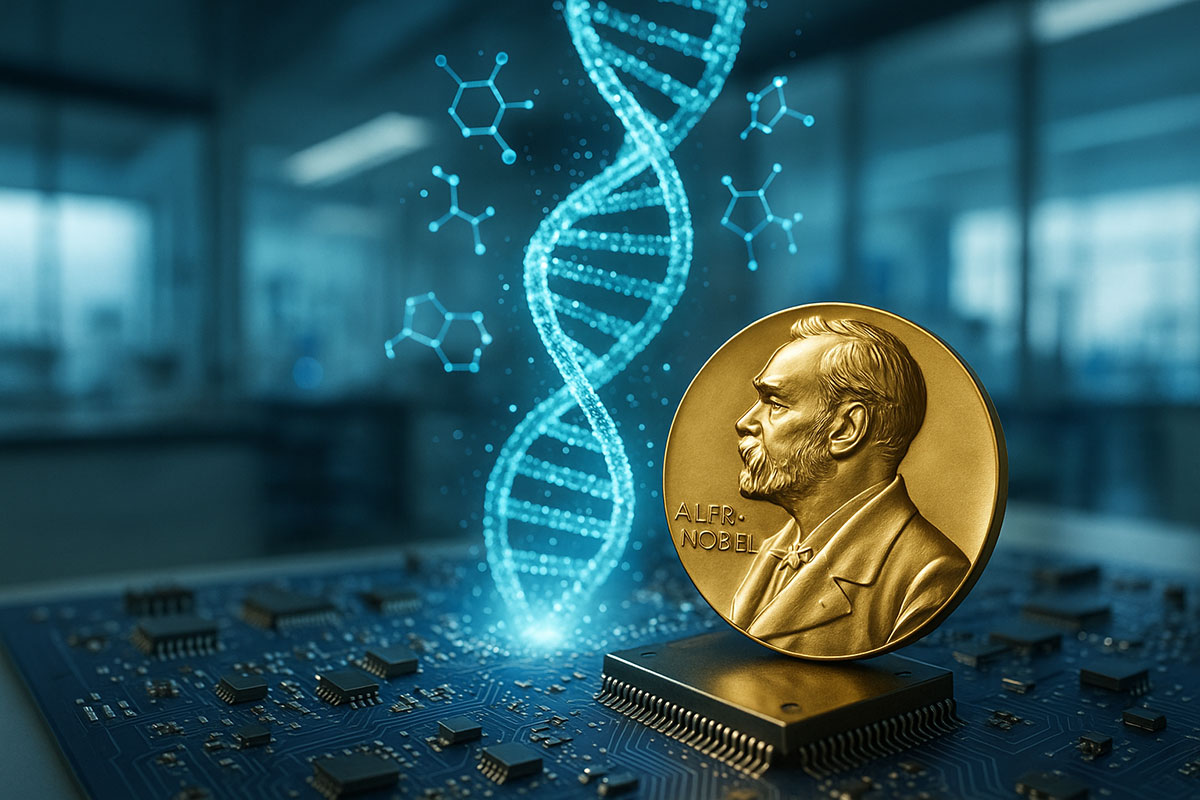
For decades, the Nobel Prize has honored the greatest human minds for discoveries that confer "the greatest benefit to humankind." But in a striking shift, the laureates of the 2020s are increasingly those who have created not just a discovery, but the discoverer itself: Artificial Intelligence. The recent awards have cemented AI's status not as a mere tool, but as a transformative engine of scientific progress, capable of tackling problems that have stumped scientists for generations. The 2025 Nobel Prizes in Physics and Chemistry stand as powerful testaments to this new reality, celebrating both the foundational mathematics of machine learning and its revolutionary application in deciphering the language of life itself. This isn't just automation; it's the dawn of a new partnership in scientific exploration.
The 2025 Nobel Prize in Physics: Honoring the Architects of AI's Mind
The 2025 Nobel Prize in Physics was awarded to US scientist John Hopfield and British researcher Geoffrey Hinton for their "foundational discoveries and inventions that enable machine learning with artificial neural networks". This award was particularly significant because it recognized theoretical work from the 1980s that laid the groundwork for today's AI boom.
The Science Behind the Award
John Hopfield was credited with inventing an associative neural network—a type of system capable of rebuilding whole images from partial, broken, or corrupted versions. This technology not only advanced computing but also provided a model for how the human brain might process information and reconstruct memories.
Geoffrey Hinton, often called the "godfather of deep learning," received the prize for creating the recurrent neural network. His work became the backbone of modern natural language processing and computer vision, enabling machines to recognize and analyze patterns in sequences of data, much like humans do with language and sight. Their collective work provided the conceptual and technical underpinning for the entire field of modern AI, demonstrating the profound role of theoretical research from physics and computer science in shaping our world.
The 2025 Nobel Prize in Chemistry: AI as a Discovery Engine
Parallel to the physics award, the Nobel Prize in Chemistry for 2025 highlighted AI's practical power to solve real-world scientific challenges. It was awarded for outstanding achievements in protein structure research, with the laureates being American scientist David Baker and British researchers John Jumper and Demis Hassabis. Their work revolved around "unravelling the code of protein structures," a problem so complex it was long considered one of biology's grand challenges.
From Impossible to Inevitable: Predicting Protein Structures
David Baker was recognised for devising methods to create entirely new types of proteins, an accomplishment scientists had previously thought to be nearly impossible. These techniques have opened new horizons in biochemistry and medicine.
Meanwhile, John Jumper and Demis Hassabis developed an advanced artificial intelligence model for predicting the complex, three-dimensional structures of proteins from their amino-acid sequences. The core of this neural network, launched in 2020, represented a seismic breakthrough in computational modelling with vast applications in pharmaceuticals and biotechnology. Their system, AlphaFold, has since been cited over 20,000 times and has been used to make discoveries in malaria vaccines and cancer treatments, showing immediate and profound real-world impact.
Beyond 2025: The Precedent of AI in Nobel Awards
The recognition of AI's role in science did not begin in 2025. The previous year, 2024, also saw Nobel Prizes with deep AI connections, setting the stage for this new trend and offering a glimpse into how the committees view the relationship between human and machine intelligence.
The 2024 Nobel Prize in Chemistry and AlphaFold
In 2024, one half of the Nobel Prize in Chemistry was awarded to Demis Hassabis and John Jumper of Google DeepMind for their work on protein structure prediction with AlphaFold. This award confirmed that the Nobel Committee recognizes achievements in creating AI systems that solve fundamental scientific problems. As one commentator noted, AlphaFold succeeded by learning the right "language" to describe protein folding, a task that had eluded scientists for half a century.
The 2024 Nobel Prize in Physics and Foundational AI
Similarly, the 2024 Nobel Prize in Physics was awarded to John J. Hopfield and Geoffrey Hinton for "foundational discoveries and inventions that enable machine learning with artificial neural networks". This award, while celebrated by the AI community, also sparked debate within the physics community, as some felt the most prestigious honor in their field had been awarded to breakthroughs in artificial intelligence rather than a traditional breakthrough in physics itself. This very debate underscores the pervasive and disruptive influence AI is having across all scientific disciplines.
How AI is Transforming the Scientific Method
The success of systems like AlphaFold points to a deeper shift in how science is conducted. Researchers are beginning to categorize AI's role in science into distinct waves or levels of impact, moving from simple assistance to full autonomy.
From Assistant to Autonomous Scientist
- Accelerated Computation and Data Processing: For years, AI's main role in science has been to process vast datasets far more quickly than humans can. A prime example is at CERN's Large Hadron Collider (LHC), where AI filters petabytes of collision data in real-time to identify the incredibly rare events that might indicate new physics, such as the Higgs boson.
- Hypothesis Generation and Evaluation: AI is now moving beyond data crunching to actively help form new scientific ideas. Researchers have shown that AI systems can scour biological data to find insights that humans miss. In one case, an AI analyzing a published paper and its associated data set found that certain immune cells in COVID-19 patients were more likely to swell up as they died—an observation the original human authors had overlooked.
- The Quest for Full Autonomy: The AI Scientist: The ultimate goal for some is the "AI Scientist"—a system that can oversee the entire scientific process from start to finish. This concept, known as the Nobel Turing Challenge, aims to develop an AI capable of making a discovery worthy of a Nobel Prize by 2050, or even sooner. Some researchers, like Ross King from the University of Cambridge, believe it's "almost certain that AI systems will get good enough to win Nobel prizes," with the main question being whether it will take 50 years or just 10.
The Future and Ethical Implications of AI in Science
As AI becomes more deeply embedded in the research pipeline, it brings not only promise but also a set of challenges that the scientific community must address to maintain integrity and trust.
Amplifying Human Potential or Replacing It?
AI is widely seen as a tool to augment human scientists, not replace them. It excels at handling vast, repetitive tasks, freeing researchers to focus on creative interpretation and big-picture thinking. However, there is a concern that over-reliance on AI could inadvertently sterilize the "human sagacity" required to reinterpret anomalies and make intuitive leaps—the very kind of genius that the Nobel Prize often celebrates. The key will be to design systems that collaborate with, rather than subordinate, human intuition.
Governance, Trust, and the Risk of Misconduct
The power of AI also introduces new risks. As a pattern recognizer rather than a truth-seeker, AI can amplify spurious correlations from datasets, potentially leading to false discoveries. Furthermore, generative AI can enable large-scale research misconduct through paper mills, producing fraudulent papers complete with fake data and citations. To combat this, the scientific community is calling for a robust governance framework that could include mandatory disclosure of AI use in research, independent audits for AI-assisted claims, and democratized access to AI tools to prevent a new digital divide from forming between well-resourced and smaller labs.
Conclusion: A New Era of Discovery
The recognition of Artificial Intelligence by the Nobel Committee is more than a trend; it is a landmark in the history of science. We are witnessing a paradigm shift where the tools of discovery are becoming active partners in the process. The 2025 Nobel Prizes in Physics and Chemistry, building on the precedents of 2024, celebrate this profound transition—from the mathematical theories that gave us modern machine learning to the applied systems that are now cracking biology's hardest codes. As we look to the future, the greatest benefit to humankind may not come from AI alone, or from humanity alone, but from the powerful synergy that is already beginning to unfold in labs around the world.
Related Reading
- Agentic AI: Your New Virtual Coworker is Here - Explore how autonomous AI is moving from the lab to the business world.
- The AI Safety Report Card: Who's Making the Grade? - As AI grows more powerful, how are leading companies managing its risks?
About the Author
Girish Soni is the founder of TrendFlash and an independent AI strategist covering artificial intelligence policy, industry shifts, and real-world adoption trends. He writes in-depth analysis on how AI is transforming work, education, and digital society. His focus is on helping readers move beyond hype and understand the practical, long-term implications of AI technologies.