- Day 1: Building Your Professional OS
- Day 2: The Digital Intern Fleet (Current)
- Day 3: The Deep-Work Shield
- Day 4: Executive Intelligence
- Day 5: Agentic Networking
- Day 6: The Human-Plus Moat
- Day 7: The Career Agent Launch
You can always tell who is still thinking about AI like it is 2023.
They open one chatbot window, type in a task, get a decent answer, tweak it a little, and call it productivity. At first glance, that seems smart. Compared to doing everything manually, it is smart. But compared to what is now possible, it is painfully limited.
The deeper shift is not “How do I get better answers from one AI?” It is “How do I coordinate several AIs so I spend my time only where human judgment actually matters?” That question changes everything.
Because once your work gets more complex, a single generalist chatbot becomes the bottleneck. It forgets context. It blends roles. It produces work that is often good enough to be tempting, but not structured enough to be dependable. And that is where ambitious professionals lose the real advantage.
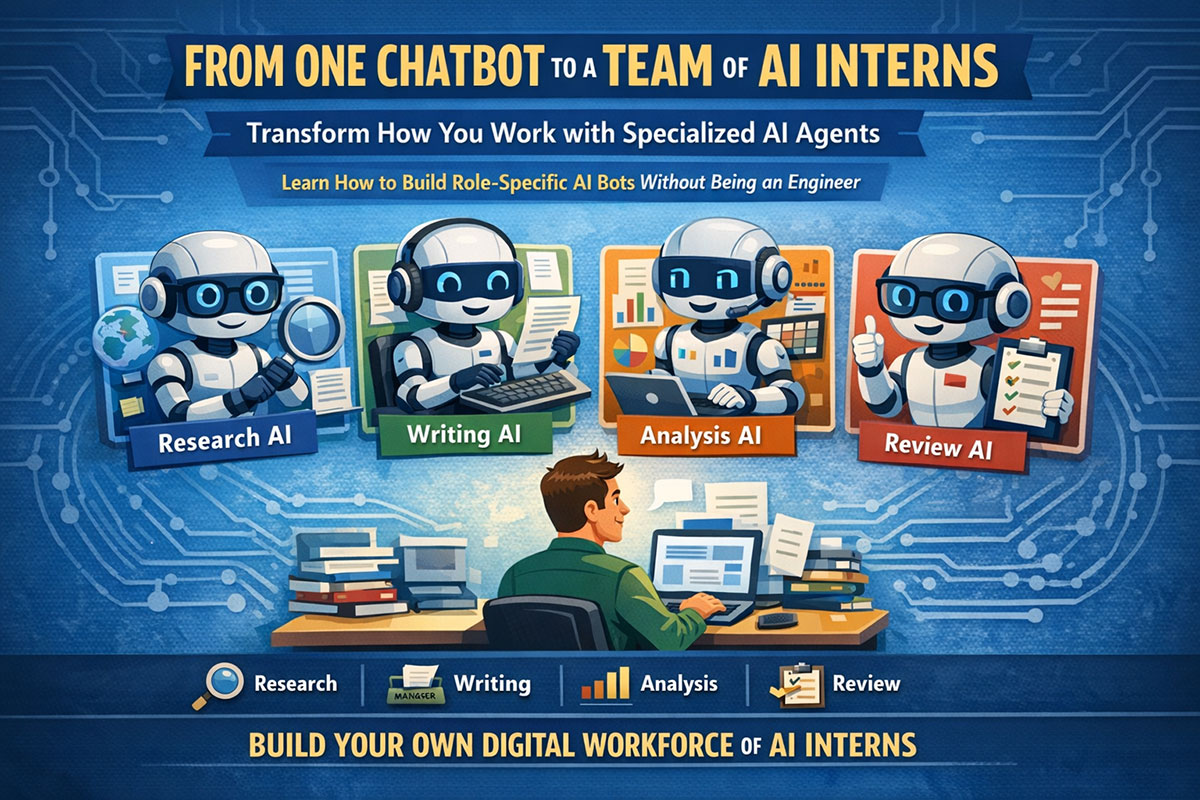
What you actually need is a digital intern fleet: a small system of role-specific AI agents that each handle a defined kind of work. One agent researches. One agent drafts. One agent analyzes. One agent edits. You become the manager, not the exhausted doer.
The professionals who win with AI will not be the ones who ask the cleverest single prompt. They will be the ones who design the best systems of delegation.
That is the mindset shift for Day 2 of this series. In Day 1, we built the idea of a personal AI operating system. Today, we move one layer deeper. We stop thinking like a solo contributor with one helpful tool and start thinking like a manager of a multi-agent team.
And no, this does not require a computer science degree. You can begin with Custom GPTs, Gemini Gems, or simple no-code workflows. The difficult part is not the software. It is learning to define roles, assign responsibilities, and create handoff logic. In other words, the difficult part is management.
That is also the opportunity.
Table of Contents
- Why One Chatbot Is Not a Workforce
- The Manager Mindset: How AI Work Really Scales
- How to Build Your First Digital Intern Fleet
- Real-Life Scenario: From 15 Hours to 2 Hours
- The Promise and the Risk of an AI Workforce
- FAQ
Why One Chatbot Is Not a Workforce
Most people do not realize they are misusing AI because the first layer of value is so obvious. Ask a chatbot to summarize a report, brainstorm some ideas, rewrite an email, or draft a social caption, and it often performs well enough to feel impressive. That early success creates a hidden trap: you assume one capable tool is the answer to everything.
But work is not one thing. It is a chain of different activities, each requiring a different standard of thinking. Research needs breadth and skepticism. Analysis needs structure and judgment. Writing needs tone and audience awareness. Editing needs precision. Strategy needs context and trade-offs. Asking one generalist system to do all of that in one thread is like asking one intern to be your market researcher, analyst, copy chief, and chief of staff simultaneously.
What happens next is predictable. The output becomes muddy. Facts and interpretation blur together. Tone becomes inconsistent. Important assumptions go unchallenged. And because the same system is doing the generation and the evaluation, weak ideas often slip through dressed up as polished language.
This is why the language of “virtual coworker” matters more than the language of “tool.” In Agentic AI: Your New Virtual Coworker Is Here, the central idea is that AI is no longer merely passive software waiting for a command. It increasingly behaves like a collaborator that can take on bounded responsibilities. That means your job also changes. You are not merely operating software anymore. You are supervising labor.
Once you see that, the flaw in the one-chatbot approach becomes obvious. A workforce is not defined by how intelligent one person is. It is defined by how clearly roles are divided and how reliably work moves from one role to the next.
| Approach | How It Works | Main Advantage | Main Weakness |
|---|---|---|---|
| One Generalist Chatbot | One thread handles research, drafting, editing, and strategy | Fast to start | Context gets messy and quality becomes inconsistent |
| Specialized Agent Fleet | Separate agents handle distinct roles with defined outputs | Better quality control and scalable delegation | Needs planning and workflow design |
| Human-Only Workflow | Every step completed manually by you or your team | High nuance when time is available | Slow, expensive, and hard to scale |
That is the core mistake many professionals are making right now. They think AI adoption means using one better interface. In reality, real leverage begins when you create a system of specialized assistants that can hand work to one another. The people who understand this early will not just be faster. They will be structurally harder to compete with.
The Manager Mindset: How AI Work Really Scales
Let us get practical. What does it actually mean to become a manager of AI instead of an individual contributor using AI on the side?
It means you stop measuring value by how much work you personally touch. Instead, you measure value by how well the system produces results under your supervision. That is a profound shift for high performers, because many ambitious professionals secretly equate control with quality. They assume that the more they personally write, review, and refine, the better the output must be.
Sometimes that is true. Often it is not. Often they are simply doing work that could have been separated, standardized, and delegated.
Think about the best managers you have ever worked with. They were not the ones rewriting everyone’s documents at midnight because nobody could meet a standard. They were the ones who created clarity. They defined the brief, assigned the right work to the right people, set review checkpoints, and preserved their energy for the decisions that actually required senior judgment.
That is the model for managing a digital intern fleet. Your AI “Data Analyst” agent should not be improvising social media tone. Your “Copywriter” agent should not be trusted to validate sources. Your “Research” agent should not publish final conclusions. Each role exists to reduce cognitive overload, not create more of it.
This is also why the future-of-work conversation feels so tense. People sense that AI can automate major parts of their job, but they are not always clear about the escape route. One useful framing is this: if routine execution is increasingly automated, your defense is not pretending automation will fail. Your defense is learning to direct it better than others. That is exactly the survival logic behind AI Agents Are Automating Jobs—But Here’s How to Stay Ahead in 2025. The safest professional position is not “the person who does the repetitive work.” It is “the person who designs, evaluates, and improves the system that gets the work done.”
Here is a simple way to think about it:
- Workers complete tasks.
- Managers define roles, review outputs, and decide what good looks like.
- Agentic professionals do the same thing, but with a blend of humans and AI agents.
That does not make your work less human. In many cases, it makes it more human. Because when AI handles the repetitive first-pass work, you have more time for taste, ethics, prioritization, stakeholder alignment, and creative judgment. Those are not side notes. Those are the parts that matter most.
A great AI workflow does not remove human value. It removes low-value human exhaustion.
So the challenge is no longer “Can AI help me?” That question is already outdated. The better question is “Which parts of my workflow deserve their own specialist, and how do I supervise the handoffs?” Once you start there, you are no longer dabbling. You are building an operating model.
How to Build Your First Digital Intern Fleet
Here is the good news: your first digital intern fleet does not need to be complicated. In fact, the biggest mistake beginners make is trying to build a grand automated empire before they have mapped one stable workflow. Start small. Start with one repeated process that drains time every week.
For many professionals, that process is one of these: research synthesis, content drafting, meeting preparation, competitive analysis, sales outreach preparation, or reporting. The right starting point is not the flashiest task. It is the one that is repetitive, mentally expensive, and easy to break into stages.
Suppose you want to create a simple three-agent system. You might define it like this:
- Research Agent: gathers source material, identifies themes, flags uncertainties, and produces a structured briefing note.
- Drafting Agent: turns the briefing note into a first draft in the right voice and format.
- Editing Agent: tightens language, checks consistency against the brief, and highlights gaps or claims that need human verification.
That alone is enough to change how your week feels.
If you use Custom GPTs or Gemini Gems, you can create separate role definitions with different instructions, tone rules, input formats, and output expectations. If you want more coordination, no-code and low-code tools can help you chain these roles together. Some professionals will eventually explore frameworks like CrewAI, especially when they want multiple agents to collaborate in a more structured workflow. But you do not need to begin there. Accessibility matters. The goal is to learn the logic of specialization first.
If you want a practical beginner-friendly path, the most useful advice is to give each agent four things:
- A clear job title so the role stays narrow.
- A specific success metric so output quality can be judged.
- A standard input format so the agent knows what it receives.
- A standard output format so the next step becomes easier.
That is exactly why building your first specialized assistant is less about “magic prompts” and more about workflow design. If you need a beginner-friendly starting point, this guide on how to build an AI agent that works for you 24/7 with no coding is a natural next read. It helps bridge the gap between curiosity and practical implementation.
Use this checklist before you build your first agent:
- Pick one recurring workflow, not five.
- Break it into separate stages.
- Name each stage like a real role.
- Decide what output each role should produce.
- Create a human review point before anything important goes live.
- Track time saved and error patterns for two weeks.
- Refine instructions only after observing real friction.
Notice what is not on that checklist: “Find the smartest all-purpose chatbot and hope for the best.” Hope is not a workflow. Design is.
The real elegance of a digital intern fleet is that each agent becomes easier to improve over time. When one role underperforms, you can fix that one role. Compare that with a giant all-purpose AI thread where every problem is tangled together. Specialization does not just improve quality. It makes quality improvable.
Real-Life Scenario: From 15 Hours to 2 Hours
Consider a Content Marketing Director at a mid-sized B2B company. Before adopting an agent-based workflow, she spent roughly 15 hours every week on what looked like “strategy work” but was actually a mix of repetitive preparation tasks. She manually scanned industry news, pulled competitor messaging, reviewed audience questions from sales calls, drafted creative briefs for her writers, and then spent additional time cleaning up rough outlines because they often lacked focus.
On paper, she was leading content strategy. In reality, she was buried in pre-production work.
The first breakthrough came when she stopped asking one chatbot to “help with content planning” and instead created three specialized agents.
The first was a Trend Researcher. Its job was not to write anything polished. It gathered current themes from approved sources, extracted repeated industry concerns, grouped them into topic clusters, and listed questions buyers seemed to be asking. Most importantly, it was instructed to separate verified observations from speculative angles.
The second was an Outliner. It received the research packet and transformed it into article angles, audience intent, proposed headlines, narrative structure, and key supporting sections. It did not try to sound clever. Its role was structural clarity.
The third was an Editor. It evaluated the brief and outline against house style, brand voice, overlap with past content, and audience usefulness. It also flagged weak framing and generic phrasing before anything reached a writer.
Within a few weeks, her weekly involvement dropped from 15 hours to around 2 hours of high-level review and approval. That did not mean the system became fully autonomous. She still made the important decisions. She chose priorities. She rejected weak angles. She approved what aligned with business goals. But she was no longer spending her best energy doing what a well-structured AI workflow could do faster.
The effect on the team was bigger than the time savings alone. Writers received clearer briefs. Fewer ideas stalled in development. Editorial meetings became sharper because the raw preparation work had already been done. Output increased, but just as importantly, quality became more consistent.
This is the part many people miss. The biggest gain was not simply “doing more content.” It was reallocating senior attention. Instead of drowning in preparation, the director could think about positioning, campaign fit, and differentiation. She became more strategic precisely because she had delegated better.
That is what a digital intern fleet should do. It should not replace judgment. It should create the conditions for judgment to matter more.
The Promise and the Risk of an AI Workforce
At this point, the idea of managing AI agents can sound almost too good. Faster output, lower friction, less mental overload, more leverage—who would not want that?
But this is exactly where thoughtful professionals need to slow down. Every powerful workflow creates new risks, and pretending otherwise is how sloppy systems end up making confident mistakes at scale.
The upside is real. A specialized AI fleet can reduce the drag of repetitive work, standardize quality, shorten turnaround times, and free senior people to focus on strategy. It can also make smaller teams feel larger. That matters in a world where many professionals are expected to deliver more without getting more hours, more budget, or more headcount.
The concerns are real too. If your agents are poorly instructed, they can reinforce bad assumptions faster than a human ever could. If nobody checks sources, research errors can move downstream into polished drafts that look credible. If everything becomes over-automated, your team may start producing work that is technically clean but emotionally flat. And if the human manager stops thinking critically because “the system already handled it,” the workflow becomes efficient in all the wrong ways.
There is also a subtle cultural risk. Teams can become dependent on AI-generated first drafts and gradually lose the habit of original framing. When that happens, output may remain high while distinctiveness quietly collapses. Readers can feel that. Customers can feel that. The market eventually punishes that.
The answer is not fear. The answer is governance.
That means setting clear rules about which tasks can be delegated, which claims require verification, which decisions stay human, and where approval gates exist. Your digital interns can do the heavy lifting, but they should not be unsupervised employees with publishing access to your reputation.
Used well, a multi-agent system becomes a force multiplier. Used lazily, it becomes a speed machine for mediocrity.
So be ambitious, but stay honest. The goal is not maximum automation. The goal is maximum intelligent leverage.
FAQ
1. Do I really need multiple AI agents, or is one advanced chatbot still enough for most people?
One advanced chatbot is enough to get started, but it is rarely enough to scale quality once your work becomes layered. That is the important distinction. If all you need is occasional brainstorming or rewriting, one generalist assistant can still be useful. But as soon as your workflow involves several different cognitive modes—research, analysis, drafting, editing, reviewing—a single thread starts to become messy.
The reason is simple: different tasks need different instructions, different success criteria, and often different output formats. A research-oriented agent should prioritize source coverage and uncertainty. A copy-focused agent should prioritize tone, clarity, and audience fit. An editing agent should be stricter, more skeptical, and less creative. Those are not minor differences. They are different jobs.
Using multiple agents does not mean you need complexity for its own sake. It means you are matching the structure of your AI system to the structure of your actual work. That usually leads to better outputs, easier debugging, and more confidence in what gets handed off to humans. So no, you do not need a fleet on day one. But if you want dependable leverage instead of random convenience, a fleet is where serious value begins.
2. What kinds of professionals benefit most from building a digital intern fleet?
The short answer is this: anyone whose work contains repeatable patterns and multiple stages of thinking. That includes marketers, consultants, founders, analysts, recruiters, researchers, operators, product managers, sales leaders, editors, and many independent professionals. If your work regularly involves collecting information, turning it into structured output, and then refining that output for a goal, you are a strong candidate.
Content teams are obvious beneficiaries because their workflows are easy to break down into research, outlining, drafting, editing, and repurposing. But they are not unique. A consultant might use one agent to synthesize client notes, another to build presentation structure, and another to pressure-test recommendations. A recruiter might use one for role research, another for candidate outreach drafts, and another for interview debrief consolidation. A founder might use separate agents for competitive analysis, investor memo drafting, and customer insight summaries.
The common thread is not industry. It is workflow design. If your week repeatedly disappears into the same kinds of preparation, synthesis, formatting, or review work, then a digital intern fleet can help. The bigger the repeat pattern, the bigger the leverage opportunity.
3. Do I need coding skills to build a multi-agent system?
No. That is one of the most liberating truths about this moment. You can begin building a useful multi-agent workflow without writing code at all. Tools like Custom GPTs and Gemini Gems let you define specialized roles with instructions, goals, and preferred output styles. Even simple prompt templates stored in a document can function like lightweight agents if you use them consistently.
Coding becomes more relevant when you want deeper automation, cross-tool orchestration, API connections, or autonomous task execution across systems. Platforms and frameworks such as CrewAI can become valuable at that stage, especially when you want agents to pass work between each other in a formal workflow. But you do not need to start there.
In fact, many people should not start there. If you automate before you understand the workflow, you often automate confusion. The better path is to define the roles manually first, test the handoffs, and learn where the friction actually is. Once the process is stable, then you can decide whether more technical tooling is worth it. So no, coding is not the barrier. Clarity is.
4. How do I know which tasks should stay human?
A useful rule is this: the higher the stakes, the more human the final decision should remain. Tasks that involve reputational risk, legal implications, sensitive communication, hiring judgments, public claims, brand positioning, or ethically complex trade-offs should always have meaningful human review. AI can assist in these areas, but it should not be the unchecked decision-maker.
By contrast, lower-risk and repeatable tasks are often excellent candidates for delegation. Summarizing notes, preparing first drafts, clustering themes, formatting content, extracting action items, generating variants, or spotting inconsistencies can all be handled effectively by AI with the right instructions.
The key is not to draw the line based on ego. Some people keep basic grunt work human because they think it proves quality. Others hand over sensitive decisions because they are chasing speed. Both extremes are dangerous. The better question is: where does judgment meaningfully change the outcome? Keep humans there. Let AI handle the lead-up work that prepares people to make better calls with less fatigue.
5. What is the biggest mistake people make when building their first AI workforce?
The biggest mistake is trying to build a giant system before proving a small one. People get excited, name six agents, connect tools, create elaborate workflows, and then wonder why the entire thing feels brittle and confusing. That usually happens because they skipped the discipline of role definition.
If your “Research Agent” also writes conclusions, your “Writer Agent” also verifies facts, and your “Editor Agent” also invents new angles, then you have not built specialization. You have just split general chaos into smaller boxes. That is not a workforce. That is duplication.
The smartest beginner move is to choose one repeatable workflow, isolate three roles at most, and define inputs and outputs cleanly. Then watch what happens. Where does quality fall? Where do instructions get misread? Where does human review still take too long? Those observations are gold. They tell you what to refine next.
So the biggest mistake is not technical. It is managerial. People want automation before they have earned understanding.
6. Will using AI agents make my work generic or less valuable over time?
It can, if you use them lazily. That is the honest answer.
When professionals rely on AI to produce finished thinking instead of structured support, their work can become flatter, safer, and more interchangeable. The language may be polished, but the perspective weakens. Over time, that creates a subtle erosion of edge. You are still producing, but not differentiating.
That is why the role of the human manager matters so much. Your agents should help you gather, filter, structure, and pressure-test information. They should not replace your taste, your lived experience, your strategic instinct, or your point of view. Those are the ingredients that turn acceptable work into memorable work.
The best way to avoid generic output is to use AI for leverage, not identity. Let it speed up the heavy lifting. But keep your standards, your editorial lens, and your real-world judgment fully engaged. Done this way, AI does not dilute your value. It amplifies it by giving your strongest thinking more room to show up.
Pro Tip: Now that you have a team of digital interns doing the heavy lifting, it’s time to protect your focus. In Day 3, we will build “The Deep-Work Shield”—showing you how to use AI to automatically triage your email, summarize your Slack channels, and completely eliminate administrative sludge. The Deep-Work Shield
About the Author
Girish Soni is the founder of TrendFlash and an independent AI strategist covering artificial intelligence policy, industry shifts, and real-world adoption trends. He writes in-depth analysis on how AI is transforming work, education, and digital society. His focus is on helping readers move beyond hype and understand the practical, long-term implications of AI technologies.