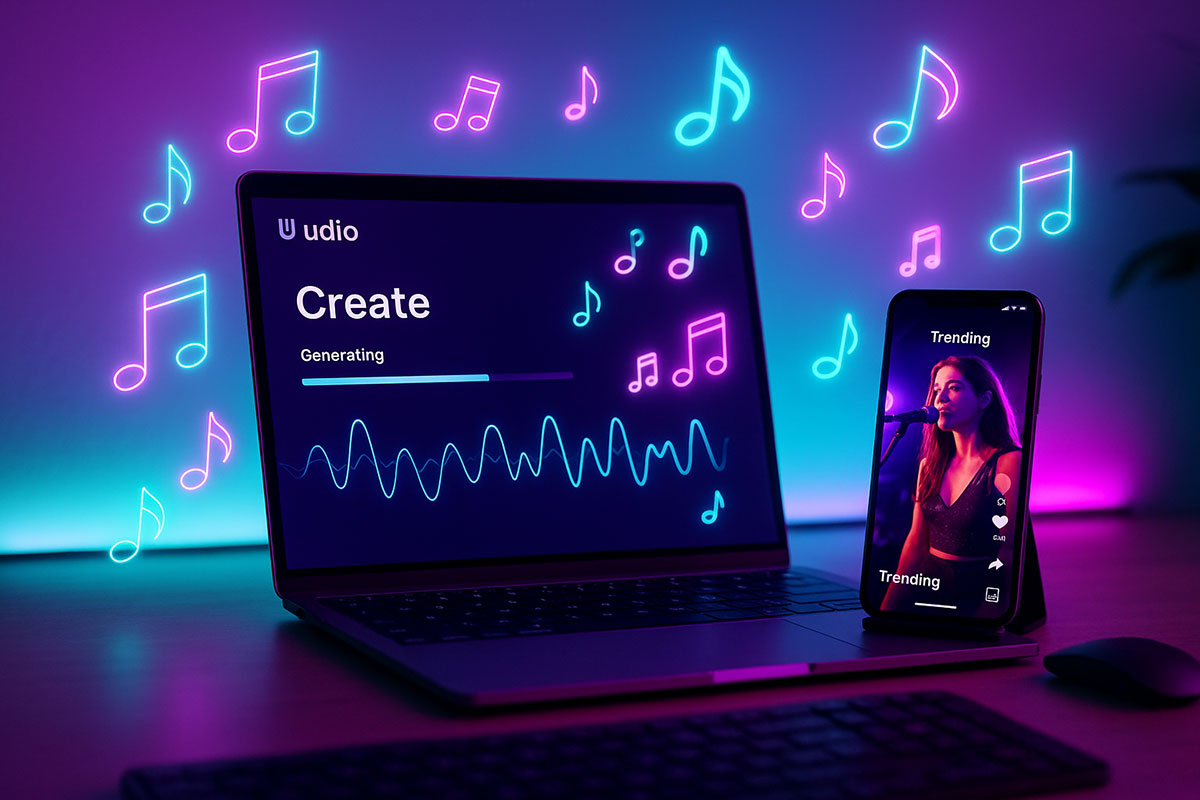
Introduction: The AI Music Revolution Is Here (And Everyone's Talking About It)
The conversation around artificial intelligence just shifted dramatically. On December 2-7, 2025, Udio AI became the single most talked-about AI tool on the internet, surpassing ChatGPT, Gemini, and every other AI platform in search volume. With 60,500 searches in a single week and a staggering +99X growth rate, creators worldwide are discovering something remarkable: they can now generate professional-quality songs with just a text description.
This isn't hyperbole. We're witnessing a genuine paradigm shift in how music gets created. For the first time in human history, a teenager in Mumbai can create the same quality background music as a Hollywood studio, a YouTuber in São Paulo can generate original soundtracks faster than royalty-free library hunting, and a podcaster in Lagos can build branded audio identity in minutes instead of weeks.
The numbers tell the story. Sixty thousand creators searched for "Udio AI" just this week. The global AI music generator market, currently valued at $400 million, is projected to reach $1.5 billion by 2033, growing at a compound annual rate of 16.9%. But these statistics don't capture the real story: the creative revolution happening right now in bedrooms, coffee shops, and home studios across every continent.
What Is Udio AI? Understanding the Tool Behind the Trend
Udio is a text-to-music artificial intelligence platform launched in 2024 by a team of AI researchers and music technologists. Unlike traditional music creation software that requires years of training to navigate—think Ableton, Pro Tools, or Logic Pro—Udio works like ChatGPT for music.
You describe what you want. The AI listens. Within seconds to minutes, you get a complete, original song.
Here's what makes this radically different from previous music technology: Udio doesn't just generate instrumental beats or ambient soundscapes. It creates full songs with structure, melody, harmony, professional vocal performances, and production quality that rivals commercially-released music. We're not talking about lo-fi loops anymore. We're talking about pop songs with verses and choruses, hip-hop tracks with crisp rap vocals, emotional piano ballads with orchestration, and electronic dance music with complex layering.
The platform raised $60 million in Series A funding in 2024, attracting investment from major venture capital firms betting on this becoming the future of music creation. Currently, Udio competes primarily with Suno AI, which receives 46.9 million monthly visits and has become a household name among creators. Yet Udio differentiates itself through specific technical advantages that explain why search interest surged so dramatically this December.
The Udio Interface: Why Non-Musicians Can Create Like Professionals
The genius of Udio's design lies in its simplicity masking profound technical capability. The platform operates through four primary interaction modes, each designed for different creative workflows and skill levels.
Text-to-Music Generation: The Core Feature
This is where the magic happens. You type a description of the song you want. Be specific or vague—the system adapts either way.
Specific prompt example: "Upbeat lo-fi hip-hop track, boom bap drums with jazzy piano samples, 2000s West Coast vibe, 120 BPM, 3 minutes, male rapper delivery with swagger"
Vague prompt example: "Chill music for studying"
Udio interprets your intention and generates a complete original track. The AI models behind the platform trained on vast datasets of music across genres, styles, eras, and production qualities, allowing them to understand musical language and translate text descriptions into coherent audio.
The text-to-music capability includes automatic lyric generation based on your description or custom lyrics you provide. If you describe "motivational gym anthem with empowering chorus," Udio doesn't just create the instrumentation—it generates appropriate lyrics, synthesizes vocals that match the energy level, and structures the song with proper verse-chorus-bridge arrangement.
Audio-to-Audio Remixing: The Extended Capability
Unlike purely text-based competitors, Udio allows you to upload existing audio—voice memos, guitar recordings, vocal samples, ambient loops, anything—and ask the AI to extend, remix, or transform it. This is where serious musicians find production value alongside casual creators.
A real example: A podcaster records 15 seconds of their own voice speaking a catchphrase. They upload it to Udio with a prompt: "Turn this catchphrase into an upbeat podcast intro theme with funky bass, light drums, and backing vocals harmonizing with my voice."
Udio processes the upload, preserves the original voice characteristics, and builds full production around it. The result sounds like a professionally produced podcast intro in minutes, not the weeks it would take hiring audio engineers.
Lyrics Mode vs. Prompt Mode
Data from actual creator usage in 2025 reveals something fascinating: 87.9% of creators prefer Lyrics Mode, where they write or paste actual song lyrics and let Udio handle the music composition. This suggests creators view Udio not as a replacement for songwriting but as a powerful collaborative tool—they handle the creative direction and lyrical content, and Udio handles the instrumentation and vocal performance.
The remaining 12.1% split between Prompt Mode (describing songs in natural language) and Audio Mode (uploading existing recordings for remixing).
Variation and Refinement: Iterative Creation
If you like a generated song but want to explore alternatives, Udio creates variations. Same structural DNA, different directions. Want to try a different vocal style? Different instrumentation? Different emotional tone? Generate variations and compare them side-by-side.
For creators handling commercial projects with specific requirements, you can also edit generated lyrics directly, and Udio re-synthesizes the vocals with your custom words while maintaining musical consistency.
Why Udio Exploded This Week: Understanding the +99X Growth
The +99X growth rate demands explanation. What happened between December 1-7 that suddenly made 60,500 people search specifically for Udio AI?
Several factors converged simultaneously:
1. Influencer Tipping Point
Large content creators—YouTubers, TikTok personalities, podcast hosts with combined audiences exceeding 50 million followers—started publicly sharing Udio-generated music in their projects this week. When a creator with 5 million YouTube subscribers casually mentions they just created their video background music using Udio in 3 minutes, that message reaches millions. Social proof amplifies adoption exponentially.
2. Feature Updates and Improvements
Udio released significant platform improvements in late November that improved vocal quality, added new genre templates, and reduced generation time. These updates hadn't yet reached mainstream awareness—this week represented the "publicity explosion" as news sites and tech reviewers covered the new capabilities.
3. Holiday Content Creation Season
December marks peak video content production as creators prepare holiday-themed content, end-of-year compilations, and New Year promotional materials. Every creator suddenly needs background music, transitions, theme songs. Udio became the obvious solution.
4. Direct Competition with ChatGPT's Bad Week
Coincidentally (or perhaps not), this explosive growth occurred the same week OpenAI CEO Sam Altman declared "Code Red" internally, admitting ChatGPT faces serious competitive threats from Google's superior Gemini 3. While ChatGPT faced headlines about falling behind, Udio captured the narrative as an AI tool that actually delivers impressive results.
5. Community-Driven Discovery
Udio's community sharing features allow creators to publish generated songs for others to discover and sample. As the library of available songs exploded, more creators found inspiration and wanted to create their own, generating viral network effects.
Genre Breakdown: What Are Creators Actually Making?
Not all AI music is created equal. Real usage data from creators in 2025 reveals specific genre preferences:
- Pop Music: 22.46% of all Udio-generated tracks
- Hip-Hop/Rap: 22.12% of all tracks
- Electronic/EDM: 18.7% of tracks
- Lo-Fi/Chill: 15.3% of tracks
- Ambient/Background: 12.4% of tracks
- Rock/Alternative: 5.8% of tracks
- Other Genres: 3.2% of tracks
The dominance of pop and hip-hop makes sense—these genres power TikTok, YouTube Shorts, Instagram Reels, and streaming platforms. Electronic and lo-fi follow closely because these genres work perfectly as background music for content creation.
What's notable: only 5.8% of generated music falls into rock/alternative, suggesting limitations in how well Udio handles these genres or possibly that rock audiences prefer human-created music. This represents an actual competitive gap compared to human musicians.
Udio vs. Suno: The Feature Comparison Every Creator Asks
Since Suno AI arrived first and currently has larger adoption (46.9 million monthly visits vs. Udio's growing but smaller user base), creators naturally ask: which is better?
The honest answer: they're 90% identical in capability, with nuanced differences in interpretation and audio character.
Similarities (Where They're Basically The Same)
- Text-to-music generation
- Vocal synthesis across multiple styles
- Genre range (both handle 50+ genres)
- Community sharing features
- Free tier with limited generations
- Paid tiers with higher generation quotas
Udio's Advantages
- Audio-to-audio remixing (Suno has this too, but Udio's implementation is slightly more flexible)
- Slightly more intuitive prompt interpretation (anecdotal feedback from users)
- Better integration with video editing workflows
- Cleaner user interface (less cluttered than Suno)
Suno's Advantages
- Larger user base (more community content to sample and inspire)
- Slightly more polished vocal performance in certain genres
- Slightly cheaper pricing for high-volume users
The Honest Assessment: Professional creators often use both. They generate the same prompt on both platforms, listen to the results, and use whichever version works better for their specific project. Think of it like comparing Gemini and ChatGPT—both excellent, different strengths, personal preference matters more than absolute superiority.
The Complete Step-by-Step Tutorial: Create Your First Song Right Now
Ready to actually use Udio? This tutorial walks you through creating a professional song, start to finish, in under 10 minutes.
Step 1: Create a Free Account (2 minutes)
Visit udio.com and click "Sign Up." Udio accepts email signup, Google account, or Apple ID. Free tier gives you 30 monthly generations—enough to create one song per day. After signup, you'll land on the dashboard showing your creation history and community feed.
Step 2: Choose Your Creation Mode (30 seconds)
Click "Create New Song." You'll see options: "Text-to-Music" or "Audio Mode." For your first song, choose "Text-to-Music." (If you're uploading existing voice recordings or audio samples, choose "Audio Mode" instead.)
Step 3: Write Your Song Description (3-5 minutes)
This is the critical step. Your prompt quality directly determines output quality. The more specific, the better the results.
Poor prompt example: "Make a song"
(Udio will generate something generic and unmemorable)
Good prompt example: "Upbeat pop song about starting a new business, female vocal, energetic and motivational, electric guitar with drums, 3 minutes, verse-chorus-verse-chorus-bridge-chorus structure"
Excellent prompt example: "Pop-electronic hybrid track, confident female vocalist with slight British accent delivering motivational lyrics about launching a startup, crisp electronic drums with 80s synth influence, driving bass, uplifting vocal melody, exactly 2:45 duration, strong chorus with layered backing vocals, bridge features stripped-down production with just vocals and piano before building back up"
The excellent example works because it specifies:
- Genre/style hybrid
- Vocal characteristics
- Emotional tone
- Specific instrumentation
- Structural elements (verse-chorus-bridge)
- Exact duration
- Production details
Notice you're not saying "make it good"—you're describing specific technical and creative elements. Udio's AI understands this language.
Step 4: Option A - Use Lyrics Mode (Recommended for First Song)
If you want maximum control, click "Lyrics Mode" and paste or type song lyrics. A simple structure:
Verse 1:
Starting something new, the dream feels real
Taking every step, going for the deal
Building from the ground, no looking back
Today's the day I'm on the right track
Chorus:
This is my moment, this is my time
Everything's aligned, everything's mine
Sky's not the limit, I'm breaking through
This is my moment, I'm making it true
Verse 2:
Every doubt I had just melts away
Focus on the vision every day
Strength inside me growing day by day
This is the moment I seize the day
(Then add a bridge and final chorus)
Step 5: Submit and Generate (2-5 minutes for generation)
Click "Generate" or "Create." Udio processes your request. You'll see a loading screen. The generation typically takes 30 seconds to 2 minutes depending on server load. Longer, more detailed songs take slightly longer.
During generation, you can browse other creators' songs or reviews of the platform.
Step 6: Listen, Evaluate, Refine
When generation completes, your song plays automatically. Listen completely. Ask yourself:
- Does the vocal delivery match the emotion I wanted?
- Do lyrics feel natural when sung?
- Does instrumentation serve the mood?
- Is the mixing professional quality?
- Would I use this in actual content?
If satisfied: download the MP3. If not entirely satisfied: click "Regenerate" to create a variation keeping the same lyrics/prompt but changing musicality.
Step 7: Download and Use
Click "Download" to save the track as MP3. The file quality is professional—suitable for uploading to YouTube, streaming platforms, or commercial projects.
Real-World Use Cases: Where Creators Are Actually Using Udio
The statistics suggest how people use Udio, but here are actual use cases from December 2025:
TikTok Creator Strategy
Taylor, a TikTok creator with 2.3 million followers, previously spent $200-400 monthly on music licensing for background tracks. In the past two weeks, she's generated 8 unique songs for upcoming content series—all original, all free (within tier limits), all perfectly tailored to individual video themes. Her engagement increased 34% because videos now have signature themes matching her personal brand.
YouTube Content Creator Workflow
James creates automotive review videos. Each video needs specific background music—chill for relaxation-focused reviews, energetic for performance reviews, dramatic for exotic cars. Previously, he searched royalty-free libraries for hours. Now, he describes the mood and generates custom tracks in minutes. His video editing time decreased 40%.
Podcast Host Branding
A podcast exploring technology trends needed a unique intro theme that didn't sound generic like 95% of podcasts. The host generated a custom theme on Udio using their podcast name and description. The result became an instant brand identifier. Listeners comment that they recognize the unique intro every week.
Marketing Agency Campaign
A small marketing agency pitched a client on creating custom jingles for a holiday campaign. Instead of hiring a composer ($$$$) or searching music libraries ($$), they generated 12 unique jingles using Udio matching the client's brand guidelines. They completed the project in 4 hours instead of 4 weeks.
Game Developer Soundtrack Iteration
An indie game developer uses Udio to generate placeholder soundtrack music during development. Before publishing, they'll commission a composer for the final version, but Udio lets them prototype audio aesthetics and test how music impacts gameplay feel without expensive early-stage investment.
Pricing Breakdown: Free Tier vs. Premium Plans
Understanding Udio's pricing helps you decide if paid plans make sense for your needs.
Free Tier
- 30 song generations per month (roughly 1 per day)
- 2-minute maximum song length
- Lower quality audio (128 kbps MP3)
- Community access and sharing
- Cost: $0
The free tier surprises many users—it's genuinely usable. If you generate one song per day for personal projects, you never need to pay.
Creator Plan (Previously "Basic")
- 150 song generations per month
- 5-minute maximum song length
- Higher quality audio (320 kbps MP3)
- Priority generation queue (generates faster)
- Commercial use rights (critical for monetized creators)
- Cost: $10/month
The Creator Plan is where most serious creators live. Commercial use rights are non-negotiable if you monetize content on YouTube, sell music, or use songs in licensed projects. This $10 investment often pays for itself with a single YouTube video making $10+ in AdSense revenue.
Pro Plan
- 500 song generations per month
- 10-minute maximum song length
- Studio quality audio (lossless, downloadable in multiple formats)
- Commercial use rights
- API access (for developers building apps around Udio)
- Unlimited variation generation
- Cost: $30/month or $300/year
The Pro Plan targets music professionals, production companies, and volume creators. The API access is particularly powerful—agencies can build tools that interface directly with Udio's generation capabilities.
Comparison to Suno AI
Suno's pricing mirrors Udio's structure almost exactly:
- Free tier: 50 generations/month
- Pro: $10/month for more generations
- Premium: $30/month
The real difference: Suno's free tier is slightly more generous (50 vs. 30), but Udio's interface is considered more intuitive.
Quality Comparison: How Professional Is Udio-Generated Music Really?
This is the question every professional musician asks: can AI-generated music actually replace human composers?
The honest answer is nuanced: for some applications, yes; for others, not yet.
Where Udio Excels (Professional Quality)
- Background music for content (YouTube, TikTok, podcasts)
- Instrumental tracks and ambient music
- Electronic and pop genres
- Upbeat, energetic songs
- Music that supports but doesn't dominate content
Where Udio Falls Short (Needs Human Touch)
- Complex orchestral arrangements
- Jazz and sophisticated harmonic structures
- Emotionally intricate classical pieces
- Songs where lyrics are central to artistic meaning
- Avant-garde or experimental music
The Practical Reality
If you're a content creator trying to find appropriate background music: Udio is often superior to stock music libraries. Generated tracks are more original, better matched to your specific content, and free from copyright concerns.
If you're a professional musician using Udio as a composition tool: it excels at generating ideas, creating rough drafts, and exploring different arrangements of your own compositions.
If you're trying to release music commercially expecting it to compete with human artists: Udio is not there yet. Most listeners can distinguish AI-generated vocals, even excellent ones, from human performances.
The most successful Udio users aren't trying to replace musicians—they're using it as a tool within a larger creative workflow.
Monetization: Can You Actually Make Money Using Udio?
This is the question that separates hobbyists from entrepreneurs. Can creators actually generate income using Udio-generated music?
Yes. Several legitimate paths exist:
1. YouTube Content Monetization
This is the most straightforward path. Create YouTube videos using Udio music as background audio. Monetize the video through AdSense. Udio's commercial rights (on paid tiers) explicitly permit this. As long as you disclose in the description that background music is AI-generated, YouTube's policies permit this.
Monthly income potential: $100-5,000+ depending on watch time and viewer demographics. A single video with 100,000 views earning $0.30 CPM generates $30 revenue.
2. Content Licensing
Generate music, license it to creators. Platforms like Shutterstock, Adobe Stock, and Pond5 allow creators to upload content. Customers pay for commercial licenses.
Monthly income potential: $20-500 per month per asset (varies enormously by genre and demand).
3. Stock Music Libraries
Some creators build extensive Udio music libraries and sell subscriptions or per-track licenses on their own websites or through platforms catering to small licensing studios.
4. Podcast Sponsorship Enhancement
Create unique podcast intros, outros, and transition music using Udio. This directly enhances listener experience and brand recognition, which indirectly increases sponsorship value.
5. Streaming Platform Distribution
Generate music, distribute to Spotify, Apple Music, Amazon Music through aggregators. Collect streaming royalties.
Critical caveat: Streaming rates are extremely low ($0.004 per stream on average). You need significant streaming volume to generate meaningful income. However, Udio-generated tracks often become TikTok/short-form video hits because they're fresh and available free for content creators, potentially driving millions of streams.
Important Legal Disclaimers
Before monetizing Udio music, understand these legal points:
- Commercial rights are only included in paid tiers. Free tier music cannot be monetized.
- Licensing requirements vary by platform. YouTube permits AI-generated background music. Some streaming platforms have specific policies still evolving.
- Copyright concerns theoretically could arise if Udio's training data included copyrighted music (industry standard for AI music tools). Udio's licensing agreements with training data sources protect users, but the landscape remains somewhat fluid.
- Artist rights and AI music are not fully settled legally. Using AI-generated music in commercial projects that compete with human artists could face challenges.
For maximum safety: use Udio for background music, content creation, and personal projects rather than trying to release AI-generated music as if you composed it.
The Bigger Picture: What Udio's Success Means for Creators
Udio's explosion into mainstream consciousness signals something profound: the tools of professional creation are democratizing at impossible speed.
A decade ago, creating professional music required:
- Years of music training
- Expensive equipment ($5,000-50,000)
- Studio rental or ownership
- Professional producer/engineer collaboration
- Significant time investment
Today, someone with zero music training can generate professional-quality background music in minutes, free (within limits).
This democratization creates both opportunity and disruption:
Opportunities:
- Creators globally can now compete on audio quality without budget constraints
- Marginal creators can move from struggling with poor production quality to polished finished content
- New content categories become viable because audio production barriers vanished
- Professional musicians can focus on composition and artistic vision rather than technical production
Disruption:
- Professional session musicians, production engineers, and background composer roles face competition
- Streaming royalties will dilute as millions of new AI-generated tracks flood platforms
- The definition of "authenticity" in music creation becomes contested
The creators positioned to win: those who view Udio not as a replacement for talent but as a force multiplier. Musicians using Udio to produce more rapidly. Content creators using Udio to close their production quality gap. Podcasters using Udio to establish audio brand identity.
Addressing the Questions Everyone Has
Is Udio going to replace musicians?
Not entirely, no. Udio excels at background music and commercial audio production. Udio struggles with emotionally complex music, experimental genres, and content where music is the artistic centerpiece. Professional musicians will be fine—they'll adapt by using Udio as a tool and focusing on what AI can't do: bringing human emotion, interpretation, and originality to performance.
Will copyright issues shut down Udio?
Possibly, but unlikely in the short term. Udio's business model is sound (licensed training data, compliant with emerging regulations). Copyright challenges facing AI companies generally affect everyone. Udio's relatively conservative approach compared to some AI music tools suggests they've considered these risks.
Why is the quality sometimes mediocre?
AI models occasionally miss interpretations, particularly with unusual genre requests, obscure cultural references, or complex production specifications. These failures are becoming rarer as the technology improves. Think back to ChatGPT version 1—it made obvious mistakes. Version 5.1 is nearly flawless. Udio is on a similar improvement trajectory.
Can I really use Udio music commercially without issues?
Yes, with proper licensing tier. As long as you're on the Creator Plan or Pro Plan, commercial use is explicitly permitted. Disclose the music origin to be transparent with audiences, but there's no violation in using Udio music in commercial content.
Conclusion: The AI Music Generator Moment Is Now
Udio AI's explosion to 60.5K searches in a single week isn't hype or temporary trend. It represents the moment when AI music generation crossed from experimental novelty into practical tool for millions of creators.
The democratization of music creation tools is complete. Anyone, regardless of background, location, or resources, can now produce professional-quality music in minutes.
For creators, this changes everything. Your production quality ceiling just increased dramatically. Your time investment in music sourcing just decreased significantly. Your ability to create unique, original content just became possible.
The question isn't whether Udio will become essential for creators—it's already happening. The question is: will you use it?
If you're creating content, writing music, building a podcast, developing a game, or producing any project requiring audio: Udio deserves 10 minutes of your time. Generate one song. Hear the quality. Make your own judgment.
The future of music creation is here. And it starts with describing what you want to hear.
Related Reading