Introduction: The Year We All Became Digital Artists
If 2024 was about discovering what AI could do, 2025 was about discovering who we could become through AI. This was the year that AI image generation stopped being a novelty and became a form of personal expression, a way to see ourselves through different lenses—sometimes nostalgic and dreamy, sometimes playful and collectible.
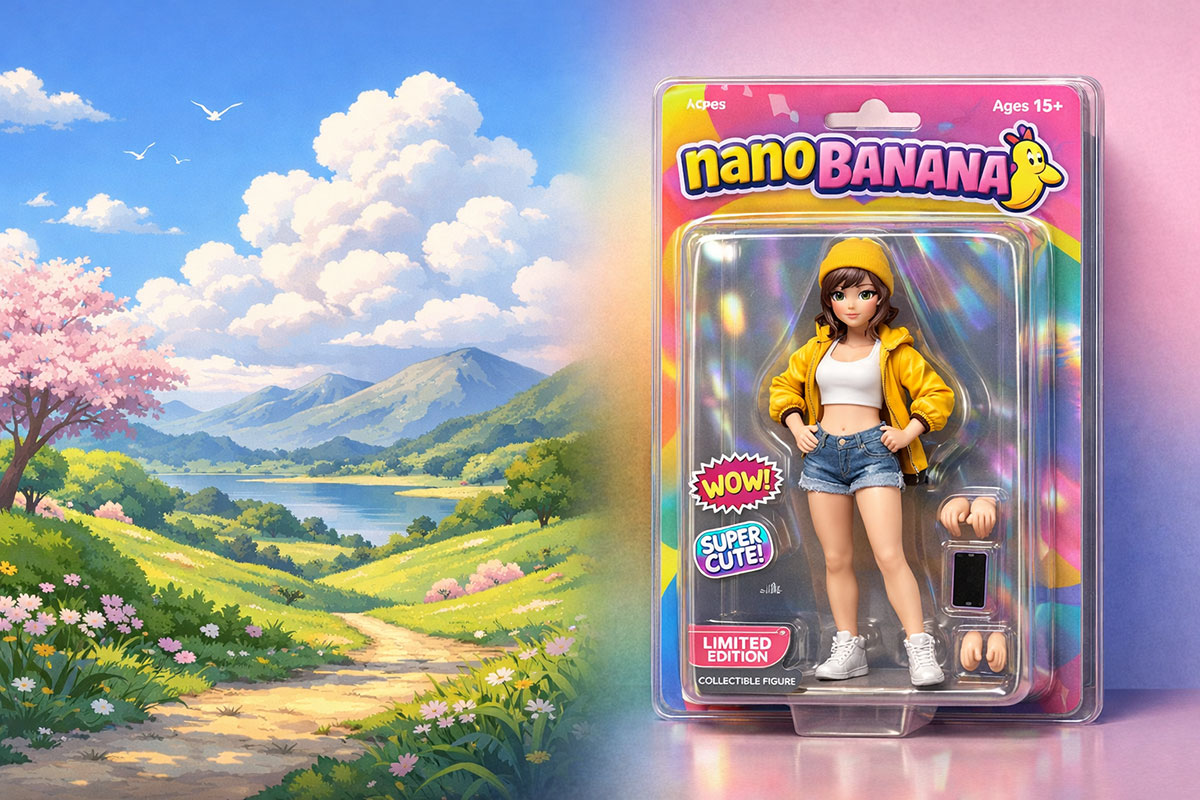
Two trends dominated social media feeds and captured the cultural zeitgeist: the warm embrace of Ghibli-style art and the glossy, playful precision of the Nano Banana figurine phenomenon. These weren't just filters or effects; they were portals to different versions of ourselves, and billions of people walked through them.
By the numbers, the transformation is staggering. The global AI image generation market reached $1.3 billion in 2025, growing at a compound annual growth rate of 35.7%. More tellingly, 62% of marketing professionals incorporated AI-generated visuals into their campaigns, while 45% of design agencies now use AI tools to supplement their creative processes. But the real story isn't in boardrooms—it's in the feeds of everyday creators who found their voice through these viral trends.
The Ghibli Explosion: When Everyone Lived in a Miyazaki Film
Early in 2025, something magical happened. Social media feeds transformed into scenes from Studio Ghibli films—soft pastels, fluffy clouds, rolling green hills, and a pervasive sense of gentle wonder. The "Ghiblification" trend took off following updates to OpenAI's GPT-4o, and within weeks, everyone from teenagers to grandparents was turning mundane photos into scenes that looked like they belonged in Spirited Away or My Neighbor Totoro.
The Emotional Alchemy of Nostalgia
What made the Ghibli trend more than just another photo filter? It tapped into something deeper—a collective longing for simplicity, beauty, and peace in a chaotic world. Studio Ghibli films have always represented a kind of visual comfort food: hand-drawn aesthetics that feel warm and human in an increasingly digital age. The AI-generated versions captured that same warmth, but made it personal.
Users transformed their morning commutes into epic journeys through countryside landscapes. Pets became companions in fantastical adventures. Even ordinary selfies gained a layer of magic—subjects found themselves reimagined with the characteristic simplified facial features and expressive eyes that define Ghibli's character design, surrounded by lush vegetation and dreamlike atmospheric effects.
The trend wasn't just about copying a famous art style; it was about injecting emotional resonance into our digital lives. As one creator described it, "I don't just see my photo turned into anime—I see the version of my life where everything is a little more magical, a little more meaningful."
The Technology Behind the Magic
GPT-4o's ability to generate Ghibli-style images stems from its multimodal architecture—a significant departure from traditional diffusion models like Stable Diffusion or DALL-E. As a natively multimodal model, GPT-4o processes both text and images using the same underlying neural network, with text and images sharing the same representational space.
This unified approach enables seamless understanding of artistic styles across modalities. The model's exposure to millions of artistic examples provides a nuanced understanding of specific stylistic elements that define the Studio Ghibli aesthetic: distinctive color palettes with soft pastels and warm golden lighting, detailed natural elements like clouds and water, European-inspired architecture with whimsical proportions, and that characteristic sense of magic in ordinary scenes.
What made GPT-4o particularly powerful for this trend was its conversational refinement capability. Unlike earlier models that generated a single image and stopped, GPT-4o allowed users to iterate through chat:
- "Give the background more cherry blossoms."
- "Make the lighting look like golden hour."
- "Add a small spirit creature in the corner."
- "Now make it look like it's from Princess Mononoke instead."
This iterative process transformed image generation from a one-shot gamble into a collaborative creative process. The AI became less like a vending machine and more like an art director you could talk to.
The model could also handle up to 20+ objects in a single image without losing context, add actual readable text (for signs, menus, or posters), and maintain consistency across multiple generated images—crucial for creators building visual narratives or content series.
The Viral Moment That Broke the Internet
The Ghibli trend hit such a peak that AI platforms were overwhelmed. CEOs of companies like OpenAI had to publicly ask users to be patient as their systems struggled to keep up with the unprecedented volume of requests. It became a victim of its own success—the demand was so intense that many users experienced wait times or temporary service interruptions.
This wasn't just a tech story; it was a cultural moment. The trend demonstrated that in a high-tech world, we still crave the warmth of hand-drawn aesthetics. It proved that AI in everyday life isn't about replacing human creativity—it's about giving people new tools to express the visions already in their heads.
Enter Nano Banana: The Collectible Version of You
Just when everyone's feeds had settled into a Ghibli-tinted glow, a new trend emerged that took a sharp turn toward the tangible and playful. "Nano Banana" exploded across Instagram and X (formerly Twitter), and suddenly everyone was transforming themselves into hyper-realistic 3D action figures, complete with plastic textures, dramatic lighting, and virtual packaging that made you look like a collectible toy fresh off the shelf.
The Origin Story: How a Code Name Became a Phenomenon
The Nano Banana story is almost as interesting as the trend itself. The name didn't come from a marketing campaign or a cute mascot—it came from a leak. "Nano Banana" was the internal code-name Google used for what would eventually be revealed as Gemini 2.5 Flash Image, their state-of-the-art image generation and editing model.
The model first appeared anonymously on a model testing site, quietly climbing to the top of the image editing charts. It wasn't even listed in the rankings initially, which only fueled speculation among AI enthusiasts. Creators quickly realized this wasn't like other image models—it was extremely precise. You could change an image's background, recolor clothing, fix lighting, and add text all in one step, and the core subject would stay perfectly intact.
This was revolutionary. Earlier AI image editors often struggled with consistency—change the background, and suddenly your subject's face looked different or their pose shifted. Nano Banana maintained character integrity across edits with unprecedented reliability.
Then Google executives started dropping banana emojis on social media, winking at the mystery without confirming anything. By the time the company officially admitted that yes, this was their new Gemini 2.5 Flash Image model, the nickname had stuck. The meme had done the marketing.
What Made Nano Banana Different
The technical capabilities of Gemini 2.5 Flash Image represented a leap forward in several key areas. The model enabled targeted transformation and precise local edits with natural language instructions. Users could:
- Remove entire people or objects from photos seamlessly
- Blur backgrounds with realistic depth-of-field effects
- Remove stains, blemishes, or unwanted elements
- Alter a subject's pose while maintaining their appearance
- Colorize black and white photos with historically accurate tones
- Add realistic text overlays that respect perspective and lighting
But the signature use case—the one that went viral—was the figurine effect. The model could take any photo and transform the subject into what looked like a pristine, professionally photographed collectible toy. The plastic textures looked real, with proper subsurface scattering (the way light penetrates and scatters within translucent materials). The virtual packaging included realistic creases, reflection, and even fake wear on the cardboard.
Why did this resonate so powerfully? It tapped into multiple forms of nostalgia simultaneously. For millennials and Gen Z, collectible action figures represent childhood wonder and the joy of unwrapping something special. Seeing yourself as a collectible toy was both playful and flattering—you became a character worthy of being immortalized in plastic.
The Power of Gemini's World Knowledge
Historically, image generation models excelled at aesthetic images but lacked deep semantic understanding of the real world. Gemini 2.5 Flash Image benefited from Gemini's broader world knowledge, which unlocked new use cases. The model understood context in sophisticated ways.
For instance, if you asked it to place a product in a "1970s kitchen," it wouldn't just add random retro elements—it would understand the color palettes, appliance styles, and design sensibilities of that specific era. If you wanted to create a figurine version of yourself as a "cyberpunk mercenary," it understood the genre conventions and applied appropriate styling.
This semantic understanding also powered multi-image fusion capabilities. Users could drag products into new scenes and quickly create photorealistic fused images. A fashion brand could take product photos shot in a studio and seamlessly place them in outdoor environments, complete with proper lighting and shadow integration.
The model's speed was equally impressive—edits that would take skilled Photoshop users 30 minutes could be accomplished with a single prompt in seconds.
Why These Trends Went Supernova
Both the Ghibli and Nano Banana trends share common DNA that explains their viral success. They weren't about creating something completely new—they were about reimagining identity. Whether it was the romanticized anime version of yourself living in a pastoral paradise or the cool collectible toy version immortalized in packaging, these tools offered new ways to tell stories about who we are.
The Accessibility Factor
Crucially, both trends were incredibly accessible. You didn't need to be a "prompt engineer" or understand technical terminology. You didn't need expensive software or years of design training. You just needed a photo and a simple request:
- "Make this look like Studio Ghibli art"
- "Turn me into a Nano Banana figurine"
This low barrier to entry democratized creative expression in a way few technologies have. Suddenly, the teenager with a smartphone had access to visual transformation tools that would have required a professional studio just a few years ago.
The shareability factor was equally important. These images looked impressive on social media feeds. They invited the question, "How did you make that?" which drove further adoption. Each share became a form of marketing, spreading the trend organically.
The Platform Wars and Model Evolution
The competition between AI platforms drove rapid improvement. When ChatGPT's GPT-4o became the go-to tool for Ghibli art, Google responded with Gemini 2.5 Flash Image's figurine capabilities. Other platforms like Midjourney, Stable Diffusion, and Adobe Firefly rushed to match or exceed these capabilities.
This competition benefited creators. Models became faster, more accurate, and more versatile. By mid-2025, most major platforms offered:
- Real-time generation and editing (changes appearing as you type)
- 4K resolution outputs as standard
- Consistent character generation across multiple images
- Style transfer that maintained subject likeness
- Text rendering that actually looked correct (a longtime struggle for AI)
For those interested in the broader landscape of generative AI tools, the image generation advances in 2025 laid groundwork for even more sophisticated video creation capabilities.
The Creator Economy Boom
These trends didn't just create viral moments—they created economic opportunities. The AI image generation market's growth to $1.3 billion represents real businesses being built, real jobs being created, and real money changing hands.
Digital artists found new revenue streams by offering custom Ghibli-style portraits or personalized Nano Banana figurines. Small businesses used these tools to create professional marketing materials without hiring expensive photographers or designers. Content creators built entire channels around teaching others how to master these techniques.
The democratization wasn't without controversy. Traditional artists raised legitimate concerns about AI models being trained on their work without permission or compensation. The question of copyright and ownership for AI-generated images remained legally murky in many jurisdictions. Some argued that making art creation "too easy" devalued the craft.
But the genie was out of the bottle. The tools existed, they were accessible, and millions of people were using them. The question became less about whether this technology should exist and more about how to ensure it benefits creators rather than exploits them.
Cultural Impact Beyond the Pixels
These trends revealed something important about how we relate to technology and self-representation in 2025. The Ghibli trend showed a collective desire for beauty, simplicity, and emotional warmth in our increasingly complex digital lives. In a year marked by AI ethics concerns and debates about authenticity, people chose to embrace a form of AI that made the world look more magical.
The Nano Banana trend showed our playful relationship with consumer culture and nostalgia. By turning ourselves into collectible toys, we both celebrated and gently mocked the commodification of identity. We became products of our own creation, literally.
Both trends also highlighted the growing sophistication of AI image models. These weren't producing the weird, uncanny valley results that characterized early AI art. The outputs looked good—good enough that non-experts often couldn't tell they were AI-generated. This marked a threshold crossing in the technology.
Other Trends That Shaped 2025
While Ghibli and Nano Banana dominated headlines, other AI image trends made their mark:
The "Hug My Younger Self" Trend: Users created images of their current selves embracing their childhood selves, often using AI to age-regress photos or blend images across decades. It became a powerful tool for personal reflection and emotional storytelling.
Retro Restoration: AI-powered colorization and enhancement of old family photos saw a resurgence, with tools that could restore damaged photographs, remove scratches, and even fill in missing sections with AI-generated content that matched the historical context.
Anime Character Generation: Beyond Ghibli's specific style, general anime aesthetics remained hugely popular, with models becoming better at maintaining consistent character designs across multiple images—crucial for creators building visual novels, comics, or animated content.
Hyper-Realistic Product Mockups: Businesses discovered they could generate photorealistic product images in any environment without expensive photo shoots, transforming e-commerce and advertising.
The Rise of "AI Fashion": Virtual clothing and styling became a trend, with users trying on outfits that never physically existed, exploring personal style without the environmental impact of fast fashion.
What's Coming in 2026: The Next Evolution
As we look toward 2026, the trajectory is clear: static images are just the beginning. The next wave will bring:
Video-to-Video Style Transfer
The technology already exists in early forms—real-time video processing that can apply these same style transformations to moving images. Imagine live-streaming yourself as a Ghibli character, with fluid animation and consistent style across frames. Or recording a video message that makes you look like a Nano Banana figurine in motion, complete with articulated joints and realistic plastic textures.
Several companies are racing to make this mainstream. When it happens—and it will happen in 2026—the impact on content creation, virtual events, and digital identity will be profound.
Seamless Physical-Digital Blending
Augmented reality integration will allow you to place AI-generated elements into your real environment through your phone's camera. Point your phone at your living room, and AI will suggest decor options that perfectly fit the space, match the lighting, and respect the perspective. Take a selfie outdoors, and AI will seamlessly add elements that look like they belong there—no green screen required.
Instant Full-Scene Generation
Current models still require some back-and-forth to create complex scenes with multiple elements. The next generation will enable complete, layered compositions in one step—entire comic book pages, complete product catalogs, or elaborate fantasy scenes generated from a single detailed prompt.
The computational requirements are dropping rapidly. What required a data center in 2023 can run on a high-end smartphone in 2025. By 2026, expect real-time, high-quality AI image generation on devices you carry in your pocket.
Personalized AI Style Models
Tools are emerging that let you train custom AI models on your own art style or photography aesthetic. This means creators can build AI assistants that generate images in their unique style, scaling their creative output without sacrificing their artistic voice.
The Ethics and Authenticity Question
As these tools become more powerful and pervasive, thorny questions remain. When an AI-generated image is indistinguishable from a photograph, how do we maintain trust in visual media? Several platforms are implementing digital watermarking—invisible signatures embedded in AI-generated images that can be detected by verification tools.
The question of training data remains contentious. Most of these powerful models were trained on images scraped from the internet, often without explicit permission from the original artists. Efforts to create opt-in training datasets and fair compensation models are underway, but progress is slow.
There's also the "filter fatigue" question. If everyone's photos look like Ghibli art or Nano Banana figurines, do these styles lose their specialness? The history of Instagram filters suggests yes—today's viral aesthetic becomes tomorrow's cliché. But the difference is that AI tools offer infinite variety. When one style gets tired, creators simply invent new ones.
Related Reading
For more on the AI trends transforming creative work and daily life, explore these articles:
Conclusion: From Filters to Futures
The Ghibli and Nano Banana trends of 2025 represent something larger than viral moments or technical achievements. They represent a shift in how we think about creativity, identity, and the role of AI in our lives.
These tools didn't make us passive consumers of technology—they made us active creators. They didn't replace human artistry—they amplified it, giving voice to visions that existed in our imagination but lacked the technical skills to manifest.
Looking back, 2025 will be remembered as the year AI image generation truly went mainstream, moving from the domain of tech enthusiasts to the everyday toolkit of billions. The tools became good enough, fast enough, and accessible enough that they stopped being novelties and became utilities.
As we move into 2026, the lines between these distinct trends will blur. We'll see hybrid styles, personalized aesthetics, and entirely new forms of visual expression that we can't yet imagine. The technology will get better, faster, and more capable.
But the core insight will remain: people don't just want to consume AI-generated content. They want to use AI to create versions of themselves and their worlds that reflect how they feel, who they aspire to be, and the stories they want to tell.
In that sense, the Ghibli and Nano Banana trends weren't about technology at all. They were about us—our nostalgia, our playfulness, our creativity, and our never-ending quest to see ourselves in new ways. The AI was just the brush. We painted the pictures.