Introduction: Black Friday 2025 Was the First True AI Shopping Season
Black Friday has always been about discounts, hype, and urgency. In 2025, it quietly became something else: the first holiday shopping season where AI systems—not humans—did much of the heavy lifting in discovery, decision-making, and even customer support.
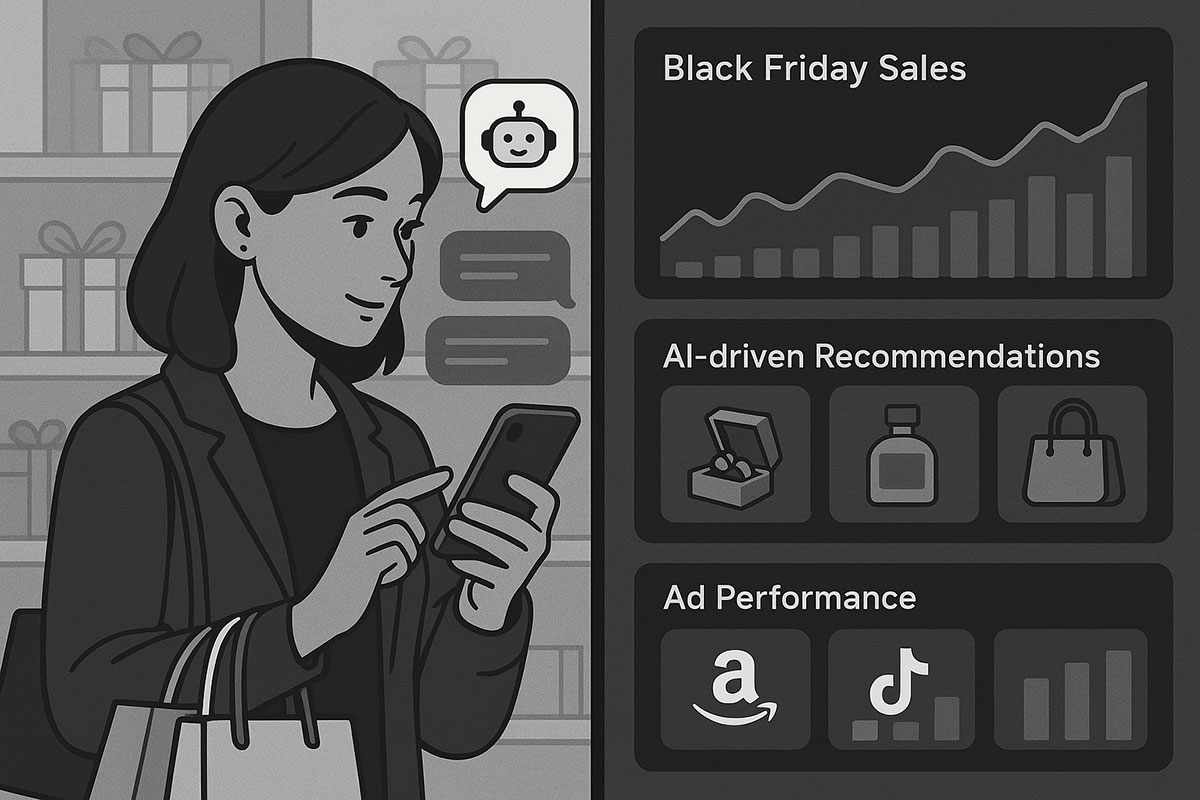
In the United States alone, online Black Friday spending hit a record 11.8 billion dollars, up 9.1% from 2024, according to Adobe Analytics and multiple retail analytics firms. At the same time, AI-driven traffic to retail sites surged by more than 800%, as shoppers increasingly arrived via AI assistants, chatbots, and recommendation engines instead of traditional search or ads.
Behind the scenes, nearly 97% of large U.S. retailers said they planned to use AI to enhance the shopping experience this holiday season—from pricing and inventory to personalization and support. Social commerce platforms joined in too: TikTok Shop crossed roughly 500 million dollars in U.S. sales over the four-day Black Friday–Cyber Monday sprint, signaling that in-app, AI-fueled shopping is no longer a sideshow.
If you’re a shopper, small business owner, seller, or side-hustler, this shift matters. It changes how products are found, which brands win attention, and what “good marketing” looks like in 2026.
This guide breaks down what actually happened on Black Friday 2025, how AI helped brands win, and how you can use the same playbook—whether you’re buying gifts, running a Shopify store, or selling via TikTok Shop.
The AI Shopping Revolution in Numbers
Let’s start with the data that defined this year’s peak shopping weekend:
- 11.8 billion dollars in U.S. online Black Friday sales, a 9.1% year-on-year increase.
- AI-generated or AI-routed traffic to retail sites up ~805% compared to 2024, as more shoppers used AI assistants to look for deals, gifts, and recommendations.
- Shoppers who arrived via an AI chat or assistant were 38% more likely to buy than those from traditional traffic sources such as generic ads or search.
- AI agents from platforms like Salesforce’s Agentforce drove around 17% of online orders for participating retailers during Cyber Week, contributing more than 13 billion dollars in sales.
- 97% of large U.S. retailers reported using AI this holiday season in some form—chatbots, personalization engines, inventory forecasting, pricing optimization, or ad targeting.
- TikTok Shop crossed 500 million dollars in U.S. sales across the Black Friday–Cyber Monday period, and is projected to hit tens of billions in global GMV over 2025.
None of this means “robots replaced marketers.” Instead, it shows that brands that embedded AI deeply into their funnels—from discovery to checkout—captured more of the same (or shrinking) attention pool.
Where AI Showed Up in Your Black Friday Journey
If you shopped online this year, you probably touched AI—even if you never typed “chat with AI” explicitly. Here are the key touchpoints.
1. Product Discovery: From Search to Smart Discovery
In previous years, product discovery was dominated by search (Google, Amazon search, marketplace filters). In 2025, discovery shifted toward AI-native experiences:
- Retail AI chatbots like Amazon’s Rufus helped shoppers find products by explaining needs in natural language. Sessions using Rufus saw significantly higher conversion, with some reports showing sessions that used the bot were roughly twice as likely to result in purchases.
- Platform-level AI assistants helped people query across multiple sites—“Best Black Friday TV deals under 600 dollars for gaming” instead of visiting ten different stores.
- Social commerce feeds like TikTok Shop blended entertainment, creator recommendations, and AI-powered product suggestions in one scroll, helping new brands be “discovered” algorithmically instead of needing massive ad budgets.
For sellers, this means creatives, product titles, and descriptions must be optimized for AI understanding, not just keywords. Posts like AI Search vs Traditional SEO: How to Optimize Content for Gemini, ChatGPT & Perplexity in 2025 explain how this “AI-mode search” is reshaping discoverability.
2. Recommendations & Personalization: Every Shopper Gets a Different Store
Once shoppers landed on a site, AI personalization engines took over:
- Dynamic product recommendations based on browsing behavior, cart contents, and historical data surfaced higher-converting items without shoppers needing to dig.
- AI pricing and promotion tools adjusted discounts and bundles on the fly based on inventory, competitor pricing, and demand forecasts.
- AI email and SMS campaigns scheduled messages at “right time” windows per user instead of blasting everyone at midnight.
Retailers using AI-driven decisioning reported more efficient campaigns, including higher click-through rates and lower cost-per-click on programmatic platforms such as Amazon DSP, which saw triple-digit increases in engagement.
If you run a brand or side-hustle store, this is exactly what posts like AI in E‑Commerce: The 11x Order Boost—How Agentic Commerce Is Reshaping Shopping in 2025 break down: using AI not just for copy, but for hands-off optimization of the whole funnel.
3. Checkout & Customer Service: AI as the First Line of Support
On the support side, automation quietly became the default:
- AI chat and voice agents handled order tracking, returns, FAQs, and simple complaints for many retailers, often resolving issues without humans in the loop.
- AI routing systems triaged complex tickets to human agents with context already summarized, cutting handle times and saving capacity for sensitive issues.
- Fraud detection models ran live during checkout to flag risky transactions while minimizing friction for legitimate buyers.
Many consumers didn’t realize they were “talking to AI” because the systems were framed simply as “chat support” or “help assistants.” This reflects a broader move toward agentic AI in customer operations, something explored deeply in AI Agents Are Replacing Chatbots in 2025: The Complete Enterprise Guide with Real Use Cases.
What Changed for Shoppers?
For everyday shoppers, AI’s impact showed up in four big ways.
1. Faster, Less Overwhelming Decisions
Instead of opening ten tabs, many shoppers simply asked an assistant to filter options: the right size TV for a small apartment, a gift for a 10-year-old who likes science, or the best mid-range phone with good camera performance. This sped up decision-making and reduced “deal fatigue.”
2. Smarter Deal Hunting Under Price Pressure
With prices rising in many categories, shoppers leaned on AI to find genuine value—not just high discount percentages. Assistants could:
- Compare historic prices to see if a “40% off” claim was real.
- Recommend alternatives with similar specs but better long-term value.
- Bundle items across multiple retailers to hit free-shipping thresholds or maximize savings.
3. More Personal, But Also More Tracked
The tradeoff: hyper-personalized experiences rely on deep data collection. Every click, view, and scroll can feed models deciding what to show you next. For privacy-conscious users, this raises familiar questions about profiling, targeting, and algorithmic bias.
4. Invisible Algorithmic Gatekeepers
As AI intermediates more shopping decisions, the products you never see matter as much as the ones you do. Brands that don’t feed the right data or fail to integrate with platform tools risk becoming invisible—even if their products are great.
What Changed for Brands, SMBs, and Side-Hustlers?
For sellers, 2025 was a stress test: could your tech stack keep up with AI-native giants?
1. AI Became Table Stakes, Not a “Nice-to-Have Experiment”
In surveys of retailers, almost all large players reported using AI across at least one of these areas:
- Customer data platforms (CDPs) to unify profiles and power personalization.
- Dynamic pricing and promotion engines.
- Inventory optimization and demand forecasting.
- AI-assisted creative production (ad copy, images, landing pages).
This aligns with broader industry surveys showing that close to 9 out of 10 retailers are already adopting or piloting AI, and over 90% say it’s boosting revenue and cutting costs.
2. Social Commerce and TikTok Shop Became Serious Sales Channels
TikTok Shop’s holiday performance is a clear signal: short-form video + AI recommendations + live shopping = real GMV, not just vanity views.
For small brands and side-hustlers, this is huge. Instead of battling entrenched competitors on traditional marketplaces, you can:
- Leverage creator-led product demos amplified by TikTok’s algorithm.
- Use built-in AI recommendation engines to match the right product to the right micro-audience.
- Experiment quickly with low-ticket products and iterate based on real-time engagement.
To go deeper on this, Holiday E‑Commerce 2025: The AI Traffic Surge Playbook breaks down how to ride these spikes with data, not guesswork.
3. Agentic AI Took Over Repetitive Growth Tasks
For more advanced teams, agentic AI systems—multi-step, semi-autonomous agents—handled full workflows:
- Generating and testing hundreds of ad variations.
- Monitoring product reviews and flagging issues automatically.
- Pulling performance data across platforms and drafting actionable weekly reports.
These workflows mirror what is described in The AI Agent Playbook: How Autonomous Workflows Are Rewiring Products in 2025, where AI doesn’t just “assist”—it executes tasks end-to-end with human oversight.
What Sellers and Side-Hustlers Should Learn from Black Friday 2025
Whether you run a one-product store or a multi-brand operation, here are practical takeaways.
1. Plug Into Platforms That Already Have AI Built In
If you can’t afford your own data science team, let platforms do the heavy lifting:
- Use Amazon’s AI tools (search optimization, ad targeting, product recommendation modules).
- Leverage TikTok Shop’s AI recommendation engine by publishing consistent, creator-friendly video content.
- Turn on Shopify apps that add AI-driven upsells, bundles, and email/SMS automation.
2. Own Your Data, Even If You Sell Through Marketplaces
AI runs on data. If all your insights live inside third-party dashboards, you’re capped. Start:
- Capturing first-party data via email lists, loyalty programs, and on-site lead magnets.
- Syncing data into a basic customer data platform or, at minimum, a clean CRM.
- Using this data for segmentation, better lookalike audiences, and more relevant creative.
For more on architecting this foundation, see AI Productivity Tools That Actually Generate Income in 2025, which shows how creators and solopreneurs build lean but powerful stacks.
3. Start with One Agentic Workflow, Not “AI Everywhere”
Instead of trying to “AI everything,” pick one repetitive, multi-step process and automate it end to end. Examples:
- Weekly performance reporting across channels.
- Responding to standard pre-sale questions using an AI chatbot fine-tuned on your FAQs.
- Creating and scheduling social posts for your best-selling products.
Guides like How to Build a Personal AI Assistant Without Coding (2025 No-Code Guide) walk through this process step by step.
Predictions: What AI Holiday Shopping Will Look Like in 2026
Looking ahead, here is where things are likely headed, based on 2025 data and retailer roadmaps.
1. “AI First” Shopping Journeys Become Default
By 2026, expect most large retailers to design AI-first experiences: you’ll start your journey by describing your need to an assistant, not browsing categories manually.
2. More Granular Personalization—and Regulation
Personalization will become hyper-specific—tailored not just to demographics but to recent behavior, financial sensitivity, and even inferred intent. Regulators and consumer advocates are already asking how transparent these systems must be and where personalization crosses into manipulation.
3. Social Commerce Matures Beyond “Trendy”
Platforms like TikTok Shop will formalize playbooks for brands, with standardized metrics, service-level expectations, and deeper integrations into logistics and returns.
4. Agentic AI Becomes a Standard “Team Member”
In marketing and e‑commerce teams, agentic AI will be treated like another team member: assigned KPIs, workflows, and review cycles—especially in performance marketing, merchandising, and lifecycle marketing.
5. Winners Will Be Those Who Mix Human Insight with Machine Scale
AI will deliver scale and precision. But differentiation will come from brand, storytelling, community, and ethics—things machines can assist with but not fully own.
How to Get Ready: A Quick 2026 Checklist
For Shoppers
- Use AI assistants to compare prices and product specs—but still check trusted reviews.
- Be aware of how much data you’re sharing; review privacy settings and opt-outs.
- Experiment with retailer chatbots for returns and support—they may resolve issues faster.
For Sellers and Side-Hustlers
- Claim and optimize your presence on at least one AI-heavy platform (Amazon, TikTok Shop, or a well-integrated Shopify stack).
- Automate one end-to-end workflow using an AI agent.
- Invest in understanding AI search and recommendation systems—the same way SEO knowledge was non-negotiable a decade ago.
Related Reading
- AI in E‑Commerce: The 11x Order Boost—How Agentic Commerce Is Reshaping Shopping in 2025
- Holiday E‑Commerce 2025: The AI Traffic Surge Playbook
- The AI Agent Playbook: How Autonomous Workflows Are Rewiring Products in 2025
- AI Search vs Traditional SEO: How to Optimize Content for Gemini, ChatGPT & Perplexity in 2025
- Start an AI Side Hustle This Weekend: 3 Simple Ideas to Make Your First 100 Dollars Online