The Historic Partnership: What Actually Happened on November 18, 2025
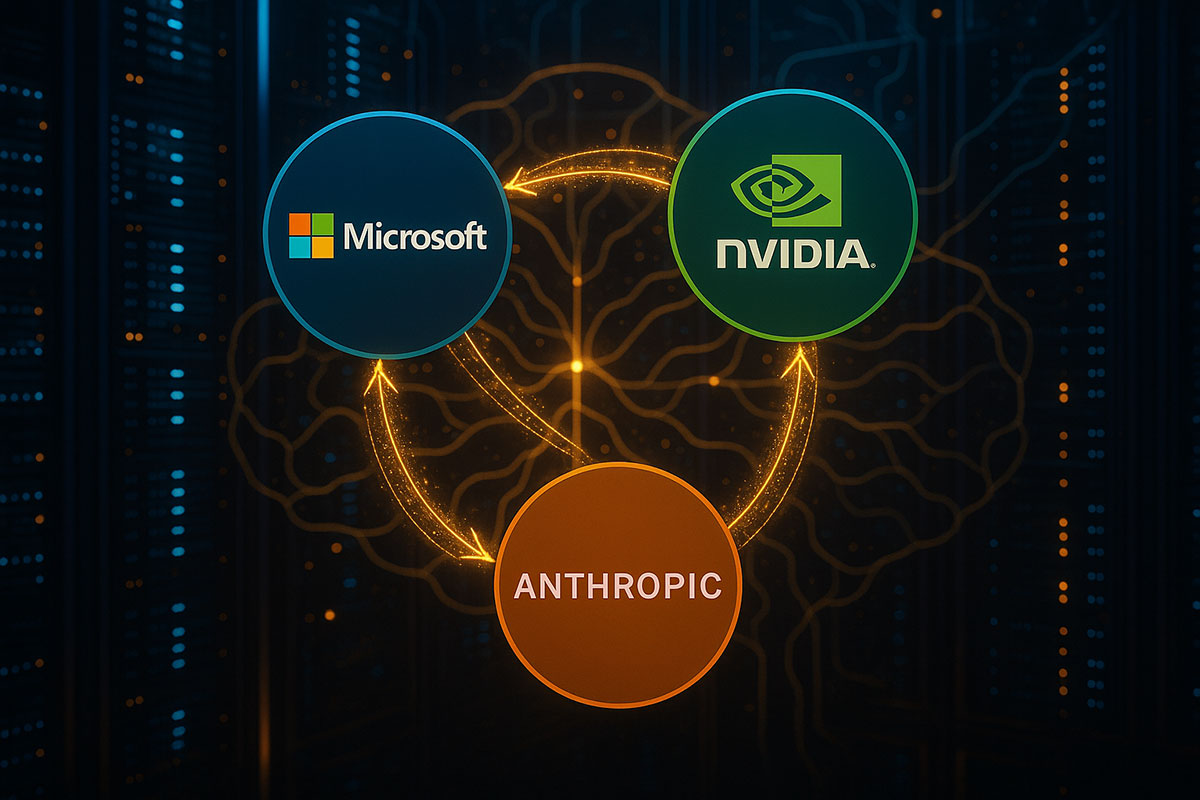
On November 18, 2025, the tech industry witnessed a watershed moment. Microsoft, NVIDIA, and Anthropic announced unprecedented strategic partnerships that fundamentally restructure AI infrastructure financing and development. This wasn't a quiet announcement. CEO Satya Nadella of Microsoft, Dario Amodei of Anthropic, and Jensen Huang of NVIDIA gathered for a joint video call to unveil the details—a signal that all three companies recognized the seismic importance of what they were announcing.
The numbers alone are staggering. Anthropic committed to purchasing $30 billion of Azure compute capacity from Microsoft, with the potential to expand to one gigawatt of computing power. Simultaneously, both Microsoft and NVIDIA committed substantial investments: Microsoft pledged up to $5 billion, while NVIDIA committed up to $10 billion. These investments pushed Anthropic's valuation from $183 billion (as of September 2025) to approximately $350 billion, making it one of the most valuable AI companies in the world.
But the numbers only tell part of the story. What matters is what this partnership means for the future of AI competition, enterprise infrastructure, and who controls the next generation of artificial intelligence.
Why This Partnership Matters Now: The Google Response Theory
The timing wasn't accidental. Just six days before this announcement, Google had launched Gemini 3, their "most capable LLM yet," claiming superior performance across major benchmarks. Google CEO Sundar Pichai announced they would be "shipping Gemini at the scale of Google," integrating the model across Search (AI Mode), the Gemini app, and developer platforms like Vertex AI.
For Anthropic, this represented an existential threat. While Claude Sonnet 4.5 had held the "best coding model" crown, Gemini 3's arrival complicated that narrative. Google wasn't just releasing another model—they were deploying it across their massive user base of over 8.5 billion Search users monthly. Anthropic faced a fundamental problem: being a great model wasn't enough if Google could out-compete on distribution and scale.
Enter Microsoft and NVIDIA. For Microsoft, the partnership serves a dual purpose. The company had already invested $13 billion in OpenAI, yet CEO Satya Nadella has increasingly emphasized building a "portfolio" of AI relationships. The new deal with Anthropic demonstrates that Microsoft is deliberately reducing dependence on OpenAI, creating what Nadella called a relationship where companies become "customers of each other." Microsoft gets Anthropic as a major Azure customer, while Anthropic gets guaranteed access to cutting-edge computing infrastructure powered by the latest NVIDIA hardware.
For NVIDIA, the partnership guarantees massive demand for its newest chips—specifically the Grace Blackwell and future Vera Rubin architectures. When Anthropic purchases one gigawatt of compute capacity, that translates directly into millions of NVIDIA GPUs and thousands of systems. NVIDIA CEO Jensen Huang promised these architectures would deliver an "order of magnitude speed up," directly addressing Anthropic's need to maintain competitive performance efficiency against Google's rapidly improving models.
The Technical Architecture: Co-Designing Hardware and AI
What sets this alliance apart from typical vendor relationships is the co-design framework. For the first time, Anthropic and NVIDIA established a "deep technology partnership" that goes far beyond simply buying chips or compute time.
The partnership works like this: Anthropic's engineers will work directly with NVIDIA's chip design teams to optimize Claude models for NVIDIA's hardware. Simultaneously, NVIDIA will feed performance data from Anthropic workloads directly into their future chip architecture decisions. This creates a virtuous cycle where:
- Anthropic models run more efficiently on NVIDIA hardware
- NVIDIA hardware is optimized for the specific computational patterns of frontier models like Claude
- Both companies benefit from faster innovation cycles
- The combined system becomes increasingly difficult for competitors to replicate
Anthropic's commitment to purchase up to 1 gigawatt with Grace Blackwell and Vera Rubin systems is the tangible expression of this partnership. One gigawatt is a staggering amount of computing power—enough to power millions of American homes. For context, the entire global AI compute capacity in 2024 was estimated at around 10-15 gigawatts. Anthropic alone will control roughly 7-10% of that capacity.
This co-design approach matters because it addresses one of the hardest problems in AI infrastructure: token economics. Jensen Huang specifically highlighted that AI costs aren't just about training anymore. With newer models implementing test-time scaling (where models "think" longer to produce higher-quality answers), inference costs are rising rapidly. The co-design partnership helps optimize the cost-per-token for inference, making Claude competitive against models with seemingly superior raw performance.
Enterprise Implications: Why This Matters for Business Leaders
For enterprise IT leaders and decision-makers, this partnership reshapes the calculus around AI adoption. Here's why:
Multi-Cloud Positioning of Claude
Before this announcement, enterprises faced a genuine dilemma. While Claude was available across multiple clouds, the best performance, pricing, and feature access often varied by platform. This partnership changes that. Microsoft said Claude would be available across Azure AI Foundry, GitHub Copilot, Microsoft 365 Copilot, and Copilot Studio. For enterprises already investing heavily in the Microsoft ecosystem, Claude becomes a seamless addition rather than a separate vendor relationship.
The beauty of the arrangement is that Claude becomes accessible across all three major cloud platforms: Microsoft Azure, Amazon Web Services (where Anthropic already has a partnership), and Google Cloud (through Vertex AI). This multi-cloud flexibility is precisely what enterprises demand. Rather than locking into a single provider's model, companies can optimize for cost, performance, and compliance by deploying Claude where it makes the most sense.
Compute Availability as a Competitive Advantage
The tighter integration between model development (Anthropic), chip design (NVIDIA), and cloud infrastructure (Microsoft Azure) creates a distinct performance advantage. When enterprises deploy Claude on Azure with NVIDIA's latest hardware, they're accessing a system specifically optimized for their use case. This stands in contrast to simply deploying any model on generic infrastructure.
For enterprises processing large-scale workloads—financial modeling, scientific research, complex data analysis—this optimization matters enormously. The difference between 50ms and 150ms latency, or 2x and 3x efficiency gains, directly impacts operational costs and user experience.
Implications for OpenAI and Competitive Positioning
The partnership notably puts pressure on OpenAI, the previous AI incumbent. While Microsoft emphasized that OpenAI "remains a critical partner," the new arrangement signals a deliberate strategy to create competitive alternatives. Microsoft's $13 billion investment in OpenAI suddenly looks like part of a portfolio strategy rather than exclusive commitment.
For enterprises previously committed to GPT-4/GPT-5 as their only option, this changes the equation. Anthropic's Claude models, now backed by Microsoft's infrastructure and co-designed with NVIDIA's latest chips, become a credible alternative. Early evaluations suggest Claude Sonnet 4.5 and upcoming versions can match or exceed GPT-5 performance in many domains, particularly coding and creative tasks.
The Broader Strategic Implications: Compute Is King
This partnership crystallizes a fundamental shift in how AI competition works. The narrative has evolved from "which company has the best AI model" to "which company controls access to AI compute infrastructure."
The AI Infrastructure Arms Race
Google responded to GPT-4's release by integrating Gemini across their services and infrastructure. OpenAI responded with GPT-5 and expanded partnerships. Now Anthropic, backed by Microsoft and NVIDIA, is responding not with just a better model, but with guaranteed access to one gigawatt of optimized compute capacity.
This trend will likely accelerate. Goldman Sachs research forecasts that data center power demand will increase by 50% by 2027 and 165% by 2030 compared to 2023 levels. AI will represent 27% of overall data center power demand by 2027. Companies without reliable, optimized access to this infrastructure face a severe competitive disadvantage.
The Circular Economy of AI Infrastructure
The partnership highlights what analysts call the "circular economy" of AI. NVIDIA sells chips to Microsoft, who sells compute to Anthropic, who trains Claude models that make Azure more valuable. Microsoft and NVIDIA gain financial returns while Anthropic gets the infrastructure it needs.
This creates interesting dynamics. When Anthropic achieves enterprise success (requiring massive compute for inference), it directly benefits both Microsoft (through Azure usage) and NVIDIA (through chip demand). The companies' interests align around Anthropic's success in ways that simple vendor relationships never achieved.
However, this concentration also raises concerns. Smaller AI startups without similar partnerships face a widening competitiveness gap. Companies need scale capital ($30+ billion commitments) to negotiate partnerships that provide edge-case optimizations and cost advantages. This likely accelerates consolidation around a handful of major players who control both models and infrastructure.
Market Position: Rebalancing the AI Landscape
Before November 18, 2025:
- OpenAI held premium positioning with GPT-4/5, backed by Microsoft's infrastructure
- Google controlled distribution through Search and services, with Gemini integration
- Anthropic had Claude technology but limited infrastructure guarantees
After November 18, 2025:
- OpenAI still strong but facing organized competition
- Google maintains distribution advantage but now competing against Anthropic-backed by two tech titans
- Anthropic repositioned as infrastructure-backed competitor with long-term compute stability
The competitive triangle becomes genuinely three-sided. This diversity benefits enterprises and developers—no single company has monopolistic control over frontier AI. But it also indicates a market that's consolidating around infrastructure partnerships rather than pure model capability.
Anthropic's Leverage: Why the Company Holds Power
One often-overlooked aspect of this deal is what it reveals about Anthropic's negotiating position. The company didn't simply accept whatever terms Microsoft and NVIDIA offered. Instead, Anthropic extracted:
- $15 billion in direct investments (not loans or partnerships, but actual equity investment)
- $30 billion in committed compute capacity at likely favorable pricing
- Co-design partnerships with NVIDIA ensuring optimization priority
- Multi-cloud availability ensuring they aren't locked into Microsoft
Anthropic achieved this positioning despite being the youngest of the three companies because it controlled something valuable: frontier AI models (Claude) that enterprises wanted. With Sam Altman positioning OpenAI as increasingly profit-focused and Google facing regulatory scrutiny around AI, Anthropic carved out a unique position as the "trustworthy" AI company with constitutional AI principles.
The company's positioning paid off. Anthropic's run-rate revenue surged from $87 million at the start of 2024 to over $1 billion by early 2025, and exceeded $5 billion by August 2025. This demonstrated genuine business traction that justified the partnership.
Energy and Sustainability Implications
The $30 billion compute commitment highlights an often-understated aspect of AI: the energy crisis. Training and running Claude at enterprise scale requires staggering amounts of electricity.
A 1-gigawatt allocation for Anthropic represents significant grid impact. For comparison, 1 gigawatt is approximately the power consumption of Las Vegas or a mid-sized US state. The Microsoft-Anthropic partnership will require substantial power infrastructure upgrades, likely including new data center construction or expansion of existing facilities.
Google CEO Sundar Pichai acknowledged in a recent BBC interview that expanding AI infrastructure has already "impacted the rate of progress" toward Google's net-zero climate targets. The energy demands of Anthropic's scale represent a meaningful portion of global AI power consumption growth.
This creates both opportunity and risk. Opportunity for renewable energy companies, nuclear power providers, and power infrastructure specialists. Risk for utilities struggling with grid capacity and for climate commitments already strained by data center expansion.
Timeline and Market Evolution
The partnership's impact will unfold in phases:
Immediate (December 2025 - Q1 2026): Anthropic integrates Claude across Azure services. Early enterprise customers begin accessing Claude through Microsoft Foundry and integrated tools. NVIDIA begins optimizing Grace Blackwell for Anthropic workloads.
Near-term (Q2-Q4 2026): First Vera Rubin systems enter production. Compute cost-per-token improvements become visible. Anthropic's enterprise revenue likely accelerates as integration matures.
Medium-term (2027): Vera Rubin systems become primary infrastructure for Anthropic compute. Performance differentials between co-designed Anthropic-NVIDIA-Microsoft systems and competitors become measurable. Industry likely sees additional similar partnerships announced.
Competitive Responses to Watch
This partnership won't remain unanswered. Competitors are likely evaluating responses:
Google: May accelerate partnerships with cloud providers or consider direct infrastructure investment to ensure Gemini has equivalent advantages.
Amazon/AWS: While retaining Anthropic partnership (company maintains multi-cloud strategy), AWS may seek deeper integration or exclusive features.
OpenAI: With Microsoft backing, they maintain infrastructure advantage. However, Microsoft's Anthropic partnership signals they're not exclusively dependent on OpenAI.
Other Startups: Face widening competitive gap. Without similar infrastructure partnerships, achieving scale becomes dramatically harder.
Investor Implications and Valuation Dynamics
Anthropic's jump to $350 billion valuation reflects genuine value creation, but also market dynamics worth examining:
Why the valuation jumped: The partnership provides revenue certainty (through Microsoft and enterprise integration), compute certainty (guaranteed access and optimization), and market reach (through Azure ecosystem). These reduce business risk substantially.
What it means for investors: The deal validates frontier AI as defensible business with real enterprise demand. However, the circular nature of the partnership means Anthropic's success directly benefits Microsoft and NVIDIA financially. Investors need to evaluate whether Anthropic can capture independent value or if most returns flow to infrastructure providers.
Risks: If enterprise AI adoption slows (which several MIT studies suggest may happen), the $30 billion compute commitment becomes a liability rather than asset. Anthropic could face stranded capacity if demand disappoints.
Why This Matters Beyond Tech
This partnership matters because it signals how AI infrastructure will evolve. Rather than open competition between models, we're seeing infrastructure-backed moats emerging. Companies without cloud provider partnerships, chip manufacturer relationships, or massive capital face genuine competitive disadvantages.
For policymakers, this raises questions about concentration in AI capabilities and whether a handful of tech giants controlling infrastructure creates problematic dependencies. For enterprises, it means AI advantage increasingly flows from infrastructure relationships as much as algorithm innovation.
Key Takeaways
For Enterprise Leaders: Claude is now more accessible through Microsoft infrastructure, with committed performance benefits. Diversifying between Claude (Anthropic), GPT (OpenAI), and Gemini (Google) remains prudent, but Claude's infrastructure backing significantly strengthens its competitive position.
For Investors: The partnership demonstrates that AI infrastructure partnerships may matter more than pure model capability. Watch for similar partnerships; they signal which companies will dominate AI infrastructure for the coming decade.
For the Industry: We're entering an era where frontier AI requires infrastructure partnerships. Standalone AI companies may struggle without similar backing. Consolidation around infrastructure-backed moats is likely.
For AI Researchers: The co-design partnership between Anthropic and NVIDIA demonstrates that future breakthroughs may depend as much on hardware-software integration as algorithmic innovation.
Looking Ahead
The November 18 partnership between Microsoft, NVIDIA, and Anthropic will likely be viewed as a pivotal moment in AI history—not because of any single innovation, but because it crystallized how AI competition is restructuring. The era of pure model competition is giving way to infrastructure-backed competition.
Google proved they could build and distribute frontier models at massive scale. Microsoft proved they could partner strategically rather than acquire. NVIDIA proved that chip makers can co-design with AI companies. Anthropic proved that being technically excellent enables negotiating favorable partnerships.
For everyone else, the question becomes clear: in an AI landscape where infrastructure partnerships determine competitive advantage, where will your company position itself?
Related Internal Links: