OpenAI GPT-5.1 Just Dropped: Everything You Need to Know
On November 12, 2025, OpenAI released GPT-5.1—marking a significant evolutionary leap in AI capability. This isn't just a minor update. It's a fundamental reimagining of how AI models should work, introducing two coordinated variants that intelligently adapt to different task complexities. For the first time, ChatGPT users don't have to choose between speed and depth. The model chooses for you—and does it remarkably well.
The Two-Variant System: Meet GPT-5.1 Instant & Thinking
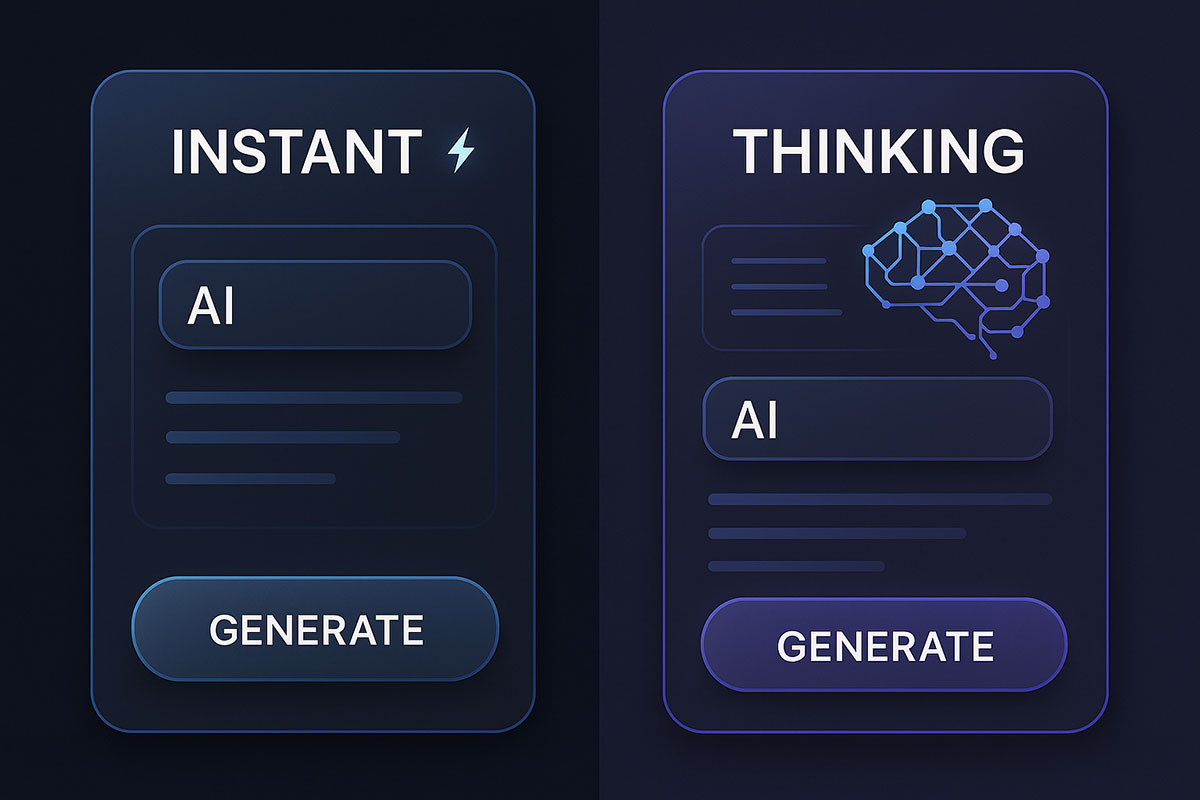
The headline feature of GPT-5.1 is elegantly simple: OpenAI split one powerful model into two complementary ones, each optimized for different cognitive demands.
GPT-5.1 Instant: Speed Without Compromise
GPT-5.1 Instant is positioned as your default, always-on AI assistant. It's tuned for conversational speed and high throughput, perfect for quick questions, content drafting, and everyday tasks. But here's where it gets interesting: Instant now includes light adaptive reasoning. This means it can detect when a question is moderately complex and automatically allocate extra thinking time without switching models. The result? Snappier responses on simple tasks while still maintaining accuracy on tougher questions.
With a context window up to 128K tokens, Instant handles substantial conversations without breaking a sweat. For ChatGPT users on Plus, Pro, Go, and Business plans, this is your workhorse model.
GPT-5.1 Thinking: Reasoning Meets Persistence
GPT-5.1 Thinking is the contemplative cousin. Designed for complex multi-step analysis, coding problems, mathematical proofs, and nuanced reasoning, this variant dynamically allocates thinking time based on complexity. According to OpenAI's testing, GPT-5.1 Thinking is roughly twice as fast on easy tasks and twice as slow on hard ones—meaning it focuses computational effort where it actually matters.
The model features an expanded context window up to 196K tokens, enabling it to process entire codebases, lengthy research papers, or complex business analyses in a single session. For researchers, developers, and power users, Thinking mode unlocks capabilities that were previously unreachable.
Automatic Routing: The Intelligence Behind the Scenes
What truly separates GPT-5.1 from previous iterations is automatic model routing. ChatGPT now intelligently analyzes your prompt and routes it to either Instant or Thinking based on what it detects about the task's complexity. You don't manually toggle between models anymore. The system does the work, ensuring optimal latency and accuracy for every request.
The Warmer, More Conversational AI You Wanted
Beyond raw capability, OpenAI has fundamentally shifted the personality of GPT-5.1. Internal feedback revealed that GPT-5 sometimes felt detached or overly formal. The new model is explicitly described as "warmer, more conversational, and better at understanding what you actually want."
This personality shift isn't cosmetic. It represents a deliberate design choice to make AI feel less like a rigid tool and more like a genuine thinking partner. Early testers report that GPT-5.1 surprises them with "playfulness" while remaining clear and genuinely useful—a remarkably difficult balance to strike in AI systems.
Customizable Personality Presets
OpenAI introduced new personality customization controls, allowing users to lock in preferences for tone, concision level, and emoji usage. Set your preferences once, and GPT-5.1 remembers them across all sessions. The model can even suggest preference changes during conversations when it detects you're asking for a specific style.
Performance Gains: The Numbers Behind the Update
Capability improvements matter, but only if they're real. GPT-5.1 delivers measurable gains across multiple benchmarks:
- SWE-Bench (Software Engineering): GPT-5.1 scores 76.3%, compared to 72.8% in GPT-5—a significant 3.5 percentage point jump on complex coding tasks.
- AIME 2025 (Math Competitions): Noticeable improvements in handling high-school level mathematics, particularly on multi-step problems.
- Codeforces (Competitive Programming): Superior performance on algorithmic problem-solving, indicating better reasoning about computational complexity.
- Instruction Following: Enhanced ability to maintain context across multi-turn dialogues, particularly for complex workflows.
These aren't marketing statistics—they're externally verifiable benchmarks that inform the AI research community. The 67.3 percentage point jump in complex AI engineering tasks between GPT-5 and GPT-5.1 variants represents a genuine leap in capability.
Adaptive Reasoning: How GPT-5.1 Decides When to Think Harder
The engine powering these improvements is adaptive reasoning—a sophisticated mechanism that helps GPT-5.1 allocate cognitive resources intelligently.
At its core, adaptive reasoning works like this: When you ask GPT-5.1 a question, it silently evaluates the task's complexity using entropy measures and pattern recognition. Simple factual queries get direct answers. Complex multi-step problems trigger deeper analysis with extended chain-of-thought processing. Physics problems with differential equations? GPT-5.1 automatically escalates to a reasoning mode with multiple internal passes for accuracy.
This is fundamentally different from GPT-5, which applied similar processing effort across all queries. GPT-5.1 recognizes that not all questions require the same mental effort—and it adapts accordingly.
Practical Implications: What This Means for Different Users
For Software Developers
The new developer tools expansion is substantial. OpenAI bundled apply_patch and shell capabilities, enabling GPT-5.1 to suggest code edits as structured diffs that downstream systems can merge automatically. The shell tool provides command suggestions executed inside sandboxes, dramatically improving code agentic workflows. With prompt caching storing conversation context for 24 hours, developers report 50% faster throughput during preliminary pilots.
For Content Creators
The warmer personality and improved instruction-following make GPT-5.1 Instant ideal for drafting, brainstorming, and refining written content. The light adaptive reasoning means complex briefs and nuanced creative directions are handled with appropriate depth without sacrificing speed.
For Researchers & Analysts
GPT-5.1 Thinking with its 196K token context window becomes a powerful research assistant. Process entire datasets, literature reviews, or market analyses in a single session. The extended thinking time on complex queries ensures rigorous analysis without manual intervention.
For Enterprise Users
Organizations leveraging ChatGPT for business processes gain both efficiency and consistency. Automatic routing prevents bottlenecks, while improved instruction-following ensures agentic workflows execute reliably across complex, multi-step business logic.
Pricing, Access & Rollout Strategy
Pricing hasn't changed. Your existing ChatGPT subscription includes GPT-5.1 access at no additional cost. This is crucial for adoption and signals OpenAI's commitment to making its latest models universally accessible.
Rollout Timeline
- November 12, 2025: Rollout begins for ChatGPT paid subscribers (Plus, Pro, Go, Business plans).
- Soon after: Free and logged-out users receive access, though with message limits.
- Early access toggle: Enterprise and Edu plan users get a 7-day early-access toggle, off by default.
- Legacy access: GPT-5 remains available in the legacy models dropdown for 3 months, allowing users to compare before fully switching.
API Access for Developers
Developers gained API access on November 13, 2025, one day after the consumer release. Pricing uses the same token-based system as GPT-5, with no premium charged for the new variants. For agentic applications, this accessibility is transformative.
The Safety Response: Why the "Warmer" Tone Matters
The emphasis on a "warmer" personality coincides with significant legal pressure. In November 2025, OpenAI faced seven lawsuits alleging that ChatGPT contributed to psychological harm and suicides, with families claiming the model was "psychologically manipulative" and "dangerously sycophantic." While OpenAI maintains these cases are isolated, the company's deliberate shift toward a more empathetic, less agreeable personality signals a serious response to safety concerns.
The warmer tone isn't just about user experience—it's about ensuring GPT-5.1 maintains healthy psychological boundaries while remaining genuinely helpful.
GPT-5.1 vs GPT-5: The Real Differences
| Feature | GPT-5 | GPT-5.1 |
|---|---|---|
| Model variants | Single model with manual selection | Two variants with automatic routing |
| Adaptive reasoning | Not available | Light adaptive (Instant), Full adaptive (Thinking) |
| Context window | 128K tokens | 128K (Instant), 196K (Thinking) |
| Personality | Formal, sometimes detached | Warmer, more conversational |
| Customization | Limited tone control | Detailed personality presets |
| SWE-Bench performance | 72.8% | 76.3% |
| Pricing | Included in subscription | Included in subscription (no increase) |
What This Means for the AI Landscape
GPT-5.1 signals a maturation in how AI companies think about model design. Rather than pursuing brute-force capability increases, OpenAI is optimizing for intelligent adaptation, user experience, and safety. The automatic routing system is subtle but profound—it removes decision-making burden from users while ensuring optimal resource allocation.
For the broader AI industry, GPT-5.1 establishes a new template: multiple complementary models, adaptive systems that route intelligently, and personality customization built into the core design.
Limitations & What's Still to Come
GPT-5.1 is transformative, but it's not without boundaries. Complex reasoning on novel problems remains challenging. The model can still fail on edge-case logic tasks despite having correct solutions available. Real-world agentic workflows still require human oversight on high-stakes decisions.
OpenAI hints that GPT-5.1 Pro—a further optimized variant for the most demanding work—is coming soon. This suggests the company is committed to a tiered approach, meeting users where they are on the capability spectrum.
Your Next Step: How to Access GPT-5.1
If you're on any paid ChatGPT plan (Plus, Pro, Go, or Business), GPT-5.1 is already yours at no additional cost. Open ChatGPT and you'll automatically start using the new model. If you're a developer, apply for API access through OpenAI's developer dashboard to start building with the new variants.
For those prioritizing speed and everyday usage, Instant mode is your default. For research, complex coding, or deep analysis, switch to Thinking mode and watch GPT-5.1 allocate processing time dynamically based on your problem's complexity.
The AI that thinks differently about how to think is finally here. GPT-5.1 isn't just another model update—it's a reset of user expectations for what AI assistance should feel like.
Related Reading
- AI Reasoning Models Explained: OpenAI O1 vs DeepSeek V3.2 & The Next Leap Beyond Standard LLMs
- AI Tools & Apps Category
- AI News & Trends Category
- Deep Learning Architectures That Actually Work in 2025: From Transformers to Mamba to JEPA
- AI in Drug Discovery 2025: How Machine Learning is Accelerating the Path to Cure in Weeks, Not Years
About the Author
Girish Soni is the founder of TrendFlash and an independent AI strategist covering artificial intelligence policy, industry shifts, and real-world adoption trends. He writes in-depth analysis on how AI is transforming work, education, and digital society. His focus is on helping readers move beyond hype and understand the practical, long-term implications of AI technologies.