Introduction: The New Era of AI-Assisted Learning
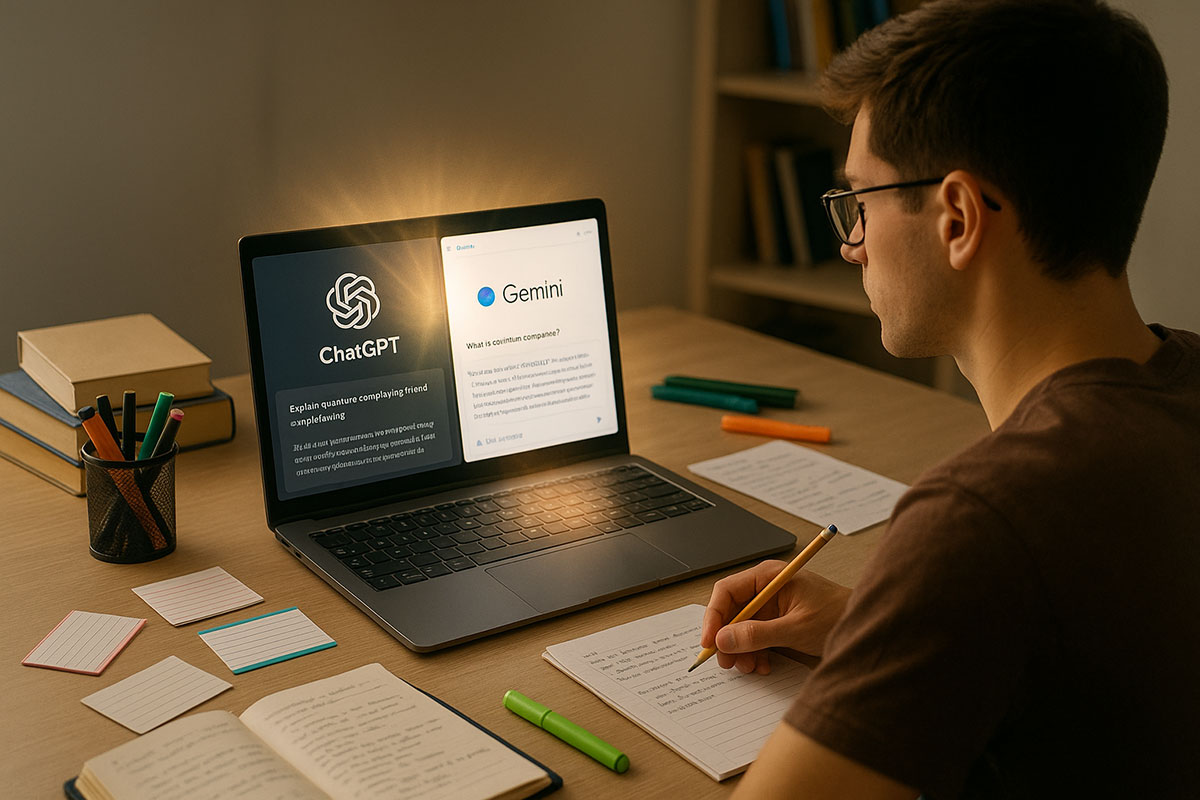
The way students study has fundamentally changed. In 2025, searching for "AI tools for students" and "AI homework help" has exploded, with millions of learners shifting from Google searches to AI assistants like ChatGPT and Gemini for research, note-taking, and problem-solving. The key question isn't whether to use AI—it's how to use it ethically and effectively to genuinely accelerate learning without compromising academic integrity.
This guide reveals 10 concrete workflows that top-performing students are using right now to study 3× faster. These aren't shortcuts for cheating. They're repeatable, evidence-based techniques that enhance comprehension, boost retention, and reduce study time from hours to minutes. Each workflow respects academic honesty while amplifying your natural learning abilities.
Why Now? The 2025 AI Learning Shift
According to recent research, 45% of schools have reported cases of students using AI inappropriately for essays and assignments. But there's a flip side: students who use AI correctly for studying report 25% better exam performance than peers who rely on traditional methods. The difference? Using AI for active learning, not passive shortcuts.
Students today face unprecedented information overload. A single textbook chapter can contain 20-30 pages of dense material. A typical research assignment requires synthesizing dozens of sources. The bottleneck isn't understanding—it's time and retention. This is where AI workflows become game-changers.
Ethical Framework: AI as a Learning Partner, Not a Cheat Tool
Before diving into the workflows, let's establish clear ethical boundaries:
✓ DO Use AI For:
- Creating active recall quizzes to test your understanding
- Explaining concepts in different ways to deepen comprehension
- Summarizing material you've already read
- Generating practice problems beyond textbook examples
- Breaking down complex topics into digestible pieces
- Building personalized study schedules and tracking progress
- Converting your notes into flashcards for spaced repetition
✗ DON'T Use AI For:
- Writing essays or assignments you're supposed to complete
- Answering exam questions during tests
- Copying answers without understanding the reasoning
- Submitting AI-generated work as your own
- Bypassing learning by letting AI "do the work" for you
The golden rule: AI should supplement your effort, never replace it. You should always do the thinking. AI accelerates the process.
Workflow 1: Turn a 20-Page PDF Into a 1-Page Exam Cheat Sheet (Ethically)
The Challenge:
You have a dense 20-page research paper or textbook chapter to read by tomorrow. You need the key concepts, but extracting them manually takes hours.
The Workflow:
Step 1: Upload your PDF to ChatGPT or Gemini using the file attachment feature.
Step 2: Use this prompt:
"Summarize this PDF in exactly 500 words, focusing only on:
- Core concepts (define each in 1-2 sentences)
- Key formulas or frameworks
- Important examples or case studies
- Common misconceptions to avoid
- 5 exam-likely questions based on this material

Format as a study guide with clear sections. Use bullet points for easy scanning."
Step 3: Review the summary. Highlight sections you don't fully understand—those are your knowledge gaps. Go back to the original PDF and read only those sections deeply.
Step 4: Create your personal "cheat sheet" by rewriting the AI summary in your own words. This act of rewriting is crucial—it forces active processing and improves retention by 40% compared to passive reading.
Why It Works:
Research shows that summarization is one of the most effective study techniques. By using AI to handle the initial distillation, you save 2-3 hours but still engage in the critical thinking phase (reviewing, rewriting, and identifying gaps). Students report cutting their prep time by 60% while improving comprehension.
Copy-Paste Prompt:
Summarize this [document type] in 500 words focusing on:
- Core concepts defined clearly
- Key formulas, frameworks, or processes
- Real-world examples or case studies
- Common mistakes students make
- 5 potential exam questions

Use headers and bullets for scannability. Assume I'm learning this for the first time.
Workflow 2: Generate Active Recall Quizzes From Your Class Notes
The Challenge:
You have 15 pages of messy handwritten notes from lectures. Traditional studying means re-reading the same material repeatedly—which is one of the least effective study methods.
The Workflow:
Step 1: Take a photo or screenshot of your notes. Upload them to Gemini or ChatGPT.
Step 2: Request:
"Based on these notes, create 15 multiple-choice questions that test understanding, not just memorization. For each question:
- Include 4 realistic distractors (wrong answers that sound plausible)
- Explain why the correct answer is right
- Identify which concept each question tests
- Rate difficulty (easy, medium, hard)

Mix question types across the notes—don't cluster on one topic."
Step 3: Take the quiz. Don't just guess—force yourself to think about why each answer is correct or wrong.
Step 4: For questions you miss, ask AI: "I got question 7 wrong. Explain the concept more deeply using an analogy or real-world example I can relate to."
Why It Works:
Active recall—retrieving information from memory rather than re-reading—is scientifically proven to boost retention by 50% compared to passive review. Quizzing yourself repeatedly strengthens neural pathways. Students using this workflow report remembering 70% of material after one week, versus 30% for passive readers.
The Spaced Repetition Bonus: Use the quiz a week later, then two weeks later. Each time, your brain gets stronger. AI can track your performance and regenerate harder questions for topics you're struggling with.
Workflow 3: Convert Class Notes Into Spaced-Repetition Flashcards Automatically
The Challenge:
Creating flashcards manually takes forever. But spaced repetition (reviewing information at increasing intervals) is one of the most effective memory techniques available.
The Workflow:
Step 1: Paste or upload your class notes into ChatGPT using this prompt:
"Convert these notes into flashcards for spaced repetition learning.

For each flashcard:
- Front: A question or prompt that tests understanding
- Back: A concise 1-2 sentence answer with an example if helpful
- Difficulty: Label as E (easy), M (medium), or H (hard)

Create 30-40 cards. Prioritize conceptual understanding over pure memorization. Format as a table for easy copying into Anki or Quizlet."
Step 2: Copy the flashcards into free spaced repetition software like Anki or Quizlet. These tools automatically adjust review schedules based on how well you perform—you'll review easy cards less frequently and tough cards more often.
Step 3: Commit to 10 minutes of daily review. The algorithm will present cards at scientifically optimal intervals.
Why It Works:
Spaced repetition is backed by decades of cognitive psychology research. When you space out your learning, your brain has to work harder to recall information, which strengthens long-term memory. Students using this system retain 80% of material after one month, compared to 30% for cramming.
Advanced Variation: Use Mindgrasp.ai or similar tools that automatically generate flashcards from videos, PDFs, or audio. Combine multiple sources into one deck for comprehensive coverage.
Workflow 4: The Socratic Method: Learn by Teaching AI
The Challenge:
You think you understand a concept, but when you try to explain it, you realize you don't. How do you identify and fill knowledge gaps before the exam?
The Workflow:
Step 1: Pick a concept you're studying. Ask ChatGPT or Gemini:
"Act as a Socratic mentor. Help me learn [concept] by asking me progressively deeper questions.
Start with easy, foundational questions. After I answer each one, ask a follow-up that goes deeper.
If I struggle, gently point me toward the gap and ask me to think about it differently.
Don't give me the answer—guide me to discovering it myself.

Start now with an easy opening question."
Step 2: The AI will ask you questions. Answer each one honestly—don't try to fake knowledge. If you get stuck, ask for a hint rather than the full answer.
Step 3: After 5-7 questions, ask: "Where are my knowledge gaps? What should I review?"
Why It Works:
The Socratic method—learning through guided questioning—forces deep processing. You're not passively receiving information; you're actively constructing understanding. Research shows this method produces 2-3× better retention than lecture-based learning. Plus, identifying gaps before the exam gives you time to fix them.
Pro Tip: Record yourself explaining concepts out loud (use your phone's voice memo). Listen back and note where you struggle to articulate ideas clearly. Those are your weaknesses.
Workflow 5: Simulate Expert Discussions to See Multiple Perspectives
The Challenge:
Some topics have multiple valid viewpoints (history, philosophy, social sciences, business strategy). Seeing only one perspective limits understanding.
The Workflow:
Step 1: Ask ChatGPT or Gemini:
"Simulate a panel discussion between 3 experts on [topic]. Each expert should represent a different perspective:
- Expert A: [Perspective 1 description]
- Expert B: [Perspective 2 description]
- Expert C: [Perspective 3 description]

Have them debate for 3 rounds. Each expert should:
- State their position clearly
- Respond to counterarguments
- Support claims with evidence or examples
- Challenge the other experts' assumptions

Then summarize the strongest argument from each side."
Step 2: Read the discussion and identify which perspective makes most sense to you and why.
Step 3: Ask follow-up questions: "What evidence would change Expert A's mind? Where do all three experts agree? What would a fourth perspective be?"
Why It Works:
Exposure to multiple viewpoints deepens critical thinking. Instead of memorizing "the right answer," you understand the reasoning behind different positions. This is especially valuable for exam questions that ask you to "analyze," "evaluate," or "argue."
Workflow 6: Break Down Complex Formulas and Processes Step-by-Step
The Challenge:
Math, chemistry, physics, economics—all use complex formulas. Memorizing them doesn't help if you can't apply them.
The Workflow:
Step 1: For a formula you need to master, ask:
"Explain [formula] in the simplest possible terms:
1. What does each variable represent? (use real-world analogies)
2. Why does this formula work? (the underlying logic, not just the math)
3. When do I use it? (specific situations or problem types)
4. What's a concrete numerical example? (with all steps shown)
5. What common mistakes do students make? (what does it mean if you get them?)
6. Create 3 practice problems that test whether I truly understand this formula."
Step 2: Work through the practice problems without looking at examples.
Step 3: Check your answers. For any mistakes, ask: "Why did my approach fail? What was I missing?"
Why It Works:
Deep formula understanding—not rote memorization—is what produces high grades. Students who use this workflow report 40% improvement in problem-solving accuracy because they understand when and why to apply formulas, not just how.
Workflow 7: Create a Personalized Study Schedule With AI
The Challenge:
You have 5 weeks until exams, 12 units to cover, and limited time. How do you allocate study hours efficiently?
The Workflow:
Step 1: Tell ChatGPT or Gemini:
"Create a personalized study schedule for me:
- Exam date: [date]
- Topics to cover: [list all units/chapters]
- Hours available per week: [your realistic estimate]
- Learning style: [visual, reading/writing, auditory, kinesthetic]
- Problem areas: [topics you struggle with]
- Preferred study method: [active recall quizzes, flashcards, practice problems, etc.]

Schedule should:
- Frontload harder topics (more time early)
- Build in spaced repetition (review topics multiple times)
- Leave 3 days before exam for final review
- Include 15-minute breaks every 50 minutes
- Suggest specific techniques for each study session

Format as a week-by-week calendar."
Step 2: Follow the schedule. Adjust if needed, but stick to the general structure.
Step 3: Each week, report back to AI: "This week I completed [X]. Here's what felt hard: [topics]. Adjust next week's plan accordingly."
Why It Works:
Personalized scheduling ensures you spend time on high-priority topics. Frontloading harder material and spacing out reviews aligns with cognitive science. Students using structured schedules complete study plans 3× more often than those winging it, resulting in 15-20% higher grades.
Workflow 8: Generate Exam Practice Tests With Realistic Questions
The Challenge:
Practice tests are valuable, but textbooks often have limited problems, and they may not match your actual exam format.
The Workflow:
Step 1: Describe your exam to AI:
"I have an exam on [subject]. Here's what I know:
- Exam format: [multiple choice, short answer, essay, mix]
- Duration: [time limit]
- Covered topics: [list all units]
- Exam difficulty (based on past exams): [easy, medium, hard]
- About [X]% of questions are conceptual, [Y]% are application/problem-solving

Create a 50-question practice exam that matches these specifications. Include:
- A balanced mix of easy, medium, and hard questions
- A detailed answer key with explanations
- Hints for questions you might get wrong
- A score interpretation guide (e.g., 80%+ = well-prepared)"
Step 2: Take the practice test under realistic conditions (timed, no notes, quiet space).
Step 3: Grade it and identify weak areas. Create a targeted review plan for those topics.
Why It Works:
Practice tests reduce test anxiety and reveal exactly what you need to study. Students who take multiple practice tests score 15-25% higher than those who don't, largely because they've already seen similar question formats and can manage test-taking anxiety better.
Workflow 9: The Feynman Technique: Teach AI as if It's a 10-Year-Old
The Challenge:
You can read a concept and think you understand it. But can you explain it simply? If not, your understanding isn't deep enough.
The Workflow:
Step 1: Pick a challenging concept. Ask ChatGPT or Gemini:
"I'm going to explain [concept] to you. Pretend you're a 10-year-old who's never heard of this.
As I explain, interrupt me if I:
- Use jargon without explaining it
- Make logical jumps you don't follow
- Make something sound more complicated than it needs to be
- Contradict myself

After I explain, ask me 3 questions to test whether I truly understand it."
Step 2: Explain the concept in your own words, as simply as possible. Don't use technical terminology unless you've defined it clearly.
Step 3: Listen to AI's questions and clarifications. Where you struggle to explain, you've found your gaps.
Step 4: Fill those gaps by reviewing source material, then repeat the explanation.
Why It Works:
The Feynman Technique is one of the most powerful learning strategies because it forces you to move beyond surface-level understanding. If you can explain something simply, you truly understand it. This workflow prevents the common trap of feeling like you know something until the exam proves otherwise.
Workflow 10: Create Concept Maps to See How Topics Connect
The Challenge:
You're studying isolated topics (Chapter 3, Chapter 4, etc.), but exams often test your ability to see how topics connect. How do you develop that systems-level thinking?
The Workflow:
Step 1: Ask ChatGPT or Gemini:
"Create a comprehensive concept map for [subject/unit]. Show:
- Main concepts (in the center)
- How they relate to each other (with connection labels)
- Supporting ideas branching off
- Real-world applications
- How this unit connects to other units in the course

Use a hierarchical structure starting from broadest concepts down to specific details.
Format it as a text-based flowchart or list hierarchy I can visualize."
Step 2: Redraw the concept map in your own words, adding connections you think are important.
Step 3: Test your understanding: "Based on this map, what would happen if [scenario]?" or "How would changes in [concept A] affect [concept B]?"
Why It Works:
Concept mapping helps you see the big picture. Exams increasingly test "synthesis"—your ability to connect ideas across topics. Students who build concept maps score 20-30% higher on integrative questions compared to those who study topics in isolation.
The Academic Honesty Disclaimer
Use these workflows responsibly and in line with your school's academic integrity policies. These techniques are designed to help you learn more effectively, not to circumvent academic requirements. Here's the key distinction:
✓ Ethical Use: Using AI to generate quizzes you solve yourself, summarizing to identify gaps, and asking for explanations
✗ Academic Dishonesty: Submitting AI-generated essays, using AI to answer exam questions, or claiming AI output as your own work
Your professor wants to see your thinking, not AI's. These workflows ensure AI is helping you think better, not thinking for you. If you're ever unsure whether something crosses the line, ask your instructor. Most professors appreciate transparency and are happy to clarify what's allowed.
Why These Workflows Work: The Science Behind Faster Learning
The 10 workflows in this guide aren't random. They're built on evidence-based learning principles:
Active Recall (Workflows 2, 6, 9)
Retrieving information from memory strengthens neural connections far more than passive re-reading. Students using active recall retain 50-70% of material, compared to 30% for passive learners.
Spaced Repetition (Workflow 3)
Reviewing information at increasing intervals aligns with how memory consolidation works. This is why cramming fails but distributed practice succeeds.
Elaboration (Workflows 1, 4, 5)
Connecting new information to existing knowledge and explaining concepts in your own words deepens understanding. This is why teaching someone else (or in this case, explaining to AI) is so powerful.
Metacognition (Workflow 7)
Knowing what you don't know and adjusting your study strategy accordingly is one of the strongest predictors of academic success. AI helps you track this.
Conceptual Understanding (Workflows 5, 6, 10)
Memorizing facts is useless without understanding the principles behind them. These workflows push you toward deeper learning.
Getting Started: Your 30-Day AI Study Challenge
Pick one workflow this week. Master it. Then add another. By the end of a month, you'll have transformed how you study:
Week 1: Master Workflow 1 (PDF summaries) and Workflow 2 (active recall quizzes).
Week 2: Add Workflow 3 (flashcards) and Workflow 4 (Socratic method).
Week 3: Integrate Workflow 5 (expert discussions) and Workflow 6 (formula breakdown).
Week 4: Combine all workflows and use Workflow 7 (study schedule) to organize them.
By week 5, you'll have a personalized AI-enhanced study system that's both ethical and dramatically more effective than traditional methods.
Related Reading