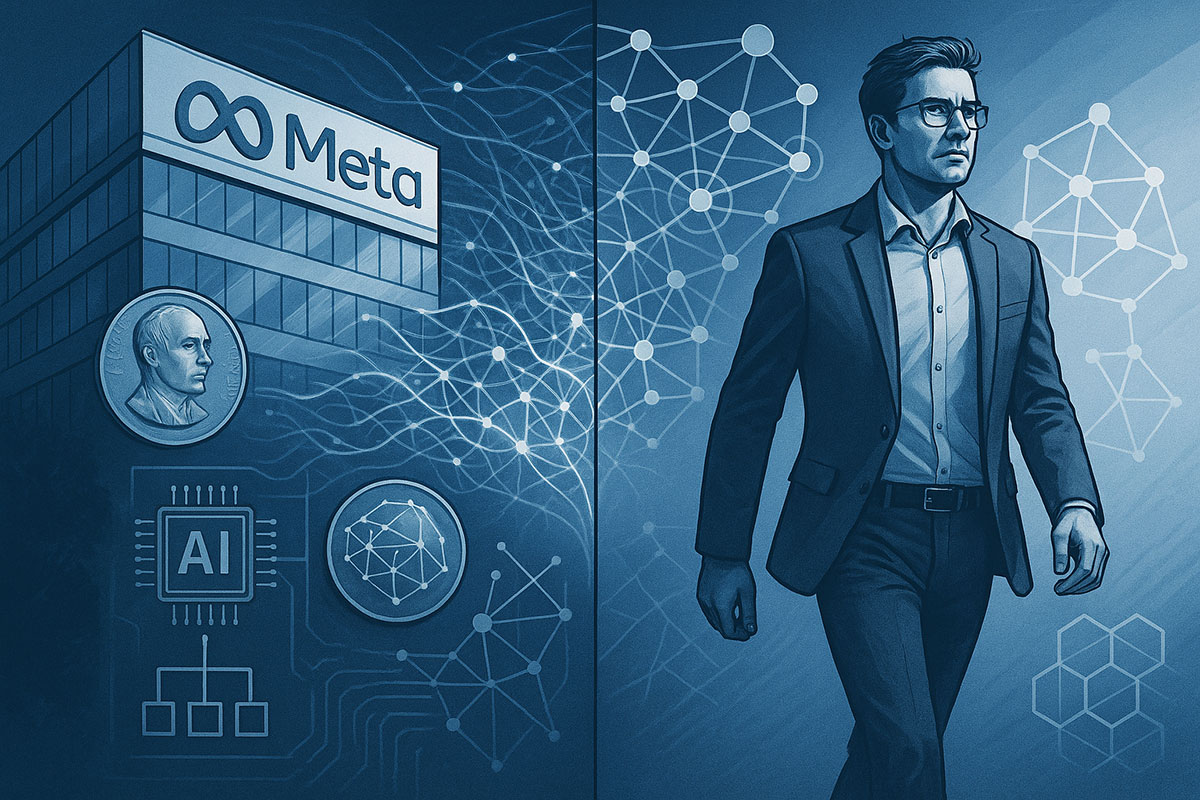
The Man, The Mission, The Departure
When the Financial Times broke the news on November 14, 2025, the AI industry collectively held its breath. Yann LeCun, one of the most influential figures in artificial intelligence and Meta's chief scientist since 2013, is planning to leave the social media giant to build his own startup focused on next-generation AI systems. This isn't just another executive departure—it's a watershed moment for the direction of AI research itself.
LeCun's credentials speak for themselves. A 2018 Turing Award laureate, he's credited with pioneering convolutional neural networks (CNNs), the foundational architecture behind modern deep learning. He built Meta's Fundamental AI Research (FAIR) division from scratch, transforming it into one of the world's most productive AI research institutions. Under his leadership, FAIR created Llama, one of the few open-source alternatives to closed commercial AI models. Yet now, after building this empire of research, LeCun is walking away from it all.
The reason? A philosophical and organizational rupture so significant that it forced one of AI's greatest minds to choose between compromise and conviction.
The Philosophical Divide: LLMs Versus World Models
To understand why LeCun is leaving, you must first grasp the core debate dividing the AI research community. On one side stands the dominant industry orthodoxy: large language models (LLMs) are the foundation for artificial general intelligence (AGI). On the other side stands Yann LeCun, arguing this approach is fundamentally limited.
LeCun has been publicly and relentlessly critical of the current LLM-centric approach to AI development. He's repeatedly described modern AI systems as sophisticated "autocomplete machines"—impressive in their text generation abilities but profoundly lacking in genuine reasoning, causal understanding, planning, and common sense. In a now-famous tweet, he wrote: "It seems to me that before 'urgently figuring out how to control AI systems much smarter than us' we need to have the beginning of a hint of a design for a system smarter than a house cat."
This isn't just theoretical hand-wringing. LeCun advocates for an alternative vision centered on three pillars:
1. Self-Supervised Learning: Rather than learning from human-annotated data, systems should autonomously discover patterns in unlabeled information—text, images, videos, interactions—the way human children learn by observing the world. This approach scales more naturally and builds more robust representations.
2. World Models: AI systems need internal representations of how the world works—causal relationships, temporal dynamics, spatial reasoning. These models would enable machines to reason about counterfactuals ("what if I did this?"), plan across long horizons, and generalize to novel situations far more effectively than current systems.
3. Hierarchical Joint Embedding Architectures: Rather than treating all information as text tokens, systems should learn multi-scale, multi-modal representations that capture both high-level abstract concepts and granular details, enabling richer reasoning and planning.
Meta's Reorganization: The Turning Point
For years, LeCun had substantial autonomy at Meta. He reported directly to Chris Cox, the Chief Product Officer, allowing FAIR to pursue long-term research with minimal commercial pressure. This arrangement enabled breakthrough work on self-supervised learning, foundation models, and the philosophical frameworks underpinning LeCun's AGI vision.
That changed dramatically in June 2025.
Meta's board, spooked by OpenAI's explosive success with ChatGPT and concerned that Meta's Llama 4 model wasn't keeping pace with competitors, demanded change. CEO Mark Zuckerberg responded with a sweeping reorganization. Meta invested $14.3 billion in Scale AI and brought on its 28-year-old CEO, Alexandr Wang, to head a new unit called Meta Superintelligence Labs (MSL).
Crucially, LeCun's reporting structure changed overnight. He no longer reported to Cox but directly to Wang—a founder focused explicitly on rapid commercialization and "personal superintelligence" as a near-term consumer product. Internal memos from Wang made the mandate crystal clear: speed, scaling, infrastructure, product deployment. Not foundational research. Not five-to-ten-year research horizons. Now.
Industry insiders quickly diagnosed the problem. Yuchen Jin, co-founder of Hyperbolic AI, observed on social media: "Zuckerberg panicked after ChatGPT's success while Meta's Llama 4 underperformed. Yann never believed in LLM-to-AGI. Zuck's patience ran out."
It was a collision between two incompatible visions of AI's future, crystallized in an organizational chart.
The Early Funding Conversations
According to multiple sources, LeCun has begun preliminary discussions with potential investors about his new startup. The nature of these conversations reveals his intentions. The venture will likely focus on his world model research—moving beyond language-only systems toward architectures that can reason about visual scenes, physical dynamics, and causal relationships more like humans do.
Exactly what the company will build remains opaque. LeCun hasn't publicly announced specifics. But insiders suggest it will explore "open-ended learning" systems capable of autonomous reasoning and planning—technology fundamentally different from ChatGPT-style chatbots. Possible directions include robotic systems that can understand and interact with their physical environments, autonomous agents capable of multi-step problem-solving, or entirely new model architectures optimized for reasoning rather than text generation.
The fact that these conversations are happening at all signals LeCun's seriousness. This isn't casual exploration but a deliberate effort to secure capital and talent for an alternative AI paradigm.
A Ripple Effect Through the Industry
LeCun's departure matters far beyond Meta. When visionary figures leave major tech companies, they often trigger industry-wide talent movements. At DeepMind, when pioneering researchers departed, they frequently founded or joined rival labs, taking knowledge and institutional culture with them. History may repeat at Meta.
Industry observers are already drawing parallels to an earlier tech drama. In 2021, AI researcher Noam Shazeer left Google to co-found Character.AI. Google later spent $2.7 billion to reacquire him in 2024—a costly lesson in not letting visionary talent leave. Some speculate Zuckerberg might attempt a similar reconciliation, though sources suggest LeCun's conviction about his research direction makes that unlikely in the near term.
The real impact could be more subtle: junior researchers at Meta's FAIR lab, seeing the tension between commercial demands and foundational research, might follow LeCun into independent ventures. This could accelerate the fragmentation of AI development—moving research away from centralized labs and toward distributed startups exploring alternative approaches.
This, paradoxically, might accelerate innovation. When creative talent feels constrained, new ecosystems emerge. In cryptography and distributed systems, early restrictions at centralized institutions led to the flourishing of independent research communities that ultimately pushed the field forward faster.
Why This Moment, Why Now?
The timing isn't coincidental. Several converging factors created the conditions for LeCun's departure:
Reduced Influence: The reorganization explicitly reduced FAIR's scope. While MSL absorbs resources and talent, FAIR transitions into a supporting role—generating research for commercial teams rather than pursuing independent investigations. LeCun went from architect of Meta's AI strategy to executor of someone else's vision.
Philosophical Misalignment: After years of subtle disagreement, the gulf became unbridgeable. Zuckerberg's bet-the-company commitment to LLM scaling directly contradicts LeCun's conviction that alternative architectures are necessary for AGI.
Opportunity Window: The AI startup ecosystem has matured dramatically. Venture funding for AI is abundant. The talent pool of researchers eager to explore alternative approaches has never been larger. The infrastructure for building AI systems (cloud compute, open models, frameworks) is more accessible than ever. The conditions for founding a competitive AI startup have never been more favorable.
Demonstrated Success: LeCun's research credentials—a Turing Award, decades of breakthroughs, a global following—provide him with credibility that most entrepreneurs lack. He can attract top talent, raise substantial capital, and command media attention. Few researchers could launch an alternative AI research program with such starting advantages.
What This Means for Meta
For Meta, LeCun's departure is a significant loss. FAIR's research productivity and reputation derive substantially from his leadership and intellectual direction. He's published hundreds of papers, mentored dozens of researchers who've gone on to senior positions across the industry, and positioned Meta's AI research as credible within academia—unusual for a commercial lab.
Losing him signals that Meta's organizational culture increasingly prioritizes commercial delivery over foundational research. This might accelerate product development in the near term but risks alienating the researchers who value open-ended investigation. Several authors of the original Llama research paper left Meta within months of publication, citing bureaucratic frustration. LeCun's exit might trigger similar departures.
However, Meta's MSL structure and Alexandr Wang's leadership bring substantial assets. Meta controls the infrastructure, compute, and talent pipeline to build cutting-edge AI systems. Wang's background in data infrastructure is genuinely valuable for scaling model training. Meta's investments in physics-based reasoning and robotics research remain substantial. The company isn't abandoning foundational work entirely—it's just reshaping it around commercial timelines.
The Broader AI Landscape Implications
LeCun's departure will likely accelerate already-visible divergences in AI research directions. The industry has increasingly split into two camps:
Camp 1: Scale & Refine LLMs
Led by OpenAI, Anthropic, and now Meta's MSL, this approach argues that scaling language models, adding reasoning capabilities through reinforcement learning, and integrating additional modalities (vision, audio) will eventually lead to AGI. The theory is that sufficiently large systems with sophisticated training procedures will spontaneously develop reasoning abilities.
Camp 2: Alternative Architectures
Researchers like LeCun argue this approach has fundamental limitations. This camp explores world models, embodied AI, neuro-symbolic hybrid systems, and other paradigms. Progress has been slower and less commercially obvious, but the theory suggests these approaches will eventually provide capabilities that scale-only methods cannot.
LeCun's new venture will be a high-stakes bet on Camp 2. If successful, it could validate the alternative approach and trigger a broader industry pivot. If unsuccessful, it might suggest the scaling camp was right all along. Either way, having a well-funded, visionary-led research program pursuing fundamentally different AI architectures benefits the entire field by preventing premature convergence on a single approach.
What's Next for LeCun's Startup?
Details remain scarce, but several clues suggest probable directions:
World Models for Robotics: LeCun has long believed embodied AI—robots learning to understand and manipulate their environment—is crucial for developing causal reasoning. A startup focusing on robotic systems with internal world models could test this hypothesis at scale.
Video Understanding & Prediction: Video contains rich causal information (seeing cause-and-effect play out temporally). Large-scale self-supervised learning on video could generate the kind of world model LeCun theorizes about. This could target industries from autonomous vehicles to manufacturing quality control.
Autonomous Planning Systems: Rather than language interfaces, LeCun's startup might build systems that autonomously decompose complex objectives into task sequences, reason about constraints and dynamics, and self-improve through experience. Think: AI systems that don't just answer questions but strategically solve multi-step problems.
Open-Source Research Platform: Given LeCun's commitment to open science, the startup might focus on building toolkits and frameworks that accelerate world model research industry-wide, similar to PyTorch's role in democratizing deep learning.
Realistically, it will probably involve combinations of these approaches, iteratively discovering what works as the team develops and tests systems.
The Competitive Dynamics
LeCun won't operate in a vacuum. Several other organizations are simultaneously exploring world models and alternative architectures:
Google DeepMind has invested in world model research through various projects, though publicly they maintain strong commitment to LLM scaling.
World Labs, a well-funded startup founded by former OpenAI researchers, is explicitly building generative world models for video generation and interactive environments.
Smaller research teams at various universities continue publishing on alternative AI architectures, though with limited commercial resources compared to industry labs.
LeCun's advantages include his reputation, ability to attract top talent, access to capital, and his systematic, published research roadmap. His challenges include competing against established labs with vastly larger compute budgets and the reality that world model research has historically been harder to monetize than language models.
Lessons for the Broader Tech Industry
LeCun's departure illuminates tensions that many large tech companies face:
How long can visionary researchers remain motivated in large organizations optimized for execution? Google's founders built a lab culture that preserved research autonomy. Meta attempted this with FAIR but ultimately prioritized product development when competitive pressure intensified. This is a recurring pattern: organizational pressures eventually squeeze out the conditions that foster breakthrough research.
Can commercial organizations compete in foundational research if research timelines don't match product timelines? This remains an open question. Bell Labs succeeded in an earlier era. Today's evidence is mixed—some company labs do breakthrough research, but increasingly the most radical innovation happens in academia or startups.
Do organizational hierarchies fundamentally constrain creative genius? LeCun is testing this directly. If his startup succeeds, it will validate the hypothesis that independent ventures can compete with well-resourced corporate labs. If it fails, it might suggest that even visionary researchers benefit from institutional support and infrastructure that only large organizations can provide.
The Road Ahead
As of November 2025, LeCun's departure hasn't been officially confirmed by either party, though the Financial Times' reporting draws on multiple sources familiar with the conversations. What's certain is that the AI research landscape is shifting. The era when Meta could serve as a home for both cutting-edge research and aggressive commercialization—simultaneously publishing groundbreaking papers while racing to beat OpenAI—appears to be ending.
For researchers who value foundational investigation, LeCun's departure might signal that independence is necessary. For Meta, it's a wake-up call about the costs of subordinating research to product development. For the broader AI industry, it's a reminder that breakthrough innovation often requires someone with conviction bold enough to walk away from authority and build something new.
The question now is what LeCun builds, what impact his alternative AI approach achieves, and whether the industry learns from this that cognitive diversity—having multiple teams exploring fundamentally different paths to AGI—might be healthier than everyone pursuing the same scaling approach. In a field as consequential as artificial intelligence, betting everything on one methodology seems, well, less intelligent than hedging your bets across multiple paradigms.
Related Reading