Introduction: The Urgent Test of AI Safety
The breakneck pace of artificial intelligence is undeniable. From autonomous agents in the workplace to life-saving medical tools, AI's potential is staggering. However, this rapid adoption has outpaced the development of robust safety and governance frameworks, creating a critical gap. The year 2025 has become a turning point, where the question is no longer just "what can AI do?" but "how can we ensure it is developed and used responsibly?" Drawing on the latest data from the authoritative 2025 Stanford AI Index Report and expert analyses, this article grades the current state of AI safety, examining the performance of key players and the emerging global report card on responsible AI.
The Benchmark: What Are We Grading On?
Before assigning grades, it's essential to define the criteria for AI safety and responsibility in 2025. The landscape has moved beyond theoretical debates to concrete challenges and measurable metrics.
The Rise of AI Incidents
The most immediate red flag is the sharp increase in recorded AI incidents. The 2025 AI Index Report confirms that these events are rising sharply, highlighting the tangible risks associated with widespread deployment. These incidents are not confined to labs; they occur in real-world applications, from generative AI producing inaccurate or harmful content to biases in automated decision-making systems affecting people's lives.
The Corporate Responsibility Gap
Within the industry, a significant disconnect persists. While many companies recognize the risks of AI, far fewer are taking meaningful action to mitigate them. A critical finding is that standardized Responsible AI (RAI) evaluations remain rare among major industrial model developers. This lack of standardized, transparent assessment makes it difficult to compare companies directly and holds the entire ecosystem back. Furthermore, a pre-2025 survey highlighted that only 21% of organizations with AI adoption had established policies governing employee use of generative AI, and a mere 32% were actively working to mitigate the most common risk: inaccuracy. This points to a widespread "responsibility gap" between ambition and action.
The Concentration of Power
Another critical criterion is market structure. The AI sector is increasingly dominated by a handful of well-resourced tech giants. As noted by economists like Philippe Aghion, this concentration of power in AI firms—controlling data, compute, and talent—poses a threat to the dynamism of creative destruction and could allow a small set of firms to dictate the pace and direction of technology, including safety standards. A healthy, competitive ecosystem is often a safer and more innovative one.
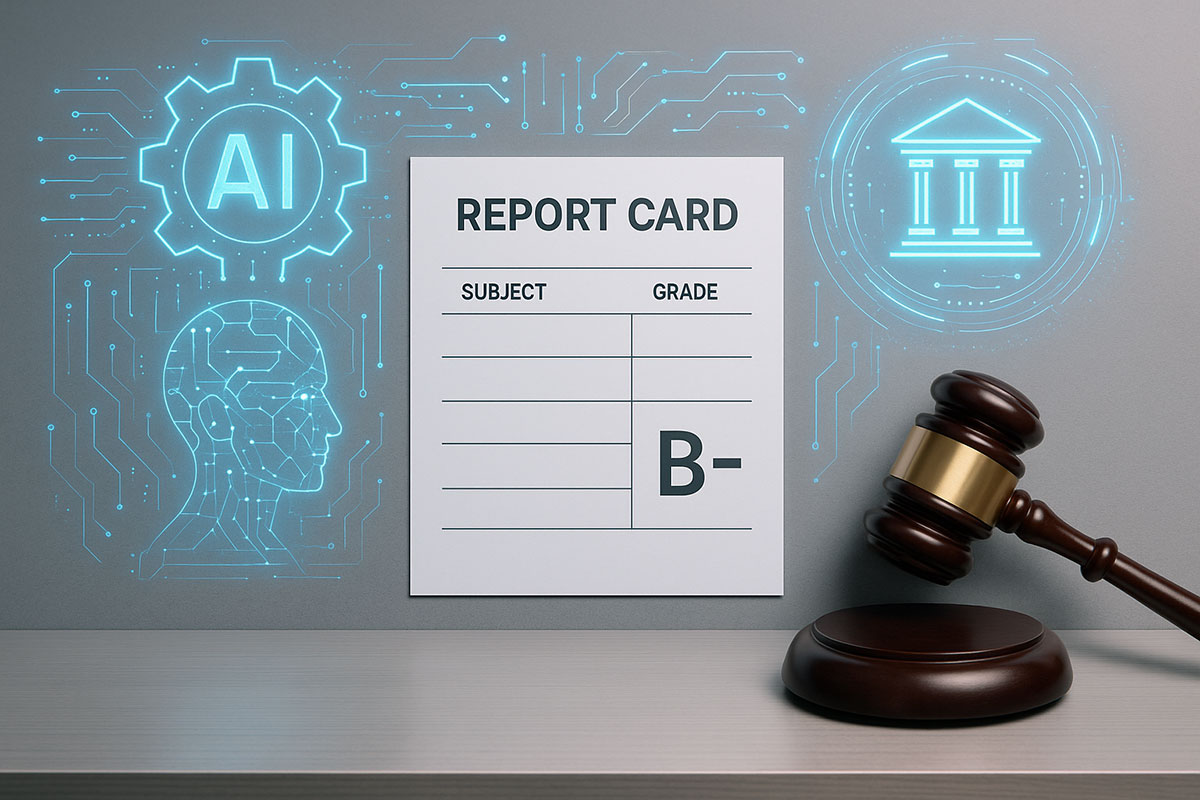
The 2025 AI Safety Report Card
Based on the current landscape and available data, here is a qualitative assessment of how major stakeholders are performing on AI safety.
| Stakeholder | Category | Grade | Analysis & Rationale |
| Leading AI Labs (e.g., OpenAI, Google DeepMind, Anthropic) | Technical Safety R&D | B | These organizations are at the forefront of developing new safety benchmarks like HELM Safety and AIR-Bench, showing high technical engagement. They also lead in red-teaming and alignment research. However, their transparency regarding model limitations, full training data, and internal safety processes is often limited, holding them back from a top grade. |
| Big Tech Companies (e.g., Microsoft, Amazon, Meta) | Deployment & Scaling | C+ | These firms are driving massive adoption and integrating AI into global products. They have dedicated responsible AI teams and public principles. However, the scale and speed of deployment, coupled with the documented gap between recognizing risks and mitigating them, leads to a high volume of public-facing incidents. The pressure to ship products can sometimes outpace safety assurances. |
| National Governments & Regulators | Governance & Policy | B- | 2024 saw a significant uptick in regulatory activity. In the U.S. alone, federal agencies introduced 59 AI-related regulations—more than double the number in 2023. The EU, UN, OECD, and African Union are all actively building governance frameworks. This shows increased urgency, but the regulations are still new, untested, and lack global harmonization, creating a complex compliance landscape. |
| The Broader Business Ecosystem | Adoption & Risk Management | D+ | With 78% of organizations reporting AI use in 2024, the majority of companies are now users. Yet, most lack the expertise and resources of tech giants. The persistent failure to address basic risks like inaccuracy and cybersecurity, as shown in earlier surveys, indicates that the average business is largely unprepared for the AI tools it is deploying, creating systemic vulnerabilities. |
The Consequences of Failing the Test
What happens if the overall grade on AI safety does not improve? The risks are not merely theoretical; they are already materializing and could intensify.
Erosion of Trust
Public trust is the foundation upon which technological progress is built. A continued flood of AI incidents—from deepfakes and misinformation to biased algorithms—could lead to a catastrophic collapse in public confidence. As one analysis warns, if AI accelerates a flood of polished but misleading studies and content, trust in the entire information ecosystem could collapse. Without trust, the benefits of AI will be severely limited by public rejection and fear.
Stifling of Innovation
Paradoxically, a failure to self-regulate and build safety from the ground up could lead to heavy-handed, reactionary government regulations. While thoughtful governance is needed, poorly designed or overly restrictive rules could stifle the very innovation that makes AI promising. The goal should be a framework that manages risk without crippling progress, a balance that has yet to be fully struck.
Exacerbating Global Inequality
The AI safety divide could also worsen global inequality. Well-resourced companies and nations in the Global North can afford to invest in safety research and compliance, while smaller players and those in the Global South may be left behind. This could create a two-tiered system: a "safe AI" elite and a much larger population forced to use less reliable, higher-risk systems, further entrenching global digital divides.
The Path to an "A": A Blueprint for Safer AI
Improving the overall safety grade requires a concerted, multi-stakeholder effort. Here is a strategic blueprint for building a more responsible AI future in 2025 and beyond.
1. Mandatory Transparency and Auditing
Voluntary guidelines are insufficient. There is a growing call for mandatory disclosure of AI use in research and writing, and independent audits for AI-assisted claims in sensitive fields like healthcare and finance. Just as companies are audited for financial compliance, they should be audited for AI ethics and safety practices.
2. Democratizing Access and Building Guardrails
To prevent a concentration of power and ensure equitable benefits, we must democratize access to the building blocks of AI. This includes initiatives for shared cloud infrastructure and compute access, especially for researchers in the Global South. Simultaneously, public investment in research is critical to ensure that innovation serves broad societal needs, not just narrow corporate interests.
3. Cultivating a Culture of Responsibility
Ultimately, technology is a reflection of its creators. Companies must move beyond publishing ethical principles and embed safety into their core engineering cultures and product development lifecycles. This means prioritizing safety even when it slows down a product launch, investing in MLOps for continuous monitoring, and empowering internal risk and ethics teams.
4. Strengthening Global Cooperation
AI is a global technology that demands global solutions. The increased cooperation seen among international bodies in 2024 is a positive start. This must be deepened to establish interoperable standards and norms, preventing a "race to the bottom" where countries compete by having the loosest regulations. A global observatory for AI in science, modeled on the IPCC, has been proposed as one promising mechanism.
Conclusion: The Final Grade is Up to Us
The 2025 AI safety report card reveals a mixed picture. There are promising signs of engagement, particularly in technical safety research and governmental awareness. However, these are outweighed by significant shortcomings in corporate risk mitigation, transparency, and broad-based preparedness. The overall grade for the ecosystem is an Incomplete.
This is not a failure, but a critical opportunity. The test is still underway. The final grade will be determined by the choices made today by industry leaders, policymakers, and researchers. By demanding greater transparency, supporting thoughtful regulation, and building safety into the very fabric of AI development, we can ensure that this transformative technology earns not just a passing grade, but honors with distinction for the benefit of all humanity.
Related Reading