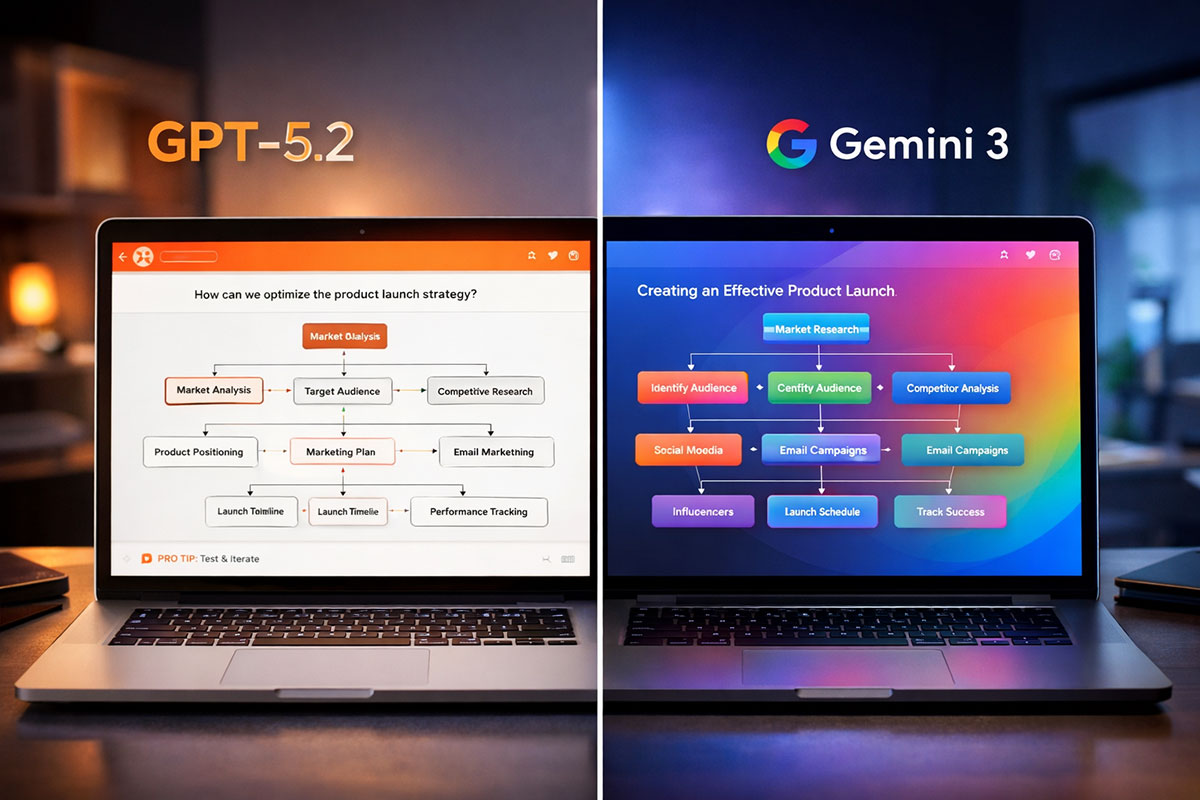
Introduction: The AI Rivalry That Just Got Real
Two weeks ago, OpenAI did something unusual. CEO Sam Altman declared "Code Red"—an internal emergency signal that pulled engineering teams away from other projects to focus on one thing: beating Gemini 3. Google had just released its latest AI model in November 2025, and the response from OpenAI leadership was panic. Fast forward to December 2025, and GPT-5.2 dropped. The question everyone's asking isn't "which one is smarter"—it's "which one should I actually subscribe to?"
The truth is, the benchmarks that tech media obsesses over don't matter much for normal work. What matters is whether an AI can actually help you write that blog post, finish your homework, nail your coding interview, or build a side project. We're going to break down what these models actually do, how much they cost, and give you a simple framework to pick the right one.
The Core Difference: Speed vs. Depth
Before we compare them directly, you need to understand the fundamental tradeoff these models represent.
GPT-5.2 comes in three flavors: Instant (quick answers), Thinking (deeper reasoning), and Pro (maximum accuracy). The model flexes most on structured tasks that need step-by-step logic—writing code, solving math problems, analyzing data. OpenAI trained this specifically to feel like working with an expert colleague who doesn't make silly mistakes.
Gemini 3 Deep Think is Google's answer to that same problem. It uses what Google calls "parallel reasoning"—testing multiple hypotheses at the same time to explore a problem from different angles. This makes it particularly strong at tackling novel, creative problems where there isn't a straightforward path.
One practical difference: GPT-5.2 has a 400,000-token context window (that's roughly 300,000 words). Gemini 3 also supports large contexts, but the exact limits vary by subscription tier. For most people, this doesn't matter. For researchers analyzing entire dissertations or developers working with massive codebases? It matters a lot.
The Real-World Comparison: Where Each Model Excels
We tested both across the tasks that actually matter to students, workers, and people building side hustles. Here's what we found:
| Task |
GPT-5.2 |
Gemini 3 Deep Think |
Real Talk |
| Blog Writing |
Exceptional (fewer hallucinations, better structure) |
Strong (more creative, better at voice) |
Use GPT-5.2 if you want accuracy; Gemini if you want personality |
| Homework Help |
Winner (perfect 100% on AIME 2025 without tools) |
Strong (93.8% on GPQA Diamond, still expert level) |
Nearly tied for math; GPT-5.2 edges ahead on step-by-step explanation |
| Coding Projects |
Clear winner (55.6% on SWE-Bench Pro vs. Gemini's 43.3%) |
Competent but slower |
GPT-5.2 is the coder's choice; it catches edge cases better |
| Data Analysis |
Strong (long context, spreadsheet comprehension) |
Solid (good at multimodal, can analyze images/charts) |
GPT-5.2 for CSV/dataset work; Gemini for visual data |
| Research & Reading |
Winner (tracks context across long documents without losing the plot) |
Strong for exploration (better at generating alternative interpretations) |
GPT-5.2 for synthesis; Gemini for ideation |
| Side Hustle Projects |
Best all-around (tool-calling at 98.7% accuracy) |
Reliable (good for content creation, visual media) |
GPT-5.2 if automating workflows; Gemini if creating media |
The honest take: on benchmarks, these models are trading blows. GPT-5.2 wins on structured reasoning and coding. Gemini 3 wins on creative tasks and visual understanding. For most people, the difference isn't "Gemini is terrible at coding"—it's "GPT-5.2 is measurably better at it."
Pricing: What This Actually Costs You
Here's where your real choice happens. Both companies want your money, but they're charging different amounts for different things.
OpenAI's Pricing:
- Free tier: Limited access to GPT-5.2 Instant (roughly 50 messages per hour, smaller file uploads). This is genuinely useful if you just want to try things out.
- ChatGPT Plus: $20/month. You get access to GPT-5.2 Thinking mode, which is the "deeper reasoning" version. This is the sweet spot for most people—students, side hustlers, professionals who want the good stuff without enterprise pricing.
- ChatGPT Pro: $200/month. This unlocks GPT-5.2 Pro (the strongest version) and "xhigh" reasoning effort, which solves the hardest problems. Only grab this if you're building complex automation or running a business that depends on it.
Google's Pricing:
- Free tier: Limited Gemini 3 Pro access (typically 3-5 high-quality outputs per day). It's restrictive, honestly.
- Gemini 3 Pro: $19.99/month. Full access to the Gemini 3 Pro model. Interestingly, this is cheaper than ChatGPT Plus by a dollar, but you're missing the "Deep Think" reasoning mode.
- Gemini 3 Ultra: $124.99/month. This includes Deep Think and the highest limits. It's pricier than ChatGPT Pro but positioned as a creative professional tier.
What You Should Actually Do:
If you're just starting out, use the free tiers. They're both legitimately useful. If you're serious about using AI for work or study, ChatGPT Plus at $20/month is the highest ROI. You get the Thinking mode that actually works like having a smarter person in the room.
If you're already a heavy Google Workspace user (Gmail, Docs, Sheets), Gemini 3 Pro at $19.99 integrates better with your workflow. If you use Microsoft Office and Windows, neither integration is perfect, but you'll adapt faster to ChatGPT.
Use Case Guide: Which One Should You Actually Pick?
If you're a student:
Use GPT-5.2 (ChatGPT Plus, $20/month). The Thinking mode is basically a study buddy who's never tired and always right about the logic. It excels at explaining concepts step-by-step, which is how you actually learn. Gemini 3 is fine for brainstorming, but GPT-5.2's accuracy on math and science problems gives you more confidence when you're checking your work.
If you're a full-time employee:
Start with Gemini 3 Pro ($19.99/month) because Google Workspace integration saves you time. If your work is heavy on coding, analysis, or complex problem-solving, upgrade to ChatGPT Plus. Many professionals end up with both—Gemini for quick questions and writing polish, ChatGPT for the hard thinking work.
If you're building a side project:
GPT-5.2 is your move. The code generation is measurably better, and if you're automating workflows or building tools, the 98.7% tool-calling accuracy matters. You won't waste time debugging broken API calls. The $20/month investment pays for itself in time saved.
If you're a content creator:
Gemini 3 Pro is probably your better bet. It's stronger at creative writing, generates more natural-sounding text, and has better visual understanding (useful if you're working with images, screenshots, or design briefs). The multimodal capabilities feel slightly more intuitive than GPT-5.2's.
If you're doing research:
GPT-5.2 wins here. The larger context window and better long-document handling means you can paste entire papers and get coherent summaries without hallucinations. If you're reading 50 research papers to write a report, this model will save you days.
If you're torn between both:
Get ChatGPT Plus ($20/month) first. The Thinking mode is genuinely different from any AI you've used. Try it for 30 days. If you're writing lots of content or doing creative work, add Gemini 3 Pro ($19.99/month). For $40/month total, you have both bases covered.
The Hidden Factor: Availability
GPT-5.2 is available in most countries. Gemini 3 Deep Think is rolling out, but only to Gemini Ultra subscribers in certain regions—availability is still patchy in some countries.
If you're in the US, EU, or major tech markets, this doesn't matter. If you're in India, Southeast Asia, or parts of Latin America, check availability first. GPT-5.2's broader rollout means fewer headaches.
Performance Nuances: What the Benchmarks Actually Mean
Let's translate the nerd stuff into human language.
GPT-5.2 scored 100% on AIME 2025 (a high school math competition for smart kids). Without any calculator or helper tools. Gemini 3 achieves this only with code execution enabled. This means GPT-5.2 can reason through tricky math intuitively; Gemini needs to write code to solve it. For a student, GPT-5.2 feels faster. For a data scientist who wants to run code anyway, Gemini's approach is actually fine.
On the SWE-Bench (software engineering test), GPT-5.2 scored 55.6% versus Gemini's 43.3%. That 12-point gap is real—it means GPT-5.2 fixes more complex bugs correctly on the first try. Gemini will get you closer, but you'll spend more time in debugging.
Gemini 3 Deep Think's 45.1% on ARC-AGI-2 shows it's genuinely good at novel problem-solving—tasks no AI was specifically trained on. If you're doing creative research or exploring new territory, this parallel reasoning approach shines.
Why OpenAI Panicked (And Why It Matters for You)
Sam Altman declared Code Red because Google released Gemini 3 in mid-November with huge fanfare. The model was genuinely impressive and undercut some of OpenAI's marketing claims. The panic wasn't about Gemini being better overall—it was about OpenAI losing the "perception of dominance" in the AI space.
What actually happened: Gemini 3 is strong, but it's strong in different ways. It didn't break OpenAI's actual product. OpenAI just wanted to ensure it had a strong response. Fast-forward six weeks, and GPT-5.2 delivered.
For you: This rivalry is good news. Both companies are pushing hard. The models are improving faster because of competition. A year from now, both will be noticeably better. For now, neither company is resting on their laurels.
Common Concerns Answered
"Won't one of these models become completely obsolete?"
No. They're optimizing for different things. GPT-5.2 will likely stay ahead on reasoning and coding. Gemini will stay competitive on creative work and integration with Google services. They'll keep pushing each other, but you're not picking a loser by choosing Gemini.
"Should I wait for the next update?"
No. Both companies release updates every few weeks now. You'll wait forever. Get started with the free tier, pay when you hit the limits, and upgrade later when a big release matters to your specific work.
"Will ChatGPT Plus still be worth it next year?"
Probably yes, but it might cost more. OpenAI is hinting that Pro features will be gated behind higher-tier subscriptions. If you jump in at $20/month now, you'll likely keep that price for a while.
"What if I pick wrong?"
Both are under $20/month. You can try ChatGPT Plus for a month, hate it, and try Gemini Pro for a month. The worst-case scenario costs you $40 to figure out which one fits your brain better. That's cheaper than a coffee a day.
The Bottom Line: A Simple Decision Tree
Do you code or do complex analysis? → ChatGPT Plus
Are you a heavy Google Workspace user? → Gemini 3 Pro
Do you create written content for an audience? → Gemini 3 Pro
Do you study math, physics, or logic? → ChatGPT Plus
Are you torn? → ChatGPT Plus (the Thinking mode is the most unique feature either company offers right now)
Do you have $40/month to spend? → Get both. This isn't extravagant—it's less than a streaming service subscription.
What's Coming Next
Neither company is standing still. OpenAI is working on real-time voice integration and agent capabilities. Google is pushing multimodal reasoning (understanding text, images, and video together). By Q2 2026, both models will be noticeably better at things they're currently mediocre at.
The fact that you're comparing them now means you care about staying current with AI. The models you choose in December 2025 will feel quaint six months from now. Don't overthink it. Pick one, learn its quirks, and upgrade when there's a real reason.
Related Reading
For deeper dives into specific topics mentioned here, check out: