Introduction: The Search Revolution You May Have Missed
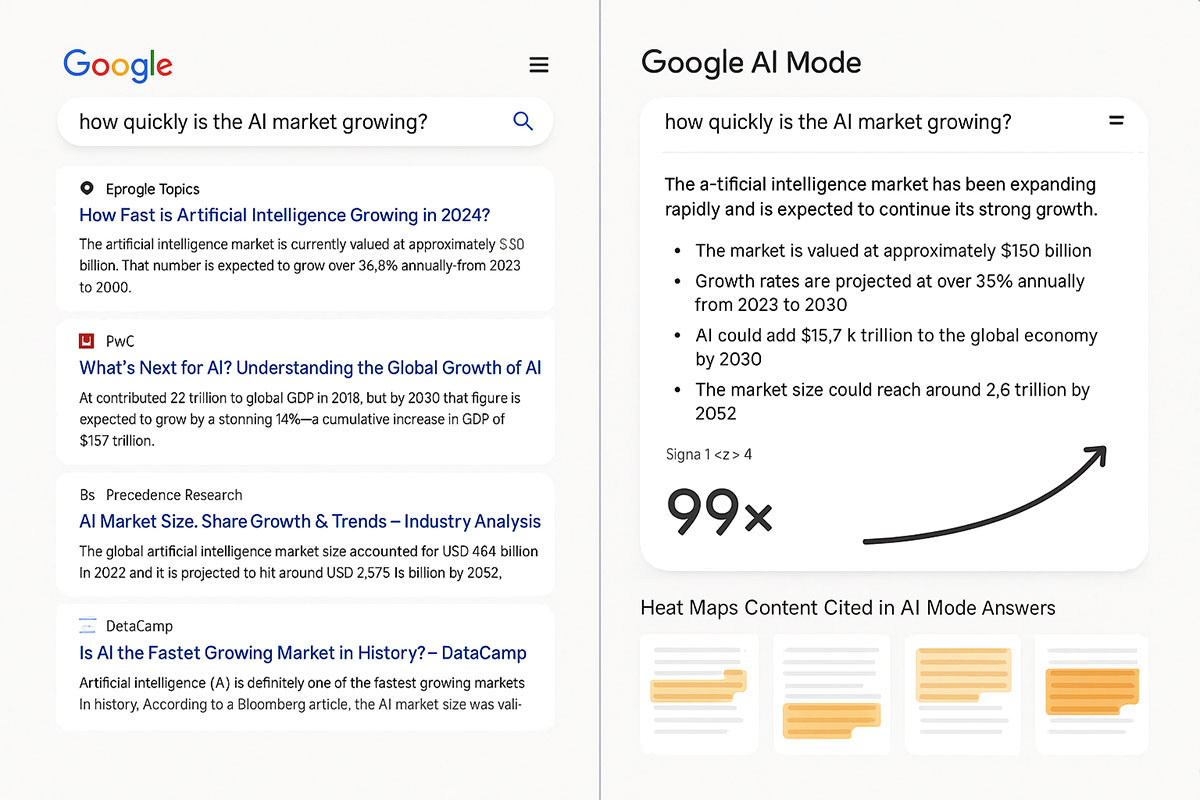
On November 11, 2025, an unprecedented phenomenon occurred in the world of search technology. Google AI Mode—the company's conversational search interface powered by Gemini 2.5—experienced a massive 99X spike in search interest. This wasn't a gradual adoption curve; it was an explosive surge that caught many content creators, businesses, and even experienced SEO professionals off-guard.
To put this in perspective: Google AI Mode had already captured 100 million monthly active users by mid-2025 and was serving AI Overviews to 2 billion searches per month. The November 99X spike represents not just growth, but acceleration—the moment when AI Mode transitioned from "emerging feature" to "cultural moment."
For website owners and content creators, this November 2025 milestone represents the most critical inflection point in search behavior since mobile optimization became mandatory for SEO success. Yet most websites are entirely unprepared for this transformation. Their content, site structure, and SEO strategies are optimized for traditional ranked links—not for AI-synthesized answers that may cite your content without driving direct traffic to your homepage.
This guide provides the complete, actionable strategy for not just surviving this shift, but thriving in it.
What Is Google AI Mode, and Why Is It Different?
Before diving into optimization strategy, we need to establish exactly what Google AI Mode is and how it differs fundamentally from traditional search.
The Traditional Search Model (Still Dominant, but Changing)
Traditional Google Search operates on a relatively straightforward model:
- User enters a query or keyword phrase
- Google's algorithm identifies relevant pages matching that query
- Google displays a ranked list of results (links, snippets, ads)
- User scans the list and clicks on promising links
- User navigates to the destination website
This model has remained essentially unchanged for 25 years. It's become so familiar that most people don't think of it as a model at all—they simply think of it as "Google."
For businesses and content creators, this model created clear incentives: optimize your content to rank as high as possible for your target keywords, because higher ranking directly correlates with more clicks and more traffic.
How Google AI Mode Changes Everything
AI Mode disrupts this entire model through a different interface and methodology:
- User enters a query (often conversational and longer than traditional searches)
- Google's AI breaks this query into related sub-questions—a process called "query fan-out"
- Google runs multiple simultaneous searches to find relevant information
- The AI synthesizes information from dozens or hundreds of sources
- The AI generates a conversational answer directly in the search interface
- The AI displays prominent links to sources it cited—but users often get their answer without clicking
This difference seems subtle, but it has enormous implications for traffic and visibility.
The Critical Shift: From Ranked Links to Cited Sources
In traditional search, the #1 ranking position receives roughly 28-32 percent of clicks. The #2 position receives roughly 15-20 percent. By position 10, you're getting less than 2 percent. Rankings are highly correlated with traffic.
In AI Mode, this correlation breaks down. Your content might be cited in the AI's answer—meaning millions of people see your information—but users may never click through to your site. They got the answer they needed directly from the AI summary.
Conversely, content that ranks #10 or isn't visible in traditional search at all might be cited in an AI response if it contains a particularly clear, relevant answer to a question the AI's "query fan-out" process identified.
This means the traditional SEO goal of "rank #1" is no longer the primary objective. Instead, the new goal is "be cited in AI Mode answers." These are dramatically different targets requiring different optimization strategies.
Google AI Mode's Explosive November 2025 Growth
The November 2025 99X spike in search interest for AI Mode represents something genuinely remarkable. To understand its significance:
- Prior to November, AI Mode was growing steadily but gradually—consistent adoption as users discovered the feature
- The November spike suggests a tipping point where AI Mode became mainstream rather than niche
- This likely resulted from multiple factors: word-of-mouth, media coverage of the 99X trend itself, seasonal search behavior, and new features
According to Exploding Topics (which tracks emergent trends), this 99X increase made AI Mode SEO optimization the single most important trend topic in November 2025, surpassing cryptocurrency market updates, generative AI breakthroughs, and other typically trending AI topics.
Related Reading