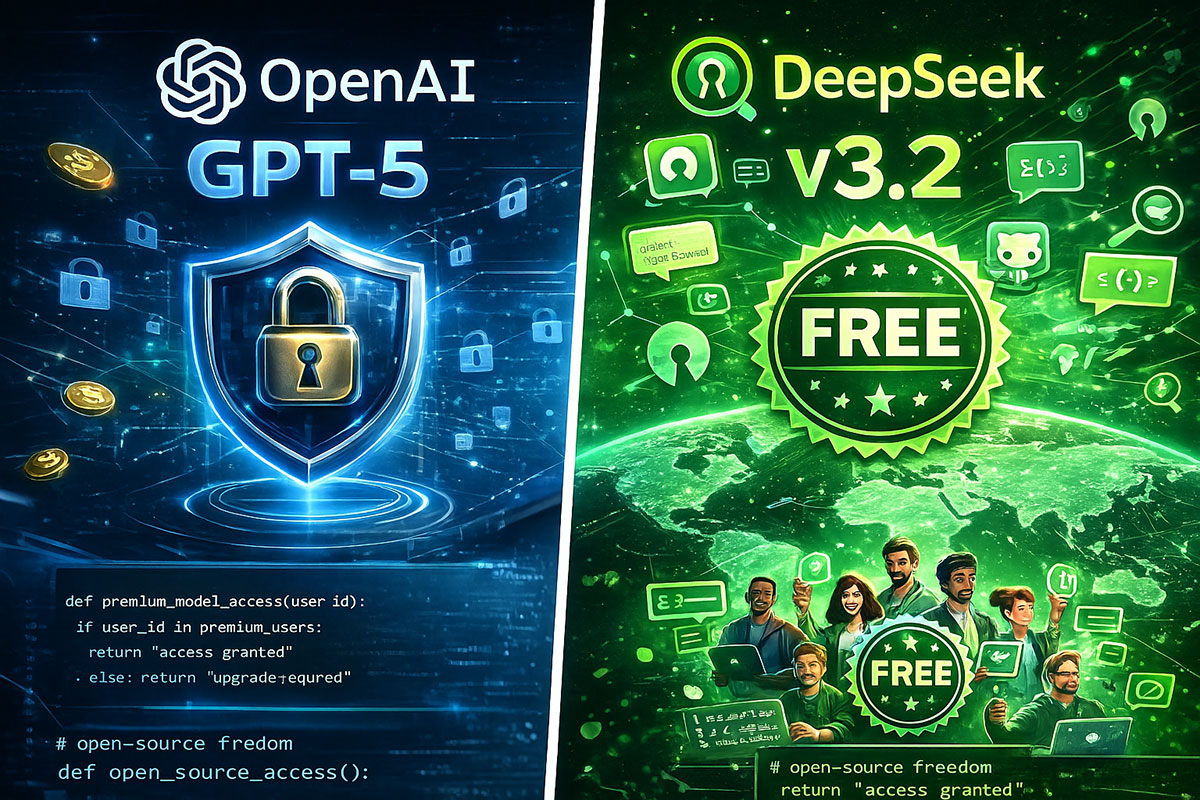
The AI Arms Race Just Entered a New Phase
For two years, OpenAI shaped the narrative around artificial intelligence. ChatGPT was the public's introduction to AI. GPT-4 set benchmarks that competitors spent months trying to match. GPT-5, announced with typical OpenAI mystique, seemed poised to extend the lead indefinitely.
Then something unexpected happened. On December 1, 2025, a company most Western audiences had never heard of announced two AI models that challenged every assumption about who wins in AI development.
DeepSeek, a Chinese AI startup, released DeepSeek-V3.2 and its specialized variant, DeepSeek-V3.2-Speciale. Their claims were audacious: these models match or exceed GPT-5 and Google's Gemini 3.0 Pro in capability. They cost a fraction to train. And—this is the part that shook the industry—they made them completely free under MIT license, available for anyone to download, modify, and deploy.
Within 48 hours, DeepSeek was trending globally. Developers were migrating from proprietary APIs. Researchers were running local instances. By the end of the week, it was the most discussed AI development since ChatGPT's launch. The narrative had shifted. The question was no longer "Can anyone beat OpenAI?" The question was "Why would anyone choose OpenAI if DeepSeek is free?"
What DeepSeek V3.2 Actually Does (And Why It Matters)
To understand why this release matters, it's essential to grasp what makes it fundamentally different from previous open-source models—and different even from closed-source competitors.
The Architecture Advantage
DeepSeek V3.2 uses something called a Mixture of Experts (MoE) architecture with 671 billion total parameters. But here's the crucial part: only 37 billion parameters are active on any given query. Think of it like a massive encyclopedia where the system intelligently chooses which section to read rather than reading the entire book every time.
This design delivers three immediate advantages:
Cost Efficiency: Training DeepSeek-V3 cost approximately $5.5 million using 2,048 NVIDIA H800 GPUs over 55 days. Compare this to OpenAI's estimated $100+ million for GPT-4 training. DeepSeek did this not through corner-cutting but through architectural innovation. The MoE approach uses resources more intelligently. That efficiency translates directly to lower inference costs—meaning using the model on an API is cheaper, and running it locally is feasible.
Speed: DeepSeek-V3 achieves approximately 60 tokens per second generation speed—roughly triple the throughput of V2. For users, this means responses arrive faster. For enterprises, this means better cost-per-inference metrics.
Reasoning Capability: The most significant innovation in V3.2 is something DeepSeek calls "thinking in tool-use." Previous AI models struggle with multi-step problems involving external tools. Each time they call an API or execute code, their reasoning resets. They lose context. DeepSeek V3.2 maintains reasoning continuity across multiple tool calls. This means the model can plan complex workflows—researching information, processing data, writing and testing code, refining approaches—without losing the thread of logic. For practical problem-solving, this is revolutionary.
Performance Benchmarks: The Numbers That Matter
The marketing claims are one thing. The performance data is another. And the data is genuinely impressive:
Mathematical Reasoning: DeepSeek-V3.2-Speciale achieved a remarkable 99.2% success rate on the Harvard-MIT Math Tournament, competing against elite mathematicians. On standard benchmarks, it achieves 90% accuracy on advanced mathematics—surpassing GPT-4's 83%.
Programming and Code Generation: On SWE-Bench Verified (a benchmark measuring ability to identify and fix software bugs), DeepSeek scores 73%, closely competing with GPT-5-High at 79%. For Terminal-Bench 2.0, which assesses real-world coding workflows, DeepSeek achieves 64% versus GPT-4.5-High at 52%. It's not just competitive—it's winning in several critical categories.
Long-Context Processing: DeepSeek supports a 128,000-token context window, allowing it to process approximately 100,000 words simultaneously. That's enough to handle entire codebases, lengthy documents, or sustained conversations. Performance on long-context tasks (like DROP and MQuAKE) demonstrates consistency that rivals or exceeds competitors.
Knowledge and Reasoning: On benchmarks measuring factual knowledge and reasoning (MMLU, MLU, GPQA, SimpleQA), DeepSeek performs at levels approaching GPT-4, significantly outpacing its predecessor V2.5. It doesn't hallucinate as frequently as some competitors, and it's more cautious about stating uncertainty when appropriate.
International Competition Success: DeepSeek-V3.2-Speciale secured gold medals across multiple prestigious competitions despite operating without internet access or external tools: International Mathematical Olympiad, International Olympiad in Informatics, and ICPC Finals (world programming championship). This isn't theoretical capability—this is demonstrated excellence on problems designed to challenge elite human competitors.
What makes these benchmarks significant isn't just that DeepSeek scores well—it's that it scores differently well. Rather than being a generalist that's moderately good at everything, V3.2 shows strength in areas that matter for enterprise use: mathematical reasoning, code generation, and long-form reasoning.
DeepSeek vs ChatGPT: The Detailed Comparison
Having compelling benchmarks is different from being better in daily use. What does the comparison actually mean for someone deciding between these tools?
Performance Strengths
| Task |
DeepSeek Winner |
ChatGPT Winner |
Notes |
| Mathematical Problems |
✓ |
|
DeepSeek is significantly stronger. 90% vs 83% accuracy |
| Code Generation |
✓ |
|
DeepSeek edges out, particularly on complex bugs and refactoring |
| Creative Writing |
|
✓ |
ChatGPT produces more natural, varied prose |
| Conversational Tone |
|
✓ |
ChatGPT adapts more naturally to different conversational styles |
| Real-Time Information |
|
✓ |
ChatGPT integrates live web search more seamlessly |
| Image Generation |
|
✓ |
ChatGPT integrates DALL-E for image creation |
| Cost Efficiency |
✓ |
|
DeepSeek costs drastically less to operate |
| Deployment Flexibility |
✓ |
|
DeepSeek can be self-hosted; ChatGPT requires API access |
| Privacy (Self-Hosted) |
✓ |
|
DeepSeek can run locally; ChatGPT always goes through OpenAI servers |
Speed and Responsiveness
ChatGPT is noticeably faster for straightforward queries. It returns polished answers in seconds. DeepSeek, particularly when using its "Deep Think" reasoning mode, takes longer—sometimes several minutes for complex problems. This is by design: the extra processing time allows deeper reasoning. For users who prioritize speed, ChatGPT wins. For users who prioritize accuracy on hard problems, DeepSeek's thoughtfulness is a feature, not a bug.
Accuracy and Hallucinations
Both models occasionally invent details. But they differ in pattern. ChatGPT tends to produce confidently incorrect information—plausible-sounding but false. DeepSeek is more likely to acknowledge uncertainty or state "I don't know." For critical applications, this difference matters. You'd rather know a system's limitations than discover them the hard way.
Multimodal Capability
ChatGPT integrated with voice (ChatGPT Voice), vision (image analysis), and image generation (DALL-E 3). DeepSeek is currently text-only. If you need image understanding or generation, ChatGPT is the only option. For pure reasoning and coding, that limitation doesn't matter.
User Rate Limits
ChatGPT's free tier has usage limits. Pro users get higher limits. DeepSeek's free tier has no rate limits for API access through platforms like OpenRouter. If you're using it heavily or can't afford subscriptions, DeepSeek's openness is genuinely different.
Practical Recommendation
If you do academic research, participate in programming competitions, or need expert-level mathematical reasoning: DeepSeek is demonstrably better.
If you need creative content, image generation, voice interaction, or prefer the conversational polish that ChatGPT delivers: ChatGPT is the better choice.
If you're price-sensitive or concerned about data privacy: DeepSeek is substantially better.
If you need real-time information or multimodal understanding: ChatGPT is still required.
Most powerful users will end up using both. DeepSeek for technical work. ChatGPT for creative or multimodal tasks.
Why This Release Matters Strategically
The significance extends beyond which model is objectively better. This is about market structure, business models, and who controls the AI future.
The Open-Source Bomb
OpenAI and Anthropic built their competitive moats on closed models. Better models = paid API access = revenue = resources for research. It's been a working formula. The assumption has always been that frontier-grade AI would remain proprietary, guarded by companies with massive compute resources.
DeepSeek proved that assumption wrong. By releasing V3.2 and V3.2-Speciale under MIT license (the most permissive open-source agreement), any developer, researcher, or organization can download the models and do whatever they want—including commercial applications. You don't need OpenAI's permission or API keys. You can modify the models, train them further, or integrate them into products without ever using OpenAI's infrastructure.
This is disruptive because it collapses the traditional moat. Frontier AI capability is no longer locked behind company APIs. It's available as infrastructure anyone can use.
Cost Disruption
DeepSeek-V3.2 is available for free through multiple free-tier platforms (OpenRouter, HuggingFace). The API cost for using it on paid tiers is dramatically lower than OpenAI—typically 10-30% of ChatGPT's pricing. Self-hosting is free after the initial download.
For enterprises, this is a lever for negotiation. If OpenAI charges $30 per million input tokens, and DeepSeek costs $3, companies will switch. They already are. And that switching cascades—the more companies optimize for DeepSeek, the more investment flows toward improving it, which attracts more users.
Geopolitical Implications
DeepSeek is a Chinese company. The US government has strategic concerns about China's AI capabilities. The EU has data residency concerns. But here's the complexity: DeepSeek's code is open-source. You can download it and run it on your own servers. That makes it harder for governments to restrict—you can't ban an algorithm if the code is public.
This might accelerate AI regulation. If open-source models make frontier AI impossible to control, policymakers might push for regulatory frameworks before open-source alternatives proliferate further. Alternatively, it might lead to restrictions on compute availability—the US already limits GPU exports to China.
For users, the openness means less regulatory risk than using a Chinese company's servers. You can run DeepSeek entirely on your own infrastructure with no data flowing to China or any external company.
What This Means for OpenAI
OpenAI's response has been muted. The company hasn't released a comparative analysis or made public statements about DeepSeek. Internally, this is likely taken very seriously. DeepSeek-V3.2 represents the clearest evidence yet that OpenAI's closed approach isn't guaranteed to maintain dominance.
The strategic options are difficult:
Option 1: Go Open: Release GPT models under open-source licenses. This abandons the proprietary model but maintains influence over development trajectory and community perception.
Option 2: Increase Capabilities: Lean into GPT-5.1 or newer versions with capabilities DeepSeek doesn't yet offer (multimodal, real-time reasoning, etc.). This maintains differentiation but requires continued heavy R&D investment.
Option 3: Vertical Integration: Focus on making ChatGPT itself the moat, not the underlying model. If ChatGPT's user experience, integrations, and applications are superior to any open-source alternative, users stay even if the model isn't technically best-in-class.
Option 4: Regulatory Strategy: Work with policymakers to implement regulations favoring larger, safer companies and making open-source models riskier to deploy. This is unspoken but likely happening.
Technical Details: What Makes V3.2 Different
For developers and technical users, several architectural choices make DeepSeek-V3.2 particularly interesting:
Mixture of Experts Implementation
The 671B parameter model with 37B active parameters is more efficient than dense models, but the engineering matters. DeepSeek's implementation uses routing mechanisms that decide which expert modules activate for each token. This is technically complex, but the practical benefit is that the system runs on fewer GPUs than equivalent dense models while maintaining comparable performance.
Training Efficiency
DeepSeek trained V3.2 using FP8 and BF16 precision formats, reducing memory and compute requirements without sacrificing quality. They also utilized reinforcement learning post-training rather than pure supervised fine-tuning. This allows the model to "think through" problems rather than memorizing patterns. The result is better generalization and reasoning.
Tool Integration Training
The "thinking in tool-use" capability required training on over 85,000 complex synthetic instructions. DeepSeek trained on real tools—actual web APIs, actual coding environments, actual data processing scenarios. This means the model understands tool usage in context, not as isolated examples. When you ask it to write code that uses three different APIs, it understands the interdependencies.
Context Length
The 128K token context is substantial but not unique. What's notable is consistent performance across the full context window. Many models degrade as context increases. DeepSeek maintains reasoning quality throughout, enabling use cases like analyzing entire codebases or processing lengthy documents.
Practical Use Cases: Where DeepSeek Excels
While performance metrics are important, practical utility determines adoption:
Software Development
This is where DeepSeek V3.2 shines. It can analyze codebases, identify bugs, suggest refactoring, generate complex functions, and understand architectural decisions. The reasoning in tool-use capability means it can write code, test it, discover failures, and refine the approach—all in one session. For developers, this is exceptionally useful. Senior engineers report using DeepSeek for code review, architecture planning, and debugging problems they'd otherwise spend hours on.
Academic Research
Mathematicians, physicists, and computer scientists are adopting DeepSeek for research assistance. The ability to work through complex problems step-by-step, combined with strong performance on mathematical reasoning, makes it valuable for formulating problems, checking derivations, and exploring alternative approaches. Some researchers report it's as useful as a collaborator.
Data Analysis and Modeling
DeepSeek excels at interpreting data patterns, suggesting statistical approaches, and explaining complex analyses. Analysts use it to understand datasets, design experiments, and troubleshoot analyses. Its reasoning capability means it can work through multi-step analytical workflows.
Content Generation (Specific Types)
While ChatGPT is better at creative prose, DeepSeek is superior for technical documentation, explanatory content, and structured writing. If you're writing technical guides, API documentation, or educational content, DeepSeek's clearer reasoning often produces better results.
Educational Tutoring
Students and educators report that DeepSeek's step-by-step reasoning is excellent for learning. Rather than just providing answers, it shows thinking process. This makes it valuable for understanding how to solve problems, not just getting solutions.
Privacy and Safety: The Complication
DeepSeek's openness and cost-effectiveness come with important caveats worth addressing directly.
Privacy Concerns
DeepSeek's official service (chat.deepseek.com) stores user conversations on servers in China. The company collects chat history, device information, and behavioral data including keystroke patterns. This raises legitimate concerns in jurisdictions with data protection regulations like GDPR. If you use DeepSeek's official interface and have sensitive data, you're routing that data through Chinese infrastructure.
However, this problem is solved if you self-host. Download the model weights from HuggingFace, run DeepSeek locally on your servers, and no data flows to DeepSeek or China. For enterprises handling sensitive information, local deployment is the obvious solution—and it's legal and free.
Security Considerations
DeepSeek has experienced cyber attacks, with security researchers finding misconfigured databases exposed. The company has addressed these publicly. For users of the official service, this history is worth considering. For self-hosted deployment, security is your responsibility—neither better nor worse than managing any other AI infrastructure.
Regulatory Uncertainty
Some governments express concern about Chinese companies controlling AI infrastructure. The EU is particularly cautious. If you're in a regulated industry (finance, healthcare, defense), using DeepSeek's official service might create compliance issues. Self-hosting sidesteps this, but you're responsible for compliance.
Fair Framing
These concerns are real but not unique to DeepSeek. OpenAI collects data, has had security incidents, and operates with its own regulatory entanglements. The choice between DeepSeek and ChatGPT involves tradeoffs, not a situation where one is clearly safer. The key is understanding your specific context: What data are you processing? What are your regulatory obligations? What's your tolerance for data flowing to a particular jurisdiction?
For many users—researchers, students, developers working on non-sensitive problems—these concerns are minor. For enterprises handling sensitive customer data, they're major. Choose accordingly.
Getting Started with DeepSeek V3.2
If you want to try DeepSeek, the barriers to entry are minimal:
Web Interface (Free)
Visit chat.deepseek.com and create an account. You can immediately start chatting. Usage is free tier with limitations on some advanced features. No credit card required initially. Note: conversations are stored on DeepSeek's servers.
API Access (Free via OpenRouter)
OpenRouter (openrouter.ai) provides API access to DeepSeek-V3.2 without cost. You create an account, generate an API key, and make requests using standard OpenAI-compatible API calls. This is useful if you're building applications. No data residency in China—you control the infrastructure.
Self-Hosted (Free)
Download model weights from HuggingFace (huggingface.co). Multiple implementations exist:
- LM Studio: GUI application for running models locally. Works on Mac, Windows, Linux. User-friendly, minimal technical setup.
- Ollama: Command-line tool optimized for performance. Slightly more technical but very fast.
- vLLM: For advanced users wanting maximum control and optimization.
You'll need a GPU with sufficient VRAM (the model runs on 70-100GB VRAM in optimal compression). Consumer GPUs with 24GB VRAM can run it with quantization. The initial download takes time (model weights are large), but after that, inference is completely free and entirely under your control.
For Non-Technical Users
Use the web interface at chat.deepseek.com. That's it. No installation, no API keys, straightforward interface.
What to Expect: Realistic Expectations
If you're trying DeepSeek expecting it to replace ChatGPT entirely, you'll be disappointed. It's exceptional at some things. It's worse at others. Here's what to realistically expect:
Where It Shines
Detailed problem-solving, especially anything mathematical, logical, or structural. Code generation and debugging. Step-by-step explanations. In these domains, it often outperforms ChatGPT noticeably.
Where It Lags
Creative writing (poetry, fiction, marketing copy). Conversational naturalness. Image generation or understanding. Real-time information access. For these, ChatGPT remains superior.
The Verdict
DeepSeek is a genuinely exceptional model that legitimately challenges OpenAI's dominance. It's not a ChatGPT replacement for everyone, but for many users—especially developers and technical professionals—it's notably better. And because it's free and open-source, the calculus is simple: if it's better for your use case, why would you use anything else?
The Bigger Picture: What This Means for AI in 2026
DeepSeek's release reshapes assumptions about AI development:
Open-Source Viability
The old assumption was that frontier AI required proprietary control. DeepSeek proves frontier-grade performance is achievable and publicly shareable. Expect acceleration in open-source AI development.
Cost Deflation
If DeepSeek demonstrates that frontier-grade models cost $5-10 million to develop (rather than $100+ million), the entire cost structure of AI development becomes different. This drives price competition and makes AI more accessible.
Geopolitical Dynamics
If Chinese companies can match or exceed American AI capabilities, and can distribute them globally as open-source, this is a strategic shift in technology competition. Expect government action, regulation, and international dynamics to intensify.
What This Means for Users
You have more options. Better options. Cheaper options. The era of OpenAI's uncontested dominance is over. The question now is which AI tool best serves your specific needs—and you have legitimate alternatives for nearly every use case.
Related Reading
Deepen your understanding of AI advancement and how to leverage these new capabilities: