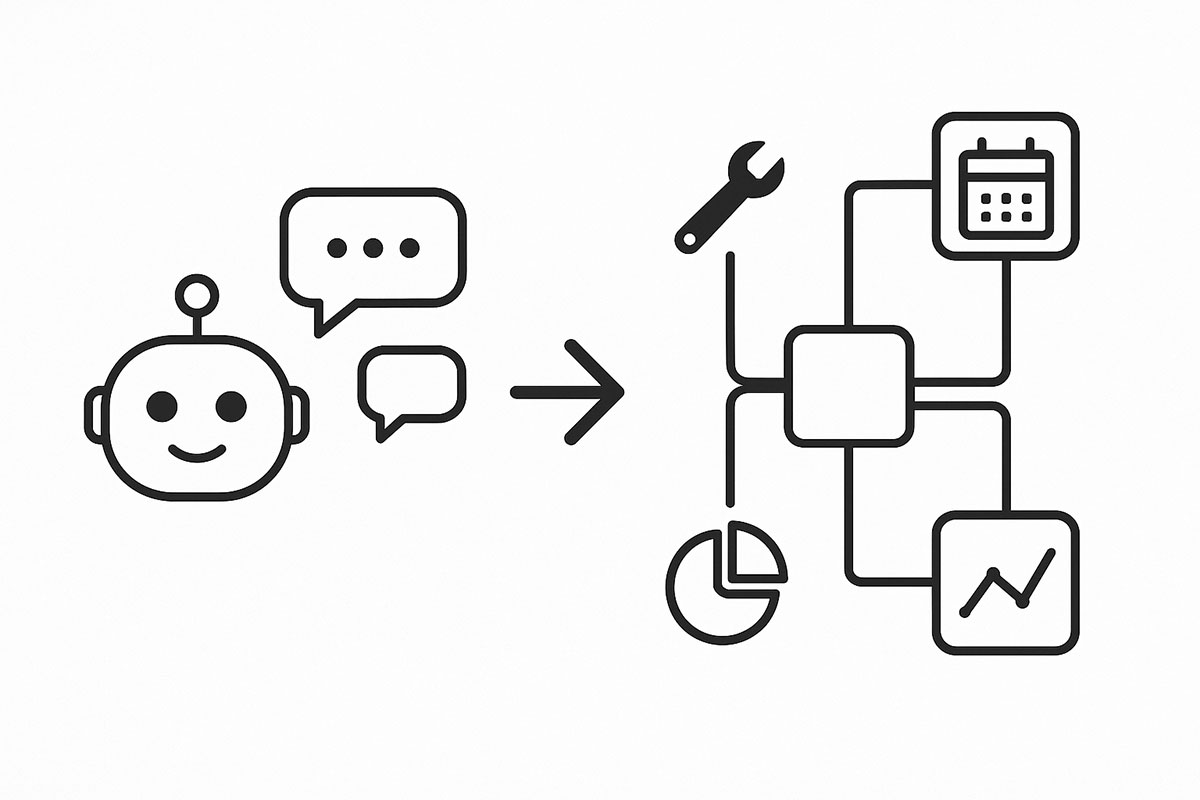
Introduction: From Conversation to Action
For years, interacting with AI has largely been a conversational affair. We ask a question, and it generates an answer. We request a summary, and it provides one. But in 2025, a fundamental shift is underway. We are moving beyond chatbots to a new era of Agentic AI—systems that don't just respond to prompts but independently pursue complex goals with minimal human oversight. This isn't AI that converses; it's AI that *does*. Imagine an AI that doesn't just tell you your password reset failed but actually diagnoses the authentication error and fixes it for you. Or an HR system that doesn't just list company policies but actively processes a legal name change across all your internal systems. This is the promise of Agentic AI, and it's already transforming how businesses operate.
What is Agentic AI? The Core Difference
So, what exactly sets Agentic AI apart from the generative AI tools we've become accustomed to? The distinction is profound.
Generative AI is primarily a content creation engine. It's reactive, waiting for a user's prompt to generate text, images, or code. Its strength lies in pattern recognition and content generation based on the data it was trained on. A tool like ChatGPT is a powerful example—it creates excellent content but doesn't act on it.
Agentic AI, on the other hand, is a decision-making and action-taking system. It is proactive, designed to autonomously understand a high-level goal, reason through the steps required, and execute them by interacting with other software and systems. It brings together the flexible reasoning of large language models (LLMs) with the precision of traditional programming to perform real-world tasks.
As IBM experts explain, the current market conception of agents is often "the addition of rudimentary planning and tool-calling... capabilities to LLMs," enabling them to break down complex tasks into smaller, executable steps. The key differentiators are:
- Reasoning: It can analyze a situation and understand what needs to be done.
- Planning: It can formulate a multi-step strategy to achieve a goal.
- Execution: It can take specific actions by using tools and APIs.
- Adaptation: It can learn from outcomes and adjust its approach in real-time.
How Agentic AI Actually Works: The Four-Step Process
To understand the magic, it's helpful to look under the hood. Leading frameworks, such as the one proposed by NVIDIA, break down the Agentic AI process into a continuous loop of four key stages:
1. Perceive
The AI agent gathers and processes data from its environment. This could be from sensors, databases, user requests, or live network traffic. It extracts meaningful information and patterns to build a contextual understanding of the current situation.
2. Reason
A large language model (LLM) acts as the system's "brain," orchestrating decision-making. It analyzes the perceived data to understand the situation, breaks down the main objective into subtasks, and devises a plan. Techniques like retrieval-augmented generation (RAG) allow it to pull in proprietary, real-time data to ensure its reasoning is accurate and relevant.
3. Act
This is where thought becomes action. The AI agent executes its plan by integrating with external tools through application programming interfaces (APIs). It might run a database query, reset a user password, send an approval notification, or update a CRM record. Built-in guardrails ensure its actions comply with predefined rules and safety protocols.
4. Learn
After acting, the system incorporates the results and feedback into its knowledge base. This "data flywheel" effect allows the AI to continuously improve its models, making it smarter, more efficient, and more reliable with each interaction.
Agentic AI in Action: Real-World Use Cases Transforming Business
The theoretical potential of Agentic AI is compelling, but its real-world applications are even more so. Across industries, these systems are already automating complex, multi-step workflows that were previously the domain of human specialists.
| Industry | Use Case | Real-World Example |
| IT Support | Autonomous troubleshooting and resolution | Power Design deployed an AI assistant named "HelpBot" that handles tasks from password resets to complex VPN troubleshooting. It integrates with various systems to pull data and resolve tickets proactively, automating over 1,000 hours of complex tasks. |
| Human Resources | Personalized employee support and onboarding | Palo Alto Networks uses an Agentic AI assistant to support its hybrid workforce. The AI doesn't just recite scripts; it evaluates each request, understands intent and context, and autonomously determines the most relevant solution for HR queries within seconds. |
| Customer Service | Complex, intent-driven issue resolution | Beyond simple chatbots, Agentic AI in call centers can simultaneously analyze customer sentiment, review order history, access company policies, and respond to needs based on all these elements, orchestrating the entire customer interaction. |
| Cybersecurity | Real-time threat detection and response | Darktrace uses Agentic AI to continuously monitor enterprise network traffic. Its AI agents autonomously identify and respond to previously unseen cyber-attacks in real-time, hunting for anomalies and deciding the best course of action without waiting for human intervention. |
| Finance & Logistics | Dynamic workflow management | In supply chains, if a drought affects produce, an AI agent can be tasked with finding alternatives. It will autonomously check available supplies in other regions, confirm prices, reconfigure supply routes, and initiate orders with new suppliers. |
Why Agentic AI is a Key Trend for 2025
The momentum behind Agentic AI is not accidental. Several factors have converged to make 2025 a pivotal "year of the agent."
First, the underlying technology has matured. LLMs have become powerful and reliable enough to serve as effective reasoning engines. As Chris Hay, a Distinguished Engineer at IBM, notes, "You wouldn't need any further progression in models today to build future AI agents". Innovations like chain-of-thought training and massively increased context windows have given AI the "working memory" needed for complex planning.
Second, there is a clear trajectory toward ROI. While generative AI captured the public's imagination, Agentic AI is capturing the attention of business leaders. One report found that 62% of executives expect returns above 100% from Agentic AI investments, anticipating faster adoption and higher ROI than from generative AI alone.
Finally, we are seeing the rise of agentic platforms. Major tech companies and startups are releasing frameworks and orchestration tools that make it easier for developers to build and deploy AI agents. Microsoft, for example, is baking Anthropic's Model Context Protocol (MCP) directly into Windows, effectively turning the operating system itself into an agent-hosting platform.
Challenges and the Path Forward
Despite its promise, the adoption of Agentic AI is not without hurdles. According to a Deloitte perspective, the primary challenges organizations face include integrating with legacy systems, addressing risk and compliance concerns, and a lack of technical expertise.
There are also legitimate concerns about reliability and control. As Marina Danilevsky, a Senior Research Scientist, cautions, "Realistically, [fully autonomous agents are] terrifying". Ensuring these systems are transparent, trustworthy, and aligned with human values is a critical focus for developers and businesses alike.
The future, however, is one of collaboration, not replacement. The most effective models will keep humans in the loop for high-stakes decisions while automating the vast middle ground of complex but well-defined workflows. The goal is not to create AI that works alone, but to build AI that works alongside us as a capable, autonomous colleague.
Conclusion
The quiet rise of Agentic AI marks a significant evolution in our relationship with technology. We are moving from using AI as a tool to partnering with AI as an active agent. This shift promises to unlock unprecedented levels of efficiency, creativity, and problem-solving capability within organizations. For businesses looking to stay competitive, understanding and exploring the practical applications of Agentic AI is no longer a forward-thinking strategy—it's a present-day imperative.
Related Reading