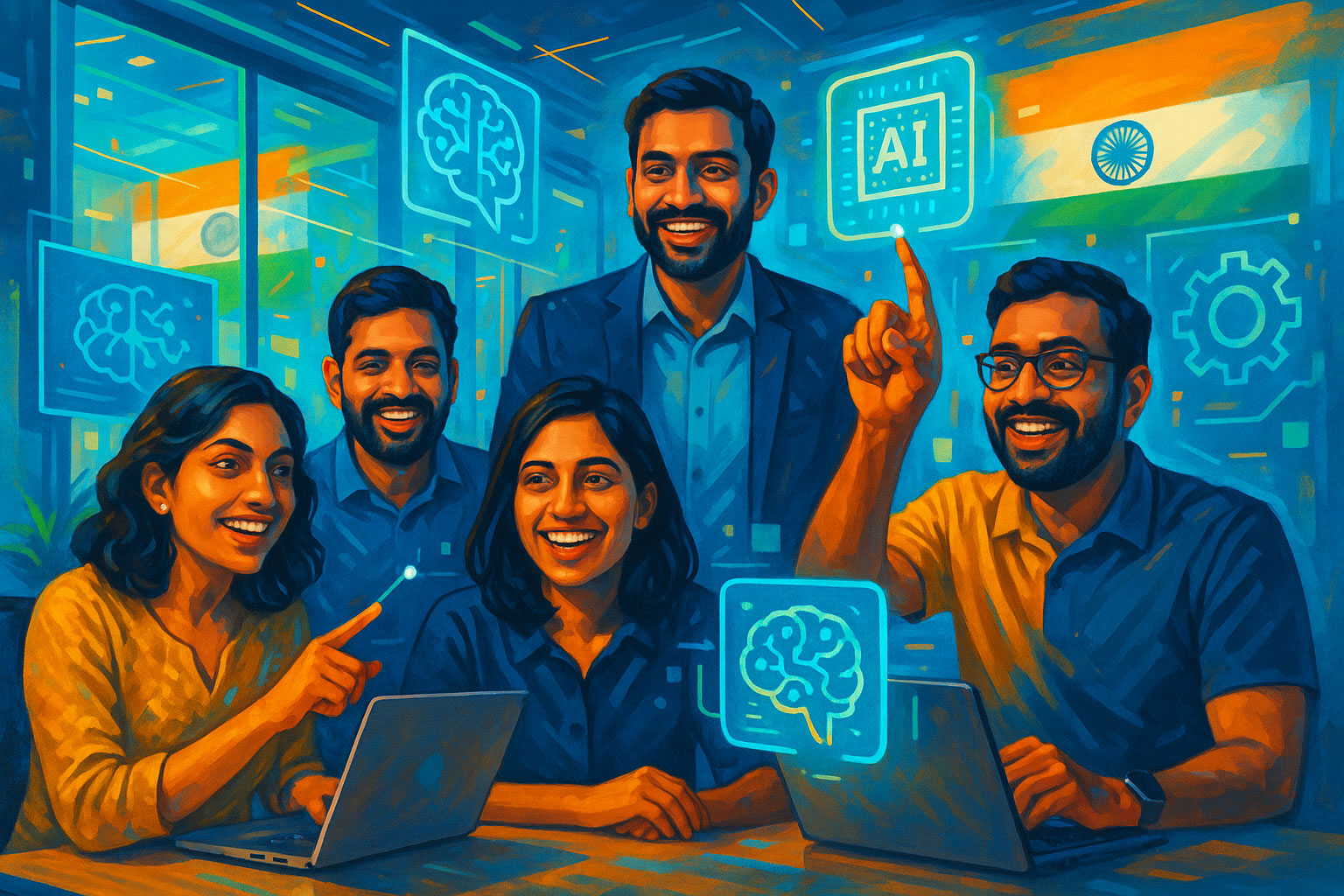
India's AI Moment: From Following to Leading
The narrative around artificial intelligence has long been dominated by Silicon Valley and Beijing. OpenAI launched ChatGPT, Anthropic built Claude, DeepSeek emerged from China's startup ecosystem—and the world watched these Western and Eastern players reshape the technological landscape. But something fundamental has shifted in November 2025. India isn't following anymore. It's leading.
In a single month, five Indian AI startups collectively raised $8.45 million in seed-stage funding, each addressing genuine market gaps with sophisticated technical solutions. This isn't about individual success stories anymore. This is about an ecosystem reaching critical mass, where world-class AI talent, venture capital, and market opportunities have converged to create a new innovation epicenter.
The numbers are staggering. India's AI market surged 31 percent year-over-year to reach $7.8 billion in 2025, with projections suggesting a compound annual growth rate of 43.76 percent through 2031, potentially reaching $45 billion by end-of-decade. The country has emerged as home to 2.35 million AI professionals—a 55 percent increase year-over-year—and is now home to the world's third-largest AI talent pool globally.
But talent and market size alone don't explain the explosive growth. What's changed is that Indian founders are no longer building features for Western companies. They're building companies. They're building for their own market first, with ambitions to serve the world. This is where everything changes.
The Big Picture: Why Now?
Several converging factors have created an environment where Indian AI startups are thriving.
Government Support and the IndiaAI Mission: India's government launched the IndiaAI Mission with an initial allocation of ₹10,300 crore ($1.24 billion) to build compute infrastructure, support emerging startups, and develop the AI talent pipeline. This isn't lip service—it's structural investment in the ecosystem.
Massive Talent Pool: With 2.35 million AI professionals and over 1.5 million dedicated AI researchers and engineers, India possesses a talent advantage that rivals the United States. Critically, this talent is distributed across multiple cities—Bengaluru, Delhi, Hyderabad, Mumbai, Pune, Chennai—creating multiple innovation hubs rather than a single fragile center.
Market Scale and First-Mover Advantages: India's population of 900 million connected internet users provides an enormous testing ground for AI applications. Problems solved for India often have applicability across South and Southeast Asia, creating markets of 2+ billion people. Unlike building solely for the US market, Indian startups can achieve global scale by solving local problems first.
Cost Efficiency: Indian startups can build and scale at a fraction of Silicon Valley costs. The same engineering talent that would cost $250,000-$400,000 annually in San Francisco costs $40,000-$80,000 in Bengaluru. This cost arbitrage isn't predatory—it reflects local market realities. It does mean Indian companies can achieve profitability faster and reinvest more aggressively in growth.
Global Capital Influx: Beyond Indian investors, international venture capital firms have recognized the opportunity. Google, Microsoft, and Anthropic have all announced increased investments in India. Traditional venture firms like Sequoia, Accel, and Lightspeed have deepened their India operations. This creates a capital environment where strong teams can raise growth funding.
Policy Framework: While AI regulation remains evolving, India has adopted a pragmatic approach—enabling innovation while building guardrails around misuse. This contrasts with European over-regulation and Chinese control, positioning India as an attractive ecosystem for ambitious founders.
The November 2025 Cohort: Meet the Five Startups Reshaping AI
Here's where the story becomes specific and compelling. These aren't hypothetical startups or feature-poor MVPs. These are technically sophisticated companies solving real problems for real markets, funded by serious investors, and led by founders with track records of success.
1. AiroClip: AI-Powered Game Personalization ($2.75M Seed)
Founders: Naga Rohith Anisetty and Pruthvi Sai Y (IIM Calcutta alumni)
What They Do: AiroClip develops AI-driven personalization engines for mobile puzzle games. The company's flagship titles—Tap Hexa and Hexa Dreams—use adaptive AI to customize gameplay, storylines, challenges, and visuals based on individual player behavior.
Funding Round: $2.75 million led by T-Accelerate Capital, with participation from Centre Court Capital and Bitkraft Ventures (November 2025)
Why It Matters: The casual gaming market is massive—the global puzzle gaming segment alone is projected to reach $3.55 billion by 2030. Traditional game development treats all players identically. AiroClip's technology creates a unique experience for each player, increasing engagement and monetization potential. The company's games have already achieved 300,000 installs with 4.8/5 ratings.
What makes this genuinely innovative is the architectural approach. Most games use basic statistical personalization. AiroClip uses generative AI to dynamically create new content—storylines, challenges, visual themes—tailored to each player's demonstrated preferences. This means the game literally learns and evolves in real-time.
Global Implications: While founded in India, AiroClip's traction in the US and European markets demonstrates that Indian founders can build globally competitive gaming technology. As the gaming industry increasingly adopts AI-driven personalization, AiroClip's early-mover advantage in building specialized infrastructure positions the company for significant scale.
Founder Insight: The AiroClip founders stated, "By merging game design with the latest advancements in generative AI, we're building games that feel alive — responding to each player uniquely. This not only elevates engagement but also opens new revenue possibilities within the global puzzle gaming market."
2. Redacto: AI-Powered Data Privacy and Governance ($1.4M Seed)
Founders: Shashank Karincheti and Amit Kumar
What They Do: Redacto provides an AI-powered data privacy and governance platform enabling enterprises to automate privacy compliance, manage sensitive data exposure, and enforce third-party accountability through intelligent automation.
Funding Round: ₹12 crore ($1.4 million) led by PeerCapital and Antler India with angel investor participation (October 2025)
Why It Matters: Regulatory pressure around data privacy is intensifying globally. The European Union's GDPR, US state privacy laws like CCPA, and India's Digital Personal Data Protection (DPDP) Act are creating compliance obligations that overwhelm traditional manual processes. Redacto addresses a genuine operational pain point.
The platform automatically identifies where sensitive data resides within enterprise systems, quantifies exposure risk, and implements controls to prevent unauthorized access. For organizations handling customer data, payment information, or health records, this eliminates weeks of manual compliance work while providing continuous monitoring.
Current Traction: Redacto has already partnered with several of India's leading payment companies and NBFCs. The startup is in active discussions with banks, fintechs, and insurance companies preparing for DPDP Act compliance. This positions Redacto as the natural default solution for India's financial services sector as regulatory compliance becomes mandatory.
Market Opportunity: India's financial services industry—banks, insurance companies, fintech platforms—manages customer data at extraordinary scale. As DPDP compliance deadlines approach, enterprise demand for solutions like Redacto will accelerate substantially. Early market share captured in India can position Redacto for expansion across Southeast Asia and other developing markets facing similar regulatory pressures.
Founder Context: Co-founder Amit Kumar emphasized the strategic moment: "AI isn't just changing business—it's redefining it. Data privacy architecture must evolve at the same pace. As a full-stack data privacy company, our platform delivers intelligent, end-to-end data governance through AI-first automation, enabling enterprises to innovate without bearing the burden of compliance."
3. Adya AI: Enterprise App Development on ONDC ($1.2M Pre-Series A)
Founders: Shayak Mazumder (CEO/CTO), Archana Mazumder (COO), Angad Singh Ahluwalia (CBO)
What They Do: Adya AI is the technology service partner for the Open Network for Digital Commerce (ONDC), providing end-to-end solutions enabling enterprises to build AI-powered applications on India's open digital commerce network.
Funding Round: ₹10.5 crore ($1.2 million) pre-Series A round led by Indian Angel Network (IAN) with prominent angel investors (January 2024, but with continued traction into 2025)
Why It Matters: ONDC represents India's strategic effort to democratize digital commerce, mirroring the success of UPI in payments and Aadhaar in digital identity. Unlike marketplace-dominated models where Amazon or Flipkart control the ecosystem, ONDC enables any merchant to participate on equal footing with access to a neutral network.
Adya AI recognized that ONDC's potential depends on developer tools that make building on the network accessible and efficient. The company provides a complete technology stack—buyer apps, seller apps, marketplace infrastructure, identity management, and payment integration—enabling enterprises to launch on ONDC without rebuilding infrastructure.
Enterprise Partnerships: Adya AI's success is evidenced by major partnerships with Canara Bank, Aditya Birla Financial, Hindustan Unilever, and others. The company is already facilitating significant enterprise contracts across retail, mobility, logistics, financial services, and food & beverage sectors.
Geopolitical Significance: Adya AI's success with ONDC matters beyond commercial metrics. India's goal is creating a commerce infrastructure that isn't controlled by foreign platforms. Success here creates a template for other developing markets seeking to build inclusive digital commerce ecosystems. Adya AI's role in making ONDC viable positions the company as critical infrastructure.
Market Scale: India's digital commerce market is projected to reach $350 billion by 2030. ONDC aims to capture significant share of this market by offering transparent, decentralized alternatives to monopolistic marketplaces. Adya AI's role as the primary technology partner means the company scales directly with ONDC adoption.
Founder Vision: CEO Shayak Mazumder articulated the broader vision: "ONDC stands as a testament to India's digital capabilities, building upon the foundations laid by the Unified Payments Interface and Aadhaar. At Adya.ai, we are committed to leveraging our technological expertise to foster an inclusive and transformative digital ecosystem for India's economy."
4. QuickAds: AI-Powered Advertising Operating System ($1.7M Seed)
Founder: Nitin Mahajan (ex-Accenture, McKinsey, Ogilvy leadership)
What They Do: QuickAds provides a full-stack AI-powered advertising intelligence and creative automation platform. The system combines a proprietary database of millions of high-performing advertisements, AI-first creative workflows for generating varied ad formats, automated compliance checking, and unified campaign analytics.
Funding Round: $1.7 million seed led by Kae Capital with participation from leaders at Google, Meta, Traya, and Rainforest.life (November 2025)
Why It Matters: Digital advertising remains incredibly inefficient. Companies spend billions creating ad variations, testing them against inconsistent criteria, and relying on intuition-driven creative decisions. QuickAds automates this process—the platform learns from millions of existing ads to predict what creative elements will drive engagement, generates compliant variations, and continuously optimizes performance.
For direct-to-consumer brands, this is genuinely transformative. The platform automatically generates product videos, catalog advertisements, and fashion photoshoots through AI agents. What previously required hiring freelance videographers, managing complex shoots, and iterative post-production now happens in minutes.
The Ads Library: As part of public launch, QuickAds released a proprietary Ads Library trained on over 10 billion OpenAI tokens, covering millions of advertisements across finance, banking, automotive, and other sectors. This database becomes more valuable as more advertisers use it—network effects create durable competitive advantages.
Business Model: QuickAds works with brands by embedding its full-stack creative and analytics operating system into their existing marketing workflows. As opposed to being a separate tool that creates friction, it becomes part of native operations.
Market Opportunity: Global advertising spending exceeds $600 billion annually. Even modest efficiency gains create enormous value. The platform's ability to reduce both creative production time and media waste positioning QuickAds to capture share from traditional advertising agencies and marketing tool providers.
Founder Background: Nitin Mahajan's experience at Accenture, McKinsey, and Ogilvy means he deeply understands enterprise marketing operations. This background informs QuickAds' product-market fit approach—solutions that align with how enterprise brands actually organize marketing, not how engineers think they should.
5. Wyzard AI: Signal-to-Revenue Platform for B2B Sales ($500K Angel / ₹4.5 Crore)
Founders: Rahul Jain (CEO), Megha Ohri, Abhishek Tomar, Jayesh Nair
What They Do: Wyzard AI provides a Signal-to-Revenue AI platform that consolidates buyer intent signals from B2B go-to-market systems and automates AI-driven, human-supervised engagement across email, chat, LinkedIn, and voice channels.
Funding Round: ₹4.5 crore ($500,000) angel round from prominent tech executives and industry leaders (November 2025)
Why It Matters: The B2B sales process is fundamentally broken. Sales teams identify buyer signals across dozens of disconnected platforms—email, CRM systems, LinkedIn, intent data platforms—but lack integrated systems to coordinate real-time responses. Result: qualified leads go uncontacted, opportunities are lost, and sales cycles extend unnecessarily.
Wyzard AI addresses this by creating a unified layer above disparate GTM tools. The platform identifies signals indicating buying intent, prioritizes them by conversion probability, and automates outreach through AI-driven conversations that feel human and contextual. Crucially, human sales teams remain supervising the AI—this isn't fully automated but intelligently augmented.
Target Market: B2B companies in any sector—SaaS, financial services, healthcare technology, enterprise software—face identical challenge: converting market awareness into qualified opportunities faster. Wyzard AI targets this massive total addressable market.
Angel Investors: The angel round included Tim Davis (OLX Group Chief of Product and Marketing), Ambarish Kenghe (Angel One Group CEO), Bhuvan Gupta (OfBusiness, Oxyzo Co-founder), Rajul Jain (Increff CEO), and other prominent tech executives. This investor profile indicates conviction from practitioners who understand the B2B sales infrastructure opportunity.
Go-to-Market Strategy: Wyzard AI initially focused on Indian B2B SaaS companies—lower enterprise sales cycles and clearer product-market fit. As traction accelerates, the company plans US and European market expansion. The funding will accelerate product development, forge partnerships with complementary GTM platforms, and scale operations globally.
Why November 2025 Matters for This Round: The startup was bootstrapped since founding in 2024. The angel round closing in November signals founder confidence that the product is achieving genuine traction with enterprise customers. In B2B SaaS, this maturity usually precedes Series A fundraising within 12-18 months.
The Broader Ecosystem: Why These Five Matter
These five startups aren't isolated successes. They're representative of an ecosystem reaching critical mass. Several patterns emerge across all five.
Problem-First Approach: Each startup identified a genuine operational problem affecting numerous enterprises. They didn't start with technology and search for problems—they started with pain and built solutions. This grounds them in market reality.
Technical Depth: All five founders demonstrate serious engineering credentials. AiroClip's founders are IIM Calcutta alumni with AI specialization. Redacto's founders have cybersecurity background. Wyzard AI's team understands B2B sales infrastructure at architectural level. This isn't feature-building—it's infrastructure thinking.
Market Focus: Three startups (Adya, Redacto, Wyzard) initially target India or India-first markets before expanding globally. This grounds them in familiar markets where founder expertise is deepest, and where they can achieve escape velocity before competing against established Western players.
Investor Composition: Notice the investors. PeerCapital, Antler, T-Accelerate Capital, Kae Capital—these are professional investors with global networks and deep sector expertise. Participation from Google, Meta, and Rainforest.life indicates these companies have achieved credibility with serious stakeholders.
India's AI Talent: The Competitive Advantage Nobody Mentions
The fundamental reason these five startups exist at this scale, this quality, this velocity is India's extraordinary AI talent concentration.
India now hosts 2.35 million AI professionals—a 55 percent year-over-year increase. This isn't just statistical—it reflects the reality that for every 10 Generative AI job openings in India, there's only 1 qualified engineer available. Paradoxically, extreme talent scarcity is creating advantages for Indian startups.
Why? Because Indian founders can access world-class AI researchers and engineers at less than Western companies pay for mid-level positions. A team of four co-founders—which is the typical founding team profile—can now be assembled from the best AI talent in the country without burning years of venture capital on salaries alone. This speed-to-execution advantage compounds massively.
Geography matters too. Bengaluru, Hyderabad, and Delhi each have emerged as serious AI hubs with cluster effects. Talent attracts investors. Investors attract more talent. Successful startups attract domain specialists. This multiplier effect is creating innovation velocity that rivals San Francisco.
Salary Dynamics: Senior Generative AI engineering roles in India command ₹58-60 lakh ($7,000-$7,200) annually. While high relative to historical Indian tech salaries, this is 1/5th the cost of comparable San Francisco talent. For bootstrapped startups and seed-stage companies, this cost structure makes international-caliber teams viable.
The Market Opportunity: How Indian Startups Scale Globally
Each of these five startups has access to a market that few Western companies understand intimately—India's 900 million internet users operating across dozens of languages, payment systems, regulatory environments, and cultural contexts.
For AiroClip, solving mobile gaming for India means understanding the specific preferences, screen time behaviors, and monetization patterns of emerging market users. These insights, once captured, apply across Southeast Asia's 700 million users and eventually to global emerging markets.
For Redacto, solving compliance in India under DPDP regulations captures expertise directly applicable to GDPR, CCPA, and other regulatory frameworks. The technology stack, once built for India, often requires minimal modification for other markets.
This creates a compounding advantage: Indian startups solve hard problems for enormous markets first, then expand globally with proven solutions. Western startups often build globally, which creates scope problems and dilutes focus.
Career Opportunities and What It Means for Talent
For AI engineers, data scientists, product managers, and sales professionals in India, this moment is unprecedented.
The startup ecosystem is actively recruiting. Entry-level AI engineers command ₹15-25 lakh ($18,000-$30,000) annually at well-funded startups. Mid-level positions paying ₹30-50 lakh ($36,000-$60,000) are abundant. Senior roles in growing startups command ₹60 lakh+ ($7,200+) with equity compensation offering additional upside.
Critically, these roles are distributed across multiple cities and sectors. It's not just Bengaluru tech recruiting anymore. Hyderabad, Delhi, Mumbai, and Pune each have active startup ecosystems offering careers with meaningful equity upside.
For someone building a career in AI, India in 2025 represents singular opportunity: participate in founding and scaling world-class AI companies from the ground floor, with direct access to markets of billions of people, with capital support from global investors, and with peer cohorts of elite engineering talent.
The Competitive Advantages: Why Global Capital Is Betting on India
Venture capital from Google, Microsoft, Anthropic, and traditional firms is flooding into Indian startups for specific reasons.
Scale: India's 900 million internet users and projected 1.5+ billion across India and South Asia create TAMs that are simply larger than most developed markets.
Talent Cost Efficiency: The ability to hire world-class AI researchers at 1/5th Silicon Valley costs creates disproportionate competitive advantages.
Regulatory Environment: Unlike China's strict controls or Europe's heavy regulations, India has adopted pragmatic AI governance enabling rapid experimentation.
Market-First Approach: Indian startups forced to compete against local alternatives develop defensive capabilities earlier and more thoroughly than Western competitors competing against weak incumbents.
Global Distribution: Once successful in India, scaling to Southeast Asia, South Asia, and eventually Africa becomes natural next step because infrastructure, languages, and user behaviors are proximate.
Challenges: What Could Derail This Momentum
India's AI moment isn't guaranteed. Several challenges could slow the trajectory.
Infrastructure Constraints: GPU compute remains expensive and sometimes scarce in India. Leading startups must often use cloud infrastructure, which adds costs and regulatory complexity compared to accessing domestic compute.
Funding Depth: While seed funding is abundant, Series A and growth capital can be constraining for companies that need scale. This forces reliance on global capital, which brings strategic dependencies.
Talent Saturation: The extreme competition for AI talent is driving salaries up rapidly. Startups that achieve profitability or strong growth will outcompete others for talent.
Regulatory Uncertainty: While the government is generally supportive, AI policy is still evolving. Unexpected regulations could constrain development in specific domains.
The GDP Impact: Why This Moment Matters Beyond Startups
These five startups aren't just creating companies. They're catalyzing economic transformation.
EY's latest research indicates that AI could contribute $359-438 billion to India's GDP in 2029-30 alone—an additional 0.9-1.1 percent annual growth. Over the decade, generative AI could add $1.5 trillion to the Indian economy by 2030.
NITI Aayog's research indicates that AI could generate up to 4 million new jobs in India's tech and customer experience sectors over the next five years, even accounting for automation displacement.
These aren't speculative projections. They're grounded in massive market scale, accelerating capital investment, and demonstrated technical capability among founders now building at scale.
The Global Implication: Rebalancing AI Geopolitics
November 2025's fundraising cohort signals a fundamental rebalancing of AI power dynamics.
For years, the narrative was binary: US vs China. Silicon Valley innovation versus Beijing's manufacturing scale. But India has quietly developed a third pole—combining Western-style entrepreneurialism, emerging market scale, and cost efficiency that neither existing pole can match.
Indian AI companies will increasingly compete against and eventually displace Western incumbents in emerging markets. They'll also establish beachheads in developed markets as quality improves and regulatory barriers fall.
This isn't about replacing Western AI. It's about creating a genuine tri-polar AI landscape where innovation comes from San Francisco, Beijing, and Bengaluru simultaneously—each with distinct advantages.
For enterprises, this creates options. For talent, this creates careers. For India, this creates economic transformation.
What Comes Next: The 2026 Inflection Point
The momentum from November 2025 will likely accelerate through 2026.
Expect Series A rounds closing for top startups from this cohort. AiroClip and Wyzard AI are particularly positioned for rapid follow-on funding given their traction and founder profiles.
Expect international expansion from these startups—AiroClip launching in Southeast Asia and North America, QuickAds expanding across APAC, Redacto targeting global financial services firms for GDPR-compliant infrastructure.
Expect increasing competition from other Indian startups across adjacent domains—healthcare AI, agriculture tech, financial services, education—all running similarly compelling trajectories.
Expect global companies increasing their India operations—not as outsourcing centers but as innovation hubs where new capabilities are developed and validated before global deployment.
Conclusion: India's AI Moment
The story of Indian AI startups transcends founder success or venture return optimization. It reflects India's transition from following innovation to leading it. From consuming technology to creating technology. From being a market to being an innovation epicenter.
November 2025's fundraising cohort—AiroClip, Redacto, Adya AI, QuickAds, and Wyzard AI—collectively raised $8.45 million. Individually, these rounds are meaningful. Collectively, they represent something larger: the moment India's AI ecosystem graduated from promising to consequential.
For global investors, this cohort represents emerging winners in markets that will define 2026-2030. For Indian talent, this represents unprecedented career opportunities in world-class companies solving billion-person-scale problems. For India's economy, this represents the beginning of a transformation that could genuinely reshape the country's competitive position.
The AI boom isn't coming to India. It's already here.
Related Articles
For deeper exploration of India's AI journey and related global developments:
Category: AI in Business & Startups