Introduction: The AI Salary Revolution Is Here
The most comprehensive analysis of the global labor market to date has revealed a startling truth: we are witnessing one of the fastest-growing skill premiums in modern history. According to PwC's 2025 Global AI Jobs Barometer, which analyzed close to a billion job ads from six continents, workers with AI skills now command an average **56% wage premium**—more than double the 25% premium recorded just one year earlier. This isn't just another business trend; it's a fundamental restructuring of how work is valued, with AI literacy becoming the new determinant of career trajectory and compensation.
While headlines often focus on AI's potential to displace jobs, the data tells a more nuanced story. Industries most exposed to AI are experiencing 3x higher growth in revenue per employee and nearly quadrupled productivity growth compared to less exposed sectors. This productivity surge is creating unprecedented opportunities for workers who can bridge the gap between technical AI capabilities and business value. In this article, we'll dive deep into the 2025 AI Jobs Barometer to uncover which skills command the highest premiums, which roles are being transformed, and how both professionals and businesses can position themselves to thrive in the new AI-driven economy.
The Great Transformation: AI's Productivity Impact
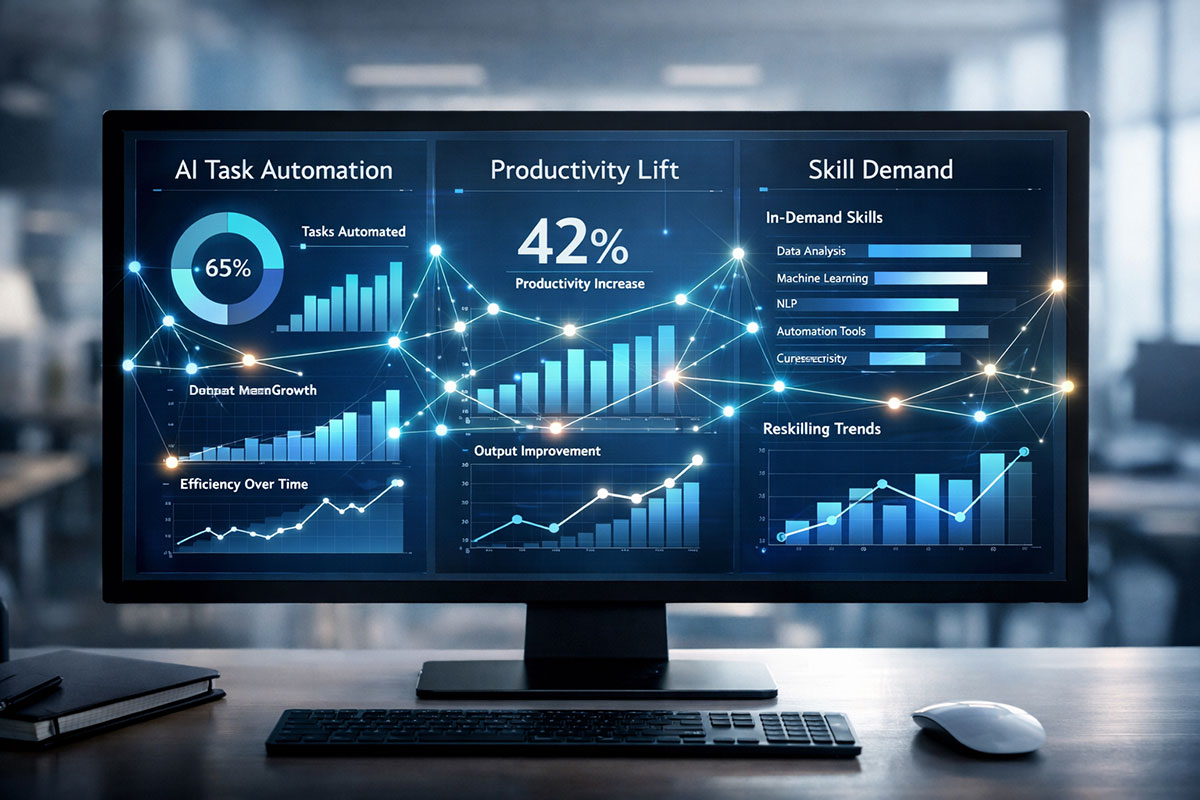
The dramatic wage premiums for AI skills aren't occurring in a vacuum—they're directly tied to measurable productivity gains. Since generative AI's proliferation in 2022, productivity growth has nearly quadrupled in industries most exposed to AI, rising from 7% (2018-2022) to 27% (2018-2024). In contrast, productivity growth in industries least exposed to AI declined from 10% to 9% over the same period. This divergence is creating a growing performance gap between AI-adopting and non-adopting organizations.
Contrary to expectations of widespread job destruction, the data reveals a more complex picture. While occupations with lower exposure to AI saw strong job growth (65%) in recent years (2019-2024), growth remained robust even in more exposed occupations (38%). This suggests that AI is primarily transforming jobs rather than eliminating them entirely. As AI automates routine tasks, workers who can leverage AI to enhance their capabilities are becoming more valuable—and their compensation reflects this new reality.
Winners and Losers: Which Roles Are Gaining From AI
The impact of AI on employment varies significantly across different professions, with some roles experiencing unprecedented demand while others face disruption. The Financial Planning & Analysis (FP&A) sector provides a revealing microcosm of these broader trends. According to Talentfoot's comprehensive study, AI adoption in FP&A has surged from 6% to 47% in just one year, transforming finance teams into strategic copilots and creating new hybrid roles.
The following table illustrates how different FP&A roles are faring in the new AI-driven landscape:
| Role Category | Market Demand | Avg. Salary Premium | Key Skills Required |
| Finance Architect | Extreme | +24% | System integration, data pipeline design, data governance |
| AI-Native Analyst | Very High | +18% | AI tool fluency, GenAI prompt use, bias detection, model validation |
| Predictive Modeler | High | +15% | Machine learning, statistical forecasting, scenario simulation |
| Insight Translator | Moderate | +12% | Data storytelling, executive communication |
| Traditional Analyst | Declining | Baseline | Excel modeling, variance analysis |
Source: Talentfoot FP&A Hiring Research 2025
This pattern extends beyond finance. Goldman Sachs Research estimates that while AI could displace 6-7% of the US workforce if widely adopted, the impact is likely to be transitory as new job opportunities created by the technology ultimately put people to work in other capacities. Their analysis suggests that just 2.5% of US employment would be at risk of displacement if current AI use cases were expanded across the economy.
The Highest-Paying AI Jobs in 2025
For professionals with specialized AI skills, compensation packages have reached unprecedented levels. The competition for top talent has become so intense that companies like Meta are offering packages worth up to $300 million over four years to top AI researchers, while Netflix posted an AI role with a salary range up to $900,000. While these extreme cases capture headlines, they reflect a broader trend of premium compensation across AI specialties.
Here are some of the highest-paying AI roles in 2025 based on compiled industry data:
- AI Product Manager: $150,000 - $900,000+ (Netflix's range: $300,000-$900,000)
- AI Research Scientist: $130,000 - $489,000+ (Meta: $489,000 packages)
- Machine Learning Engineer: $120,000 - $440,000+ (Meta: $440,000 base salary)
- Chief AI Officer (CAIO): $263,824 - $643,731+ (Average: $351,766)
- AI Architect: $196,000 - $320,000+ (Microsoft: $250,000-$320,000)
What's particularly notable is how compensation structures are evolving at big tech companies. Senior AI engineers at Google, Meta, and OpenAI typically receive base salaries of $180,000-$220,000, but their total compensation can surpass $600,000-$800,000 yearly due to stock options and incentives. This "total comp divergence" means professionals need to look beyond base salary when evaluating offers.
Skills Versus Credentials: The New Hiring Landscape
The AI revolution is accelerating a broader shift toward skills-based hiring. Research reveals a critical distinction between practical AI skills and formal credentials. Foote Partners' analysis shows that employers pay 19% to 23% more for practical AI skills compared to only 9% to 11% for AI certifications. This practical skills premium reflects the immediate productivity gains that experienced AI practitioners can deliver.
The data shows that employer demand for formal degrees is declining for all jobs, but especially quickly for AI-exposed jobs. The percentage of AI-augmented jobs requiring a degree fell 7 percentage points between 2019 and 2024 (from 66% to 59%), and 9 percentage points for automated jobs (from 53% to 44%). This represents a significant opportunity for professionals without traditional credentials but with demonstrable AI capabilities.
According to analysis of job posting requirements, the most valuable AI skills in 2025 include:
- AI Model Validation: Appearing in 67% of job requirements (up 10% YoY)
- Finance Process Automation: Appearing in 61% of requirements (up 21% YoY)
- Scenario Modeling with ML: Appearing in 54% of requirements (up 13% YoY)
- Real-Time Dashboard Creation: Appearing in 73% of job postings
- Executive Data Storytelling: Appearing in 49% of senior roles
Industry Insights: Where AI Skills Pay Most
The AI skills premium extends across virtually all sectors, but some industries are leading in adoption and compensation. According to CNBC's analysis of Lightcast data, the fields with the largest premiums include customer service and support, sales, and manufacturing and production. However, knowledge work sectors show the most rapid growth in AI skill requirements.
PwC's sector-specific analysis reveals significant variations in AI adoption and compensation patterns:
- Financial Services: Jobs requiring AI skills appear 2.8 times more frequently than in other sectors
- Professional Services: 3 times higher rates of AI skill requirements
- Information & Communication: 5 times higher rates than baseline industries
Role-specific premiums further illustrate this pattern:
- Financial analysts: 33% premium
- Lawyers: 49% premium
- Accountants: 18% premium
- Sales and marketing managers: 43% premium
This data confirms that AI skills are delivering value across traditional functional boundaries, creating new hybrid roles that combine domain expertise with technical AI capabilities.
The Future Outlook: Sustained Growth and New Challenges
Multiple data points suggest that AI salary premiums will continue growing in the near term. PwC's research shows that skill requirements change 66% faster in AI-exposed jobs, up from 25% in the previous year. This accelerating pace of change creates continuous demand for updated skills and suggests that early adopters will continue to benefit from premium compensation.
Investment trends support continued growth. According to the Stanford HAI 2025 AI Index Report, U.S. private AI investment grew to $109.1 billion in 2024—nearly 12 times China's $9.3 billion and 24 times the U.K.'s $4.5 billion. Generative AI saw particularly strong momentum, attracting $33.9 billion globally in private investment—an 18.7% increase from 2023. This unprecedented funding directly translates to aggressive hiring and premium compensation packages.
However, 2025 is also showing early signals of a market reset in some segments. Some top AI research laboratories and large tech businesses have begun to restructure teams or pause wide-scale recruiting, indicating a shift toward more selective recruitment. This suggests that while AI compensation trends remain positive overall, the market is maturing and becoming more discerning about which roles justify premium compensation.
Geographic Variations in AI Compensation
While AI is a global phenomenon, compensation varies significantly by region. PwC's analysis of major labor markets shows that wage premiums exist across all developed economies, but the United States shows the highest documented premiums, reaching the full 56% in some sectors and roles.
A global AI salary comparison reveals substantial disparities:
- United States: Typical AI developer income surpasses $150,000
- Western Europe: (Germany, UK, France) average closer to $90,000-$120,000
- India: AI developers earn 70% less than their counterparts in the United States
These geographic variations are creating complex global hiring patterns, with companies implementing "location banding" for remote roles while simultaneously competing for top talent across borders.
Actionable Strategies for Professionals and Businesses
For Professionals Seeking AI Premiums
The research provides clear guidance for professionals seeking to capture AI salary premiums. Success requires immediate action focused on practical, demonstrable skills rather than theoretical knowledge.
Immediate Steps (Next 30 Days):
- Evaluate your current role for AI integration opportunities. Identify specific tasks where AI tools could increase productivity or output quality.
- Experiment with industry-relevant AI tools. Customer service professionals might explore automated response systems, while marketing professionals could try content generation platforms.
- Document your AI tool usage and results. This documentation becomes crucial evidence when negotiating salary increases or pursuing new opportunities.
Medium-Term Strategy (3-6 Months):
- Develop case studies of AI-enhanced work that show how AI tools helped solve problems, improve processes, or drive results.
- Quantify impact wherever possible through time saved, accuracy improved, or value generated.
- Build connections with AI-forward professionals in your field through industry-specific communities and relevant events.
For Businesses Competing for AI Talent
Companies seeking to attract and retain AI talent need to rethink traditional compensation and development approaches.
- Benchmark against "total compensation" rather than just base salary, recognizing that equity and bonuses can double or triple overall compensation at top tech firms.
- Prioritize practical skills over credentials in hiring decisions, focusing on demonstrated competency rather than formal qualifications.
- Invest in internal reskilling programs to close capability gaps. Leading companies have introduced AI "bootcamps" that pair analysts with data scientists to practice prompt engineering and output validation.
- Develop specialized career paths for emerging AI roles such as Finance Architects, Predictive Modelers, and Insight Translators.
Conclusion: Navigating the AI-Driven Labor Market
The 2025 AI Jobs Barometer reveals a labor market in rapid transformation, where AI skills have become the primary determinant of compensation growth and career trajectory. The stunning 56% wage premium for AI-skilled workers reflects genuine productivity gains rather than temporary market hype, with industries most exposed to AI experiencing 3x higher growth in revenue per employee.
For professionals, the message is clear: developing practical AI skills represents the most reliable path to higher earnings in today's job market. The time to build these competencies is now, as early adopters capture compounding benefits from continued premium growth. For businesses, the race for AI-ready talent is already underway, with organizations that invest in hybrid, AI-literate professionals strengthening their forecasting accuracy, scenario planning, and strategic agility for years to come.
The AI revolution is not about machines replacing humans but about humans who use machines replacing those who don't. The data from 2025 confirms that the future belongs to professionals and organizations that can harness AI to amplify human judgment, turning machine intelligence into business insight and competitive advantage.
Related Reading