What Just Happened to Your Meta Account?
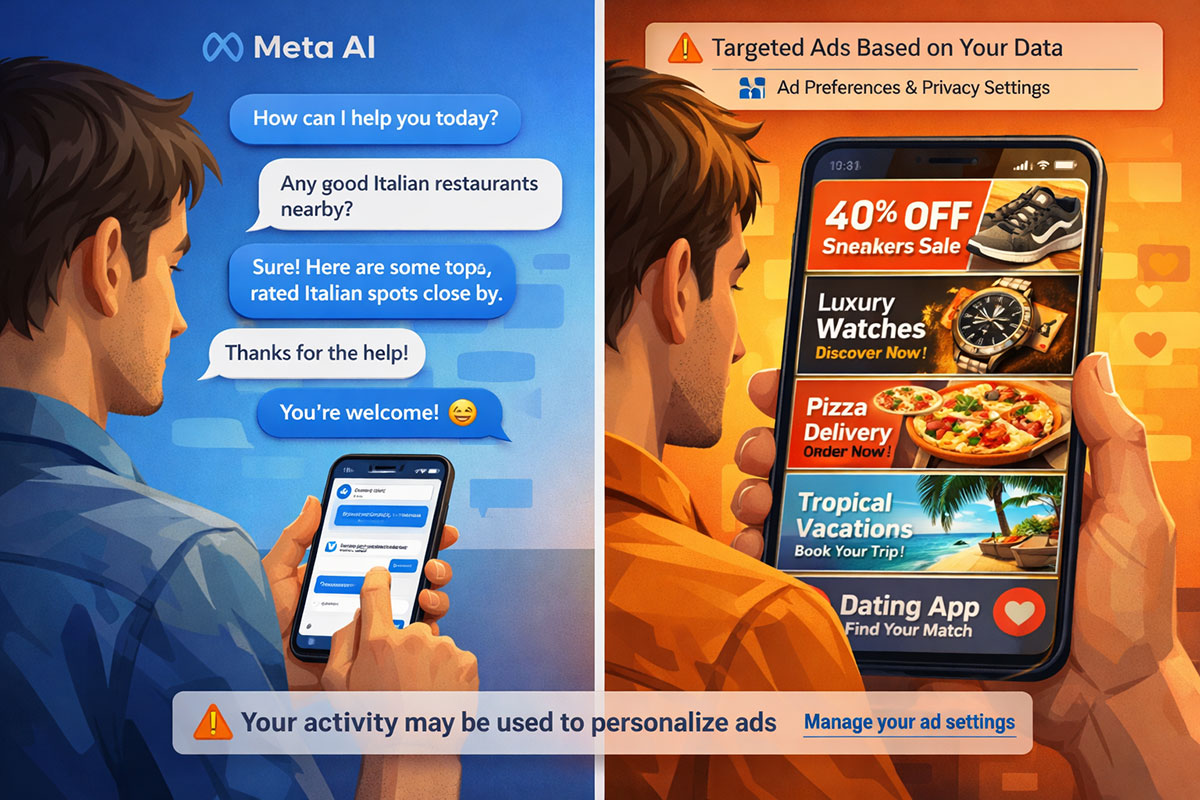
On October 1, 2025, Meta quietly announced something that would fundamentally change how your personal data works. Starting December 16, 2025, the company will begin harvesting conversations you have with Meta AI—every question you ask, every image you generate, every prompt you submit—and use it all to personalize the ads you see across Facebook, Instagram, Messenger, and WhatsApp.
This isn't a minor policy tweak. This is the moment when your AI interactions officially become advertising data at scale. For context, Meta AI has already reached 1 billion users. That's 1 billion people about to have their AI conversations analyzed, categorized, and fed into the world's most sophisticated ad-targeting machine.
The notification rollout started on October 7, 2025, appearing in-app for Meta users. But if you missed it or dismissed it, here's the reality: on December 16, this change goes live whether you noticed the notification or not.
The Details Meta Wants You to Know (But Doesn't Emphasize)
When you dig into Meta's updated privacy policy, the company lays out exactly what will happen:
What Data Gets Collected:
Your interactions with Meta AI will now include every conversation, question, request for image generation, topic you discuss, assistance you seek, and preference you express. This is raw, unfiltered behavioral data that reveals intent in ways that normal social media activity never could.
When you ask Meta AI about health symptoms, relationship advice, career decisions, financial planning, or personal struggles, Meta will see that. And starting December 16, that context becomes fair game for algorithmic analysis.
Who Gets Affected:
If you've ever used Meta AI on Facebook, Instagram, WhatsApp, or Messenger, you're in scope. That's roughly 1 billion people. Even if you haven't used it much, the option exists on your accounts. Meta doesn't require explicit opt-in for this new data collection—you're enrolled by default.
Parents using Meta platforms need to understand this applies to their accounts and, if their children use Meta AI, their children's accounts as well.
The Geographic Carve-Out:
Here's where it gets interesting: this policy will not immediately apply in the European Union, United Kingdom, or South Korea. These regions have strict privacy regulations. The EU's General Data Protection Regulation (GDPR) and similar laws make it legally risky for Meta to use AI conversation data for ad targeting without explicit, informed consent.
But if you're in the United States, Canada, Australia, India, Southeast Asia, Latin America, or most other regions, this applies to you starting December 16.
What Sensitive Topics Are (Partially) Protected?
Meta acknowledges that some AI conversations reveal sensitive information. The company states that discussions involving religion, sexual orientation, political opinions, health conditions, and racial or ethnic backgrounds will not be used for ad targeting.
Here's the problem: this protection is incomplete. First, Meta must successfully identify these topics in your conversations—something that's notoriously difficult for AI systems to do accurately. Second, the company still uses this data to improve its AI models and for other personalization purposes, even if it doesn't directly target ads based on health information.
In practical terms, if you ask Meta AI about anxiety management, the company won't use that to sell you anxiety medications. But it will use that conversation to build a richer profile of who you are as a person. The data flows into Meta's broader personalization engine.
How This Changes What Ads You'll See
Meta's vice president of AI, Sriram Krishnan, emphasized that this change creates "richer context for personalization." Translation: expect ads that feel uncomfortably specific.
Currently, Meta targets ads based on what you like, who you follow, pages you visit, and apps you use. Starting December 16, it will add another layer: what you actively seek help with. Want to learn about cryptocurrency? Ask Meta AI one question, and suddenly your feed fills with crypto investment ads. Research back pain remedies? Expect orthopaedic clinics and wellness products in your sponsored content.
This layered approach makes ads more relevant—but also more intrusive. Meta calls it "personalization." Critics call it surveillance.
The Opt-Out Problem (Spoiler: There Isn't One)
The uncomfortable truth: you can't opt out of this in any meaningful way. Your privacy options are limited.
Through Privacy Checkup: Meta provides a dashboard where you can manage what data is used for ads. But this is limited. You can't prevent your AI conversation data from being collected; you can only manage how it's used in secondary ways.
Through Ad Preferences: You can hide certain topics from targeting, but this is a reactive approach. The data is already flowing into Meta's systems.
The Real Opt-Out: The only way to completely prevent your AI conversations from being used is to not use Meta AI at all. But in a world where AI assistants are becoming essential tools, this is less of an "opt-out" and more of a "exit the platform" choice.
Meta frames this as "user control," but the framing obscures a reality: you're not truly opting out. You're managing the damage.
What This Means for Your Behavior
This change might subtly alter how you use Meta AI. If you know your conversations are being analyzed for ad targeting, will you ask it personal questions? Will you admit your struggles? Will you use it to research something embarrassing?
This is the chilling effect that privacy experts worry about. When people know they're being observed, they self-censor. The advice Meta AI could give you becomes less valuable because you're less honest with it.
For marketers, this is intentional. Meta is creating stronger predictive data about human behavior and desires. For users, it's a gradual erosion of a space where you could ask questions without corporate surveillance.
The Legal Implications Nobody's Talking About
While Europe has regulatory protections, the U.S. doesn't have equivalent privacy laws. This means Meta can proceed with minimal legal friction domestically. However, civil rights organizations and privacy advocates are already asking uncomfortable questions:
Data Minimization Principle: Does collecting AI conversation data violate principles of collecting only necessary data? Legally, this remains untested.
Informed Consent: Meta sent notifications, but did users truly understand what they were consenting to? Regulatory agencies are increasingly skeptical of "notice-based" consent models.
Third-Party Data Sharing: Meta's policy mentions sharing information with partners. How does this work with AI conversation data? What partners have access?
These questions haven't been litigated yet. But as privacy regulation evolves globally, Meta's December 16 policy could become a test case.
What You Should Do Right Now
1. Review Your Meta AI Activity: Open Meta Settings and check what activity is logged. Understand what data already exists in Meta's systems.
2. Adjust Ad Preferences: While this doesn't prevent collection, it limits the surface-level targeting. Go to Settings > Ads > Ad Preferences and adjust topics you don't want to see targeted around.
3. Be Intentional with Meta AI: If you use it, assume everything is being recorded for ad targeting purposes. Ask questions you're comfortable having analyzed.
4. Diversify AI Tools: Use ChatGPT, Claude, Gemini, or other AI tools for personal queries where you want more privacy. Different tools have different data policies.
5. Advocate for Regulation: Support privacy-focused legislation. The U.S. lacks comprehensive privacy laws that European users have.
6. Inform Your Network: If you're a parent or manager, communicate this change to people who might not see the notifications.
The Bigger Picture: Where AI Advertising Is Heading
Meta's move signals where the entire industry is heading. As AI assistants become central to how people search, learn, and make decisions, companies want to monetize that behavioral data.
OpenAI, Google, and other AI companies are watching to see how Meta's policy plays out. If there's minimal pushback, expect similar changes across the AI ecosystem.
The December 16 rollout is the beginning of something larger: the convergence of AI assistants and behavioral advertising. Your conversations with machines are becoming the richest behavioral dataset ever created. And that data is worth enormous amounts of money to advertisers.
Understanding this change isn't just about protecting your privacy today. It's about recognizing the direction technology is moving and making informed choices about your digital life.